

The preceding sections of the series examined women’s undergarments within the urban Moroccan dress landscape of the 19th and 20th centuries. While part i focused on the principal forms of women’s underdress of the period and their material, morphological, and functional characteristics, part ii extended the analysis to the outer layer of the lower body garments that constituted the broader female dress ensemble. These analyses significantly focused on the ways in which these garments varied across urban contexts and contributed to the construction and articulation of women’s sartorial identities.
The discussions also addressed the apparent visual asymmetry between male and female dress within the urban landscape of Morocco during the period, especially when considered through representations of public appearance. However, such an impression risks conflating the visibility of dress with the extent of its material and decorative complexity. This is especially significant since conventions governing women’s appearance in public frequently involved enveloping forms of bodily covering that concealed substantial portions of the layered garments worn beneath. Consequently, how the relative visual simplicity of the publicly observable silhouette should not have been interpreted as indicative of a correspondingly limited sartorial repertoire.
Building upon this observation, the present section turns to the principal overgarments that structured and visually articulated urban women’s dress during the 19th and 20th centuries. Special focus is directed towards the varied forms of the qaftan
Qafṭān: (Persian: khaftān, Pl. qafāṭin, synonyms: ghandurah, qandurah
Qandūrah: (Arabic, pl. qanādīr, synonyms: ghandurah, darā’ah, dishdāshah, jalābah, jallābīyah, qaftan, mqta’, thawb
Thawb: (Arabic: thawb, Pl. Athwāb/thībān), can be pronounced thobe
Thobe: (Arabic: thawb, Pl. Athwāb/thībān), can be pronounced thawb or tobe
Tobe: (Arabic: thawb, Pl. Athwāb/thībān), can be pronounced thawb or thobe based on locale. The standard Arabic word for ‘fabric’ or ‘garment’. It can refer to a qamīs-like tunic worn by men and women in the Arabian Peninsula, Iraq, the southern and south-western ports and islands of Iran, and some countries in East and West Africa. More specifically, it can refer to the square-shaped Bedouin overgarment worn by women. based on locale. The standard Arabic word for ‘fabric’ or ‘garment’. It can also refer to a qamīs-like tunic worn by men and women in the Arabian Peninsula, Iraq, the southern and south-western ports and islands of Iran, and some countries in East and West Africa. More specifically, it can refer to the square-shaped Bedouin overgarment worn by women. or tobe
Tobe: (Arabic: thawb, Pl. Athwāb/thībān), can be pronounced thawb or thobe based on locale. The standard Arabic word for ‘fabric’ or ‘garment’. It can refer to a qamīs-like tunic worn by men and women in the Arabian Peninsula, Iraq, the southern and south-western ports and islands of Iran, and some countries in East and West Africa. More specifically, it can refer to the square-shaped Bedouin overgarment worn by women. based on locale. The standard Arabic word for ‘fabric’ or ‘garment’. It can also refer to a qamīs-like tunic worn by men and women in the Arabian Peninsula, Iraq, the southern and south-western ports and islands of Iran, and some countries in East and West Africa. More specifically, it can refer to the square-shaped Bedouin overgarment worn by women in the Arabian Gulf region. or tobe
Tobe: (Arabic: thawb, Pl. Athwāb/thībān), can be pronounced thawb or thobe based on locale. The standard Arabic word for ‘fabric’ or ‘garment’. It can refer to a qamīs-like tunic worn by men and women in the Arabian Peninsula, Iraq, the southern and south-western ports and islands of Iran, and some countries in East and West Africa. More specifically, it can refer to the square-shaped Bedouin overgarment worn by women. ), a loose, short or long-sleeved, shirt like (qamis) tunic with frontal neckline opening, worn by both sexes. Each Arab region has a different term for what is essentially a similar garment with various small differences. , drā’ah, dishdāshah, jalābah, jallābīyah, kandurah, mqta’, thawb
Thawb: (Arabic: thawb, Pl. Athwāb/thībān), can be pronounced thobe
Thobe: (Arabic: thawb, Pl. Athwāb/thībān), can be pronounced thawb or tobe
Tobe: (Arabic: thawb, Pl. Athwāb/thībān), can be pronounced thawb or thobe based on locale. The standard Arabic word for ‘fabric’ or ‘garment’. It can refer to a qamīs-like tunic worn by men and women in the Arabian Peninsula, Iraq, the southern and south-western ports and islands of Iran, and some countries in East and West Africa. More specifically, it can refer to the square-shaped Bedouin overgarment worn by women. based on locale. The standard Arabic word for ‘fabric’ or ‘garment’. It can also refer to a qamīs-like tunic worn by men and women in the Arabian Peninsula, Iraq, the southern and south-western ports and islands of Iran, and some countries in East and West Africa. More specifically, it can refer to the square-shaped Bedouin overgarment worn by women. or tobe
Tobe: (Arabic: thawb, Pl. Athwāb/thībān), can be pronounced thawb or thobe based on locale. The standard Arabic word for ‘fabric’ or ‘garment’. It can refer to a qamīs-like tunic worn by men and women in the Arabian Peninsula, Iraq, the southern and south-western ports and islands of Iran, and some countries in East and West Africa. More specifically, it can refer to the square-shaped Bedouin overgarment worn by women. based on locale. The standard Arabic word for ‘fabric’ or ‘garment’. It can also refer to a qamīs-like tunic worn by men and women in the Arabian Peninsula, Iraq, the southern and south-western ports and islands of Iran, and some countries in East and West Africa. More specifically, it can refer to the square-shaped Bedouin overgarment worn by women in the Arabian Gulf region. or tobe
Tobe: (Arabic: thawb, Pl. Athwāb/thībān), can be pronounced thawb or thobe based on locale. The standard Arabic word for ‘fabric’ or ‘garment’. It can refer to a qamīs-like tunic worn by men and women in the Arabian Peninsula, Iraq, the southern and south-western ports and islands of Iran, and some countries in East and West Africa. More specifically, it can refer to the square-shaped Bedouin overgarment worn by women. ) loose, short or long-sleeved, shirt like (qamis
Qamīṣ: (Possibly late Latin: Camisia – Linen Undergarment; Synonym: Kamiz), a traditional loose fitting long tunic or shirt worn by both men and women in South and Central Asia and the Arab world. Typically extending below the waist it is usually paired with a pair of trousers.
Qaftan
Qafṭān: (Persian: khaftān, Pl. qafāṭin, synonyms: ghandurah, qandurah
Qandūrah: (Arabic, pl. qanādīr, synonyms: ghandurah, darā’ah, dishdāshah, jalābah, jallābīyah, qaftan, mqta’, thawb
Thawb: (Arabic: thawb, Pl. Athwāb/thībān), can be pronounced thobe
Thobe: (Arabic: thawb, Pl. Athwāb/thībān), can be pronounced thawb or tobe
Tobe: (Arabic: thawb, Pl. Athwāb/thībān), can be pronounced thawb or thobe based on locale. The standard Arabic word for ‘fabric’ or ‘garment’. It can refer to a qamīs-like tunic worn by men and women in the Arabian Peninsula, Iraq, the southern and south-western ports and islands of Iran, and some countries in East and West Africa. More specifically, it can refer to the square-shaped Bedouin overgarment worn by women. based on locale. The standard Arabic word for ‘fabric’ or ‘garment’. It can also refer to a qamīs-like tunic worn by men and women in the Arabian Peninsula, Iraq, the southern and south-western ports and islands of Iran, and some countries in East and West Africa. More specifically, it can refer to the square-shaped Bedouin overgarment worn by women. or tobe
Tobe: (Arabic: thawb, Pl. Athwāb/thībān), can be pronounced thawb or thobe based on locale. The standard Arabic word for ‘fabric’ or ‘garment’. It can refer to a qamīs-like tunic worn by men and women in the Arabian Peninsula, Iraq, the southern and south-western ports and islands of Iran, and some countries in East and West Africa. More specifically, it can refer to the square-shaped Bedouin overgarment worn by women. based on locale. The standard Arabic word for ‘fabric’ or ‘garment’. It can also refer to a qamīs-like tunic worn by men and women in the Arabian Peninsula, Iraq, the southern and south-western ports and islands of Iran, and some countries in East and West Africa. More specifically, it can refer to the square-shaped Bedouin overgarment worn by women in the Arabian Gulf region. or tobe
Tobe: (Arabic: thawb, Pl. Athwāb/thībān), can be pronounced thawb or thobe based on locale. The standard Arabic word for ‘fabric’ or ‘garment’. It can refer to a qamīs-like tunic worn by men and women in the Arabian Peninsula, Iraq, the southern and south-western ports and islands of Iran, and some countries in East and West Africa. More specifically, it can refer to the square-shaped Bedouin overgarment worn by women. ), a loose, short or long-sleeved, shirt like (qamis) tunic with frontal neckline opening, worn by both sexes. Each Arab region has a different term for what is essentially a similar garment with various small differences. , drā’ah, dishdāshah, jalābah, jallābīyah, kandurah, mqta’, thawb
Thawb: (Arabic: thawb, Pl. Athwāb/thībān), can be pronounced thobe
Thobe: (Arabic: thawb, Pl. Athwāb/thībān), can be pronounced thawb or tobe
Tobe: (Arabic: thawb, Pl. Athwāb/thībān), can be pronounced thawb or thobe based on locale. The standard Arabic word for ‘fabric’ or ‘garment’. It can refer to a qamīs-like tunic worn by men and women in the Arabian Peninsula, Iraq, the southern and south-western ports and islands of Iran, and some countries in East and West Africa. More specifically, it can refer to the square-shaped Bedouin overgarment worn by women. based on locale. The standard Arabic word for ‘fabric’ or ‘garment’. It can also refer to a qamīs-like tunic worn by men and women in the Arabian Peninsula, Iraq, the southern and south-western ports and islands of Iran, and some countries in East and West Africa. More specifically, it can refer to the square-shaped Bedouin overgarment worn by women. or tobe
Tobe: (Arabic: thawb, Pl. Athwāb/thībān), can be pronounced thawb or thobe based on locale. The standard Arabic word for ‘fabric’ or ‘garment’. It can refer to a qamīs-like tunic worn by men and women in the Arabian Peninsula, Iraq, the southern and south-western ports and islands of Iran, and some countries in East and West Africa. More specifically, it can refer to the square-shaped Bedouin overgarment worn by women. based on locale. The standard Arabic word for ‘fabric’ or ‘garment’. It can also refer to a qamīs-like tunic worn by men and women in the Arabian Peninsula, Iraq, the southern and south-western ports and islands of Iran, and some countries in East and West Africa. More specifically, it can refer to the square-shaped Bedouin overgarment worn by women in the Arabian Gulf region. or tobe
Tobe: (Arabic: thawb, Pl. Athwāb/thībān), can be pronounced thawb or thobe based on locale. The standard Arabic word for ‘fabric’ or ‘garment’. It can refer to a qamīs-like tunic worn by men and women in the Arabian Peninsula, Iraq, the southern and south-western ports and islands of Iran, and some countries in East and West Africa. More specifically, it can refer to the square-shaped Bedouin overgarment worn by women. ) loose, short or long-sleeved, shirt like (qamis
Qamīṣ: (Possibly late Latin: Camisia – Linen Undergarment; Synonym: Kamiz), a traditional loose fitting long tunic or shirt worn by both men and women in South and Central Asia and the Arab world. Typically extending below the waist it is usually paired with a pair of trousers.
The qaftan
Qafṭān: (Persian: khaftān, Pl. qafāṭin, synonyms: ghandurah, qandurah
Qandūrah: (Arabic, pl. qanādīr, synonyms: ghandurah, darā’ah, dishdāshah, jalābah, jallābīyah, qaftan, mqta’, thawb
Thawb: (Arabic: thawb, Pl. Athwāb/thībān), can be pronounced thobe
Thobe: (Arabic: thawb, Pl. Athwāb/thībān), can be pronounced thawb or tobe
Tobe: (Arabic: thawb, Pl. Athwāb/thībān), can be pronounced thawb or thobe based on locale. The standard Arabic word for ‘fabric’ or ‘garment’. It can refer to a qamīs-like tunic worn by men and women in the Arabian Peninsula, Iraq, the southern and south-western ports and islands of Iran, and some countries in East and West Africa. More specifically, it can refer to the square-shaped Bedouin overgarment worn by women. based on locale. The standard Arabic word for ‘fabric’ or ‘garment’. It can also refer to a qamīs-like tunic worn by men and women in the Arabian Peninsula, Iraq, the southern and south-western ports and islands of Iran, and some countries in East and West Africa. More specifically, it can refer to the square-shaped Bedouin overgarment worn by women. or tobe
Tobe: (Arabic: thawb, Pl. Athwāb/thībān), can be pronounced thawb or thobe based on locale. The standard Arabic word for ‘fabric’ or ‘garment’. It can refer to a qamīs-like tunic worn by men and women in the Arabian Peninsula, Iraq, the southern and south-western ports and islands of Iran, and some countries in East and West Africa. More specifically, it can refer to the square-shaped Bedouin overgarment worn by women. based on locale. The standard Arabic word for ‘fabric’ or ‘garment’. It can also refer to a qamīs-like tunic worn by men and women in the Arabian Peninsula, Iraq, the southern and south-western ports and islands of Iran, and some countries in East and West Africa. More specifically, it can refer to the square-shaped Bedouin overgarment worn by women in the Arabian Gulf region. or tobe
Tobe: (Arabic: thawb, Pl. Athwāb/thībān), can be pronounced thawb or thobe based on locale. The standard Arabic word for ‘fabric’ or ‘garment’. It can refer to a qamīs-like tunic worn by men and women in the Arabian Peninsula, Iraq, the southern and south-western ports and islands of Iran, and some countries in East and West Africa. More specifically, it can refer to the square-shaped Bedouin overgarment worn by women. ), a loose, short or long-sleeved, shirt like (qamis) tunic with frontal neckline opening, worn by both sexes. Each Arab region has a different term for what is essentially a similar garment with various small differences. , drā’ah, dishdāshah, jalābah, jallābīyah, kandurah, mqta’, thawb
Thawb: (Arabic: thawb, Pl. Athwāb/thībān), can be pronounced thobe
Thobe: (Arabic: thawb, Pl. Athwāb/thībān), can be pronounced thawb or tobe
Tobe: (Arabic: thawb, Pl. Athwāb/thībān), can be pronounced thawb or thobe based on locale. The standard Arabic word for ‘fabric’ or ‘garment’. It can refer to a qamīs-like tunic worn by men and women in the Arabian Peninsula, Iraq, the southern and south-western ports and islands of Iran, and some countries in East and West Africa. More specifically, it can refer to the square-shaped Bedouin overgarment worn by women. based on locale. The standard Arabic word for ‘fabric’ or ‘garment’. It can also refer to a qamīs-like tunic worn by men and women in the Arabian Peninsula, Iraq, the southern and south-western ports and islands of Iran, and some countries in East and West Africa. More specifically, it can refer to the square-shaped Bedouin overgarment worn by women. or tobe
Tobe: (Arabic: thawb, Pl. Athwāb/thībān), can be pronounced thawb or thobe based on locale. The standard Arabic word for ‘fabric’ or ‘garment’. It can refer to a qamīs-like tunic worn by men and women in the Arabian Peninsula, Iraq, the southern and south-western ports and islands of Iran, and some countries in East and West Africa. More specifically, it can refer to the square-shaped Bedouin overgarment worn by women. based on locale. The standard Arabic word for ‘fabric’ or ‘garment’. It can also refer to a qamīs-like tunic worn by men and women in the Arabian Peninsula, Iraq, the southern and south-western ports and islands of Iran, and some countries in East and West Africa. More specifically, it can refer to the square-shaped Bedouin overgarment worn by women in the Arabian Gulf region. or tobe
Tobe: (Arabic: thawb, Pl. Athwāb/thībān), can be pronounced thawb or thobe based on locale. The standard Arabic word for ‘fabric’ or ‘garment’. It can refer to a qamīs-like tunic worn by men and women in the Arabian Peninsula, Iraq, the southern and south-western ports and islands of Iran, and some countries in East and West Africa. More specifically, it can refer to the square-shaped Bedouin overgarment worn by women. ) loose, short or long-sleeved, shirt like (qamis
Qamīṣ: (Possibly late Latin: Camisia – Linen Undergarment; Synonym: Kamiz), a traditional loose fitting long tunic or shirt worn by both men and women in South and Central Asia and the Arab world. Typically extending below the waist it is usually paired with a pair of trousers.
The precise historical trajectory through which the qaftan
Qafṭān: (Persian: khaftān, Pl. qafāṭin, synonyms: ghandurah, qandurah
Qandūrah: (Arabic, pl. qanādīr, synonyms: ghandurah, darā’ah, dishdāshah, jalābah, jallābīyah, qaftan, mqta’, thawb
Thawb: (Arabic: thawb, Pl. Athwāb/thībān), can be pronounced thobe
Thobe: (Arabic: thawb, Pl. Athwāb/thībān), can be pronounced thawb or tobe
Tobe: (Arabic: thawb, Pl. Athwāb/thībān), can be pronounced thawb or thobe based on locale. The standard Arabic word for ‘fabric’ or ‘garment’. It can refer to a qamīs-like tunic worn by men and women in the Arabian Peninsula, Iraq, the southern and south-western ports and islands of Iran, and some countries in East and West Africa. More specifically, it can refer to the square-shaped Bedouin overgarment worn by women. based on locale. The standard Arabic word for ‘fabric’ or ‘garment’. It can also refer to a qamīs-like tunic worn by men and women in the Arabian Peninsula, Iraq, the southern and south-western ports and islands of Iran, and some countries in East and West Africa. More specifically, it can refer to the square-shaped Bedouin overgarment worn by women. or tobe
Tobe: (Arabic: thawb, Pl. Athwāb/thībān), can be pronounced thawb or thobe based on locale. The standard Arabic word for ‘fabric’ or ‘garment’. It can refer to a qamīs-like tunic worn by men and women in the Arabian Peninsula, Iraq, the southern and south-western ports and islands of Iran, and some countries in East and West Africa. More specifically, it can refer to the square-shaped Bedouin overgarment worn by women. based on locale. The standard Arabic word for ‘fabric’ or ‘garment’. It can also refer to a qamīs-like tunic worn by men and women in the Arabian Peninsula, Iraq, the southern and south-western ports and islands of Iran, and some countries in East and West Africa. More specifically, it can refer to the square-shaped Bedouin overgarment worn by women in the Arabian Gulf region. or tobe
Tobe: (Arabic: thawb, Pl. Athwāb/thībān), can be pronounced thawb or thobe based on locale. The standard Arabic word for ‘fabric’ or ‘garment’. It can refer to a qamīs-like tunic worn by men and women in the Arabian Peninsula, Iraq, the southern and south-western ports and islands of Iran, and some countries in East and West Africa. More specifically, it can refer to the square-shaped Bedouin overgarment worn by women. ), a loose, short or long-sleeved, shirt like (qamis) tunic with frontal neckline opening, worn by both sexes. Each Arab region has a different term for what is essentially a similar garment with various small differences. , drā’ah, dishdāshah, jalābah, jallābīyah, kandurah, mqta’, thawb
Thawb: (Arabic: thawb, Pl. Athwāb/thībān), can be pronounced thobe
Thobe: (Arabic: thawb, Pl. Athwāb/thībān), can be pronounced thawb or tobe
Tobe: (Arabic: thawb, Pl. Athwāb/thībān), can be pronounced thawb or thobe based on locale. The standard Arabic word for ‘fabric’ or ‘garment’. It can refer to a qamīs-like tunic worn by men and women in the Arabian Peninsula, Iraq, the southern and south-western ports and islands of Iran, and some countries in East and West Africa. More specifically, it can refer to the square-shaped Bedouin overgarment worn by women. based on locale. The standard Arabic word for ‘fabric’ or ‘garment’. It can also refer to a qamīs-like tunic worn by men and women in the Arabian Peninsula, Iraq, the southern and south-western ports and islands of Iran, and some countries in East and West Africa. More specifically, it can refer to the square-shaped Bedouin overgarment worn by women. or tobe
Tobe: (Arabic: thawb, Pl. Athwāb/thībān), can be pronounced thawb or thobe based on locale. The standard Arabic word for ‘fabric’ or ‘garment’. It can refer to a qamīs-like tunic worn by men and women in the Arabian Peninsula, Iraq, the southern and south-western ports and islands of Iran, and some countries in East and West Africa. More specifically, it can refer to the square-shaped Bedouin overgarment worn by women. based on locale. The standard Arabic word for ‘fabric’ or ‘garment’. It can also refer to a qamīs-like tunic worn by men and women in the Arabian Peninsula, Iraq, the southern and south-western ports and islands of Iran, and some countries in East and West Africa. More specifically, it can refer to the square-shaped Bedouin overgarment worn by women in the Arabian Gulf region. or tobe
Tobe: (Arabic: thawb, Pl. Athwāb/thībān), can be pronounced thawb or thobe based on locale. The standard Arabic word for ‘fabric’ or ‘garment’. It can refer to a qamīs-like tunic worn by men and women in the Arabian Peninsula, Iraq, the southern and south-western ports and islands of Iran, and some countries in East and West Africa. More specifically, it can refer to the square-shaped Bedouin overgarment worn by women. ) loose, short or long-sleeved, shirt like (qamis
Qamīṣ: (Possibly late Latin: Camisia – Linen Undergarment; Synonym: Kamiz), a traditional loose fitting long tunic or shirt worn by both men and women in South and Central Asia and the Arab world. Typically extending below the waist it is usually paired with a pair of trousers.
Irrespective of the unresolved questions surrounding its earlier provenance, the qaftan
Qafṭān: (Persian: khaftān, Pl. qafāṭin, synonyms: ghandurah, qandurah
Qandūrah: (Arabic, pl. qanādīr, synonyms: ghandurah, darā’ah, dishdāshah, jalābah, jallābīyah, qaftan, mqta’, thawb
Thawb: (Arabic: thawb, Pl. Athwāb/thībān), can be pronounced thobe
Thobe: (Arabic: thawb, Pl. Athwāb/thībān), can be pronounced thawb or tobe
Tobe: (Arabic: thawb, Pl. Athwāb/thībān), can be pronounced thawb or thobe based on locale. The standard Arabic word for ‘fabric’ or ‘garment’. It can refer to a qamīs-like tunic worn by men and women in the Arabian Peninsula, Iraq, the southern and south-western ports and islands of Iran, and some countries in East and West Africa. More specifically, it can refer to the square-shaped Bedouin overgarment worn by women. based on locale. The standard Arabic word for ‘fabric’ or ‘garment’. It can also refer to a qamīs-like tunic worn by men and women in the Arabian Peninsula, Iraq, the southern and south-western ports and islands of Iran, and some countries in East and West Africa. More specifically, it can refer to the square-shaped Bedouin overgarment worn by women. or tobe
Tobe: (Arabic: thawb, Pl. Athwāb/thībān), can be pronounced thawb or thobe based on locale. The standard Arabic word for ‘fabric’ or ‘garment’. It can refer to a qamīs-like tunic worn by men and women in the Arabian Peninsula, Iraq, the southern and south-western ports and islands of Iran, and some countries in East and West Africa. More specifically, it can refer to the square-shaped Bedouin overgarment worn by women. based on locale. The standard Arabic word for ‘fabric’ or ‘garment’. It can also refer to a qamīs-like tunic worn by men and women in the Arabian Peninsula, Iraq, the southern and south-western ports and islands of Iran, and some countries in East and West Africa. More specifically, it can refer to the square-shaped Bedouin overgarment worn by women in the Arabian Gulf region. or tobe
Tobe: (Arabic: thawb, Pl. Athwāb/thībān), can be pronounced thawb or thobe based on locale. The standard Arabic word for ‘fabric’ or ‘garment’. It can refer to a qamīs-like tunic worn by men and women in the Arabian Peninsula, Iraq, the southern and south-western ports and islands of Iran, and some countries in East and West Africa. More specifically, it can refer to the square-shaped Bedouin overgarment worn by women. ), a loose, short or long-sleeved, shirt like (qamis) tunic with frontal neckline opening, worn by both sexes. Each Arab region has a different term for what is essentially a similar garment with various small differences. , drā’ah, dishdāshah, jalābah, jallābīyah, kandurah, mqta’, thawb
Thawb: (Arabic: thawb, Pl. Athwāb/thībān), can be pronounced thobe
Thobe: (Arabic: thawb, Pl. Athwāb/thībān), can be pronounced thawb or tobe
Tobe: (Arabic: thawb, Pl. Athwāb/thībān), can be pronounced thawb or thobe based on locale. The standard Arabic word for ‘fabric’ or ‘garment’. It can refer to a qamīs-like tunic worn by men and women in the Arabian Peninsula, Iraq, the southern and south-western ports and islands of Iran, and some countries in East and West Africa. More specifically, it can refer to the square-shaped Bedouin overgarment worn by women. based on locale. The standard Arabic word for ‘fabric’ or ‘garment’. It can also refer to a qamīs-like tunic worn by men and women in the Arabian Peninsula, Iraq, the southern and south-western ports and islands of Iran, and some countries in East and West Africa. More specifically, it can refer to the square-shaped Bedouin overgarment worn by women. or tobe
Tobe: (Arabic: thawb, Pl. Athwāb/thībān), can be pronounced thawb or thobe based on locale. The standard Arabic word for ‘fabric’ or ‘garment’. It can refer to a qamīs-like tunic worn by men and women in the Arabian Peninsula, Iraq, the southern and south-western ports and islands of Iran, and some countries in East and West Africa. More specifically, it can refer to the square-shaped Bedouin overgarment worn by women. based on locale. The standard Arabic word for ‘fabric’ or ‘garment’. It can also refer to a qamīs-like tunic worn by men and women in the Arabian Peninsula, Iraq, the southern and south-western ports and islands of Iran, and some countries in East and West Africa. More specifically, it can refer to the square-shaped Bedouin overgarment worn by women in the Arabian Gulf region. or tobe
Tobe: (Arabic: thawb, Pl. Athwāb/thībān), can be pronounced thawb or thobe based on locale. The standard Arabic word for ‘fabric’ or ‘garment’. It can refer to a qamīs-like tunic worn by men and women in the Arabian Peninsula, Iraq, the southern and south-western ports and islands of Iran, and some countries in East and West Africa. More specifically, it can refer to the square-shaped Bedouin overgarment worn by women. ) loose, short or long-sleeved, shirt like (qamis
Qamīṣ: (Possibly late Latin: Camisia – Linen Undergarment; Synonym: Kamiz), a traditional loose fitting long tunic or shirt worn by both men and women in South and Central Asia and the Arab world. Typically extending below the waist it is usually paired with a pair of trousers. Qamīṣ: (Possibly late Latin: Camisia – Linen Undergarment; Synonym: Kamiz), a traditional loose fitting long tunic or shirt worn by both men and women in South and Central Asia and the Arab world. Typically extending below the waist it is usually paired with a pair of trousers. Naṭa’_fasī: (Arabic: nata’ – leather mat; Fez – Moroccan city; Synonyms: qaftan_nata’, nata’_fasi), a traditional overgarment of Persian origin worn in the Northern African countries especially Morocco generally manufactured in the city of Fez, characterized by its thick base fabric often velvet and metal thread embroidered embellishment in Turkish dival technique. Qaftān_Makhzinī_Darz_Al_Khanjar:: (Arabic: Makhzini – Imperial; Persian: Durz / Dorz – needlework; Arabic: Khanjar – Dagger; Synonym: qaftan_makhzini_tiraz_al_khanjar
Qaftān_Makhzinī _Tirāz_Al_Khanjar: (Arabic: Makhzini – Imperial; Persian: Durz / Dorz – needlework; Arabic: Khanjar – Dagger; Synonym: qaftan_makhzini_darz_al_khanjar), a traditional overgarment from Northern African countries especially Morocco characterized by dagger like triangular patterned designs. Often made of luxurious fabric garments such as this were usually traditionally worn at the ruler’s court.
Qaftan_Nata’ / Nata’_Fasi
Naṭa’_fasī: (Arabic: nata’ – leather mat; Fez – Moroccan city; Synonyms: qaftan_nata’, nata’_fasi), a traditional overgarment of Persian origin worn in the Northern African countries especially Morocco generally manufactured in the city of Fez, characterized by its thick base fabric often velvet and metal thread embroidered embellishment in Turkish dival technique.
The qaftan_nata’ also referred to as nata’_fasi
Naṭa’_fasī: (Arabic: nata’ – leather mat; Fez – Moroccan city; Synonyms: qaftan_nata’, nata’_fasi), a traditional overgarment of Persian origin worn in the Northern African countries especially Morocco generally manufactured in the city of Fez, characterized by its thick base fabric often velvet and metal thread embroidered embellishment in Turkish dival technique. Fez: (Ottoman Turkish: fes boyası - madder
Madder: (Latin: Rubia tinctorum – Eurasian herb), rose madder, common madder or dyer's madder is a vegetable dye made from the roots of a perennial plant belonging to the bedstraw and coffee family. It has been used extensively as a vegetable red dye across the globe from India to England. Ṭarbūsh: (Turkish: terpos – turban; from Persian serposh – headdress; Synonym: fez), a type of traditional skull cap with a high crown. With a possible Mediterranean origin, this head wear gained popularity in the late Ottoman period and became the forerunner of other similar caps with slight variations.
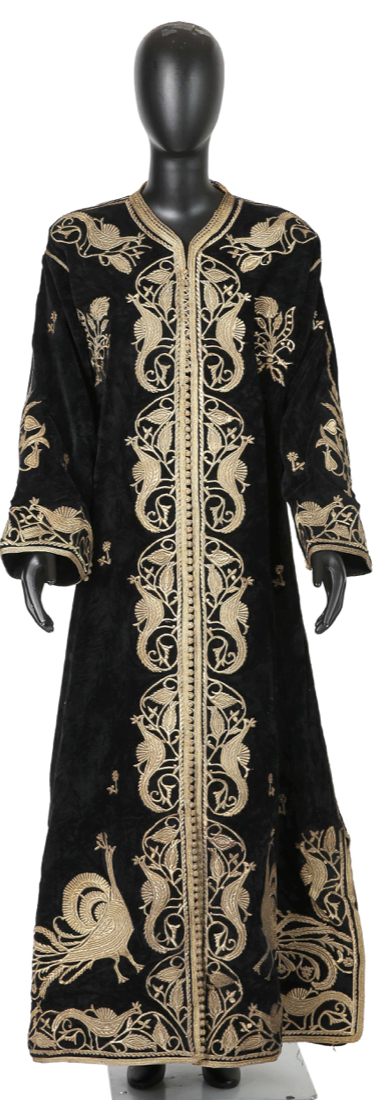
Naṭa’_fasī: (Arabic: nata’ – leather mat; Fez – Moroccan city; Synonyms: qaftan_nata’, nata’_fasi), a traditional overgarment of Persian origin worn in the Northern African countries especially Morocco generally manufactured in the city of Fez, characterized by its thick base fabric often velvet and metal thread embroidered embellishment in Turkish dival technique.
; Title: Embellished Velvet Robe, Morocco, c. late 19th early 20th century; Acc. No: ZI2022.502004 MOROCCO; Source: The Zay Zay: (Arabic: costume, Pl. azyaā’), a set of clothes in a style typical of a particular country or historical period. InitiativeThe garment is frequently embellished with zoomorphic motifs executed in raised satin_stitch
Satin_stitch: (Synonym: Damask Stitch), is a type of flat embroidery stitch that creates a satin like smooth and shiny surface by closely spaced stitches, covering an entire area or shape. embroidery, locally known as tarz_al_sqilli
Ṭarz_al_sqillī: (Persian: Durz / Dorz – needlework; Italian: Sicily – an Italian Island; Synonym: al_majbud), a traditional embroidery technique from Morocco similar or akin to satin_stitch and Turkish dival embroidery characterised by its use of metal thread often silver that was historically imported from Sicily. Sqillī: (Arabic: Sicily – an Italian Island), a silver metal thread historically imported from Sicily used for decorative purposes – weave and needlework – in the North African Arab countries especially Morocco.
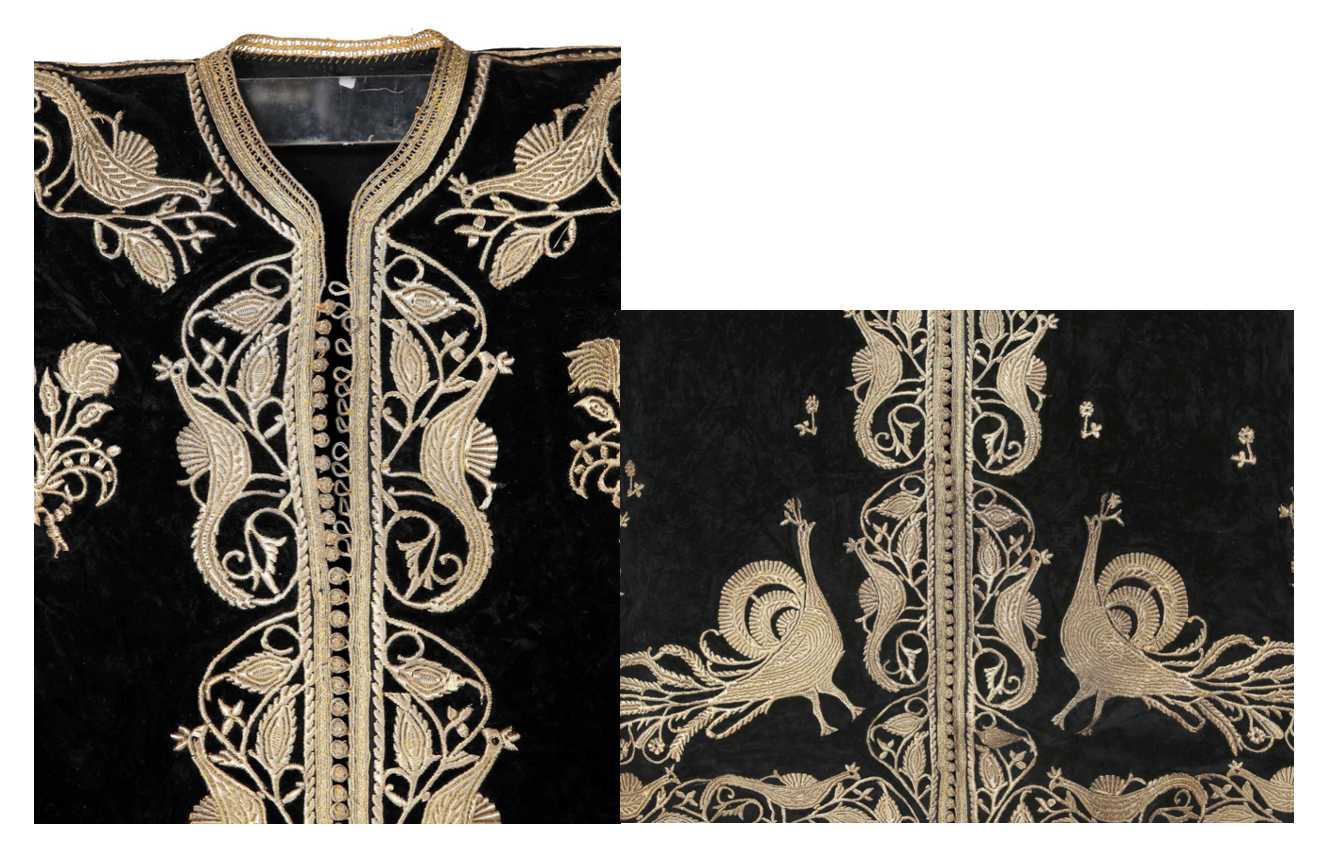
Naṭa’_fasī: (Arabic: nata’ – leather mat; Fez – Moroccan city; Synonyms: qaftan_nata’, nata’_fasi), a traditional overgarment of Persian origin worn in the Northern African countries especially Morocco generally manufactured in the city of Fez, characterized by its thick base fabric often velvet and metal thread embroidered embellishment in Turkish dival technique.
; Title: Embellished Velvet Robe, Morocco, c. late 19th early 20thcentury; Acc. No: ZI2022.502004 MOROCCO; Source: The Zay Zay: (Arabic: costume, Pl. azyaā’), a set of clothes in a style typical of a particular country or historical period. InitiativeTypically ankle-length, the qaftan_nata’ is further distinguished by metal thread passementerie
Passementerie: (French: passement – braid), decorative trimmings or edgings for textile, often made of threads of silk, cotton, or precious metals such as gold and silver, generally braided or twisted into cords. Passementerie: (French: passement – braid), decorative trimmings or edgings for textile, often made of threads of silk, cotton, or precious metals such as gold and silver, generally braided or twisted into cords.
Qaftan_makhzini_darz_al_khanjar
Qaftān_Makhzinī_Darz_Al_Khanjar:: (Arabic: Makhzini – Imperial; Persian: Durz / Dorz – needlework; Arabic: Khanjar – Dagger; Synonym: qaftan_makhzini_tiraz_al_khanjar
Qaftān_Makhzinī _Tirāz_Al_Khanjar: (Arabic: Makhzini – Imperial; Persian: Durz / Dorz – needlework; Arabic: Khanjar – Dagger; Synonym: qaftan_makhzini_darz_al_khanjar), a traditional overgarment from Northern African countries especially Morocco characterized by dagger like triangular patterned designs. Often made of luxurious fabric garments such as this were usually traditionally worn at the ruler’s court.
The qaftan_makhzini_darz_al_khanjar
Qaftān_Makhzinī_Darz_Al_Khanjar:: (Arabic: Makhzini – Imperial; Persian: Durz / Dorz – needlework; Arabic: Khanjar – Dagger; Synonym: qaftan_makhzini_tiraz_al_khanjar
Qaftān_Makhzinī _Tirāz_Al_Khanjar: (Arabic: Makhzini – Imperial; Persian: Durz / Dorz – needlework; Arabic: Khanjar – Dagger; Synonym: qaftan_makhzini_darz_al_khanjar), a traditional overgarment from Northern African countries especially Morocco characterized by dagger like triangular patterned designs. Often made of luxurious fabric garments such as this were usually traditionally worn at the ruler’s court.
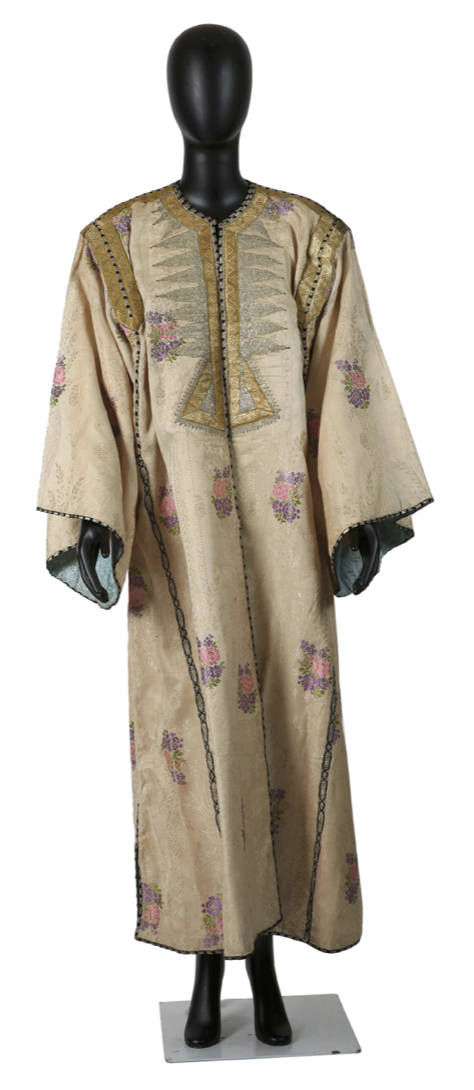
Qaftān_Makhzinī_Darz_Al_Khanjar:: (Arabic: Makhzini – Imperial; Persian: Durz / Dorz – needlework; Arabic: Khanjar – Dagger; Synonym: qaftan_makhzini_tiraz_al_khanjar
Qaftān_Makhzinī _Tirāz_Al_Khanjar: (Arabic: Makhzini – Imperial; Persian: Durz / Dorz – needlework; Arabic: Khanjar – Dagger; Synonym: qaftan_makhzini_darz_al_khanjar), a traditional overgarment from Northern African countries especially Morocco characterized by dagger like triangular patterned designs. Often made of luxurious fabric garments such as this were usually traditionally worn at the ruler’s court.
French artist and ethnographer Jean Besancenot documented related patterned qaftan
Qafṭān: (Persian: khaftān, Pl. qafāṭin, synonyms: ghandurah, qandurah
Qandūrah: (Arabic, pl. qanādīr, synonyms: ghandurah, darā’ah, dishdāshah, jalābah, jallābīyah, qaftan, mqta’, thawb
Thawb: (Arabic: thawb, Pl. Athwāb/thībān), can be pronounced thobe
Thobe: (Arabic: thawb, Pl. Athwāb/thībān), can be pronounced thawb or tobe
Tobe: (Arabic: thawb, Pl. Athwāb/thībān), can be pronounced thawb or thobe based on locale. The standard Arabic word for ‘fabric’ or ‘garment’. It can refer to a qamīs-like tunic worn by men and women in the Arabian Peninsula, Iraq, the southern and south-western ports and islands of Iran, and some countries in East and West Africa. More specifically, it can refer to the square-shaped Bedouin overgarment worn by women. based on locale. The standard Arabic word for ‘fabric’ or ‘garment’. It can also refer to a qamīs-like tunic worn by men and women in the Arabian Peninsula, Iraq, the southern and south-western ports and islands of Iran, and some countries in East and West Africa. More specifically, it can refer to the square-shaped Bedouin overgarment worn by women. or tobe
Tobe: (Arabic: thawb, Pl. Athwāb/thībān), can be pronounced thawb or thobe based on locale. The standard Arabic word for ‘fabric’ or ‘garment’. It can refer to a qamīs-like tunic worn by men and women in the Arabian Peninsula, Iraq, the southern and south-western ports and islands of Iran, and some countries in East and West Africa. More specifically, it can refer to the square-shaped Bedouin overgarment worn by women. based on locale. The standard Arabic word for ‘fabric’ or ‘garment’. It can also refer to a qamīs-like tunic worn by men and women in the Arabian Peninsula, Iraq, the southern and south-western ports and islands of Iran, and some countries in East and West Africa. More specifically, it can refer to the square-shaped Bedouin overgarment worn by women in the Arabian Gulf region. or tobe
Tobe: (Arabic: thawb, Pl. Athwāb/thībān), can be pronounced thawb or thobe based on locale. The standard Arabic word for ‘fabric’ or ‘garment’. It can refer to a qamīs-like tunic worn by men and women in the Arabian Peninsula, Iraq, the southern and south-western ports and islands of Iran, and some countries in East and West Africa. More specifically, it can refer to the square-shaped Bedouin overgarment worn by women. ), a loose, short or long-sleeved, shirt like (qamis) tunic with frontal neckline opening, worn by both sexes. Each Arab region has a different term for what is essentially a similar garment with various small differences. , drā’ah, dishdāshah, jalābah, jallābīyah, kandurah, mqta’, thawb
Thawb: (Arabic: thawb, Pl. Athwāb/thībān), can be pronounced thobe
Thobe: (Arabic: thawb, Pl. Athwāb/thībān), can be pronounced thawb or tobe
Tobe: (Arabic: thawb, Pl. Athwāb/thībān), can be pronounced thawb or thobe based on locale. The standard Arabic word for ‘fabric’ or ‘garment’. It can refer to a qamīs-like tunic worn by men and women in the Arabian Peninsula, Iraq, the southern and south-western ports and islands of Iran, and some countries in East and West Africa. More specifically, it can refer to the square-shaped Bedouin overgarment worn by women. based on locale. The standard Arabic word for ‘fabric’ or ‘garment’. It can also refer to a qamīs-like tunic worn by men and women in the Arabian Peninsula, Iraq, the southern and south-western ports and islands of Iran, and some countries in East and West Africa. More specifically, it can refer to the square-shaped Bedouin overgarment worn by women. or tobe
Tobe: (Arabic: thawb, Pl. Athwāb/thībān), can be pronounced thawb or thobe based on locale. The standard Arabic word for ‘fabric’ or ‘garment’. It can refer to a qamīs-like tunic worn by men and women in the Arabian Peninsula, Iraq, the southern and south-western ports and islands of Iran, and some countries in East and West Africa. More specifically, it can refer to the square-shaped Bedouin overgarment worn by women. based on locale. The standard Arabic word for ‘fabric’ or ‘garment’. It can also refer to a qamīs-like tunic worn by men and women in the Arabian Peninsula, Iraq, the southern and south-western ports and islands of Iran, and some countries in East and West Africa. More specifically, it can refer to the square-shaped Bedouin overgarment worn by women in the Arabian Gulf region. or tobe
Tobe: (Arabic: thawb, Pl. Athwāb/thībān), can be pronounced thawb or thobe based on locale. The standard Arabic word for ‘fabric’ or ‘garment’. It can refer to a qamīs-like tunic worn by men and women in the Arabian Peninsula, Iraq, the southern and south-western ports and islands of Iran, and some countries in East and West Africa. More specifically, it can refer to the square-shaped Bedouin overgarment worn by women. ) loose, short or long-sleeved, shirt like (qamis
Qamīṣ: (Possibly late Latin: Camisia – Linen Undergarment; Synonym: Kamiz), a traditional loose fitting long tunic or shirt worn by both men and women in South and Central Asia and the Arab world. Typically extending below the waist it is usually paired with a pair of trousers. Qamīṣ: (Possibly late Latin: Camisia – Linen Undergarment; Synonym: Kamiz), a traditional loose fitting long tunic or shirt worn by both men and women in South and Central Asia and the Arab world. Typically extending below the waist it is usually paired with a pair of trousers.
Typically, ankle length and open at the front, the qaftan_makhzini_darz_al_khanjar
Qaftān_Makhzinī_Darz_Al_Khanjar:: (Arabic: Makhzini – Imperial; Persian: Durz / Dorz – needlework; Arabic: Khanjar – Dagger; Synonym: qaftan_makhzini_tiraz_al_khanjar
Qaftān_Makhzinī _Tirāz_Al_Khanjar: (Arabic: Makhzini – Imperial; Persian: Durz / Dorz – needlework; Arabic: Khanjar – Dagger; Synonym: qaftan_makhzini_darz_al_khanjar), a traditional overgarment from Northern African countries especially Morocco characterized by dagger like triangular patterned designs. Often made of luxurious fabric garments such as this were usually traditionally worn at the ruler’s court. Tela_aurea: (Latin: tela – web, aurea – gold/golden; Synonym: cloth_of_gold; gold_cloth), a luxurious fabric woven with gold threads, creating a shimmering effect. Historically prized for its opulence, it was used in royal garments, ecclesiastical vestments, and ceremonial textiles, signifying wealth and prestige.
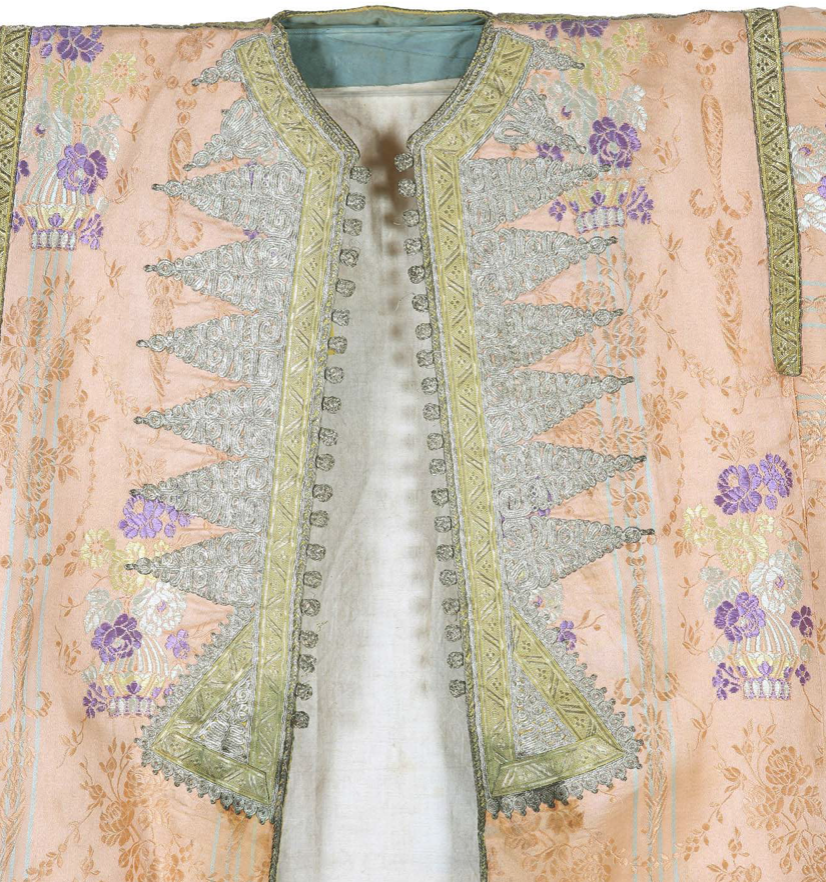
Qaftān_Makhzinī_Darz_Al_Khanjar:: (Arabic: Makhzini – Imperial; Persian: Durz / Dorz – needlework; Arabic: Khanjar – Dagger; Synonym: qaftan_makhzini_tiraz_al_khanjar
Qaftān_Makhzinī _Tirāz_Al_Khanjar: (Arabic: Makhzini – Imperial; Persian: Durz / Dorz – needlework; Arabic: Khanjar – Dagger; Synonym: qaftan_makhzini_darz_al_khanjar), a traditional overgarment from Northern African countries especially Morocco characterized by dagger like triangular patterned designs. Often made of luxurious fabric garments such as this were usually traditionally worn at the ruler’s court.
The garment is further characterised by loose, bell shaped sleeves and elaborate passementerie
Passementerie: (French: passement – braid), decorative trimmings or edgings for textile, often made of threads of silk, cotton, or precious metals such as gold and silver, generally braided or twisted into cords. Qaftān_Makhzinī_Darz_Al_Khanjar:: (Arabic: Makhzini – Imperial; Persian: Durz / Dorz – needlework; Arabic: Khanjar – Dagger; Synonym: qaftan_makhzini_tiraz_al_khanjar
Qaftān_Makhzinī _Tirāz_Al_Khanjar: (Arabic: Makhzini – Imperial; Persian: Durz / Dorz – needlework; Arabic: Khanjar – Dagger; Synonym: qaftan_makhzini_darz_al_khanjar), a traditional overgarment from Northern African countries especially Morocco characterized by dagger like triangular patterned designs. Often made of luxurious fabric garments such as this were usually traditionally worn at the ruler’s court.
Qaftan_khrib / Qaftan_khrib_fasi
Often associated particularly with Fez
Fez: (Ottoman Turkish: fes boyası - madder
Madder: (Latin: Rubia tinctorum – Eurasian herb), rose madder, common madder or dyer's madder is a vegetable dye made from the roots of a perennial plant belonging to the bedstraw and coffee family. It has been used extensively as a vegetable red dye across the globe from India to England. Ṭarbūsh: (Turkish: terpos – turban; from Persian serposh – headdress; Synonym: fez), a type of traditional skull cap with a high crown. With a possible Mediterranean origin, this head wear gained popularity in the late Ottoman period and became the forerunner of other similar caps with slight variations. Qamīṣ: (Possibly late Latin: Camisia – Linen Undergarment; Synonym: Kamiz), a traditional loose fitting long tunic or shirt worn by both men and women in South and Central Asia and the Arab world. Typically extending below the waist it is usually paired with a pair of trousers. Fez: (Ottoman Turkish: fes boyası - madder
Madder: (Latin: Rubia tinctorum – Eurasian herb), rose madder, common madder or dyer's madder is a vegetable dye made from the roots of a perennial plant belonging to the bedstraw and coffee family. It has been used extensively as a vegetable red dye across the globe from India to England. Ṭarbūsh: (Turkish: terpos – turban; from Persian serposh – headdress; Synonym: fez), a type of traditional skull cap with a high crown. With a possible Mediterranean origin, this head wear gained popularity in the late Ottoman period and became the forerunner of other similar caps with slight variations.
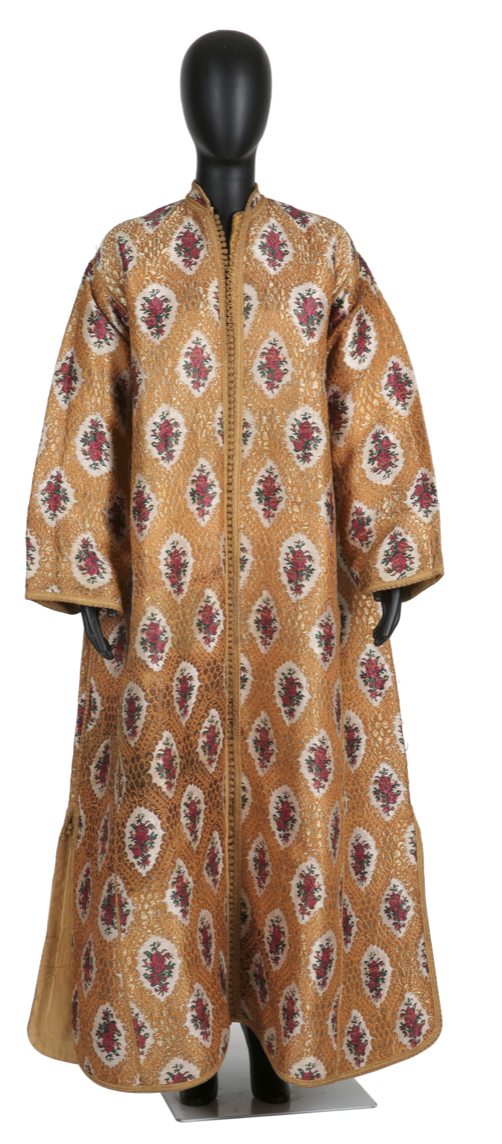
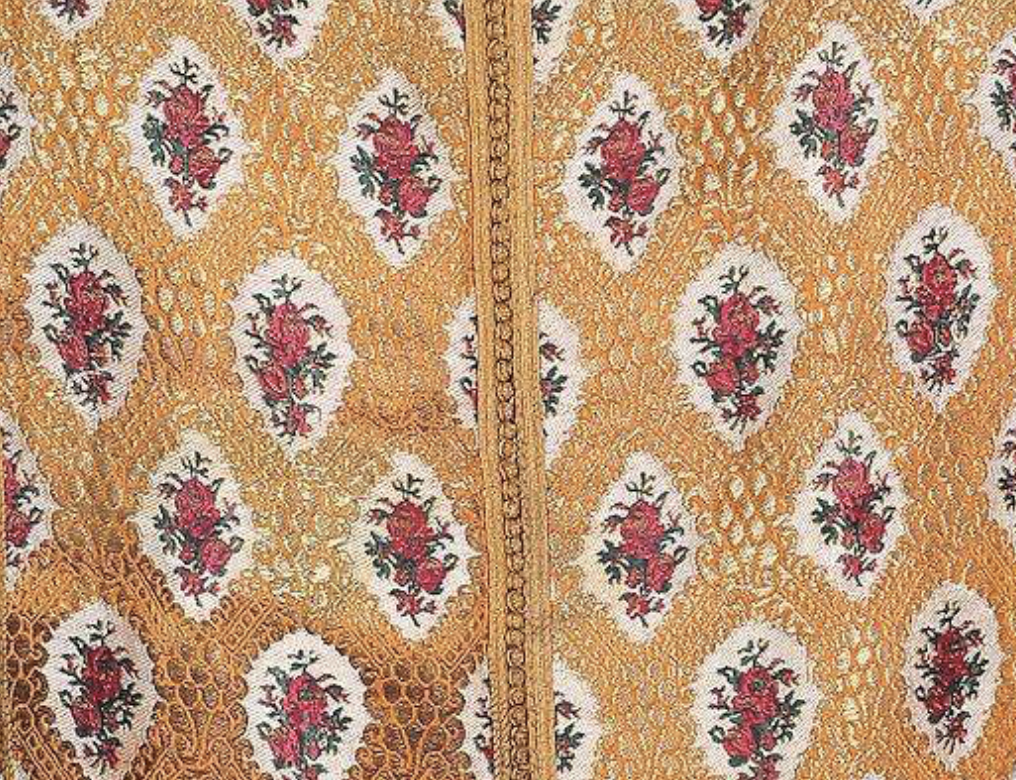
The garment is distinguished by recurring floral motifs, among which the chrysanthemum, identified in local terminology as qhiwan zaharat al ghrib, was traditionally prominent. By the late 19th century however, this motif was increasingly replaced by the rose bouquet, reflecting shifts in the decorative vocabulary of the garment. Principally associated with ceremonial dress the qaftan_khrib was particularly significant within the bridal attire of Muslim women in Fez
Fez: (Ottoman Turkish: fes boyası - madder
Madder: (Latin: Rubia tinctorum – Eurasian herb), rose madder, common madder or dyer's madder is a vegetable dye made from the roots of a perennial plant belonging to the bedstraw and coffee family. It has been used extensively as a vegetable red dye across the globe from India to England. Ṭarbūsh: (Turkish: terpos – turban; from Persian serposh – headdress; Synonym: fez), a type of traditional skull cap with a high crown. With a possible Mediterranean origin, this head wear gained popularity in the late Ottoman period and became the forerunner of other similar caps with slight variations.
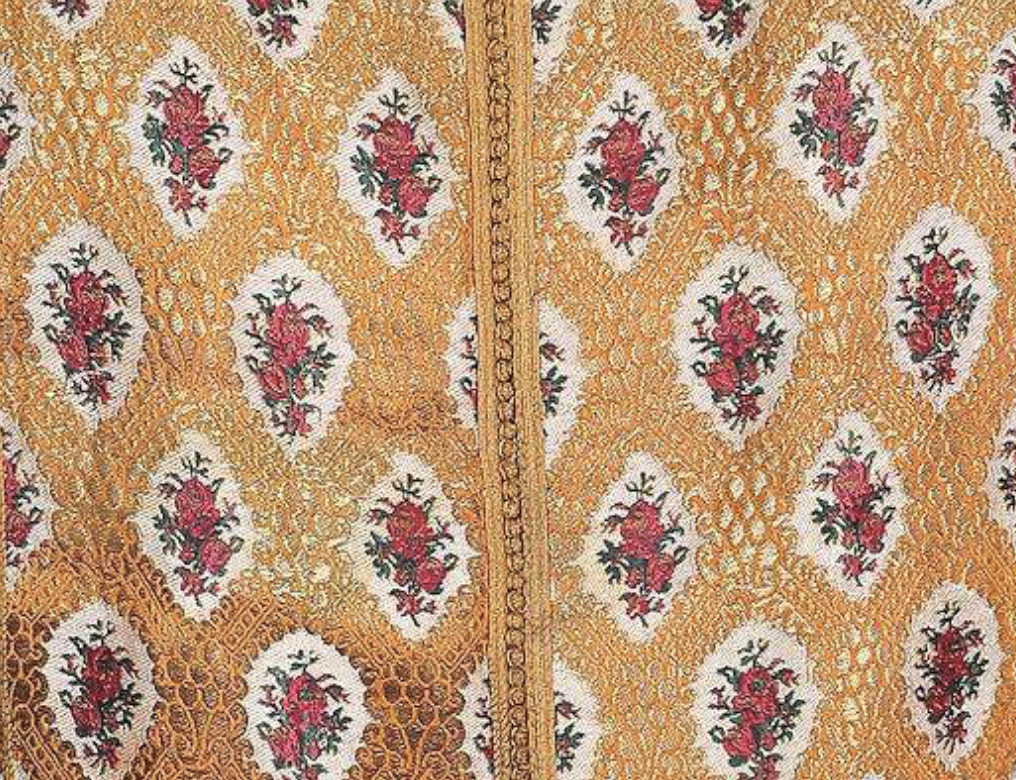
The designation khrib
khrib: (Arabic; Moroccan colloquial) a luxurious gold coloured brocaded fabric from Fes in a rose motif. In Modern Standard Arabic, khrib is the verb meaning ‘to ruin.’ Therefore, the name of the fabric can be understood to literally mean ‘the thing that ruins (the family budget) due to the material costing a fortune. derives from the Arabic kharaba, meaning “to destroy”, and refers to the garment’s exceptionally high cost. The expression consequently conveys the considerable financial expenditure historically associated with its acquisition, encapsulated in the proverbial notion that purchasing such a garment could effectively “destroy” the purchaser’s purse. The historical manufacture of the qaftan_khrib has been associated with prominent Fez
Fez: (Ottoman Turkish: fes boyası - madder
Madder: (Latin: Rubia tinctorum – Eurasian herb), rose madder, common madder or dyer's madder is a vegetable dye made from the roots of a perennial plant belonging to the bedstraw and coffee family. It has been used extensively as a vegetable red dye across the globe from India to England. Ṭarbūsh: (Turkish: terpos – turban; from Persian serposh – headdress; Synonym: fez), a type of traditional skull cap with a high crown. With a possible Mediterranean origin, this head wear gained popularity in the late Ottoman period and became the forerunner of other similar caps with slight variations. Fez: (Ottoman Turkish: fes boyası - madder
Madder: (Latin: Rubia tinctorum – Eurasian herb), rose madder, common madder or dyer's madder is a vegetable dye made from the roots of a perennial plant belonging to the bedstraw and coffee family. It has been used extensively as a vegetable red dye across the globe from India to England. Ṭarbūsh: (Turkish: terpos – turban; from Persian serposh – headdress; Synonym: fez), a type of traditional skull cap with a high crown. With a possible Mediterranean origin, this head wear gained popularity in the late Ottoman period and became the forerunner of other similar caps with slight variations.
The examination of the different types of qaftan
Qafṭān: (Persian: khaftān, Pl. qafāṭin, synonyms: ghandurah, qandurah
Qandūrah: (Arabic, pl. qanādīr, synonyms: ghandurah, darā’ah, dishdāshah, jalābah, jallābīyah, qaftan, mqta’, thawb
Thawb: (Arabic: thawb, Pl. Athwāb/thībān), can be pronounced thobe
Thobe: (Arabic: thawb, Pl. Athwāb/thībān), can be pronounced thawb or tobe
Tobe: (Arabic: thawb, Pl. Athwāb/thībān), can be pronounced thawb or thobe based on locale. The standard Arabic word for ‘fabric’ or ‘garment’. It can refer to a qamīs-like tunic worn by men and women in the Arabian Peninsula, Iraq, the southern and south-western ports and islands of Iran, and some countries in East and West Africa. More specifically, it can refer to the square-shaped Bedouin overgarment worn by women. based on locale. The standard Arabic word for ‘fabric’ or ‘garment’. It can also refer to a qamīs-like tunic worn by men and women in the Arabian Peninsula, Iraq, the southern and south-western ports and islands of Iran, and some countries in East and West Africa. More specifically, it can refer to the square-shaped Bedouin overgarment worn by women. or tobe
Tobe: (Arabic: thawb, Pl. Athwāb/thībān), can be pronounced thawb or thobe based on locale. The standard Arabic word for ‘fabric’ or ‘garment’. It can refer to a qamīs-like tunic worn by men and women in the Arabian Peninsula, Iraq, the southern and south-western ports and islands of Iran, and some countries in East and West Africa. More specifically, it can refer to the square-shaped Bedouin overgarment worn by women. based on locale. The standard Arabic word for ‘fabric’ or ‘garment’. It can also refer to a qamīs-like tunic worn by men and women in the Arabian Peninsula, Iraq, the southern and south-western ports and islands of Iran, and some countries in East and West Africa. More specifically, it can refer to the square-shaped Bedouin overgarment worn by women in the Arabian Gulf region. or tobe
Tobe: (Arabic: thawb, Pl. Athwāb/thībān), can be pronounced thawb or thobe based on locale. The standard Arabic word for ‘fabric’ or ‘garment’. It can refer to a qamīs-like tunic worn by men and women in the Arabian Peninsula, Iraq, the southern and south-western ports and islands of Iran, and some countries in East and West Africa. More specifically, it can refer to the square-shaped Bedouin overgarment worn by women. ), a loose, short or long-sleeved, shirt like (qamis) tunic with frontal neckline opening, worn by both sexes. Each Arab region has a different term for what is essentially a similar garment with various small differences. , drā’ah, dishdāshah, jalābah, jallābīyah, kandurah, mqta’, thawb
Thawb: (Arabic: thawb, Pl. Athwāb/thībān), can be pronounced thobe
Thobe: (Arabic: thawb, Pl. Athwāb/thībān), can be pronounced thawb or tobe
Tobe: (Arabic: thawb, Pl. Athwāb/thībān), can be pronounced thawb or thobe based on locale. The standard Arabic word for ‘fabric’ or ‘garment’. It can refer to a qamīs-like tunic worn by men and women in the Arabian Peninsula, Iraq, the southern and south-western ports and islands of Iran, and some countries in East and West Africa. More specifically, it can refer to the square-shaped Bedouin overgarment worn by women. based on locale. The standard Arabic word for ‘fabric’ or ‘garment’. It can also refer to a qamīs-like tunic worn by men and women in the Arabian Peninsula, Iraq, the southern and south-western ports and islands of Iran, and some countries in East and West Africa. More specifically, it can refer to the square-shaped Bedouin overgarment worn by women. or tobe
Tobe: (Arabic: thawb, Pl. Athwāb/thībān), can be pronounced thawb or thobe based on locale. The standard Arabic word for ‘fabric’ or ‘garment’. It can refer to a qamīs-like tunic worn by men and women in the Arabian Peninsula, Iraq, the southern and south-western ports and islands of Iran, and some countries in East and West Africa. More specifically, it can refer to the square-shaped Bedouin overgarment worn by women. based on locale. The standard Arabic word for ‘fabric’ or ‘garment’. It can also refer to a qamīs-like tunic worn by men and women in the Arabian Peninsula, Iraq, the southern and south-western ports and islands of Iran, and some countries in East and West Africa. More specifically, it can refer to the square-shaped Bedouin overgarment worn by women in the Arabian Gulf region. or tobe
Tobe: (Arabic: thawb, Pl. Athwāb/thībān), can be pronounced thawb or thobe based on locale. The standard Arabic word for ‘fabric’ or ‘garment’. It can refer to a qamīs-like tunic worn by men and women in the Arabian Peninsula, Iraq, the southern and south-western ports and islands of Iran, and some countries in East and West Africa. More specifically, it can refer to the square-shaped Bedouin overgarment worn by women. ) loose, short or long-sleeved, shirt like (qamis
Qamīṣ: (Possibly late Latin: Camisia – Linen Undergarment; Synonym: Kamiz), a traditional loose fitting long tunic or shirt worn by both men and women in South and Central Asia and the Arab world. Typically extending below the waist it is usually paired with a pair of trousers. Qaftān_Makhzinī_Darz_Al_Khanjar:: (Arabic: Makhzini – Imperial; Persian: Durz / Dorz – needlework; Arabic: Khanjar – Dagger; Synonym: qaftan_makhzini_tiraz_al_khanjar
Qaftān_Makhzinī _Tirāz_Al_Khanjar: (Arabic: Makhzini – Imperial; Persian: Durz / Dorz – needlework; Arabic: Khanjar – Dagger; Synonym: qaftan_makhzini_darz_al_khanjar), a traditional overgarment from Northern African countries especially Morocco characterized by dagger like triangular patterned designs. Often made of luxurious fabric garments such as this were usually traditionally worn at the ruler’s court.