

1 of 15
| Local Name | Qaftan; Qaftan_nata’; Nata’_Fasi |
| Object Category | Overgarment |
| Gender | Female |
| Date of object | c. late 19th – early 20th century |
| Place Of orgin | Morocco |
| Region | Fez |
| Object Range | Morocco, Libya, Tunis, Egypt, Algeria, et al |
| Dimensions | Length: 140 cm Width: 150 cm |
| Materials | Silk Metal Other |
| Technique | Hand Stitched Hand Embroidered |
| Color | |
| Motif | Floral Animal |
| Provenance | Purchased, Dealer, London 2022 |
| Location | The Zay Zay: (Arabic: costume, Pl. azyaā’), a set of clothes in a style typical of a particular country or historical period. Initiative |
| Status | In storage |
| ZI number | ZI2022.501004 MOROCCO |
Object History
This piece was purchased by Dr. Reem Tariq
Ṭariq: (Arabic; Synonym: tulle_bi_talli
Tūlle_bi_tallī: (French: Tulle – a city in France where fine material for veil was first made; Turkish: tel – wire; Synonym: tariq; talli; badla; khus_dozi ), series of small metal knots made on a woven net ground as embellishment. The term is commonly used in the North African Arab region specifically in Egypt. Ṭariq: (Arabic; Synonym: tulle_bi_talli
Tūlle_bi_tallī: (French: Tulle – a city in France where fine material for veil was first made; Turkish: tel – wire; Synonym: tariq; talli; badla; khus_dozi ), series of small metal knots made on a woven net ground as embellishment. The term is commonly used in the North African Arab region specifically in Egypt.
Object Features
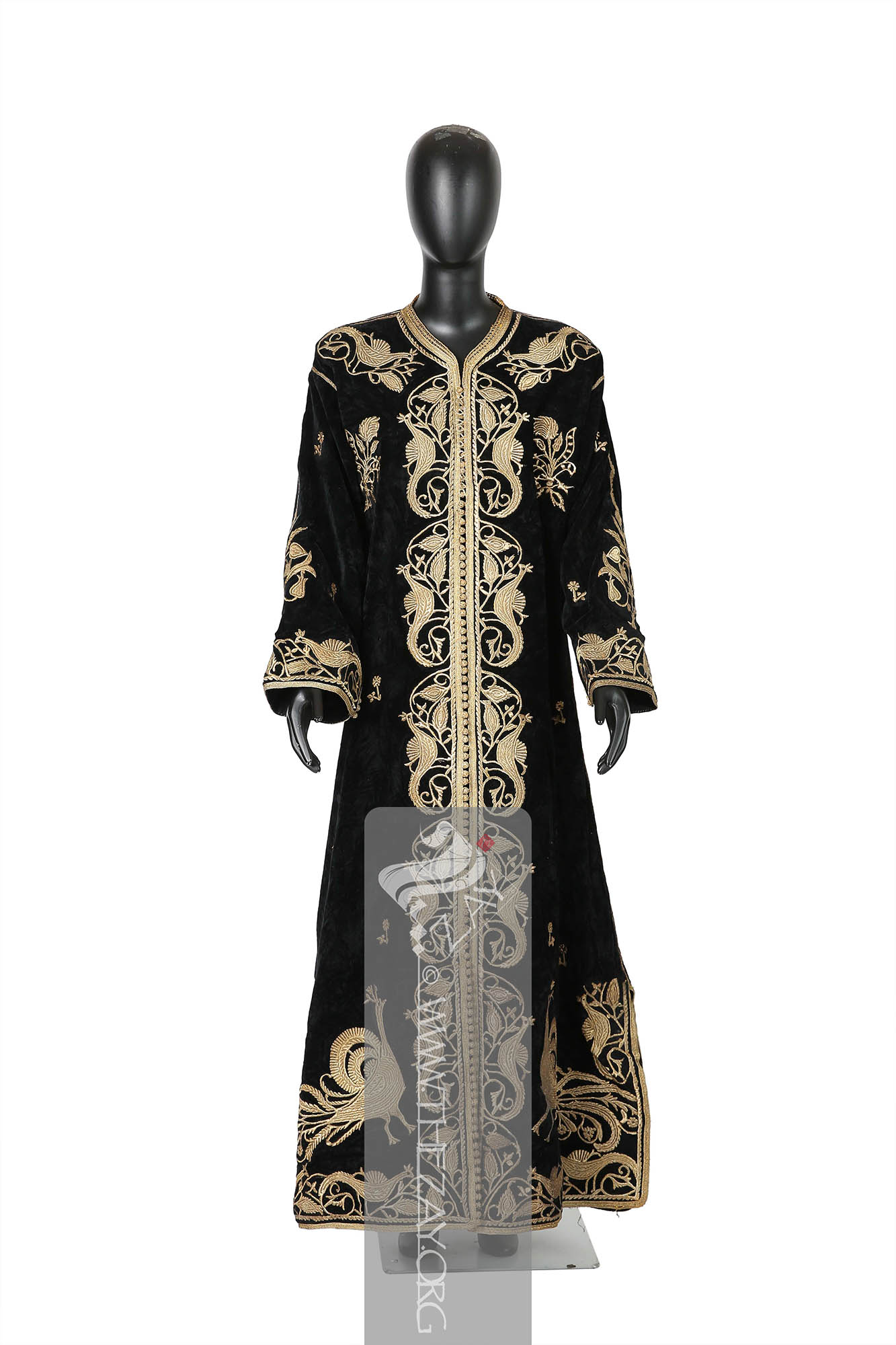
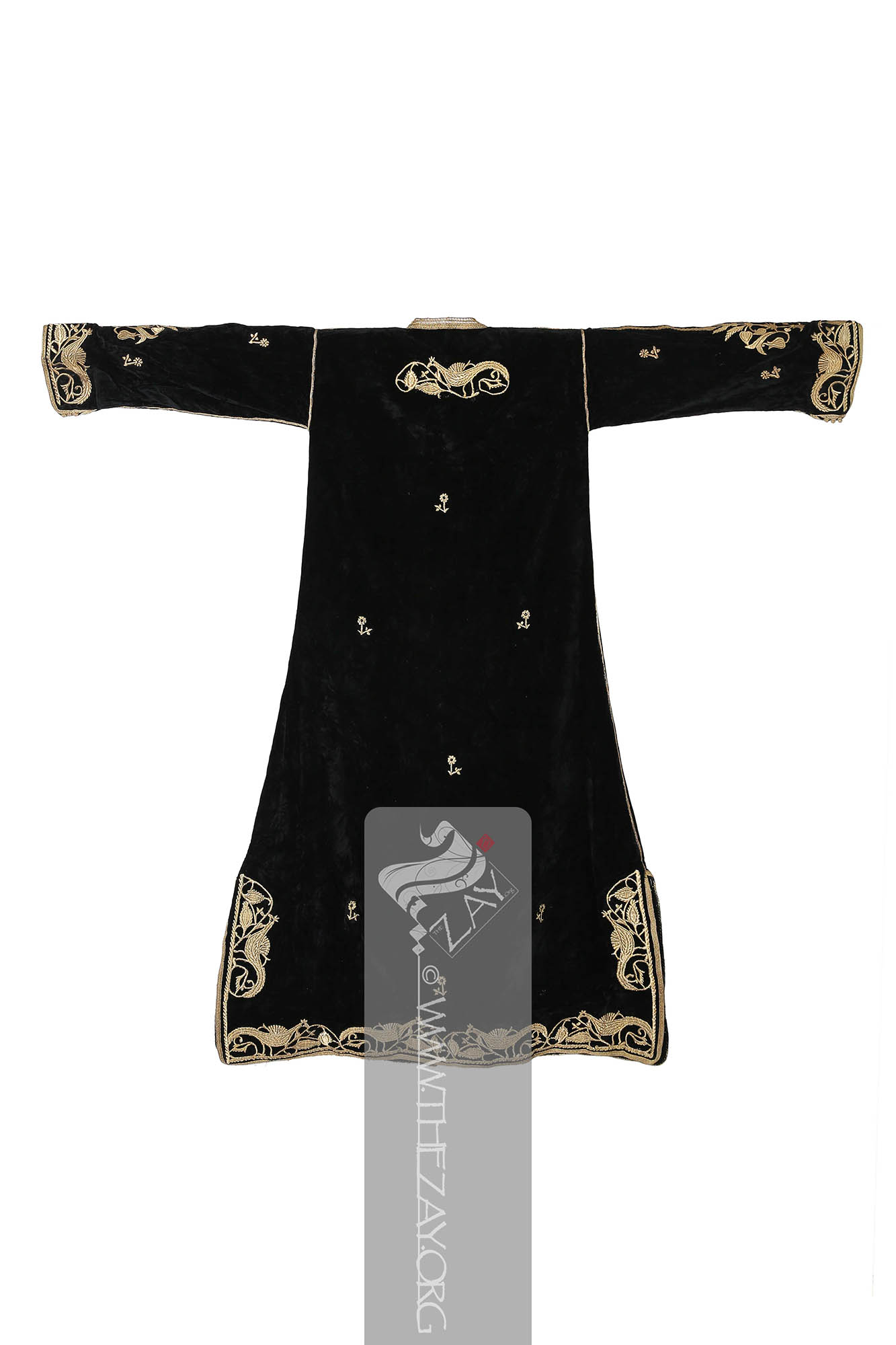
This is a woman’s ankle-length, front-open robe (qaftan
Qafṭān: (Persian: khaftān, Pl. qafāṭin, synonyms: ghandurah, qandurah
Qandūrah: (Arabic, pl. qanādīr, synonyms: ghandurah, darā’ah, dishdāshah, jalābah, jallābīyah, qaftan, mqta’, thawb
Thawb: (Arabic: thawb, Pl. Athwāb/thībān), can be pronounced thobe
Thobe: (Arabic: thawb, Pl. Athwāb/thībān), can be pronounced thawb or tobe
Tobe: (Arabic: thawb, Pl. Athwāb/thībān), can be pronounced thawb or thobe based on locale. The standard Arabic word for ‘fabric’ or ‘garment’. It can refer to a qamīs-like tunic worn by men and women in the Arabian Peninsula, Iraq, the southern and south-western ports and islands of Iran, and some countries in East and West Africa. More specifically, it can refer to the square-shaped Bedouin overgarment worn by women. based on locale. The standard Arabic word for ‘fabric’ or ‘garment’. It can also refer to a qamīs-like tunic worn by men and women in the Arabian Peninsula, Iraq, the southern and south-western ports and islands of Iran, and some countries in East and West Africa. More specifically, it can refer to the square-shaped Bedouin overgarment worn by women. or tobe
Tobe: (Arabic: thawb, Pl. Athwāb/thībān), can be pronounced thawb or thobe based on locale. The standard Arabic word for ‘fabric’ or ‘garment’. It can refer to a qamīs-like tunic worn by men and women in the Arabian Peninsula, Iraq, the southern and south-western ports and islands of Iran, and some countries in East and West Africa. More specifically, it can refer to the square-shaped Bedouin overgarment worn by women. based on locale. The standard Arabic word for ‘fabric’ or ‘garment’. It can also refer to a qamīs-like tunic worn by men and women in the Arabian Peninsula, Iraq, the southern and south-western ports and islands of Iran, and some countries in East and West Africa. More specifically, it can refer to the square-shaped Bedouin overgarment worn by women in the Arabian Gulf region. or tobe
Tobe: (Arabic: thawb, Pl. Athwāb/thībān), can be pronounced thawb or thobe based on locale. The standard Arabic word for ‘fabric’ or ‘garment’. It can refer to a qamīs-like tunic worn by men and women in the Arabian Peninsula, Iraq, the southern and south-western ports and islands of Iran, and some countries in East and West Africa. More specifically, it can refer to the square-shaped Bedouin overgarment worn by women. ), a loose, short or long-sleeved, shirt like (qamis) tunic with frontal neckline opening, worn by both sexes. Each Arab region has a different term for what is essentially a similar garment with various small differences. , drā’ah, dishdāshah, jalābah, jallābīyah, kandurah, mqta’, thawb
Thawb: (Arabic: thawb, Pl. Athwāb/thībān), can be pronounced thobe
Thobe: (Arabic: thawb, Pl. Athwāb/thībān), can be pronounced thawb or tobe
Tobe: (Arabic: thawb, Pl. Athwāb/thībān), can be pronounced thawb or thobe based on locale. The standard Arabic word for ‘fabric’ or ‘garment’. It can refer to a qamīs-like tunic worn by men and women in the Arabian Peninsula, Iraq, the southern and south-western ports and islands of Iran, and some countries in East and West Africa. More specifically, it can refer to the square-shaped Bedouin overgarment worn by women. based on locale. The standard Arabic word for ‘fabric’ or ‘garment’. It can also refer to a qamīs-like tunic worn by men and women in the Arabian Peninsula, Iraq, the southern and south-western ports and islands of Iran, and some countries in East and West Africa. More specifically, it can refer to the square-shaped Bedouin overgarment worn by women. or tobe
Tobe: (Arabic: thawb, Pl. Athwāb/thībān), can be pronounced thawb or thobe based on locale. The standard Arabic word for ‘fabric’ or ‘garment’. It can refer to a qamīs-like tunic worn by men and women in the Arabian Peninsula, Iraq, the southern and south-western ports and islands of Iran, and some countries in East and West Africa. More specifically, it can refer to the square-shaped Bedouin overgarment worn by women. based on locale. The standard Arabic word for ‘fabric’ or ‘garment’. It can also refer to a qamīs-like tunic worn by men and women in the Arabian Peninsula, Iraq, the southern and south-western ports and islands of Iran, and some countries in East and West Africa. More specifically, it can refer to the square-shaped Bedouin overgarment worn by women in the Arabian Gulf region. or tobe
Tobe: (Arabic: thawb, Pl. Athwāb/thībān), can be pronounced thawb or thobe based on locale. The standard Arabic word for ‘fabric’ or ‘garment’. It can refer to a qamīs-like tunic worn by men and women in the Arabian Peninsula, Iraq, the southern and south-western ports and islands of Iran, and some countries in East and West Africa. More specifically, it can refer to the square-shaped Bedouin overgarment worn by women. ) loose, short or long-sleeved, shirt like (qamis
Qamīṣ: (Possibly late Latin: Camisia – Linen Undergarment; Synonym: Kamiz), a traditional loose fitting long tunic or shirt worn by both men and women in South and Central Asia and the Arab world. Typically extending below the waist it is usually paired with a pair of trousers. Fez: (Ottoman Turkish: fes boyası - madder
Madder: (Latin: Rubia tinctorum – Eurasian herb), rose madder, common madder or dyer's madder is a vegetable dye made from the roots of a perennial plant belonging to the bedstraw and coffee family. It has been used extensively as a vegetable red dye across the globe from India to England. Ṭarbūsh: (Turkish: terpos – turban; from Persian serposh – headdress; Synonym: fez), a type of traditional skull cap with a high crown. With a possible Mediterranean origin, this head wear gained popularity in the late Ottoman period and became the forerunner of other similar caps with slight variations. Naṭa’_fasī: (Arabic: nata’ – leather mat; Fez – Moroccan city; Synonyms: qaftan_nata’, nata’_fasi), a traditional overgarment of Persian origin worn in the Northern African countries especially Morocco generally manufactured in the city of Fez, characterized by its thick base fabric often velvet and metal thread embroidered embellishment in Turkish dival technique.
The field of the qaftan
Qafṭān: (Persian: khaftān, Pl. qafāṭin, synonyms: ghandurah, qandurah
Qandūrah: (Arabic, pl. qanādīr, synonyms: ghandurah, darā’ah, dishdāshah, jalābah, jallābīyah, qaftan, mqta’, thawb
Thawb: (Arabic: thawb, Pl. Athwāb/thībān), can be pronounced thobe
Thobe: (Arabic: thawb, Pl. Athwāb/thībān), can be pronounced thawb or tobe
Tobe: (Arabic: thawb, Pl. Athwāb/thībān), can be pronounced thawb or thobe based on locale. The standard Arabic word for ‘fabric’ or ‘garment’. It can refer to a qamīs-like tunic worn by men and women in the Arabian Peninsula, Iraq, the southern and south-western ports and islands of Iran, and some countries in East and West Africa. More specifically, it can refer to the square-shaped Bedouin overgarment worn by women. based on locale. The standard Arabic word for ‘fabric’ or ‘garment’. It can also refer to a qamīs-like tunic worn by men and women in the Arabian Peninsula, Iraq, the southern and south-western ports and islands of Iran, and some countries in East and West Africa. More specifically, it can refer to the square-shaped Bedouin overgarment worn by women. or tobe
Tobe: (Arabic: thawb, Pl. Athwāb/thībān), can be pronounced thawb or thobe based on locale. The standard Arabic word for ‘fabric’ or ‘garment’. It can refer to a qamīs-like tunic worn by men and women in the Arabian Peninsula, Iraq, the southern and south-western ports and islands of Iran, and some countries in East and West Africa. More specifically, it can refer to the square-shaped Bedouin overgarment worn by women. based on locale. The standard Arabic word for ‘fabric’ or ‘garment’. It can also refer to a qamīs-like tunic worn by men and women in the Arabian Peninsula, Iraq, the southern and south-western ports and islands of Iran, and some countries in East and West Africa. More specifically, it can refer to the square-shaped Bedouin overgarment worn by women in the Arabian Gulf region. or tobe
Tobe: (Arabic: thawb, Pl. Athwāb/thībān), can be pronounced thawb or thobe based on locale. The standard Arabic word for ‘fabric’ or ‘garment’. It can refer to a qamīs-like tunic worn by men and women in the Arabian Peninsula, Iraq, the southern and south-western ports and islands of Iran, and some countries in East and West Africa. More specifically, it can refer to the square-shaped Bedouin overgarment worn by women. ), a loose, short or long-sleeved, shirt like (qamis) tunic with frontal neckline opening, worn by both sexes. Each Arab region has a different term for what is essentially a similar garment with various small differences. , drā’ah, dishdāshah, jalābah, jallābīyah, kandurah, mqta’, thawb
Thawb: (Arabic: thawb, Pl. Athwāb/thībān), can be pronounced thobe
Thobe: (Arabic: thawb, Pl. Athwāb/thībān), can be pronounced thawb or tobe
Tobe: (Arabic: thawb, Pl. Athwāb/thībān), can be pronounced thawb or thobe based on locale. The standard Arabic word for ‘fabric’ or ‘garment’. It can refer to a qamīs-like tunic worn by men and women in the Arabian Peninsula, Iraq, the southern and south-western ports and islands of Iran, and some countries in East and West Africa. More specifically, it can refer to the square-shaped Bedouin overgarment worn by women. based on locale. The standard Arabic word for ‘fabric’ or ‘garment’. It can also refer to a qamīs-like tunic worn by men and women in the Arabian Peninsula, Iraq, the southern and south-western ports and islands of Iran, and some countries in East and West Africa. More specifically, it can refer to the square-shaped Bedouin overgarment worn by women. or tobe
Tobe: (Arabic: thawb, Pl. Athwāb/thībān), can be pronounced thawb or thobe based on locale. The standard Arabic word for ‘fabric’ or ‘garment’. It can refer to a qamīs-like tunic worn by men and women in the Arabian Peninsula, Iraq, the southern and south-western ports and islands of Iran, and some countries in East and West Africa. More specifically, it can refer to the square-shaped Bedouin overgarment worn by women. based on locale. The standard Arabic word for ‘fabric’ or ‘garment’. It can also refer to a qamīs-like tunic worn by men and women in the Arabian Peninsula, Iraq, the southern and south-western ports and islands of Iran, and some countries in East and West Africa. More specifically, it can refer to the square-shaped Bedouin overgarment worn by women in the Arabian Gulf region. or tobe
Tobe: (Arabic: thawb, Pl. Athwāb/thībān), can be pronounced thawb or thobe based on locale. The standard Arabic word for ‘fabric’ or ‘garment’. It can refer to a qamīs-like tunic worn by men and women in the Arabian Peninsula, Iraq, the southern and south-western ports and islands of Iran, and some countries in East and West Africa. More specifically, it can refer to the square-shaped Bedouin overgarment worn by women. ) loose, short or long-sleeved, shirt like (qamis
Qamīṣ: (Possibly late Latin: Camisia – Linen Undergarment; Synonym: Kamiz), a traditional loose fitting long tunic or shirt worn by both men and women in South and Central Asia and the Arab world. Typically extending below the waist it is usually paired with a pair of trousers. Ṭarz_al_sqillī: (Persian: Durz / Dorz – needlework; Italian: Sicily – an Italian Island; Synonym: al_majbud), a traditional embroidery technique from Morocco similar or akin to satin_stitch and Turkish dival embroidery characterised by its use of metal thread often silver that was historically imported from Sicily. Sqillī: (Arabic: Sicily – an Italian Island), a silver metal thread historically imported from Sicily used for decorative purposes – weave and needlework – in the North African Arab countries especially Morocco.
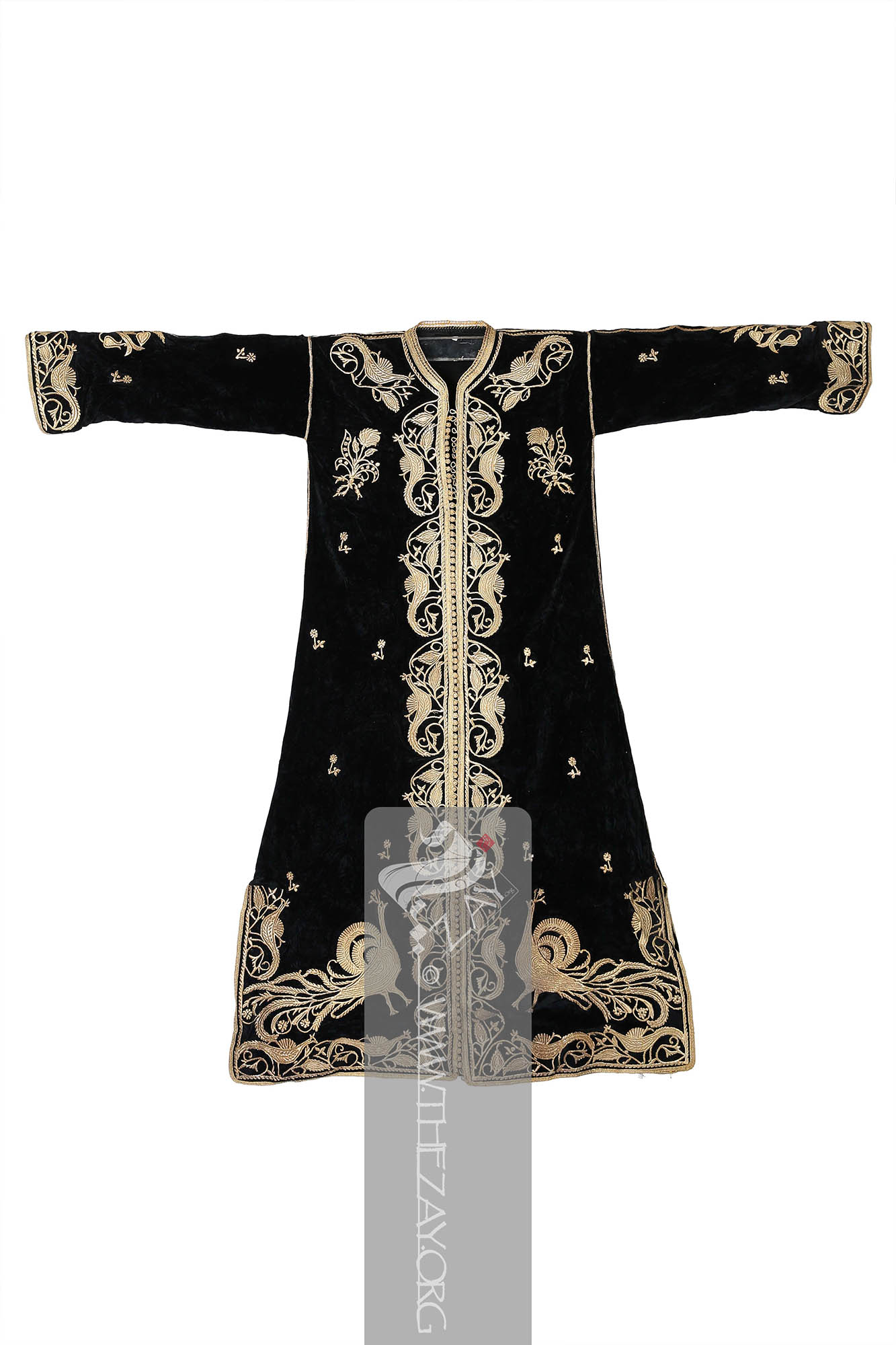
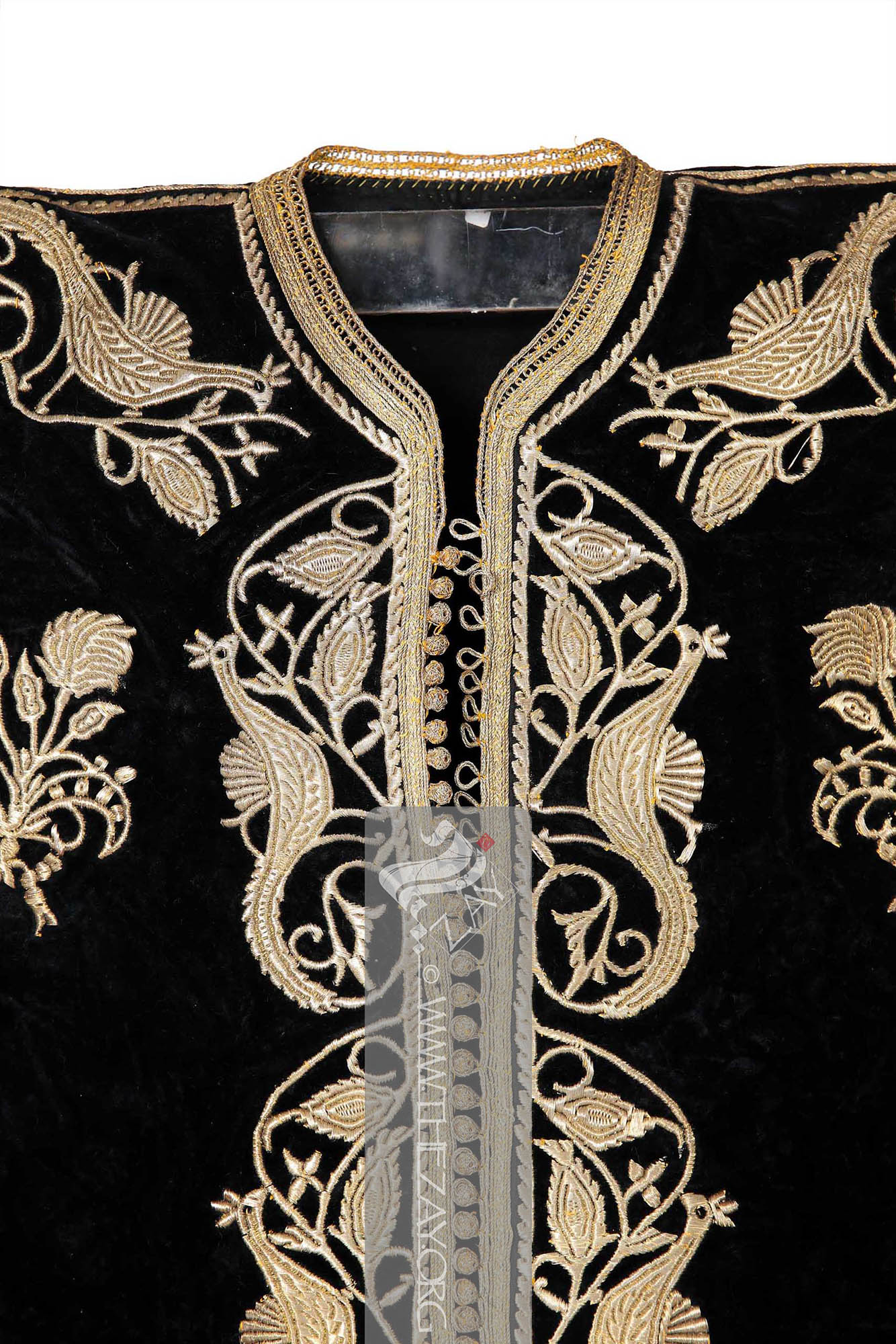
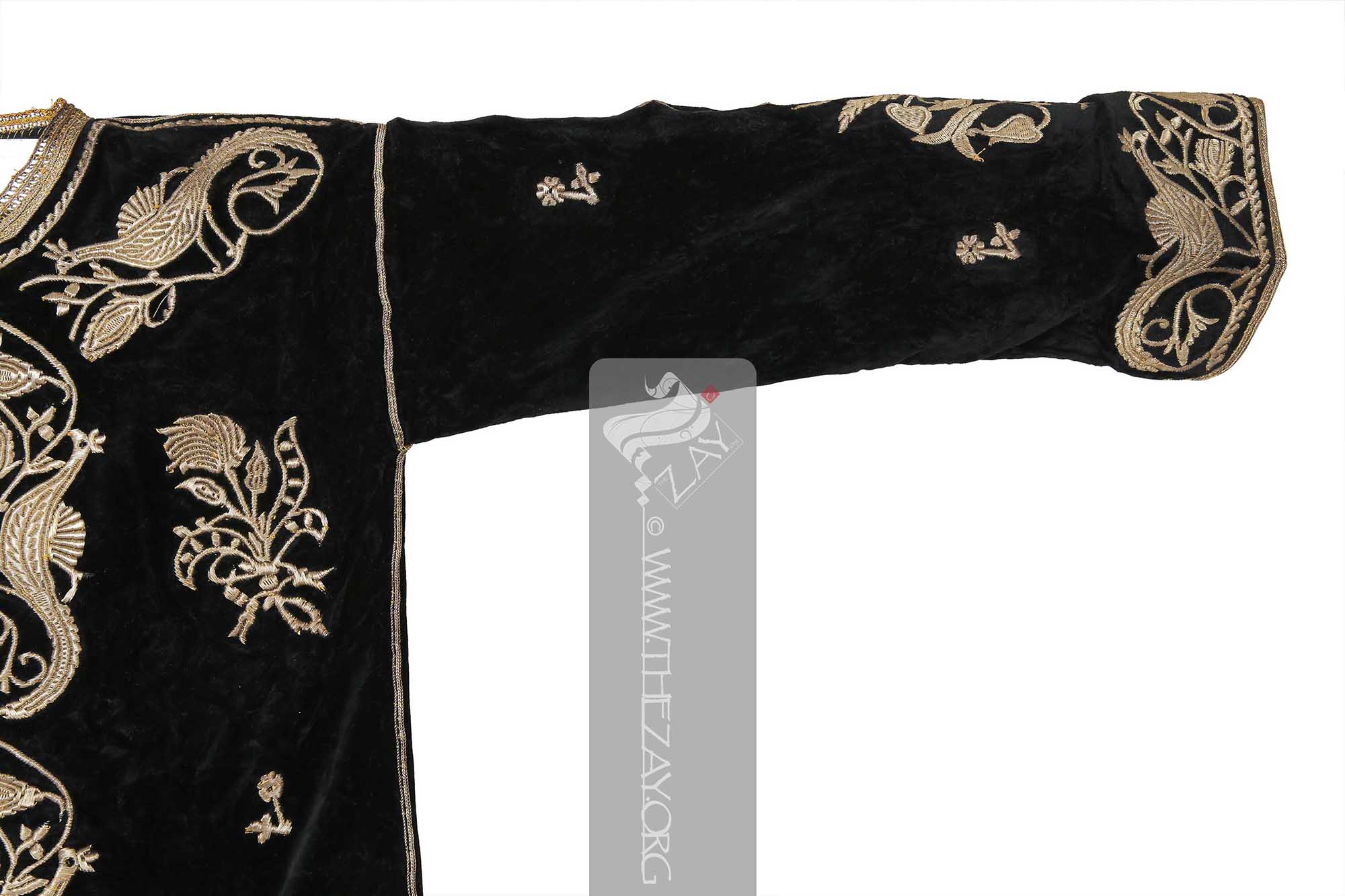
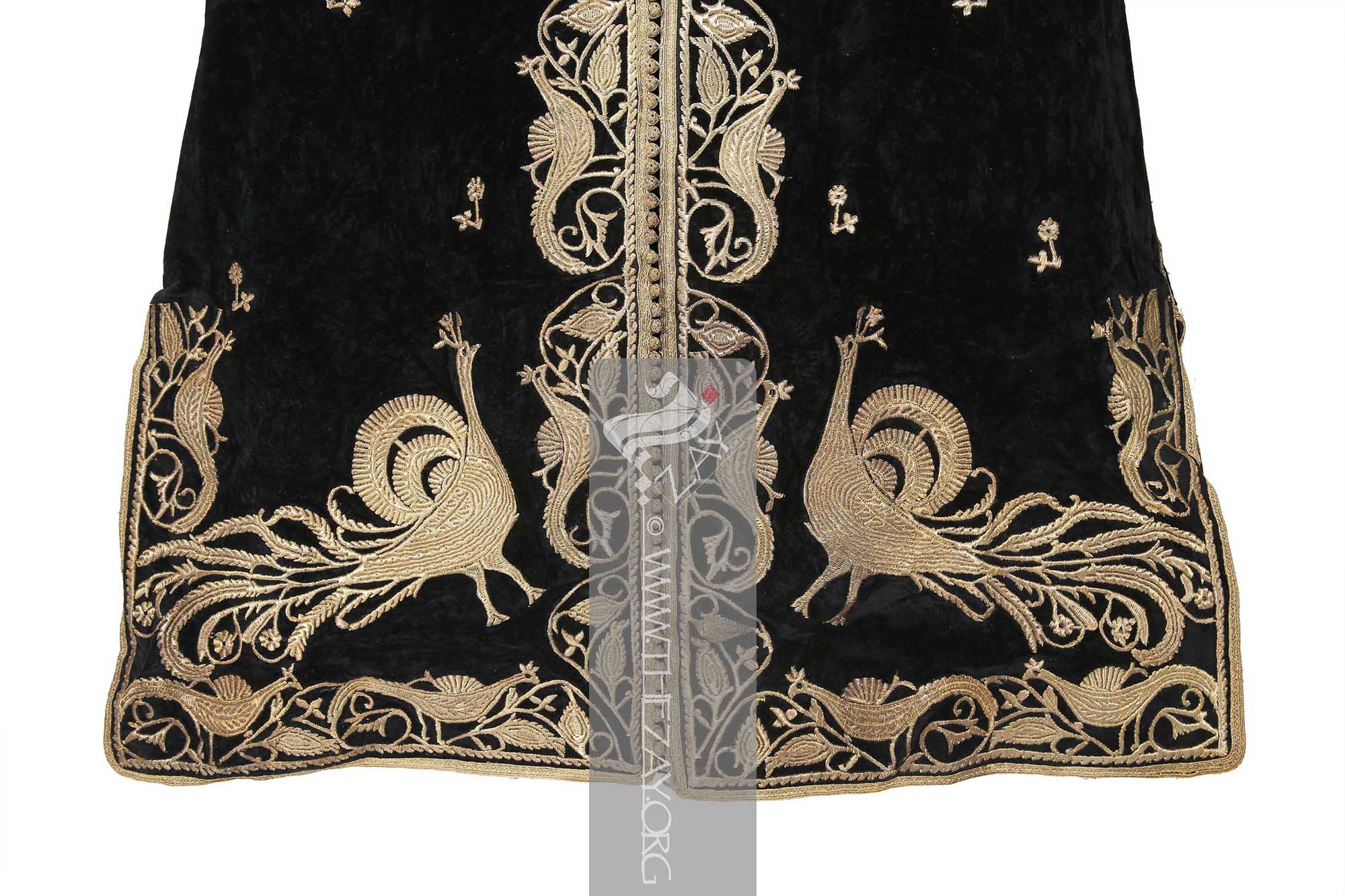
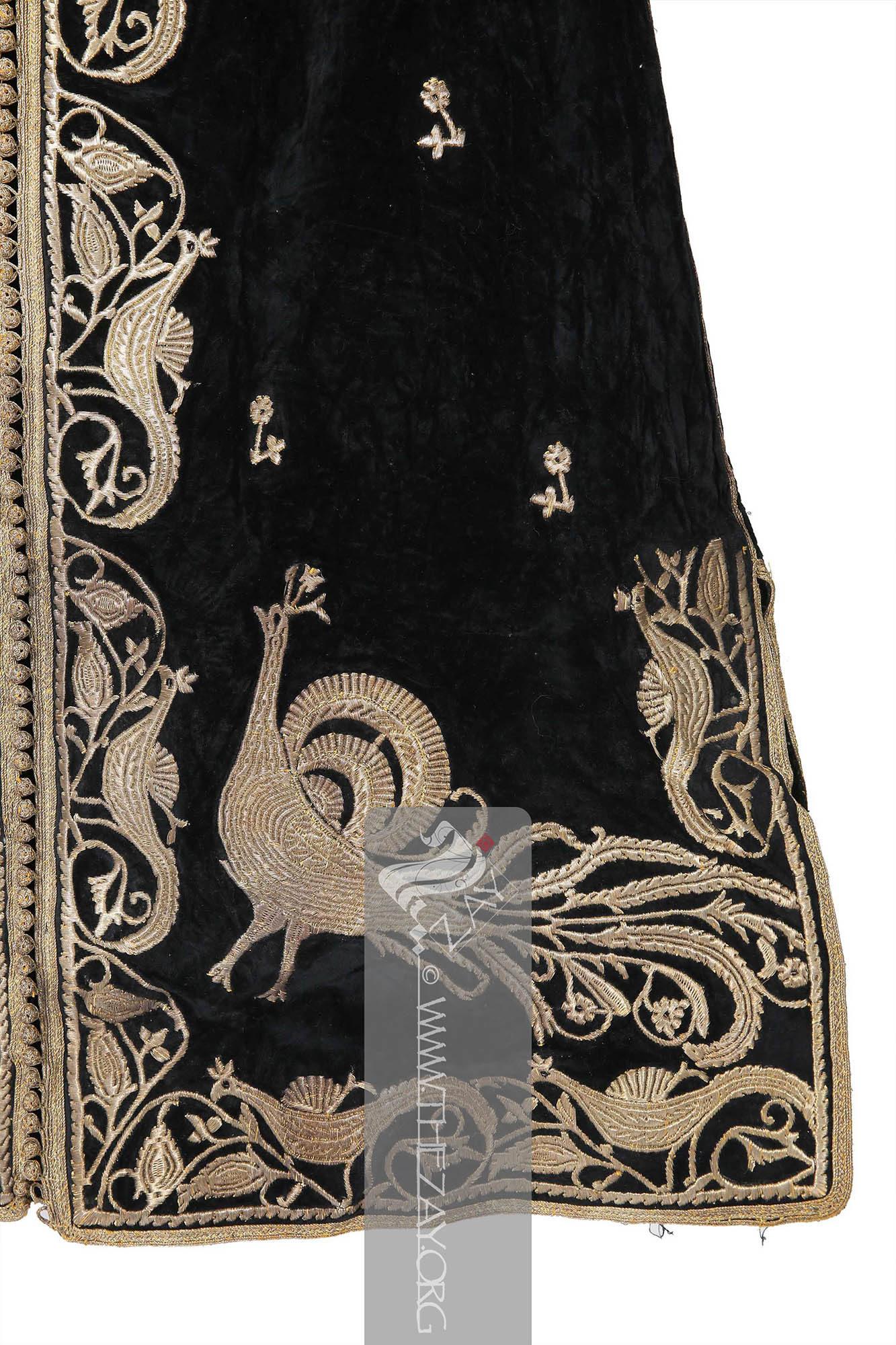
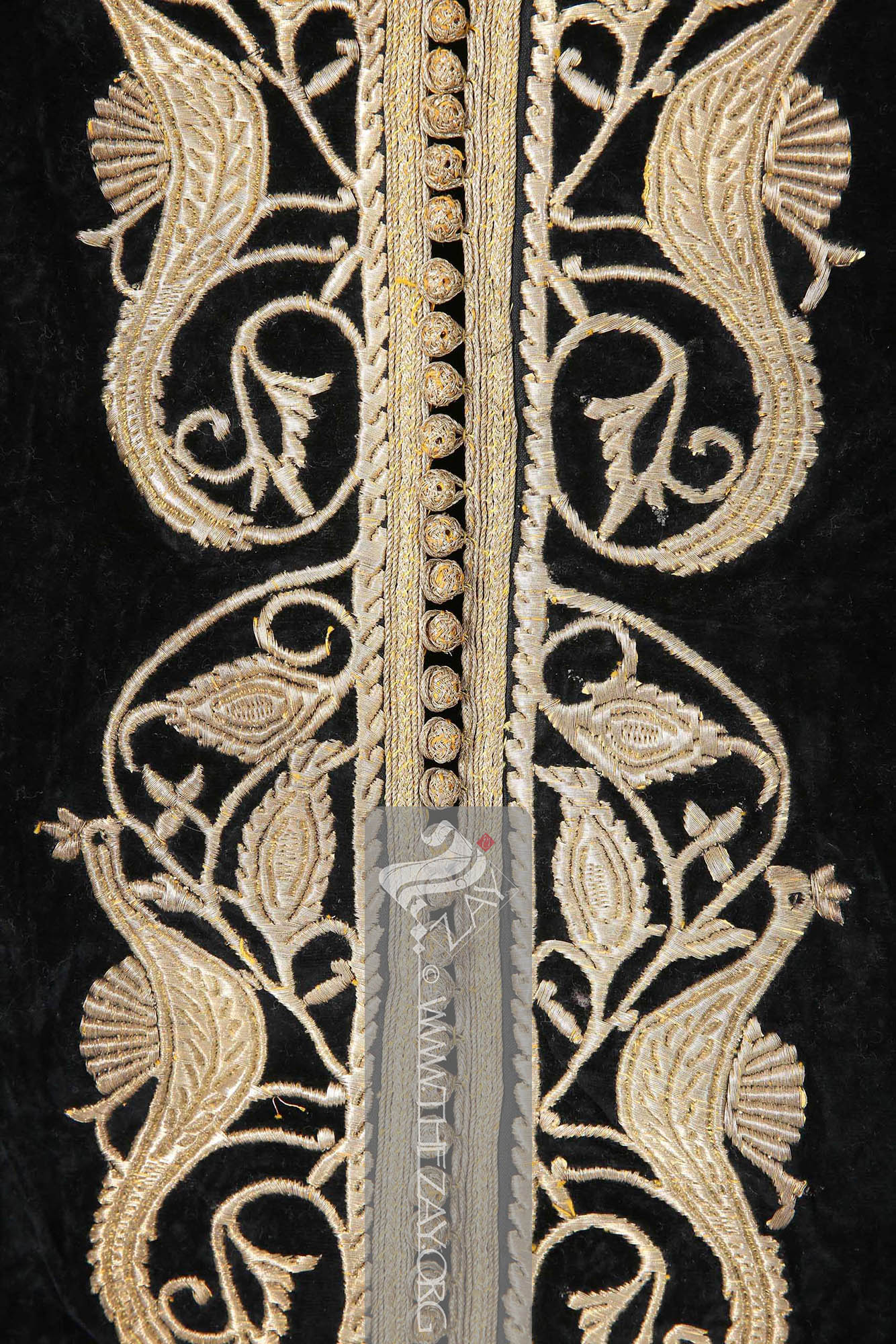
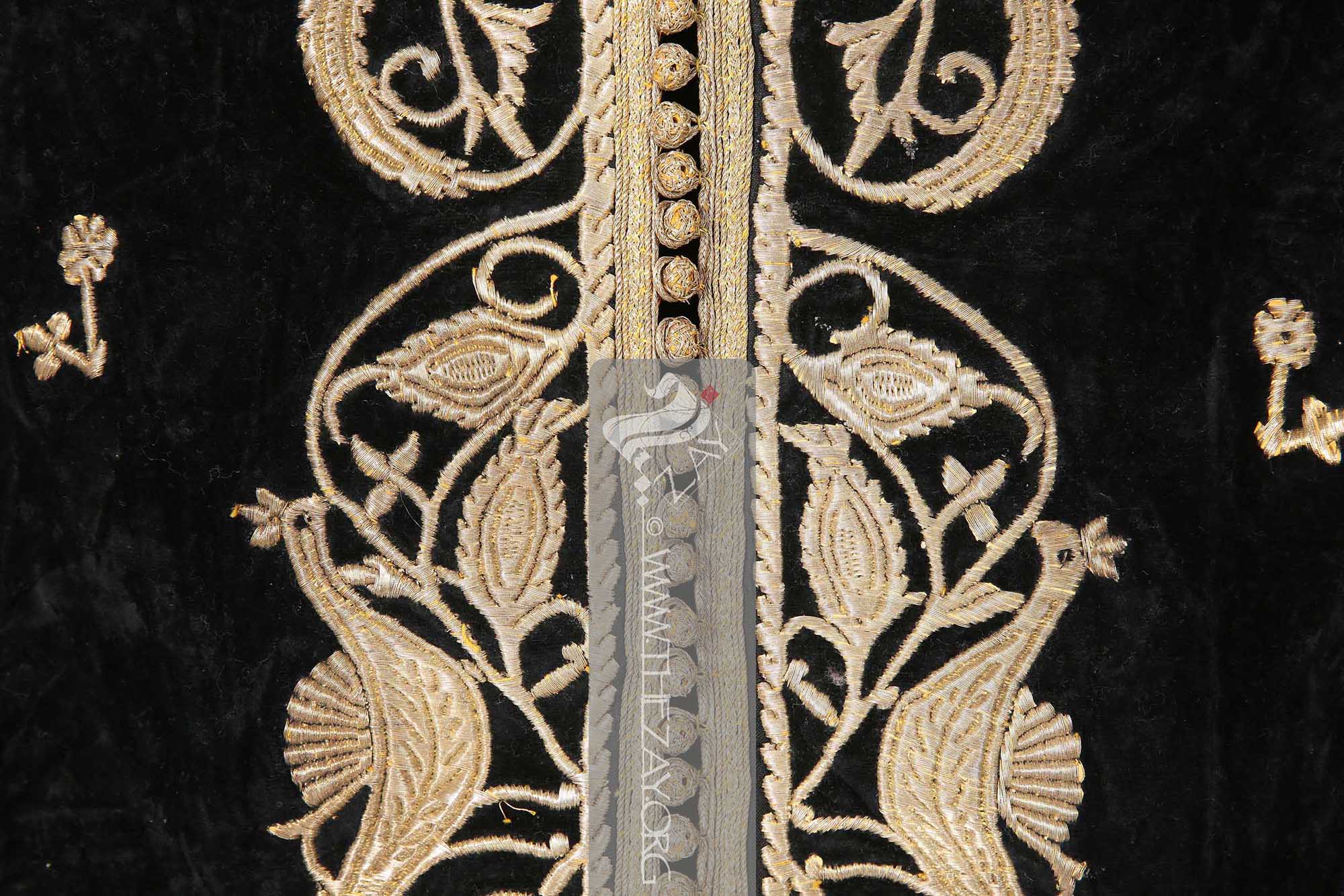
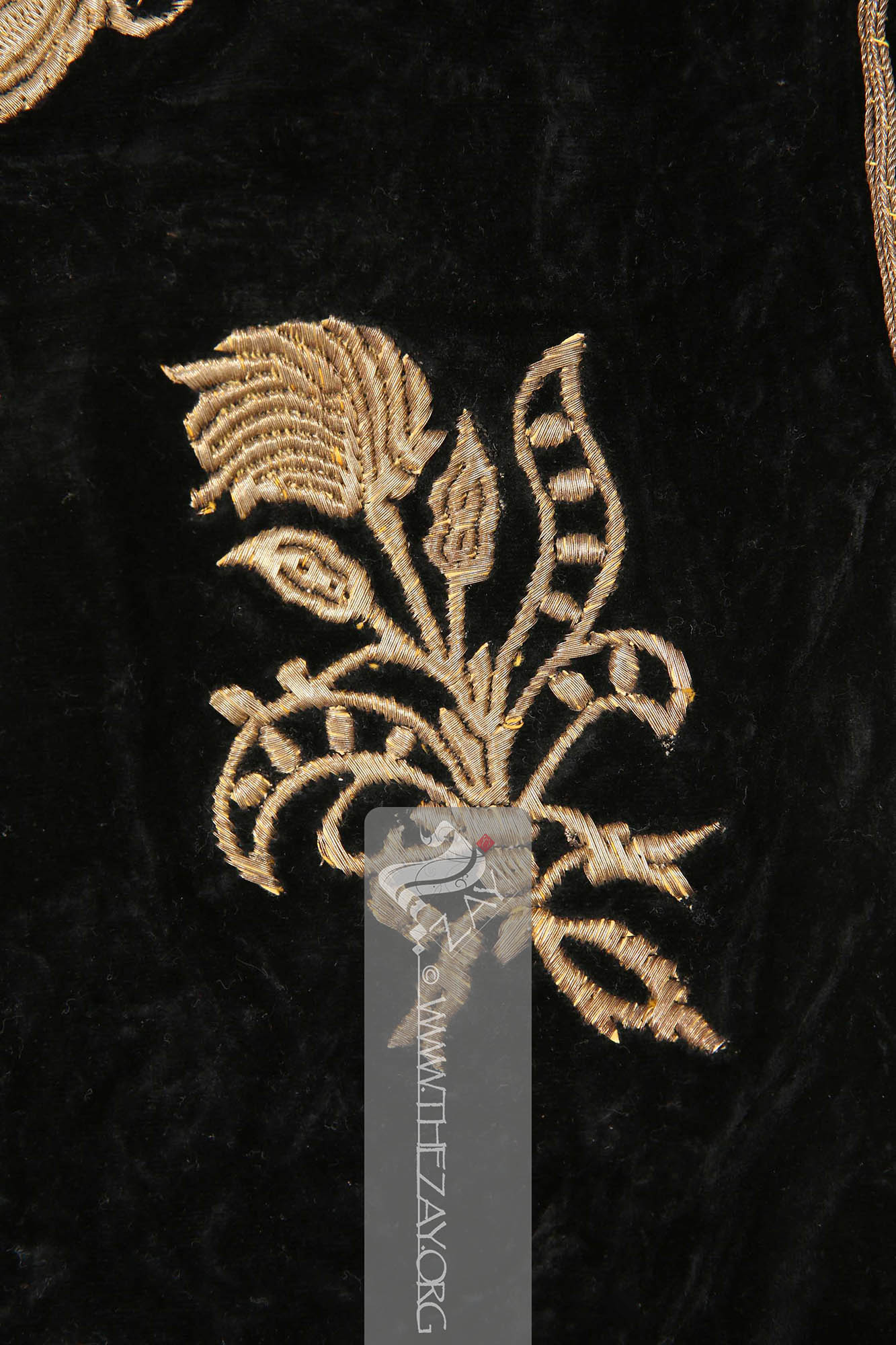
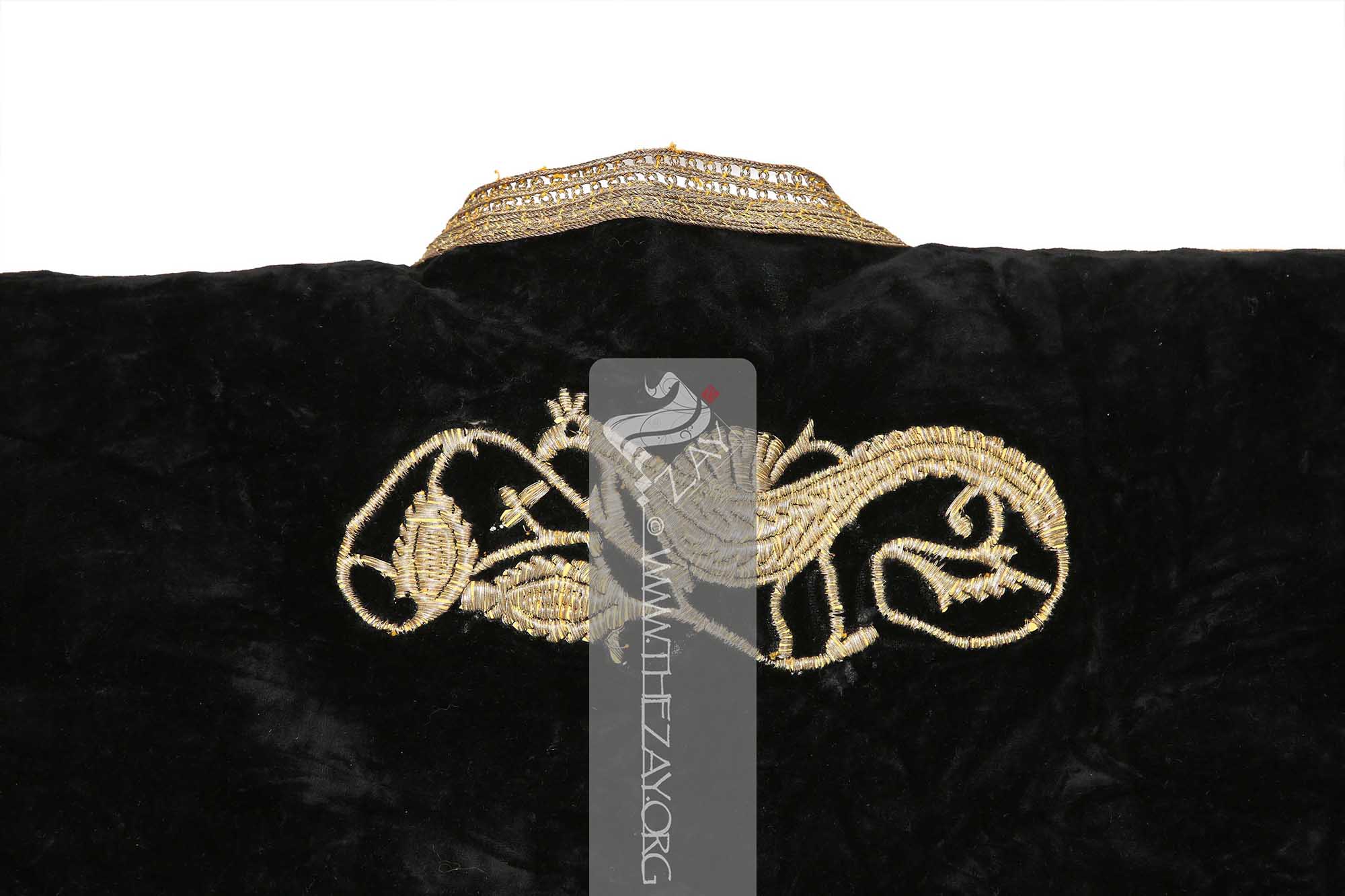
The front opening on both sides features a floral and foliage pattern along a wavy central vine running vertically from the base of the neckline to the ankle in Ottoman style (dival Dīval: (Possibly Persian: divan – throne), an embroidery technique prominent during the Ottoman era done with metal threads or wire with a cardboard base usually over velvet. The motif is cut out on a cardboard and the metal thread is then embroidered over it using satin_stitch Satin_stitch: (Synonym: Damask Stitch), is a type of flat embroidery stitch that creates a satin like smooth and shiny surface by closely spaced stitches, covering an entire area or shape. and gimped couching style embroidery.) embroidery. The foliage is interspersed with repeats of peacock figures perched atop the vine.
This is followed by several cords of braided metal thread (passementerie
Passementerie: (French: passement – braid), decorative trimmings or edgings for textile, often made of threads of silk, cotton, or precious metals such as gold and silver, generally braided or twisted into cords. ‘Uqad: (Arabic: ‘uqdah
‘uqdah: (Arabic: ‘uqdah – knot), passementerie buttons often used for fastening or for decorative purposes on North African Arab garments especially Moroccan qaftan. ‘uqdah: (Arabic: ‘uqdah – knot), passementerie buttons often used for fastening or for decorative purposes on North African Arab garments especially Moroccan qaftan. Frog_fastener: (Synonym: Chinese frog closure, frog closure), is a decorative and functional type of button used to fasten clothing. Said to have originated between c. 5th to 7th century China these buttons consist of a cord or braid looped through a decorative knot.
The pattern of wavy vine with floral, foliage, and peacock repeats, and the metal passementerie
Passementerie: (French: passement – braid), decorative trimmings or edgings for textile, often made of threads of silk, cotton, or precious metals such as gold and silver, generally braided or twisted into cords. Frog_fastener: (Synonym: Chinese frog closure, frog closure), is a decorative and functional type of button used to fasten clothing. Said to have originated between c. 5th to 7th century China these buttons consist of a cord or braid looped through a decorative knot.
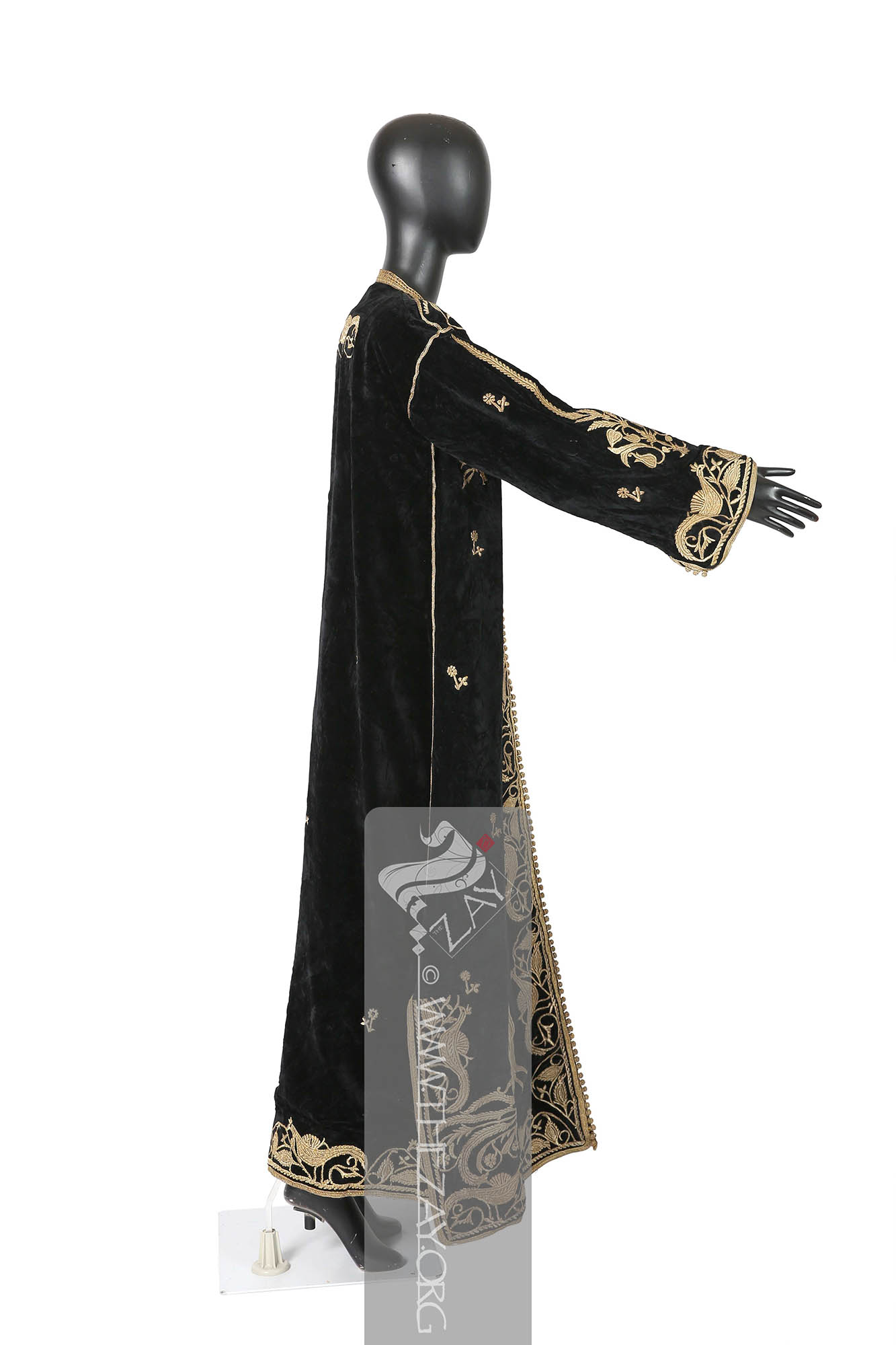
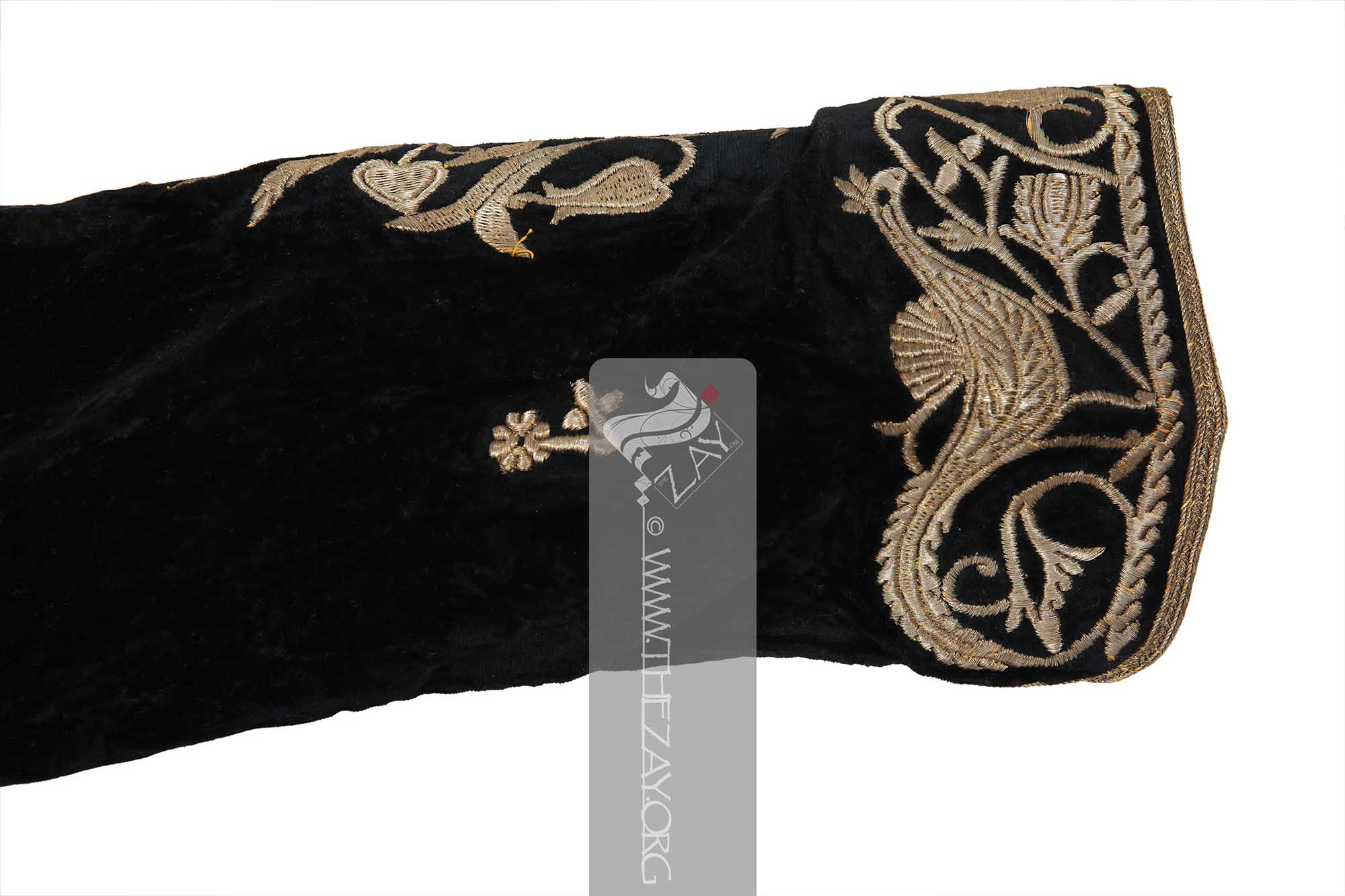
While the top front (yoke Yoke: (Synonym: Bodice_Yoke), a structured pattern fitted at the shoulders defining the structure of women’s garments. Introduced in c. 1880s it defines the transition between the upper and lower parts of the garments and can now be found stitched-in where the blouse is separated from the skirt by a horizontal seam. ) displays a floral bouquet on each side with a top central flower flanked by curling foliage, the sleeves display a taller bouquet with two flanking tulips and floral buds, along with foliage. This is topped with a herringbone-style vertical row.
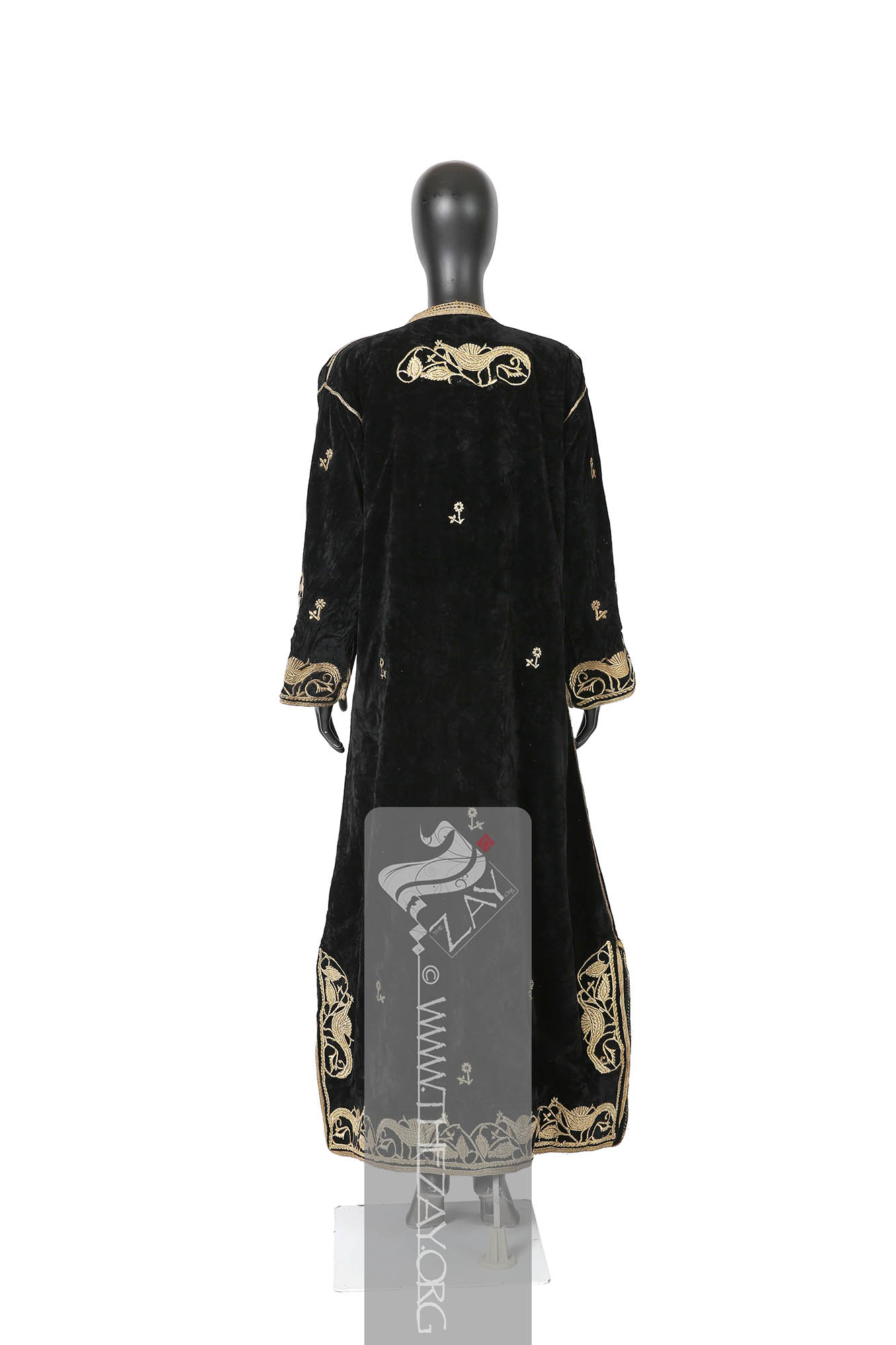
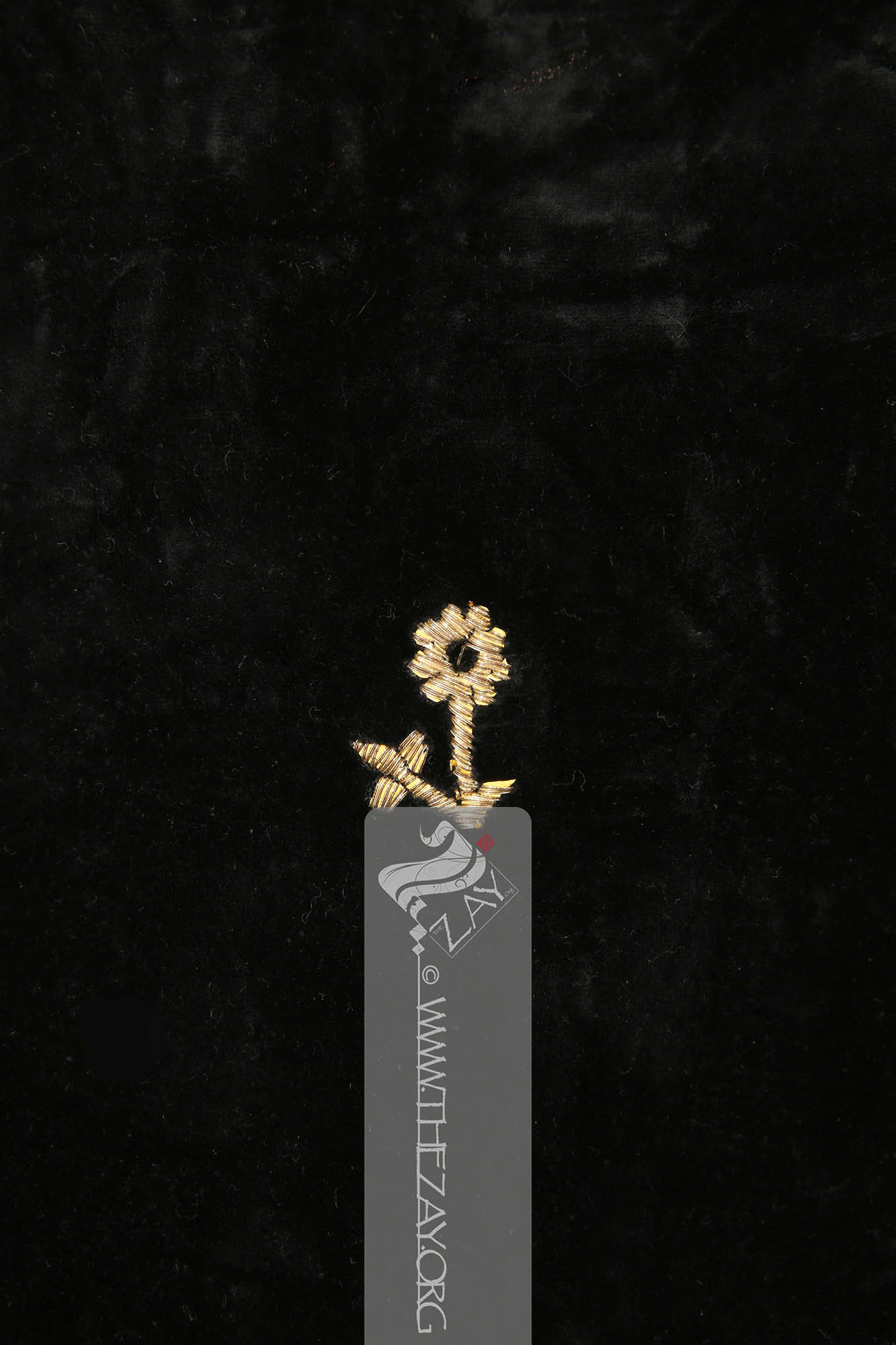
The rest of the front and back fields of the qaftan_nata’ have sporadic repeats of a small floral pattern. Each corner along the front hemline is adorned with a larger peacock with its tail spread. The seamlines of the piece are trimmed with rows of metal passementerie
Passementerie: (French: passement – braid), decorative trimmings or edgings for textile, often made of threads of silk, cotton, or precious metals such as gold and silver, generally braided or twisted into cords. Qamīṣ: (Possibly late Latin: Camisia – Linen Undergarment; Synonym: Kamiz), a traditional loose fitting long tunic or shirt worn by both men and women in South and Central Asia and the Arab world. Typically extending below the waist it is usually paired with a pair of trousers.
Also known as (qaftan_nata’
Qaftan_naṭa’: (Arabic: nata’ – leather mat; Synonyms: qaftan_nata’_fasi
Qaftan_naṭa’_fasī: (Arabic: nata’ – leather mat; Fez – Moroccan city; Synonyms: qaftan_nata’, nata’_fasi), a traditional overgarment of Persian origin worn in the Northern African countries especially Morocco generally manufactured in the city of Fez, characterized by its thick base fabric often velvet and metal thread embroidered embellishment in Turkish dival technique. Fez: (Ottoman Turkish: fes boyası - madder
Madder: (Latin: Rubia tinctorum – Eurasian herb), rose madder, common madder or dyer's madder is a vegetable dye made from the roots of a perennial plant belonging to the bedstraw and coffee family. It has been used extensively as a vegetable red dye across the globe from India to England. Ṭarbūsh: (Turkish: terpos – turban; from Persian serposh – headdress; Synonym: fez), a type of traditional skull cap with a high crown. With a possible Mediterranean origin, this head wear gained popularity in the late Ottoman period and became the forerunner of other similar caps with slight variations. Qamīṣ: (Possibly late Latin: Camisia – Linen Undergarment; Synonym: Kamiz), a traditional loose fitting long tunic or shirt worn by both men and women in South and Central Asia and the Arab world. Typically extending below the waist it is usually paired with a pair of trousers. Al_majbūd: (Arabic; Synonym: tarz_al_sqilli
Ṭarz_al_sqillī: (Persian: Durz / Dorz – needlework; Italian: Sicily – an Italian Island; Synonym: al_majbud), a traditional embroidery technique from Morocco similar or akin to satin_stitch and Turkish dival embroidery characterised by its use of metal thread often silver that was historically imported from Sicily.
Links