




1 of 11
| Local Name | Qaftan; Qaftan_Makhzini_Darz_Al_Khanjar , Qaftan_Makhzini_Tiraz_Al_Khanjar |
| Object Category | Overgarment |
| Gender | Female |
| Date of object | c. 1925 |
| Place Of orgin | Morocco |
| Region | Tetouan |
| Object Range | Morocco, Libya, Tunis, Egypt, Algeria, et al |
| Dimensions | Length: 150 cm Width: 100 cm |
| Materials | Silk Cotton Wool Metal |
| Technique | Hand Stitched Machine Stitched Woven |
| Color | |
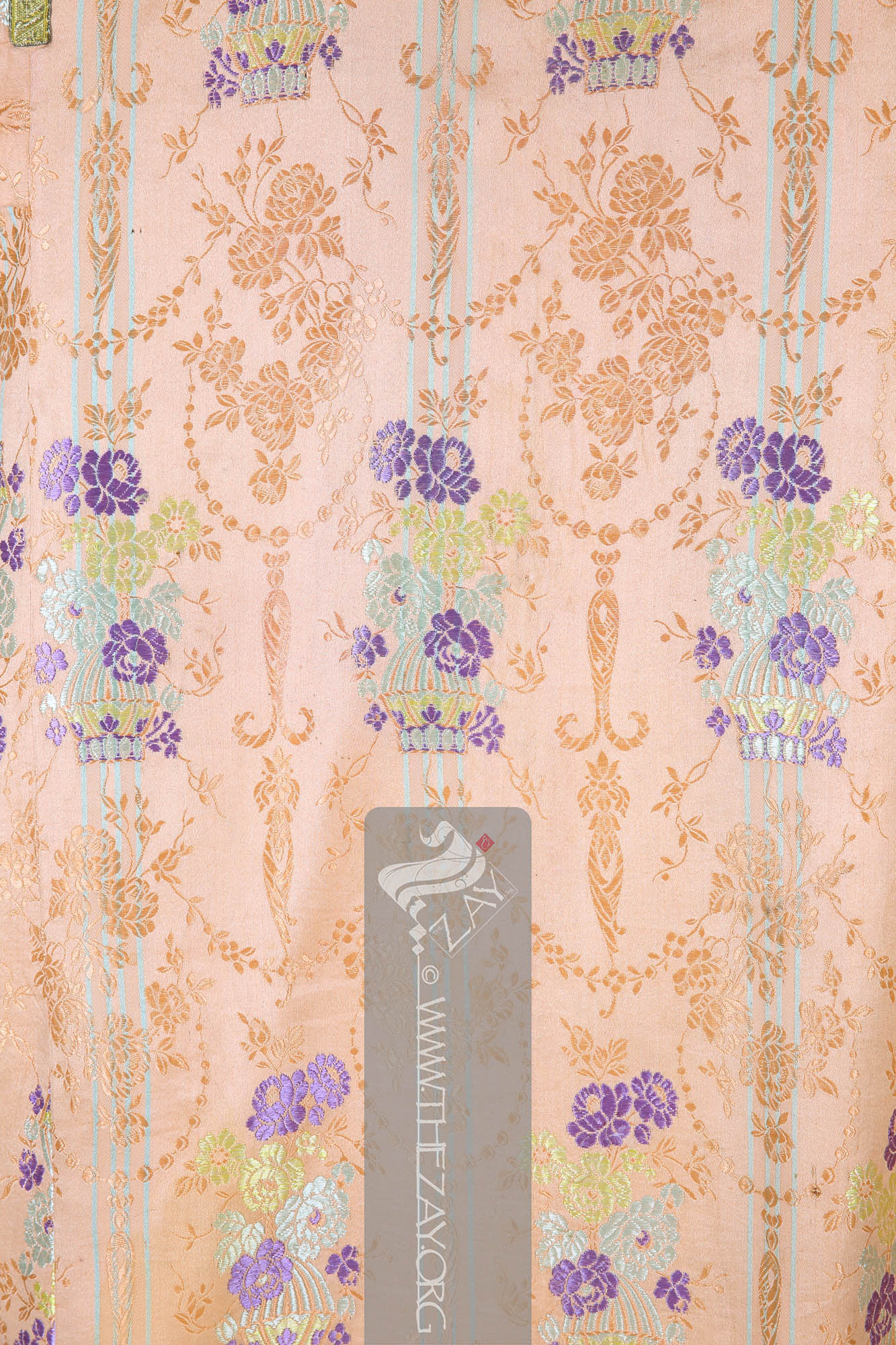
| Motif | Floral Geometric |
| Provenance | Purchased, Leonor Arno Pons, Amsterdam 2019 |
| Location | The Zay Zay: (Arabic: costume, Pl. azyaā’), a set of clothes in a style typical of a particular country or historical period. Initiative |
| Status | In storage |
| ZI number | ZI2019.500554 MOROCCO |
Object History
This piece was purchased by Dr. Reem Tariq
Ṭariq: (Arabic; Synonym: tulle_bi_talli
Tūlle_bi_tallī: (French: Tulle – a city in France where fine material for veil was first made; Turkish: tel – wire; Synonym: tariq; talli; badla; khus_dozi ), series of small metal knots made on a woven net ground as embellishment. The term is commonly used in the North African Arab region specifically in Egypt. Ṭariq: (Arabic; Synonym: tulle_bi_talli
Tūlle_bi_tallī: (French: Tulle – a city in France where fine material for veil was first made; Turkish: tel – wire; Synonym: tariq; talli; badla; khus_dozi ), series of small metal knots made on a woven net ground as embellishment. The term is commonly used in the North African Arab region specifically in Egypt.
In her quest to include a Moroccan traditional ensemble in the collection, Dr. Reem initially explored customizing one from local ateliers in Morocco. However, the process proved time-consuming. Fortunately, during this period, Leonor Arno Pons, a distinguished Asian ethnographer and tribalist, generously offered this particular piece.
Originally belonging to Reine Van Der Linden, Leonor’s stepmother, it was obtained from the renowned clothing store Reflections in Amsterdam. Reine, an enthusiastic traveler with a fondness for exquisite and luxurious costumes, frequently featured them in films produced by her brother, the renowned Dutch filmmaker.
Object Features
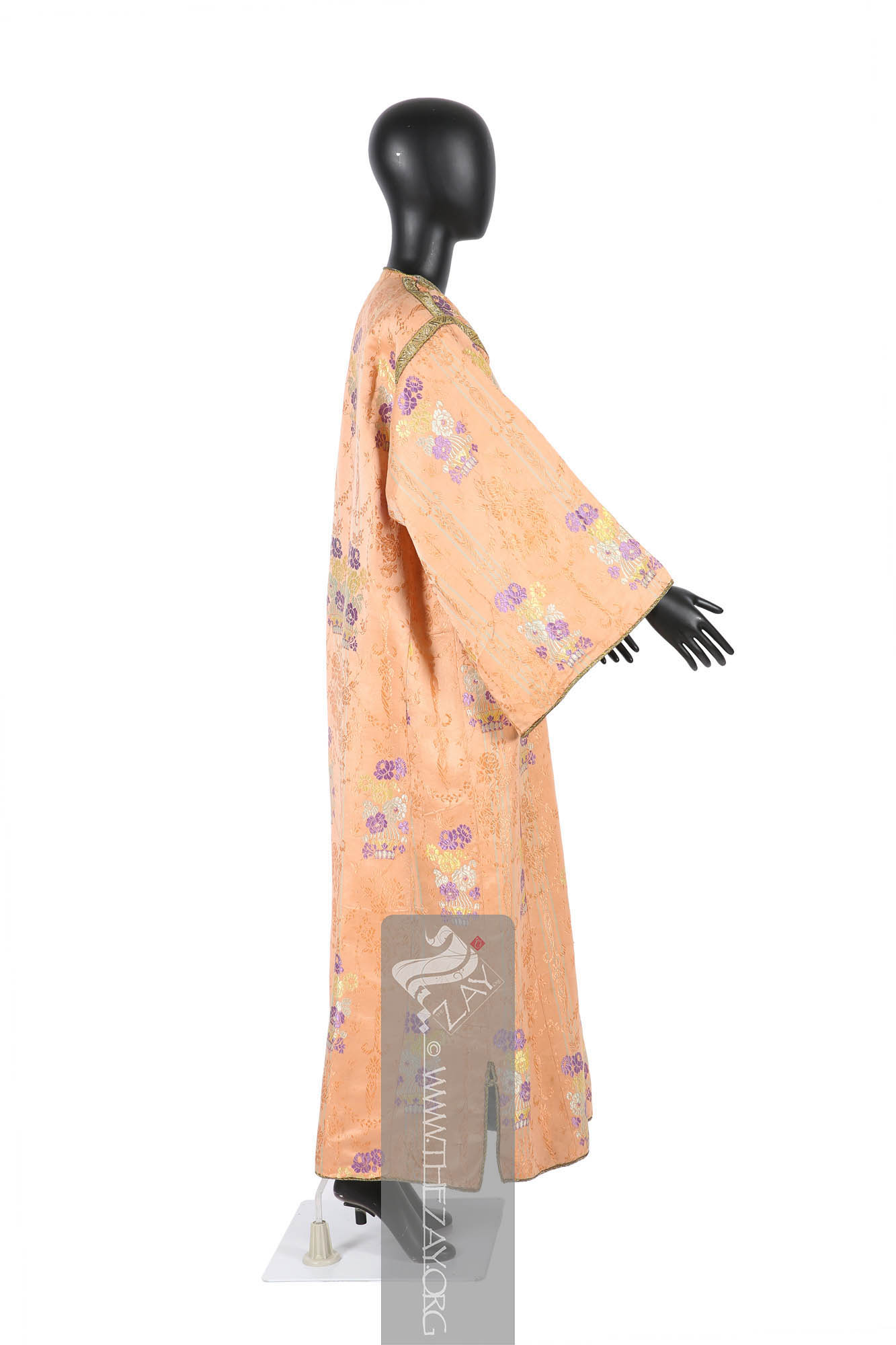
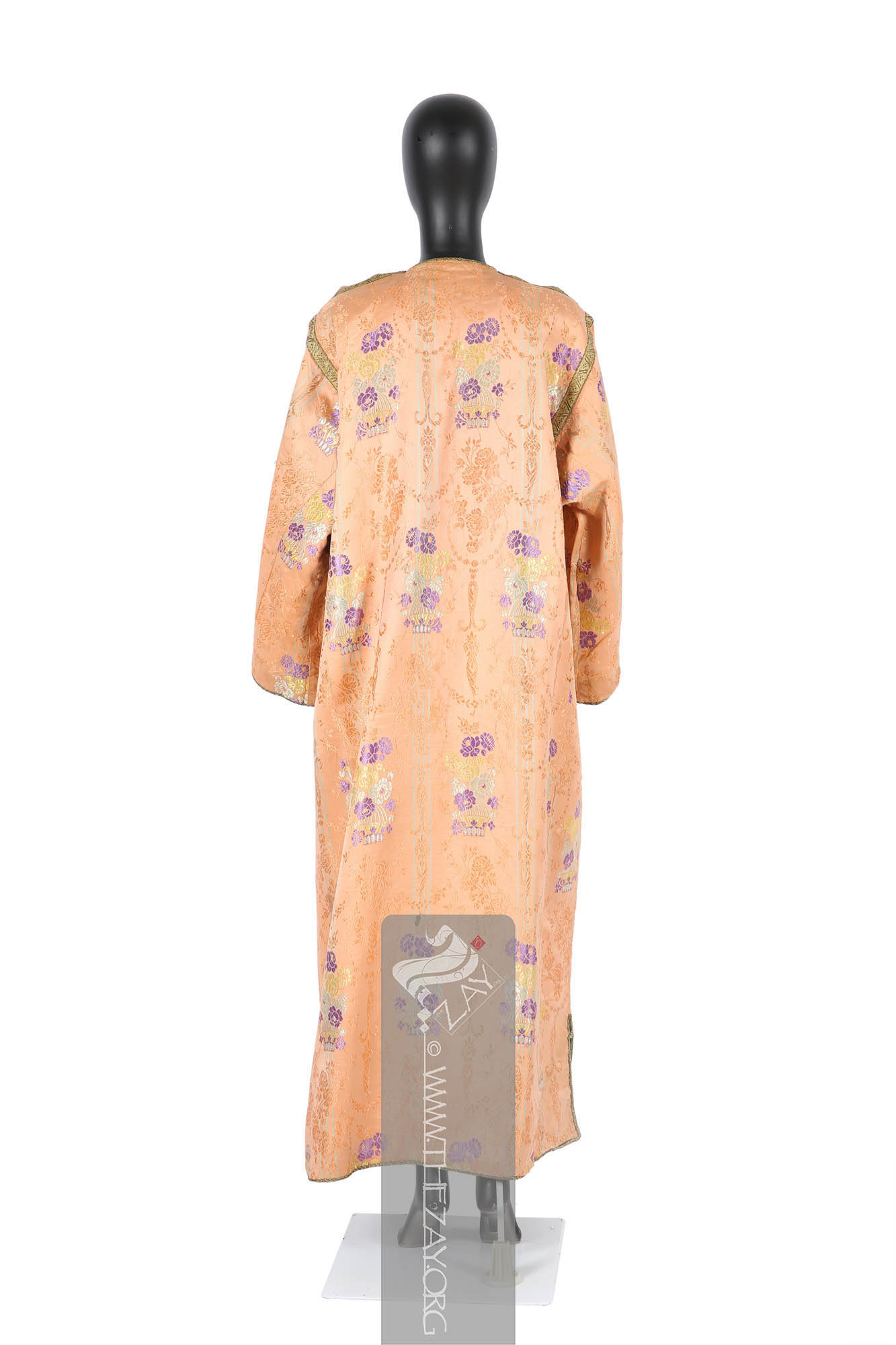
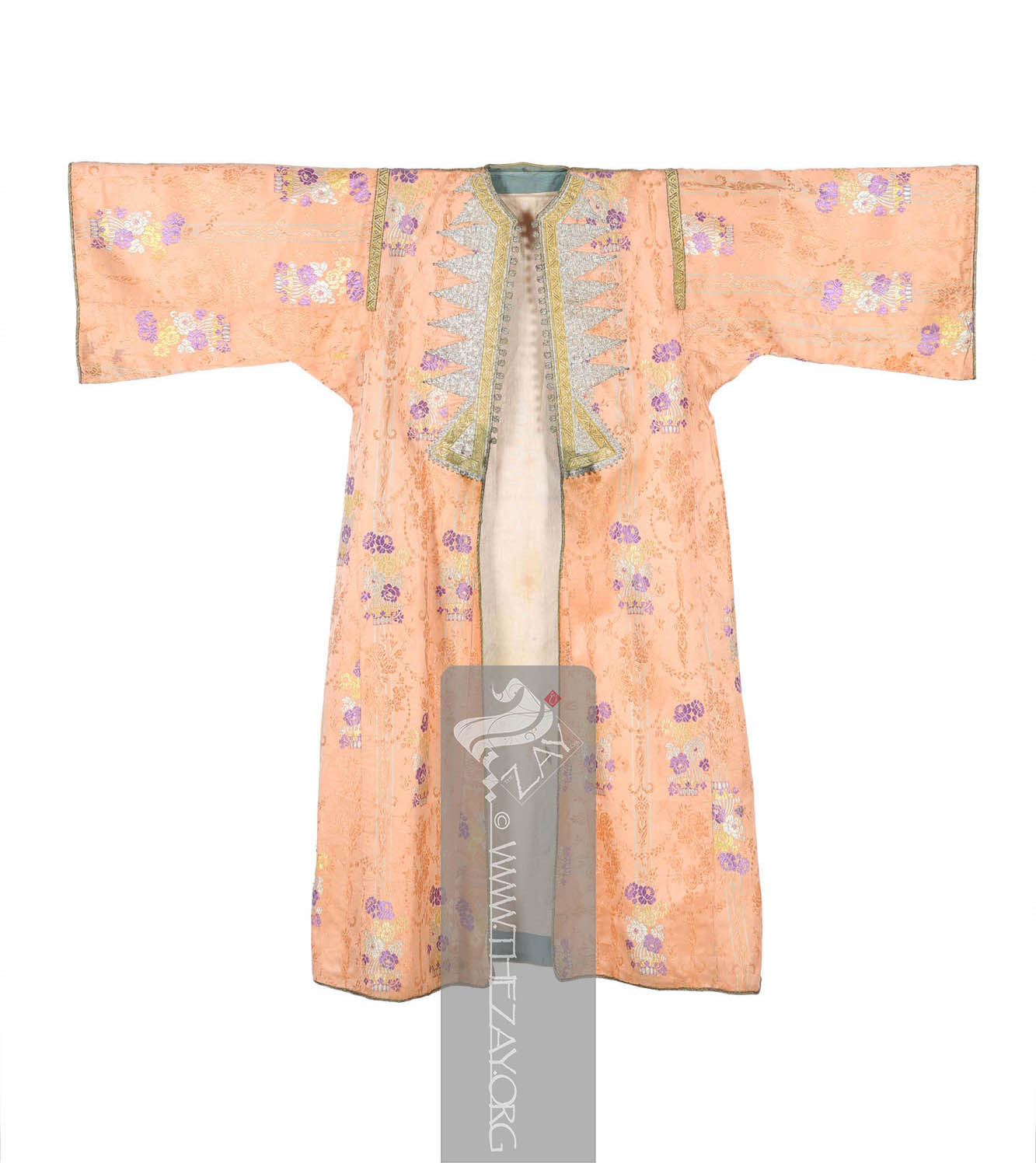
This is an ankle-length, front open robe (qaftan
Qafṭān: (Persian: khaftān, Pl. qafāṭin, synonyms: ghandurah, qandurah
Qandūrah: (Arabic, pl. qanādīr, synonyms: ghandurah, darā’ah, dishdāshah, jalābah, jallābīyah, qaftan, mqta’, thawb
Thawb: (Arabic: thawb, Pl. Athwāb/thībān), can be pronounced thobe
Thobe: (Arabic: thawb, Pl. Athwāb/thībān), can be pronounced thawb or tobe
Tobe: (Arabic: thawb, Pl. Athwāb/thībān), can be pronounced thawb or thobe based on locale. The standard Arabic word for ‘fabric’ or ‘garment’. It can refer to a qamīs-like tunic worn by men and women in the Arabian Peninsula, Iraq, the southern and south-western ports and islands of Iran, and some countries in East and West Africa. More specifically, it can refer to the square-shaped Bedouin overgarment worn by women. based on locale. The standard Arabic word for ‘fabric’ or ‘garment’. It can also refer to a qamīs-like tunic worn by men and women in the Arabian Peninsula, Iraq, the southern and south-western ports and islands of Iran, and some countries in East and West Africa. More specifically, it can refer to the square-shaped Bedouin overgarment worn by women. or tobe
Tobe: (Arabic: thawb, Pl. Athwāb/thībān), can be pronounced thawb or thobe based on locale. The standard Arabic word for ‘fabric’ or ‘garment’. It can refer to a qamīs-like tunic worn by men and women in the Arabian Peninsula, Iraq, the southern and south-western ports and islands of Iran, and some countries in East and West Africa. More specifically, it can refer to the square-shaped Bedouin overgarment worn by women. based on locale. The standard Arabic word for ‘fabric’ or ‘garment’. It can also refer to a qamīs-like tunic worn by men and women in the Arabian Peninsula, Iraq, the southern and south-western ports and islands of Iran, and some countries in East and West Africa. More specifically, it can refer to the square-shaped Bedouin overgarment worn by women in the Arabian Gulf region. or tobe
Tobe: (Arabic: thawb, Pl. Athwāb/thībān), can be pronounced thawb or thobe based on locale. The standard Arabic word for ‘fabric’ or ‘garment’. It can refer to a qamīs-like tunic worn by men and women in the Arabian Peninsula, Iraq, the southern and south-western ports and islands of Iran, and some countries in East and West Africa. More specifically, it can refer to the square-shaped Bedouin overgarment worn by women. ), a loose, short or long-sleeved, shirt like (qamis) tunic with frontal neckline opening, worn by both sexes. Each Arab region has a different term for what is essentially a similar garment with various small differences. , drā’ah, dishdāshah, jalābah, jallābīyah, kandurah, mqta’, thawb
Thawb: (Arabic: thawb, Pl. Athwāb/thībān), can be pronounced thobe
Thobe: (Arabic: thawb, Pl. Athwāb/thībān), can be pronounced thawb or tobe
Tobe: (Arabic: thawb, Pl. Athwāb/thībān), can be pronounced thawb or thobe based on locale. The standard Arabic word for ‘fabric’ or ‘garment’. It can refer to a qamīs-like tunic worn by men and women in the Arabian Peninsula, Iraq, the southern and south-western ports and islands of Iran, and some countries in East and West Africa. More specifically, it can refer to the square-shaped Bedouin overgarment worn by women. based on locale. The standard Arabic word for ‘fabric’ or ‘garment’. It can also refer to a qamīs-like tunic worn by men and women in the Arabian Peninsula, Iraq, the southern and south-western ports and islands of Iran, and some countries in East and West Africa. More specifically, it can refer to the square-shaped Bedouin overgarment worn by women. or tobe
Tobe: (Arabic: thawb, Pl. Athwāb/thībān), can be pronounced thawb or thobe based on locale. The standard Arabic word for ‘fabric’ or ‘garment’. It can refer to a qamīs-like tunic worn by men and women in the Arabian Peninsula, Iraq, the southern and south-western ports and islands of Iran, and some countries in East and West Africa. More specifically, it can refer to the square-shaped Bedouin overgarment worn by women. based on locale. The standard Arabic word for ‘fabric’ or ‘garment’. It can also refer to a qamīs-like tunic worn by men and women in the Arabian Peninsula, Iraq, the southern and south-western ports and islands of Iran, and some countries in East and West Africa. More specifically, it can refer to the square-shaped Bedouin overgarment worn by women in the Arabian Gulf region. or tobe
Tobe: (Arabic: thawb, Pl. Athwāb/thībān), can be pronounced thawb or thobe based on locale. The standard Arabic word for ‘fabric’ or ‘garment’. It can refer to a qamīs-like tunic worn by men and women in the Arabian Peninsula, Iraq, the southern and south-western ports and islands of Iran, and some countries in East and West Africa. More specifically, it can refer to the square-shaped Bedouin overgarment worn by women. ) loose, short or long-sleeved, shirt like (qamis
Qamīṣ: (Possibly late Latin: Camisia – Linen Undergarment; Synonym: Kamiz), a traditional loose fitting long tunic or shirt worn by both men and women in South and Central Asia and the Arab world. Typically extending below the waist it is usually paired with a pair of trousers. Qaftān_Makhzinī_Darz_Al_Khanjar:: (Arabic: Makhzini – Imperial; Persian: Durz / Dorz – needlework; Arabic: Khanjar – Dagger; Synonym: qaftan_makhzini_tiraz_al_khanjar
Qaftān_Makhzinī _Tirāz_Al_Khanjar: (Arabic: Makhzini – Imperial; Persian: Durz / Dorz – needlework; Arabic: Khanjar – Dagger; Synonym: qaftan_makhzini_darz_al_khanjar), a traditional overgarment from Northern African countries especially Morocco characterized by dagger like triangular patterned designs. Often made of luxurious fabric garments such as this were usually traditionally worn at the ruler’s court. Qaftān_Makhzinī _Tirāz_Al_Khanjar: (Arabic: Makhzini – Imperial; Persian: Durz / Dorz – needlework; Arabic: Khanjar – Dagger; Synonym: qaftan_makhzini_darz_al_khanjar), a traditional overgarment from Northern African countries especially Morocco characterized by dagger like triangular patterned designs. Often made of luxurious fabric garments such as this were usually traditionally worn at the ruler’s court.
The qaftan
Qafṭān: (Persian: khaftān, Pl. qafāṭin, synonyms: ghandurah, qandurah
Qandūrah: (Arabic, pl. qanādīr, synonyms: ghandurah, darā’ah, dishdāshah, jalābah, jallābīyah, qaftan, mqta’, thawb
Thawb: (Arabic: thawb, Pl. Athwāb/thībān), can be pronounced thobe
Thobe: (Arabic: thawb, Pl. Athwāb/thībān), can be pronounced thawb or tobe
Tobe: (Arabic: thawb, Pl. Athwāb/thībān), can be pronounced thawb or thobe based on locale. The standard Arabic word for ‘fabric’ or ‘garment’. It can refer to a qamīs-like tunic worn by men and women in the Arabian Peninsula, Iraq, the southern and south-western ports and islands of Iran, and some countries in East and West Africa. More specifically, it can refer to the square-shaped Bedouin overgarment worn by women. based on locale. The standard Arabic word for ‘fabric’ or ‘garment’. It can also refer to a qamīs-like tunic worn by men and women in the Arabian Peninsula, Iraq, the southern and south-western ports and islands of Iran, and some countries in East and West Africa. More specifically, it can refer to the square-shaped Bedouin overgarment worn by women. or tobe
Tobe: (Arabic: thawb, Pl. Athwāb/thībān), can be pronounced thawb or thobe based on locale. The standard Arabic word for ‘fabric’ or ‘garment’. It can refer to a qamīs-like tunic worn by men and women in the Arabian Peninsula, Iraq, the southern and south-western ports and islands of Iran, and some countries in East and West Africa. More specifically, it can refer to the square-shaped Bedouin overgarment worn by women. based on locale. The standard Arabic word for ‘fabric’ or ‘garment’. It can also refer to a qamīs-like tunic worn by men and women in the Arabian Peninsula, Iraq, the southern and south-western ports and islands of Iran, and some countries in East and West Africa. More specifically, it can refer to the square-shaped Bedouin overgarment worn by women in the Arabian Gulf region. or tobe
Tobe: (Arabic: thawb, Pl. Athwāb/thībān), can be pronounced thawb or thobe based on locale. The standard Arabic word for ‘fabric’ or ‘garment’. It can refer to a qamīs-like tunic worn by men and women in the Arabian Peninsula, Iraq, the southern and south-western ports and islands of Iran, and some countries in East and West Africa. More specifically, it can refer to the square-shaped Bedouin overgarment worn by women. ), a loose, short or long-sleeved, shirt like (qamis) tunic with frontal neckline opening, worn by both sexes. Each Arab region has a different term for what is essentially a similar garment with various small differences. , drā’ah, dishdāshah, jalābah, jallābīyah, kandurah, mqta’, thawb
Thawb: (Arabic: thawb, Pl. Athwāb/thībān), can be pronounced thobe
Thobe: (Arabic: thawb, Pl. Athwāb/thībān), can be pronounced thawb or tobe
Tobe: (Arabic: thawb, Pl. Athwāb/thībān), can be pronounced thawb or thobe based on locale. The standard Arabic word for ‘fabric’ or ‘garment’. It can refer to a qamīs-like tunic worn by men and women in the Arabian Peninsula, Iraq, the southern and south-western ports and islands of Iran, and some countries in East and West Africa. More specifically, it can refer to the square-shaped Bedouin overgarment worn by women. based on locale. The standard Arabic word for ‘fabric’ or ‘garment’. It can also refer to a qamīs-like tunic worn by men and women in the Arabian Peninsula, Iraq, the southern and south-western ports and islands of Iran, and some countries in East and West Africa. More specifically, it can refer to the square-shaped Bedouin overgarment worn by women. or tobe
Tobe: (Arabic: thawb, Pl. Athwāb/thībān), can be pronounced thawb or thobe based on locale. The standard Arabic word for ‘fabric’ or ‘garment’. It can refer to a qamīs-like tunic worn by men and women in the Arabian Peninsula, Iraq, the southern and south-western ports and islands of Iran, and some countries in East and West Africa. More specifically, it can refer to the square-shaped Bedouin overgarment worn by women. based on locale. The standard Arabic word for ‘fabric’ or ‘garment’. It can also refer to a qamīs-like tunic worn by men and women in the Arabian Peninsula, Iraq, the southern and south-western ports and islands of Iran, and some countries in East and West Africa. More specifically, it can refer to the square-shaped Bedouin overgarment worn by women in the Arabian Gulf region. or tobe
Tobe: (Arabic: thawb, Pl. Athwāb/thībān), can be pronounced thawb or thobe based on locale. The standard Arabic word for ‘fabric’ or ‘garment’. It can refer to a qamīs-like tunic worn by men and women in the Arabian Peninsula, Iraq, the southern and south-western ports and islands of Iran, and some countries in East and West Africa. More specifically, it can refer to the square-shaped Bedouin overgarment worn by women. ) loose, short or long-sleeved, shirt like (qamis
Qamīṣ: (Possibly late Latin: Camisia – Linen Undergarment; Synonym: Kamiz), a traditional loose fitting long tunic or shirt worn by both men and women in South and Central Asia and the Arab world. Typically extending below the waist it is usually paired with a pair of trousers.
The yoke
Yoke: (Synonym: Bodice_Yoke), a structured pattern fitted at the shoulders defining the structure of women’s garments. Introduced in c. 1880s it defines the transition between the upper and lower parts of the garments and can now be found stitched-in where the blouse is separated from the skirt by a horizontal seam. of the qaftan
Qafṭān: (Persian: khaftān, Pl. qafāṭin, synonyms: ghandurah, qandurah
Qandūrah: (Arabic, pl. qanādīr, synonyms: ghandurah, darā’ah, dishdāshah, jalābah, jallābīyah, qaftan, mqta’, thawb
Thawb: (Arabic: thawb, Pl. Athwāb/thībān), can be pronounced thobe
Thobe: (Arabic: thawb, Pl. Athwāb/thībān), can be pronounced thawb or tobe
Tobe: (Arabic: thawb, Pl. Athwāb/thībān), can be pronounced thawb or thobe based on locale. The standard Arabic word for ‘fabric’ or ‘garment’. It can refer to a qamīs-like tunic worn by men and women in the Arabian Peninsula, Iraq, the southern and south-western ports and islands of Iran, and some countries in East and West Africa. More specifically, it can refer to the square-shaped Bedouin overgarment worn by women. based on locale. The standard Arabic word for ‘fabric’ or ‘garment’. It can also refer to a qamīs-like tunic worn by men and women in the Arabian Peninsula, Iraq, the southern and south-western ports and islands of Iran, and some countries in East and West Africa. More specifically, it can refer to the square-shaped Bedouin overgarment worn by women. or tobe
Tobe: (Arabic: thawb, Pl. Athwāb/thībān), can be pronounced thawb or thobe based on locale. The standard Arabic word for ‘fabric’ or ‘garment’. It can refer to a qamīs-like tunic worn by men and women in the Arabian Peninsula, Iraq, the southern and south-western ports and islands of Iran, and some countries in East and West Africa. More specifically, it can refer to the square-shaped Bedouin overgarment worn by women. based on locale. The standard Arabic word for ‘fabric’ or ‘garment’. It can also refer to a qamīs-like tunic worn by men and women in the Arabian Peninsula, Iraq, the southern and south-western ports and islands of Iran, and some countries in East and West Africa. More specifically, it can refer to the square-shaped Bedouin overgarment worn by women in the Arabian Gulf region. or tobe
Tobe: (Arabic: thawb, Pl. Athwāb/thībān), can be pronounced thawb or thobe based on locale. The standard Arabic word for ‘fabric’ or ‘garment’. It can refer to a qamīs-like tunic worn by men and women in the Arabian Peninsula, Iraq, the southern and south-western ports and islands of Iran, and some countries in East and West Africa. More specifically, it can refer to the square-shaped Bedouin overgarment worn by women. ), a loose, short or long-sleeved, shirt like (qamis) tunic with frontal neckline opening, worn by both sexes. Each Arab region has a different term for what is essentially a similar garment with various small differences. , drā’ah, dishdāshah, jalābah, jallābīyah, kandurah, mqta’, thawb
Thawb: (Arabic: thawb, Pl. Athwāb/thībān), can be pronounced thobe
Thobe: (Arabic: thawb, Pl. Athwāb/thībān), can be pronounced thawb or tobe
Tobe: (Arabic: thawb, Pl. Athwāb/thībān), can be pronounced thawb or thobe based on locale. The standard Arabic word for ‘fabric’ or ‘garment’. It can refer to a qamīs-like tunic worn by men and women in the Arabian Peninsula, Iraq, the southern and south-western ports and islands of Iran, and some countries in East and West Africa. More specifically, it can refer to the square-shaped Bedouin overgarment worn by women. based on locale. The standard Arabic word for ‘fabric’ or ‘garment’. It can also refer to a qamīs-like tunic worn by men and women in the Arabian Peninsula, Iraq, the southern and south-western ports and islands of Iran, and some countries in East and West Africa. More specifically, it can refer to the square-shaped Bedouin overgarment worn by women. or tobe
Tobe: (Arabic: thawb, Pl. Athwāb/thībān), can be pronounced thawb or thobe based on locale. The standard Arabic word for ‘fabric’ or ‘garment’. It can refer to a qamīs-like tunic worn by men and women in the Arabian Peninsula, Iraq, the southern and south-western ports and islands of Iran, and some countries in East and West Africa. More specifically, it can refer to the square-shaped Bedouin overgarment worn by women. based on locale. The standard Arabic word for ‘fabric’ or ‘garment’. It can also refer to a qamīs-like tunic worn by men and women in the Arabian Peninsula, Iraq, the southern and south-western ports and islands of Iran, and some countries in East and West Africa. More specifically, it can refer to the square-shaped Bedouin overgarment worn by women in the Arabian Gulf region. or tobe
Tobe: (Arabic: thawb, Pl. Athwāb/thībān), can be pronounced thawb or thobe based on locale. The standard Arabic word for ‘fabric’ or ‘garment’. It can refer to a qamīs-like tunic worn by men and women in the Arabian Peninsula, Iraq, the southern and south-western ports and islands of Iran, and some countries in East and West Africa. More specifically, it can refer to the square-shaped Bedouin overgarment worn by women. ) loose, short or long-sleeved, shirt like (qamis
Qamīṣ: (Possibly late Latin: Camisia – Linen Undergarment; Synonym: Kamiz), a traditional loose fitting long tunic or shirt worn by both men and women in South and Central Asia and the Arab world. Typically extending below the waist it is usually paired with a pair of trousers. Couching: (Latin: collocare – Place together), in needlework and embroidery couching is a technique in which yarn or other materials are laid across the surface of the ground fabric and fastened in place with small stitches of the same or a different yarn
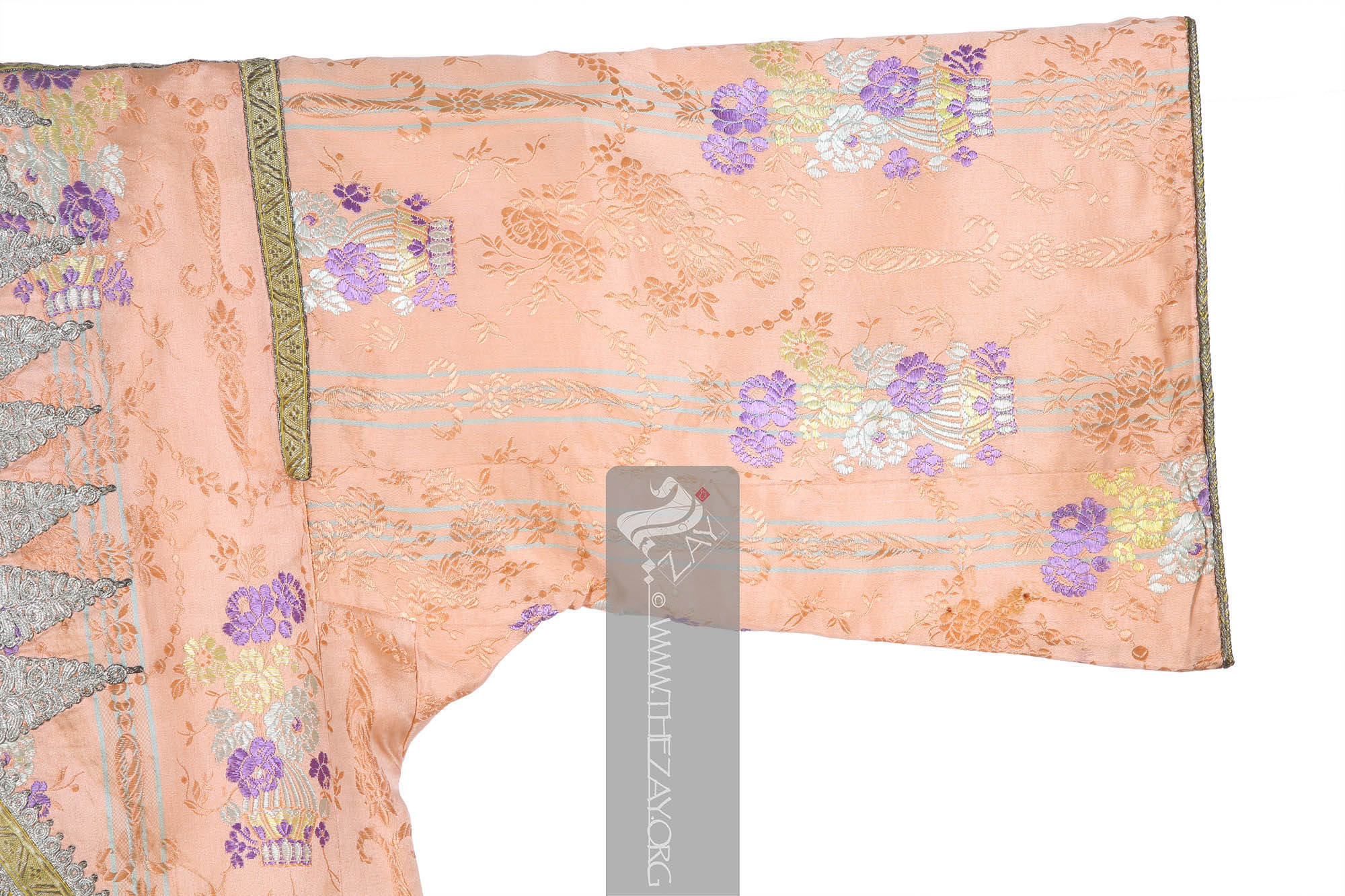
While the edge of the neckline and the front opening is trimmed with braided cords of metal thread, possibly in silver, with a total of twenty ball-shaped silver corded buttons on each side, a repeat of the pine tree-shaped pattern is embroidered extending inside the field of the (bodice
Bodice: (English: body), or bodices the plural form of body, it is the close-fitting garment meant to cover the body above the waist or the torso. However, it was not until the 17th century that the term became synonymous to women’s undergarment. ). These patterns are created by twisting and looping braided silver cords, using couching
Couching: (Latin: collocare – Place together), in needlework and embroidery couching is a technique in which yarn or other materials are laid across the surface of the ground fabric and fastened in place with small stitches of the same or a different yarn
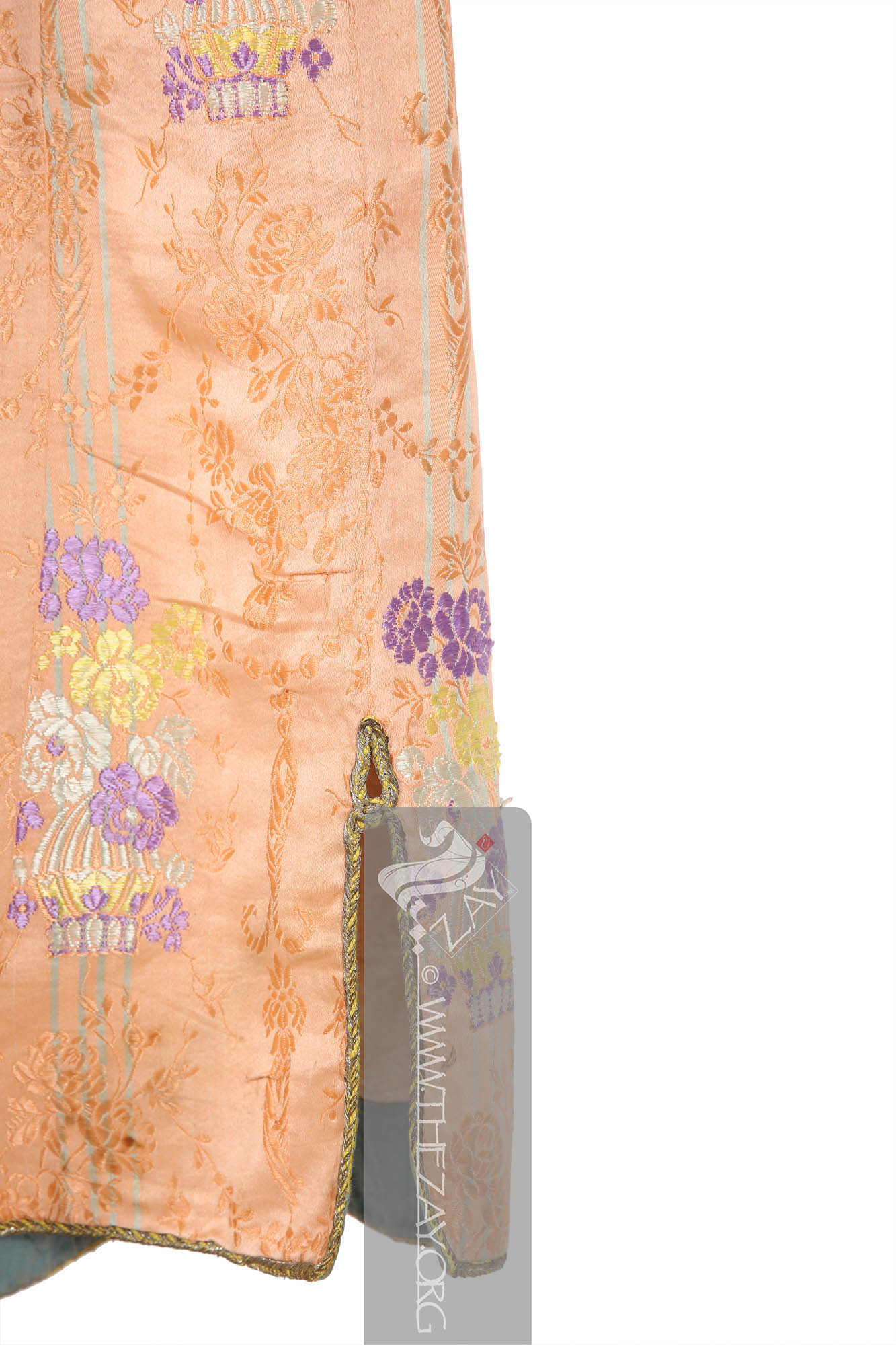
The series of patterns on each side sits on a triangular base with a central pine tree within a tela_aura ribbon frame, which is further bordered by a series of corded silver looped repeats. The corded silver trimming used to adorn the edges of the bodice Bodice: (English: body), or bodices the plural form of body, it is the close-fitting garment meant to cover the body above the waist or the torso. However, it was not until the 17th century that the term became synonymous to women’s undergarment. is also used to trim the entire length of the front edge, the fall hemline, as well as the cuffs.
The qaftan
Qafṭān: (Persian: khaftān, Pl. qafāṭin, synonyms: ghandurah, qandurah
Qandūrah: (Arabic, pl. qanādīr, synonyms: ghandurah, darā’ah, dishdāshah, jalābah, jallābīyah, qaftan, mqta’, thawb
Thawb: (Arabic: thawb, Pl. Athwāb/thībān), can be pronounced thobe
Thobe: (Arabic: thawb, Pl. Athwāb/thībān), can be pronounced thawb or tobe
Tobe: (Arabic: thawb, Pl. Athwāb/thībān), can be pronounced thawb or thobe based on locale. The standard Arabic word for ‘fabric’ or ‘garment’. It can refer to a qamīs-like tunic worn by men and women in the Arabian Peninsula, Iraq, the southern and south-western ports and islands of Iran, and some countries in East and West Africa. More specifically, it can refer to the square-shaped Bedouin overgarment worn by women. based on locale. The standard Arabic word for ‘fabric’ or ‘garment’. It can also refer to a qamīs-like tunic worn by men and women in the Arabian Peninsula, Iraq, the southern and south-western ports and islands of Iran, and some countries in East and West Africa. More specifically, it can refer to the square-shaped Bedouin overgarment worn by women. or tobe
Tobe: (Arabic: thawb, Pl. Athwāb/thībān), can be pronounced thawb or thobe based on locale. The standard Arabic word for ‘fabric’ or ‘garment’. It can refer to a qamīs-like tunic worn by men and women in the Arabian Peninsula, Iraq, the southern and south-western ports and islands of Iran, and some countries in East and West Africa. More specifically, it can refer to the square-shaped Bedouin overgarment worn by women. based on locale. The standard Arabic word for ‘fabric’ or ‘garment’. It can also refer to a qamīs-like tunic worn by men and women in the Arabian Peninsula, Iraq, the southern and south-western ports and islands of Iran, and some countries in East and West Africa. More specifically, it can refer to the square-shaped Bedouin overgarment worn by women in the Arabian Gulf region. or tobe
Tobe: (Arabic: thawb, Pl. Athwāb/thībān), can be pronounced thawb or thobe based on locale. The standard Arabic word for ‘fabric’ or ‘garment’. It can refer to a qamīs-like tunic worn by men and women in the Arabian Peninsula, Iraq, the southern and south-western ports and islands of Iran, and some countries in East and West Africa. More specifically, it can refer to the square-shaped Bedouin overgarment worn by women. ), a loose, short or long-sleeved, shirt like (qamis) tunic with frontal neckline opening, worn by both sexes. Each Arab region has a different term for what is essentially a similar garment with various small differences. , drā’ah, dishdāshah, jalābah, jallābīyah, kandurah, mqta’, thawb
Thawb: (Arabic: thawb, Pl. Athwāb/thībān), can be pronounced thobe
Thobe: (Arabic: thawb, Pl. Athwāb/thībān), can be pronounced thawb or tobe
Tobe: (Arabic: thawb, Pl. Athwāb/thībān), can be pronounced thawb or thobe based on locale. The standard Arabic word for ‘fabric’ or ‘garment’. It can refer to a qamīs-like tunic worn by men and women in the Arabian Peninsula, Iraq, the southern and south-western ports and islands of Iran, and some countries in East and West Africa. More specifically, it can refer to the square-shaped Bedouin overgarment worn by women. based on locale. The standard Arabic word for ‘fabric’ or ‘garment’. It can also refer to a qamīs-like tunic worn by men and women in the Arabian Peninsula, Iraq, the southern and south-western ports and islands of Iran, and some countries in East and West Africa. More specifically, it can refer to the square-shaped Bedouin overgarment worn by women. or tobe
Tobe: (Arabic: thawb, Pl. Athwāb/thībān), can be pronounced thawb or thobe based on locale. The standard Arabic word for ‘fabric’ or ‘garment’. It can refer to a qamīs-like tunic worn by men and women in the Arabian Peninsula, Iraq, the southern and south-western ports and islands of Iran, and some countries in East and West Africa. More specifically, it can refer to the square-shaped Bedouin overgarment worn by women. based on locale. The standard Arabic word for ‘fabric’ or ‘garment’. It can also refer to a qamīs-like tunic worn by men and women in the Arabian Peninsula, Iraq, the southern and south-western ports and islands of Iran, and some countries in East and West Africa. More specifically, it can refer to the square-shaped Bedouin overgarment worn by women in the Arabian Gulf region. or tobe
Tobe: (Arabic: thawb, Pl. Athwāb/thībān), can be pronounced thawb or thobe based on locale. The standard Arabic word for ‘fabric’ or ‘garment’. It can refer to a qamīs-like tunic worn by men and women in the Arabian Peninsula, Iraq, the southern and south-western ports and islands of Iran, and some countries in East and West Africa. More specifically, it can refer to the square-shaped Bedouin overgarment worn by women. ) loose, short or long-sleeved, shirt like (qamis
Qamīṣ: (Possibly late Latin: Camisia – Linen Undergarment; Synonym: Kamiz), a traditional loose fitting long tunic or shirt worn by both men and women in South and Central Asia and the Arab world. Typically extending below the waist it is usually paired with a pair of trousers.
Although the qaftan
Qafṭān: (Persian: khaftān, Pl. qafāṭin, synonyms: ghandurah, qandurah
Qandūrah: (Arabic, pl. qanādīr, synonyms: ghandurah, darā’ah, dishdāshah, jalābah, jallābīyah, qaftan, mqta’, thawb
Thawb: (Arabic: thawb, Pl. Athwāb/thībān), can be pronounced thobe
Thobe: (Arabic: thawb, Pl. Athwāb/thībān), can be pronounced thawb or tobe
Tobe: (Arabic: thawb, Pl. Athwāb/thībān), can be pronounced thawb or thobe based on locale. The standard Arabic word for ‘fabric’ or ‘garment’. It can refer to a qamīs-like tunic worn by men and women in the Arabian Peninsula, Iraq, the southern and south-western ports and islands of Iran, and some countries in East and West Africa. More specifically, it can refer to the square-shaped Bedouin overgarment worn by women. based on locale. The standard Arabic word for ‘fabric’ or ‘garment’. It can also refer to a qamīs-like tunic worn by men and women in the Arabian Peninsula, Iraq, the southern and south-western ports and islands of Iran, and some countries in East and West Africa. More specifically, it can refer to the square-shaped Bedouin overgarment worn by women. or tobe
Tobe: (Arabic: thawb, Pl. Athwāb/thībān), can be pronounced thawb or thobe based on locale. The standard Arabic word for ‘fabric’ or ‘garment’. It can refer to a qamīs-like tunic worn by men and women in the Arabian Peninsula, Iraq, the southern and south-western ports and islands of Iran, and some countries in East and West Africa. More specifically, it can refer to the square-shaped Bedouin overgarment worn by women. based on locale. The standard Arabic word for ‘fabric’ or ‘garment’. It can also refer to a qamīs-like tunic worn by men and women in the Arabian Peninsula, Iraq, the southern and south-western ports and islands of Iran, and some countries in East and West Africa. More specifically, it can refer to the square-shaped Bedouin overgarment worn by women in the Arabian Gulf region. or tobe
Tobe: (Arabic: thawb, Pl. Athwāb/thībān), can be pronounced thawb or thobe based on locale. The standard Arabic word for ‘fabric’ or ‘garment’. It can refer to a qamīs-like tunic worn by men and women in the Arabian Peninsula, Iraq, the southern and south-western ports and islands of Iran, and some countries in East and West Africa. More specifically, it can refer to the square-shaped Bedouin overgarment worn by women. ), a loose, short or long-sleeved, shirt like (qamis) tunic with frontal neckline opening, worn by both sexes. Each Arab region has a different term for what is essentially a similar garment with various small differences. , drā’ah, dishdāshah, jalābah, jallābīyah, kandurah, mqta’, thawb
Thawb: (Arabic: thawb, Pl. Athwāb/thībān), can be pronounced thobe
Thobe: (Arabic: thawb, Pl. Athwāb/thībān), can be pronounced thawb or tobe
Tobe: (Arabic: thawb, Pl. Athwāb/thībān), can be pronounced thawb or thobe based on locale. The standard Arabic word for ‘fabric’ or ‘garment’. It can refer to a qamīs-like tunic worn by men and women in the Arabian Peninsula, Iraq, the southern and south-western ports and islands of Iran, and some countries in East and West Africa. More specifically, it can refer to the square-shaped Bedouin overgarment worn by women. based on locale. The standard Arabic word for ‘fabric’ or ‘garment’. It can also refer to a qamīs-like tunic worn by men and women in the Arabian Peninsula, Iraq, the southern and south-western ports and islands of Iran, and some countries in East and West Africa. More specifically, it can refer to the square-shaped Bedouin overgarment worn by women. or tobe
Tobe: (Arabic: thawb, Pl. Athwāb/thībān), can be pronounced thawb or thobe based on locale. The standard Arabic word for ‘fabric’ or ‘garment’. It can refer to a qamīs-like tunic worn by men and women in the Arabian Peninsula, Iraq, the southern and south-western ports and islands of Iran, and some countries in East and West Africa. More specifically, it can refer to the square-shaped Bedouin overgarment worn by women. based on locale. The standard Arabic word for ‘fabric’ or ‘garment’. It can also refer to a qamīs-like tunic worn by men and women in the Arabian Peninsula, Iraq, the southern and south-western ports and islands of Iran, and some countries in East and West Africa. More specifically, it can refer to the square-shaped Bedouin overgarment worn by women in the Arabian Gulf region. or tobe
Tobe: (Arabic: thawb, Pl. Athwāb/thībān), can be pronounced thawb or thobe based on locale. The standard Arabic word for ‘fabric’ or ‘garment’. It can refer to a qamīs-like tunic worn by men and women in the Arabian Peninsula, Iraq, the southern and south-western ports and islands of Iran, and some countries in East and West Africa. More specifically, it can refer to the square-shaped Bedouin overgarment worn by women. ) loose, short or long-sleeved, shirt like (qamis
Qamīṣ: (Possibly late Latin: Camisia – Linen Undergarment; Synonym: Kamiz), a traditional loose fitting long tunic or shirt worn by both men and women in South and Central Asia and the Arab world. Typically extending below the waist it is usually paired with a pair of trousers.
More Info
This garment is a representative example of a Qaftan_Makhzini_Darz / Tiraz_Al_Khanjar, terms that denote a qaftan
Qafṭān: (Persian: khaftān, Pl. qafāṭin, synonyms: ghandurah, qandurah
Qandūrah: (Arabic, pl. qanādīr, synonyms: ghandurah, darā’ah, dishdāshah, jalābah, jallābīyah, qaftan, mqta’, thawb
Thawb: (Arabic: thawb, Pl. Athwāb/thībān), can be pronounced thobe
Thobe: (Arabic: thawb, Pl. Athwāb/thībān), can be pronounced thawb or tobe
Tobe: (Arabic: thawb, Pl. Athwāb/thībān), can be pronounced thawb or thobe based on locale. The standard Arabic word for ‘fabric’ or ‘garment’. It can refer to a qamīs-like tunic worn by men and women in the Arabian Peninsula, Iraq, the southern and south-western ports and islands of Iran, and some countries in East and West Africa. More specifically, it can refer to the square-shaped Bedouin overgarment worn by women. based on locale. The standard Arabic word for ‘fabric’ or ‘garment’. It can also refer to a qamīs-like tunic worn by men and women in the Arabian Peninsula, Iraq, the southern and south-western ports and islands of Iran, and some countries in East and West Africa. More specifically, it can refer to the square-shaped Bedouin overgarment worn by women. or tobe
Tobe: (Arabic: thawb, Pl. Athwāb/thībān), can be pronounced thawb or thobe based on locale. The standard Arabic word for ‘fabric’ or ‘garment’. It can refer to a qamīs-like tunic worn by men and women in the Arabian Peninsula, Iraq, the southern and south-western ports and islands of Iran, and some countries in East and West Africa. More specifically, it can refer to the square-shaped Bedouin overgarment worn by women. based on locale. The standard Arabic word for ‘fabric’ or ‘garment’. It can also refer to a qamīs-like tunic worn by men and women in the Arabian Peninsula, Iraq, the southern and south-western ports and islands of Iran, and some countries in East and West Africa. More specifically, it can refer to the square-shaped Bedouin overgarment worn by women in the Arabian Gulf region. or tobe
Tobe: (Arabic: thawb, Pl. Athwāb/thībān), can be pronounced thawb or thobe based on locale. The standard Arabic word for ‘fabric’ or ‘garment’. It can refer to a qamīs-like tunic worn by men and women in the Arabian Peninsula, Iraq, the southern and south-western ports and islands of Iran, and some countries in East and West Africa. More specifically, it can refer to the square-shaped Bedouin overgarment worn by women. ), a loose, short or long-sleeved, shirt like (qamis) tunic with frontal neckline opening, worn by both sexes. Each Arab region has a different term for what is essentially a similar garment with various small differences. , drā’ah, dishdāshah, jalābah, jallābīyah, kandurah, mqta’, thawb
Thawb: (Arabic: thawb, Pl. Athwāb/thībān), can be pronounced thobe
Thobe: (Arabic: thawb, Pl. Athwāb/thībān), can be pronounced thawb or tobe
Tobe: (Arabic: thawb, Pl. Athwāb/thībān), can be pronounced thawb or thobe based on locale. The standard Arabic word for ‘fabric’ or ‘garment’. It can refer to a qamīs-like tunic worn by men and women in the Arabian Peninsula, Iraq, the southern and south-western ports and islands of Iran, and some countries in East and West Africa. More specifically, it can refer to the square-shaped Bedouin overgarment worn by women. based on locale. The standard Arabic word for ‘fabric’ or ‘garment’. It can also refer to a qamīs-like tunic worn by men and women in the Arabian Peninsula, Iraq, the southern and south-western ports and islands of Iran, and some countries in East and West Africa. More specifically, it can refer to the square-shaped Bedouin overgarment worn by women. or tobe
Tobe: (Arabic: thawb, Pl. Athwāb/thībān), can be pronounced thawb or thobe based on locale. The standard Arabic word for ‘fabric’ or ‘garment’. It can refer to a qamīs-like tunic worn by men and women in the Arabian Peninsula, Iraq, the southern and south-western ports and islands of Iran, and some countries in East and West Africa. More specifically, it can refer to the square-shaped Bedouin overgarment worn by women. based on locale. The standard Arabic word for ‘fabric’ or ‘garment’. It can also refer to a qamīs-like tunic worn by men and women in the Arabian Peninsula, Iraq, the southern and south-western ports and islands of Iran, and some countries in East and West Africa. More specifically, it can refer to the square-shaped Bedouin overgarment worn by women in the Arabian Gulf region. or tobe
Tobe: (Arabic: thawb, Pl. Athwāb/thībān), can be pronounced thawb or thobe based on locale. The standard Arabic word for ‘fabric’ or ‘garment’. It can refer to a qamīs-like tunic worn by men and women in the Arabian Peninsula, Iraq, the southern and south-western ports and islands of Iran, and some countries in East and West Africa. More specifically, it can refer to the square-shaped Bedouin overgarment worn by women. ) loose, short or long-sleeved, shirt like (qamis
Qamīṣ: (Possibly late Latin: Camisia – Linen Undergarment; Synonym: Kamiz), a traditional loose fitting long tunic or shirt worn by both men and women in South and Central Asia and the Arab world. Typically extending below the waist it is usually paired with a pair of trousers.
The suffix Darz Darz: (Arabic: to seam or stitch), can be applied to the decorative band of embroidery that reaches down from the neck of the robe to the large amuletic medallion known as (hijāb) on (tūr_bi_tallī) garments in Egypt. / Tiraz refers to the act of needlework or adornment, while the term Khanjar refers to the traditional dagger, a symbol of power, protection, and honour in many Mediterranean and Near Eastern cultures, including Morocco. In this context, it likely refers to a specific type of embroidery pattern featuring motifs resembling daggers.
Thus, this piece exemplifies a traditional Moroccan qaftan
Qafṭān: (Persian: khaftān, Pl. qafāṭin, synonyms: ghandurah, qandurah
Qandūrah: (Arabic, pl. qanādīr, synonyms: ghandurah, darā’ah, dishdāshah, jalābah, jallābīyah, qaftan, mqta’, thawb
Thawb: (Arabic: thawb, Pl. Athwāb/thībān), can be pronounced thobe
Thobe: (Arabic: thawb, Pl. Athwāb/thībān), can be pronounced thawb or tobe
Tobe: (Arabic: thawb, Pl. Athwāb/thībān), can be pronounced thawb or thobe based on locale. The standard Arabic word for ‘fabric’ or ‘garment’. It can refer to a qamīs-like tunic worn by men and women in the Arabian Peninsula, Iraq, the southern and south-western ports and islands of Iran, and some countries in East and West Africa. More specifically, it can refer to the square-shaped Bedouin overgarment worn by women. based on locale. The standard Arabic word for ‘fabric’ or ‘garment’. It can also refer to a qamīs-like tunic worn by men and women in the Arabian Peninsula, Iraq, the southern and south-western ports and islands of Iran, and some countries in East and West Africa. More specifically, it can refer to the square-shaped Bedouin overgarment worn by women. or tobe
Tobe: (Arabic: thawb, Pl. Athwāb/thībān), can be pronounced thawb or thobe based on locale. The standard Arabic word for ‘fabric’ or ‘garment’. It can refer to a qamīs-like tunic worn by men and women in the Arabian Peninsula, Iraq, the southern and south-western ports and islands of Iran, and some countries in East and West Africa. More specifically, it can refer to the square-shaped Bedouin overgarment worn by women. based on locale. The standard Arabic word for ‘fabric’ or ‘garment’. It can also refer to a qamīs-like tunic worn by men and women in the Arabian Peninsula, Iraq, the southern and south-western ports and islands of Iran, and some countries in East and West Africa. More specifically, it can refer to the square-shaped Bedouin overgarment worn by women in the Arabian Gulf region. or tobe
Tobe: (Arabic: thawb, Pl. Athwāb/thībān), can be pronounced thawb or thobe based on locale. The standard Arabic word for ‘fabric’ or ‘garment’. It can refer to a qamīs-like tunic worn by men and women in the Arabian Peninsula, Iraq, the southern and south-western ports and islands of Iran, and some countries in East and West Africa. More specifically, it can refer to the square-shaped Bedouin overgarment worn by women. ), a loose, short or long-sleeved, shirt like (qamis) tunic with frontal neckline opening, worn by both sexes. Each Arab region has a different term for what is essentially a similar garment with various small differences. , drā’ah, dishdāshah, jalābah, jallābīyah, kandurah, mqta’, thawb
Thawb: (Arabic: thawb, Pl. Athwāb/thībān), can be pronounced thobe
Thobe: (Arabic: thawb, Pl. Athwāb/thībān), can be pronounced thawb or tobe
Tobe: (Arabic: thawb, Pl. Athwāb/thībān), can be pronounced thawb or thobe based on locale. The standard Arabic word for ‘fabric’ or ‘garment’. It can refer to a qamīs-like tunic worn by men and women in the Arabian Peninsula, Iraq, the southern and south-western ports and islands of Iran, and some countries in East and West Africa. More specifically, it can refer to the square-shaped Bedouin overgarment worn by women. based on locale. The standard Arabic word for ‘fabric’ or ‘garment’. It can also refer to a qamīs-like tunic worn by men and women in the Arabian Peninsula, Iraq, the southern and south-western ports and islands of Iran, and some countries in East and West Africa. More specifically, it can refer to the square-shaped Bedouin overgarment worn by women. or tobe
Tobe: (Arabic: thawb, Pl. Athwāb/thībān), can be pronounced thawb or thobe based on locale. The standard Arabic word for ‘fabric’ or ‘garment’. It can refer to a qamīs-like tunic worn by men and women in the Arabian Peninsula, Iraq, the southern and south-western ports and islands of Iran, and some countries in East and West Africa. More specifically, it can refer to the square-shaped Bedouin overgarment worn by women. based on locale. The standard Arabic word for ‘fabric’ or ‘garment’. It can also refer to a qamīs-like tunic worn by men and women in the Arabian Peninsula, Iraq, the southern and south-western ports and islands of Iran, and some countries in East and West Africa. More specifically, it can refer to the square-shaped Bedouin overgarment worn by women in the Arabian Gulf region. or tobe
Tobe: (Arabic: thawb, Pl. Athwāb/thībān), can be pronounced thawb or thobe based on locale. The standard Arabic word for ‘fabric’ or ‘garment’. It can refer to a qamīs-like tunic worn by men and women in the Arabian Peninsula, Iraq, the southern and south-western ports and islands of Iran, and some countries in East and West Africa. More specifically, it can refer to the square-shaped Bedouin overgarment worn by women. ) loose, short or long-sleeved, shirt like (qamis
Qamīṣ: (Possibly late Latin: Camisia – Linen Undergarment; Synonym: Kamiz), a traditional loose fitting long tunic or shirt worn by both men and women in South and Central Asia and the Arab world. Typically extending below the waist it is usually paired with a pair of trousers. Qamīṣ: (Possibly late Latin: Camisia – Linen Undergarment; Synonym: Kamiz), a traditional loose fitting long tunic or shirt worn by both men and women in South and Central Asia and the Arab world. Typically extending below the waist it is usually paired with a pair of trousers.
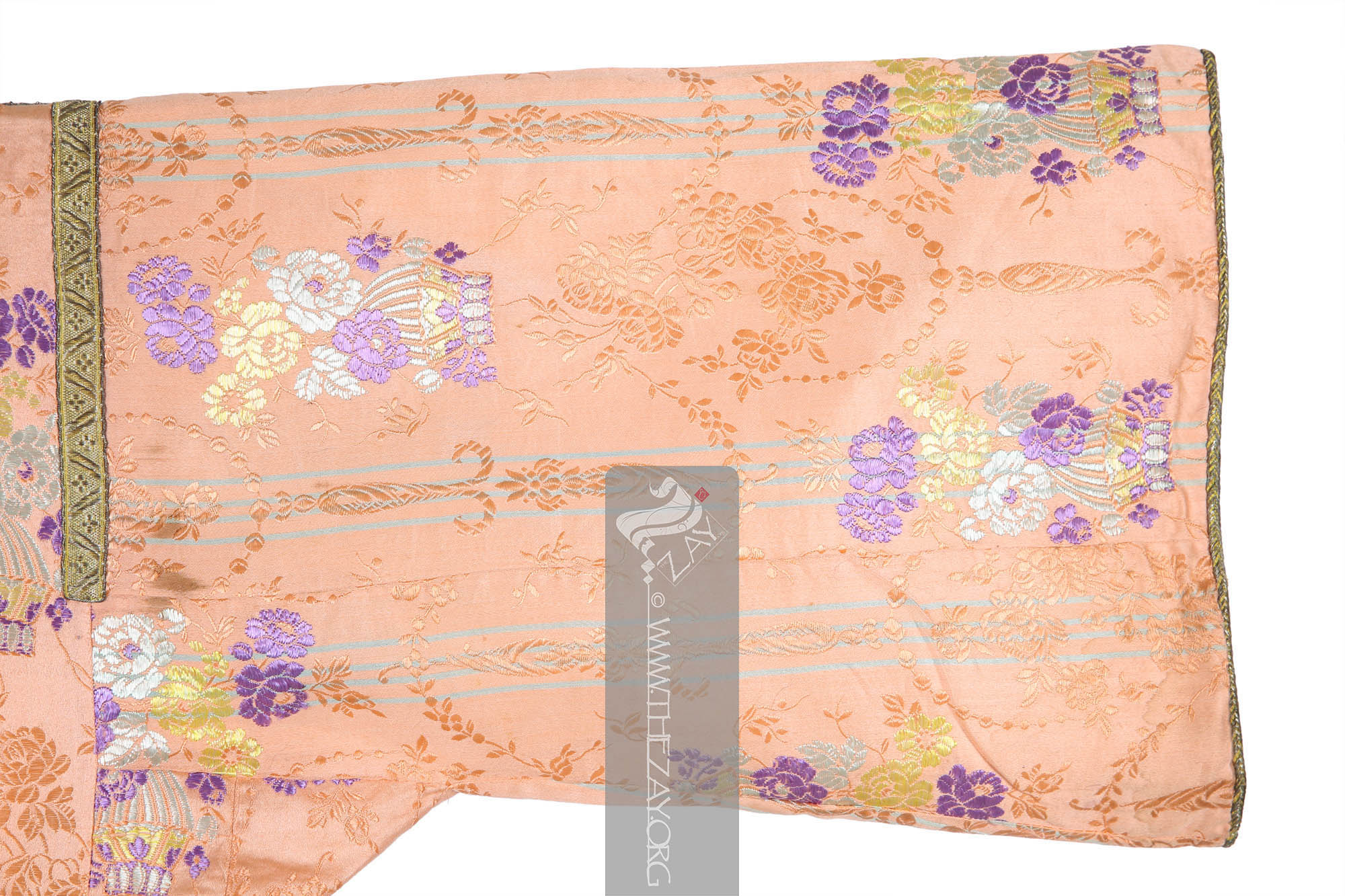
It is noteworthy that the wide sleeves seen in this example are more prevalent in older surviving garments, with the style gradually evolving into more tapered versions in later examples.
Links