

Author Dr Reem Tariq
Ṭariq: (Arabic; Synonym: tulle_bi_talli
Tūlle_bi_tallī: (French: Tulle – a city in France where fine material for veil was first made; Turkish: tel – wire; Synonym: tariq; talli; badla; khus_dozi ), series of small metal knots made on a woven net ground as embellishment. The term is commonly used in the North African Arab region specifically in Egypt.
Co Authored and Edited by Rajrupa Das
Introduction: Comparison, Evolution and Relation
Building on the historical and textual foundations established in Part I, this second part shifts toward a comparative and material analysis of the izār within broader systems of draped dress. Rather than treating wrapped garments as isolated cultural artifacts, this section approaches them as participants in a shared “grammar of cloth,” characterized by uncut textiles, modular draping, and multifunctional use.
Central to this discussion is the early Islamic sartorial environment, in which layered clothing systems relied heavily on large, rectangular pieces of fabric rather than tailored forms. The material and symbolic value of textiles in the Middle East – where cloth functioned as wealth, gift, and currency – shaped practices of wearing fabric uncut, a principle that informs both the persistence of the izār and the emergence of stitched derivatives such as the ʿabāyah. By situating the izār within these material economies and construction logics, Part II provides the analytical bridge between historical specificity and transregional comparison.
1. COMPARITIVE ANALYSIS
2.1 Draped vs Stitched Garments and the Grammar of Cloth
During the advent of Islam, the basic sartorial repertoire for both men and women comprised multiple layers, including an undergarment, a body shirt, a long dress or tunic, and an outer covering such as a mantle or coat, complemented by accessories including footwear and head coverings. Many of these garments were not strictly gender-specific and often consisted of large, rectangular pieces of fabric wrapped around the body. This mode of dress closely reflects Bedouin clothing traditions, as observed by Ibn Khaldūn, and underscores the continuity between pre-Islamic and early Islamic practices of dress.
Textiles and garments held considerable material and symbolic value in the Middle East across historical periods. Clothing functioned not only as everyday attire but also as prestigious gifts, units of exchange, and spoils of war. This high valuation of woven cloth may help explain why fabric produced on looms was traditionally left uncut and untailored prior to use, preserving its integrity and value.
Such practices may have contributed to the evolution of the contemporary stitched ʿabāyah from the originally unstitched izār. The ʿabāyah is typically constructed from two uncut panels of similar fabric, stitched horizontally along the weft Weft: one of the two basic components used in weaving that transforms thread or yarns into a piece of fabric. It is the crosswise thread on a loom that is passed over and under the warp threads.. The warp Warp: One of the two basic components used in weaving which transforms thread or yarns to a piece of fabric. The warp is the set of yarns stretched longitudinally in place on a loom before the weft Weft: one of the two basic components used in weaving that transforms thread or yarns into a piece of fabric. It is the crosswise thread on a loom that is passed over and under the warp threads. is introduced during the weaving process. ends are then folded inward and joined at the centre, while the upper edges are stitched along the selvedge Selvedge: (English: Self-finished edge or self-edge: a dialect forming transition), an edge produced on woven fabric during manufacture that prevents it from unravelling. Traditionally the term selvage applied to only loom woven fabric, presently it could be applied to flat knitted fabric too. to form a square, front-opening garment. Finally, slits are cut at the upper corners of the vertically folded sides to create armholes, resulting in a garment that retains the structural logic of woven cloth while accommodating the functional requirements of tailored dress.
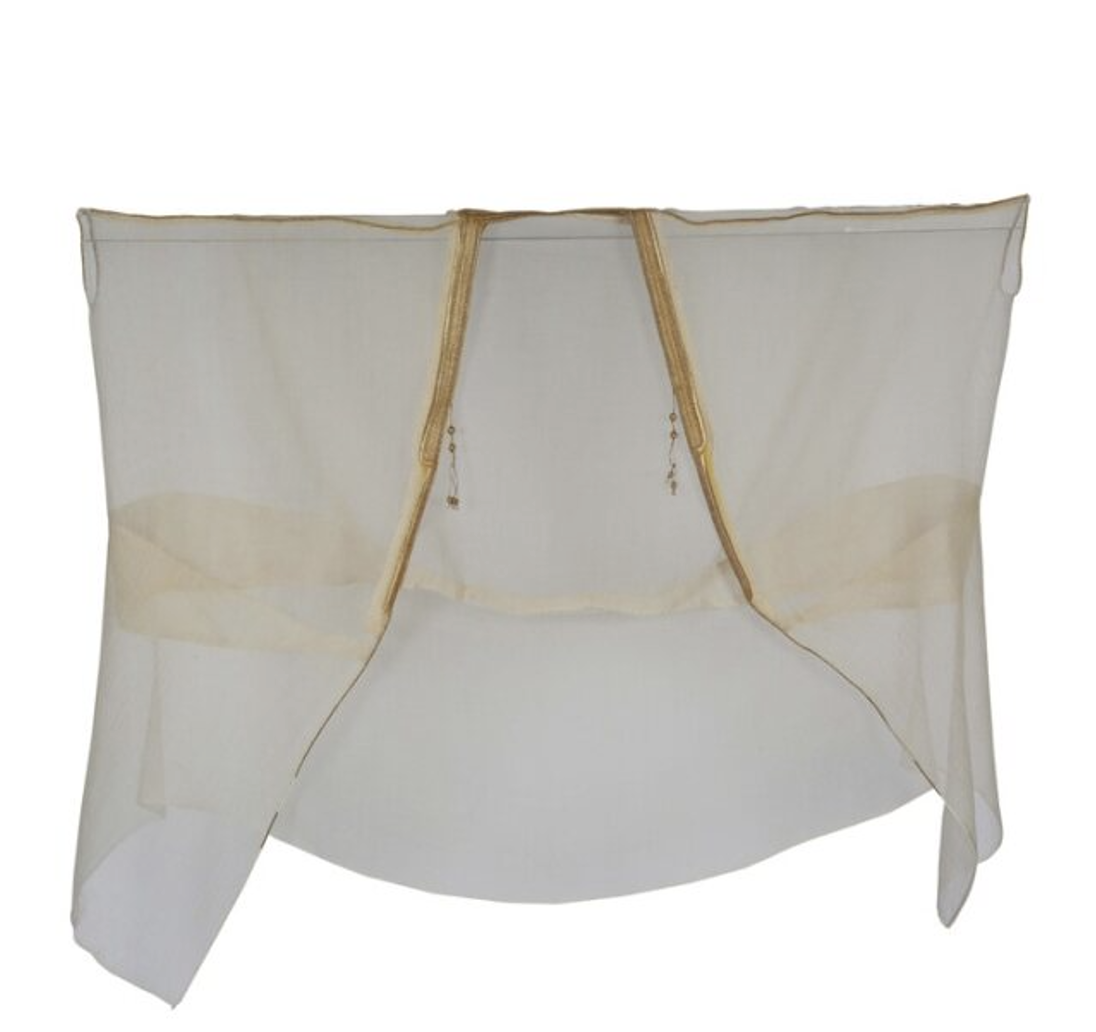
A Traditional Men’s Animal Hair Cloak or ‘Abāyah, Iraq, c. 19th – 20th century; Acc No ZI2019.500849 IRAQ; Source: The Zay Zay: (Arabic: costume, Pl. azyaā’), a set of clothes in a style typical of a particular country or historical period. Initiative
Additionally, it must be mentioned that upon close inspection of construction grammar, it could be inferred or an educated conclusion could be drawn that the ‘abāyah has perhaps evolved as the stitched form of the izār. In its traditional construction, the former is rarely tailored but fashioned out of two identical
2.2 Terminological Differentiation and Regional Naming Practices
Within this broader family of draped garments, important distinctions must be made between unstitched wrappers and sewn outerwear, distinctions that are frequently obscured in both colloquial usage and secondary literature. While the izar
Izār: (Arabic: azar: to support and strengthen, synonyms: wizrah
Wizrah: (Arabic: small garment, synonyms: izār, wizār, fūṭah), refers to a loincloth wrapped around the lower half of the body, between the navel and the knee. Known in the Arabian Peninsula, Iraq, the Horn of Africa (Somalia, Somaliland, Djibouti, Ethiopia, and Eritrea), Indonesia, Malaysia, Bangladesh, Pakistan, and countries in some parts of East Africa and in India., wizār, fūṭah, sharshaf
Sharshaf: (Ottoman Turkic: çarsaf – bed sheet; Synonym: mlaya, mlyaya, sharsaf), a set of large cloth usually used as a body wrap by women in public.
Of particular interest is the linguistic and cultural migration of the Turkic term çarşaf into Arabic-speaking regions, especially the Levant. Its adoption into Syrian colloquial usage can plausibly be attributed to prolonged Ottoman governance and the resulting circulation of sartorial practices and terminologies across imperial space. This linguistic persistence underscores the extent to which garments functioned not only as material objects but also as carriers of imperial, administrative, and cultural memory.
The semantic complexity surrounding these garments is further compounded by the richness and regional specificity of Arabic sartorial vocabulary. In some sources, the complete ensemble is designated as a çarşaf (or sharshaf
Sharshaf: (Ottoman Turkic: çarsaf – bed sheet; Synonym: mlaya, mlyaya, sharsaf), a set of large cloth usually used as a body wrap by women in public.
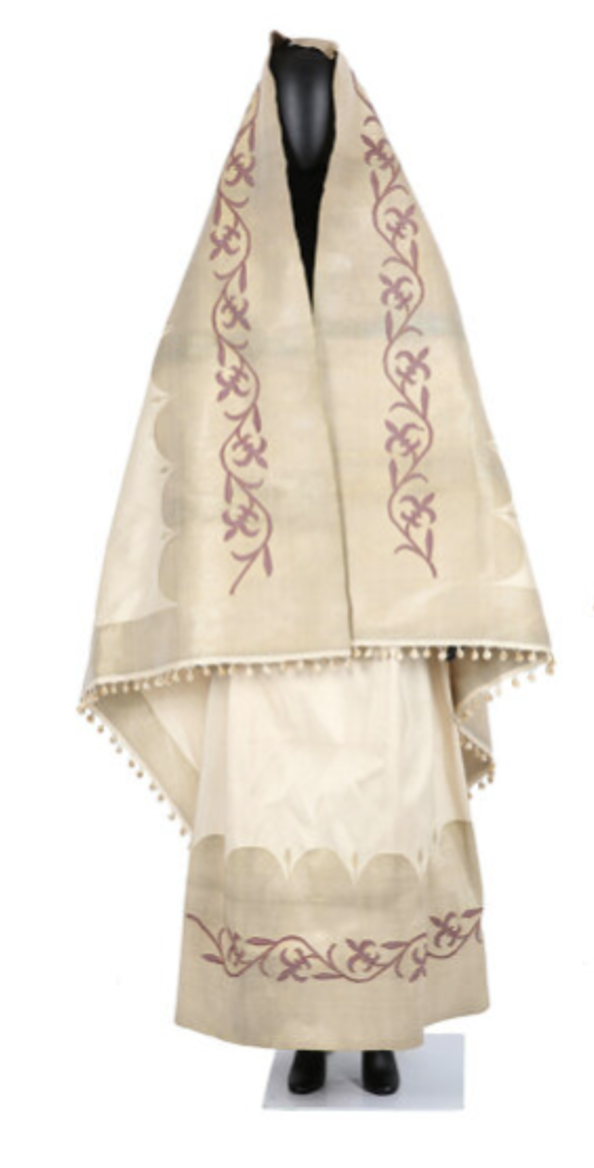
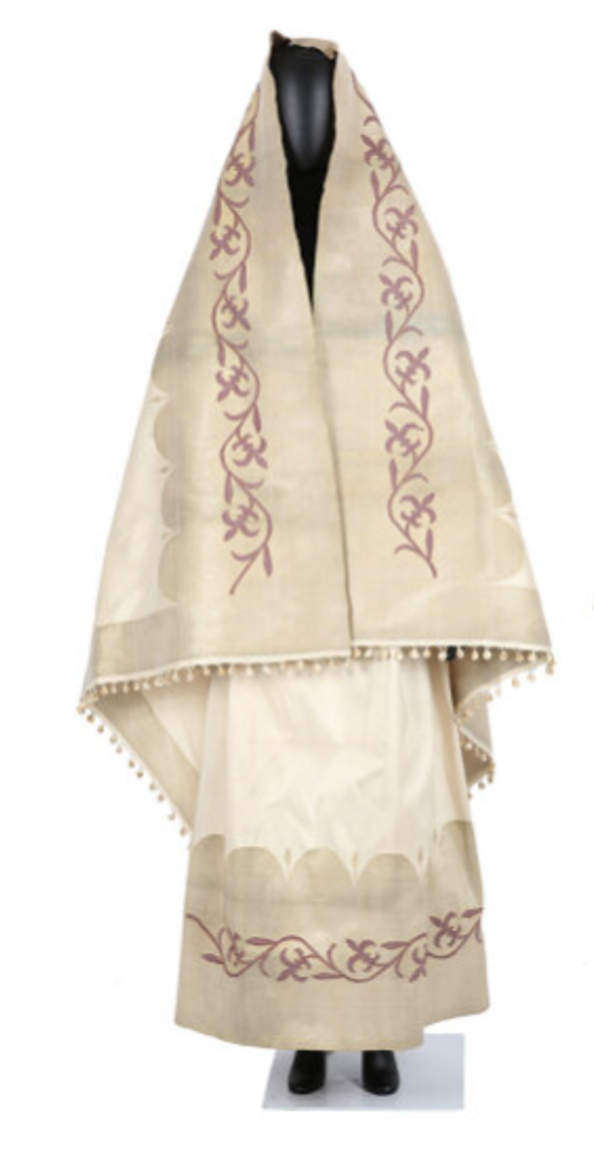
A Traditional Jewish Silk Brocade Brocade: (Italian: brocco – twisted thread), is a richly decorative fabric woven with an intricate raised pattern. Its origins can be traced back to ancient China, where it was made for the imperial court. It later spread to Europe during the Renaissance and became popular in couture and decorative arts. Cloak or Izār, Iraq, c. 20th century; Acc No ZI2018.500239.1 IRAQ; Source: The Zay Zay: (Arabic: costume, Pl. azyaā’), a set of clothes in a style typical of a particular country or historical period. Initiative
Comparable forms of draped dress are also widely observed among women in North African contexts such as Algeria, Libya, and Tunisia. Although these garments may differ in textile composition, weave structure, surface decoration, and dimensions from Levantine examples, they are worn through analogous methods of wrapping and fastening. Typically secured with belts and large fibula brooches, these draped ensembles attest to shared structural principles across the region, even as they articulate localized aesthetic preferences and social meanings. Such continuities reinforce the argument that unstitched drapery constitutes a flexible sartorial system capable of accommodating linguistic diversity, regional identity, and historical transformation within a broadly shared material grammar.
2.3 Izar
Izār: (Arabic: azar: to support and strengthen, synonyms: wizrah
Wizrah: (Arabic: small garment, synonyms: izār, wizār, fūṭah), refers to a loincloth wrapped around the lower half of the body, between the navel and the knee. Known in the Arabian Peninsula, Iraq, the Horn of Africa (Somalia, Somaliland, Djibouti, Ethiopia, and Eritrea), Indonesia, Malaysia, Bangladesh, Pakistan, and countries in some parts of East Africa and in India., wizār, fūṭah, sharshaf
Sharshaf: (Ottoman Turkic: çarsaf – bed sheet; Synonym: mlaya, mlyaya, sharsaf), a set of large cloth usually used as a body wrap by women in public.
The izar
Izār: (Arabic: azar: to support and strengthen, synonyms: wizrah
Wizrah: (Arabic: small garment, synonyms: izār, wizār, fūṭah), refers to a loincloth wrapped around the lower half of the body, between the navel and the knee. Known in the Arabian Peninsula, Iraq, the Horn of Africa (Somalia, Somaliland, Djibouti, Ethiopia, and Eritrea), Indonesia, Malaysia, Bangladesh, Pakistan, and countries in some parts of East Africa and in India., wizār, fūṭah, sharshaf
Sharshaf: (Ottoman Turkic: çarsaf – bed sheet; Synonym: mlaya, mlyaya, sharsaf), a set of large cloth usually used as a body wrap by women in public. Izār: (Arabic: azar: to support and strengthen, synonyms: wizrah
Wizrah: (Arabic: small garment, synonyms: izār, wizār, fūṭah), refers to a loincloth wrapped around the lower half of the body, between the navel and the knee. Known in the Arabian Peninsula, Iraq, the Horn of Africa (Somalia, Somaliland, Djibouti, Ethiopia, and Eritrea), Indonesia, Malaysia, Bangladesh, Pakistan, and countries in some parts of East Africa and in India., wizār, fūṭah, sharshaf
Sharshaf: (Ottoman Turkic: çarsaf – bed sheet; Synonym: mlaya, mlyaya, sharsaf), a set of large cloth usually used as a body wrap by women in public.
Wrapped garments circulating across the Indian Ocean and Nile Valley – variously designated as izar
Izār: (Arabic: azar: to support and strengthen, synonyms: wizrah
Wizrah: (Arabic: small garment, synonyms: izār, wizār, fūṭah), refers to a loincloth wrapped around the lower half of the body, between the navel and the knee. Known in the Arabian Peninsula, Iraq, the Horn of Africa (Somalia, Somaliland, Djibouti, Ethiopia, and Eritrea), Indonesia, Malaysia, Bangladesh, Pakistan, and countries in some parts of East Africa and in India., wizār, fūṭah, sharshaf
Sharshaf: (Ottoman Turkic: çarsaf – bed sheet; Synonym: mlaya, mlyaya, sharsaf), a set of large cloth usually used as a body wrap by women in public.
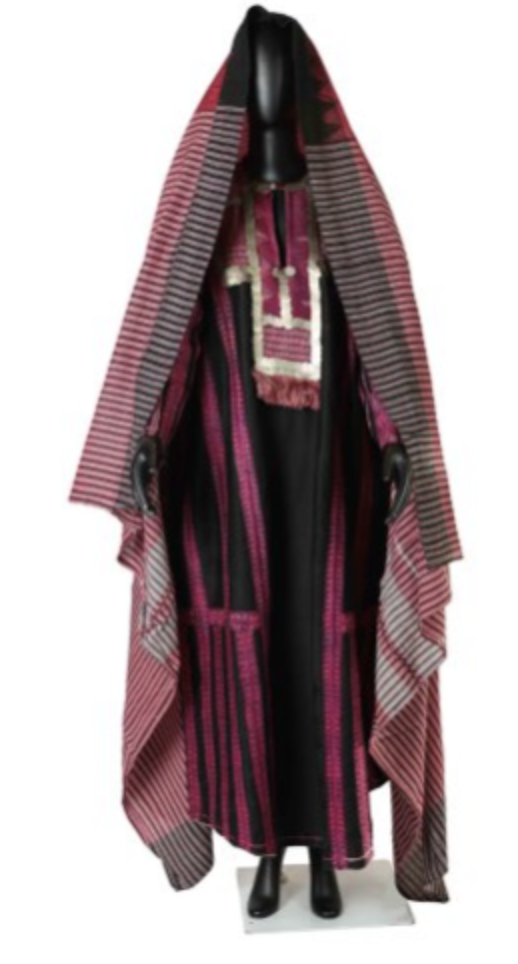
Woven linen and silk veil, Bahariya, Egypt, c. 20th century; ZI2022.501007.2 EGYPT; The Zay Zay: (Arabic: costume, Pl. azyaā’), a set of clothes in a style typical of a particular country or historical period. Initiative
This family resemblance is most convincingly explained through the convergence of three interrelated processes: the sustained movement of textiles along maritime trade routes; localized technological, aesthetic, and symbolic adaptations; and functional convergence shaped by comparable ecological conditions and social requirements.
2.4 Formal and Technical Frameworks of Comparison
Formal and functional comparison across wrapped garments reveals a set of shared structural principles that underpin their widespread adoption and adaptability. First, with respect to geometry and cut, most wrappers are produced as rectangular lengths of woven or printed cloth. Typical dimensions vary by region – for example, the kanga averages approximately 110 × 150 cm, many saris measure roughly 1.1–1.2 meters in width and between five and nine meters in length, and lungi or sarong lengths exhibit considerable variation. The rectangular format generates a limited yet highly flexible repertoire of draping configurations, including waist wrapping, over-the-shoulder draping, and head covering. These proportions enable a high degree of modularity, allowing a single textile to function interchangeably as a skirt, shawl Shawl: (Persian: shāl from Hindi: duśālā – Shoulder Mantle), a shawl is a South Asian version of a scarf worn or wrapped loosely over the shoulders and is usually made of wool. , head covering, or infant carrier.
A second shared feature concerns the use of selvedges, borders, and anchoring motifs. Many wrapped textiles incorporate a visually distinctive border – such as the pindo in kanga – and a central or “head” motif, including the mji in kanga, the pola in sarongs, or anchoring stripes in the izar
Izār: (Arabic: azar: to support and strengthen, synonyms: wizrah
Wizrah: (Arabic: small garment, synonyms: izār, wizār, fūṭah), refers to a loincloth wrapped around the lower half of the body, between the navel and the knee. Known in the Arabian Peninsula, Iraq, the Horn of Africa (Somalia, Somaliland, Djibouti, Ethiopia, and Eritrea), Indonesia, Malaysia, Bangladesh, Pakistan, and countries in some parts of East Africa and in India., wizār, fūṭah, sharshaf
Sharshaf: (Ottoman Turkic: çarsaf – bed sheet; Synonym: mlaya, mlyaya, sharsaf), a set of large cloth usually used as a body wrap by women in public.
Finally, wrapped garments are characterized by multifunctionality and modular use. In contrast to tailored apparel, wrappers operate as polyvalent objects, serving as domestic textiles, everyday dress, ritual coverings, trade commodities, mourning cloths, or prestige gifts. This functional flexibility encourages cultural diffusion, as imported textiles can be readily incorporated into local sartorial systems without the need for specialized tailoring. Collectively, these formal and functional attributes elucidate both the persistence and the extensive geographical circulation of wrapped garments within interconnected textile economies as demonstrated by the case studies that follow.
At the same time, it is essential that analyses of draped garments resist monocausal or linear narratives of origin and transmission, instead accounting for the complexity of multidirectional exchange, local innovation, and contextual reinterpretation that characterizes their historical trajectories. Single-line genealogies are seldom substantiated by material, textual, or visual evidence. Instead, the historical record consistently points to processes of multidirectional exchange, localized innovation, and the repeated reinterpretation of imported textiles within distinct social and cultural contexts.
Equally important is the need to read material culture through locally grounded frameworks. Individual wrapper forms should be interpreted in relation to regional written sources, oral histories, and museum collections, in conjunction with commercial and archival trade records. Such an approach acknowledges that identical or similar imported cloths could acquire divergent meanings and functions in different port cities or inland settings, shaped by local social relations, aesthetic preferences, and symbolic economies.
Through comparative examination, this part has demonstrated that the izār participates in a widespread system of draped garments unified by shared structural principles rather than singular origins. Terminological diversity, regional naming practices, and variations in use do not obscure but rather reinforce the adaptability of wrapped cloth as a sartorial solution responsive to climate, economy, and social norms.
By foregrounding construction grammar, material value, and comparative form, Part II reframes the izār not as a static tradition but as a flexible textile logic. The following part advances this argument through focused case studies that trace how specific garments – shaped by trade, ecology, and local aesthetics – embody distinct yet interconnected pathways within Indian Ocean and Nile Valley networks.