




1 of 9
| Local Name | ‘Abayah, ‘Aba |
| Object Category | Overgarment |
| Gender | Male |
| Date of object | c. 19th-20th century |
| Place Of orgin | Iraq |
| Region | Iraq |
| Object Range | Syria, Jordan, Lebanon, Egypt, Palestine, Iraq, Saudi Arabia, Bahrain, UAE, Kuwait, Yemen et al. |
| Dimensions | Length: 147 cm Width: 155 cm |
| Materials | Animal Hair Cotton Metal |
| Technique | Hand Stitched Hand Embroidered Woven |
| Color | |
| Motif | Geometric |
| Provenance | - |
| Location | The Zay Zay: (Arabic: costume, Pl. azyaā’), a set of clothes in a style typical of a particular country or historical period. Initiative |
| Status | In Storage |
| ZI number | ZI2019.500849 IRAQ |
Object Features
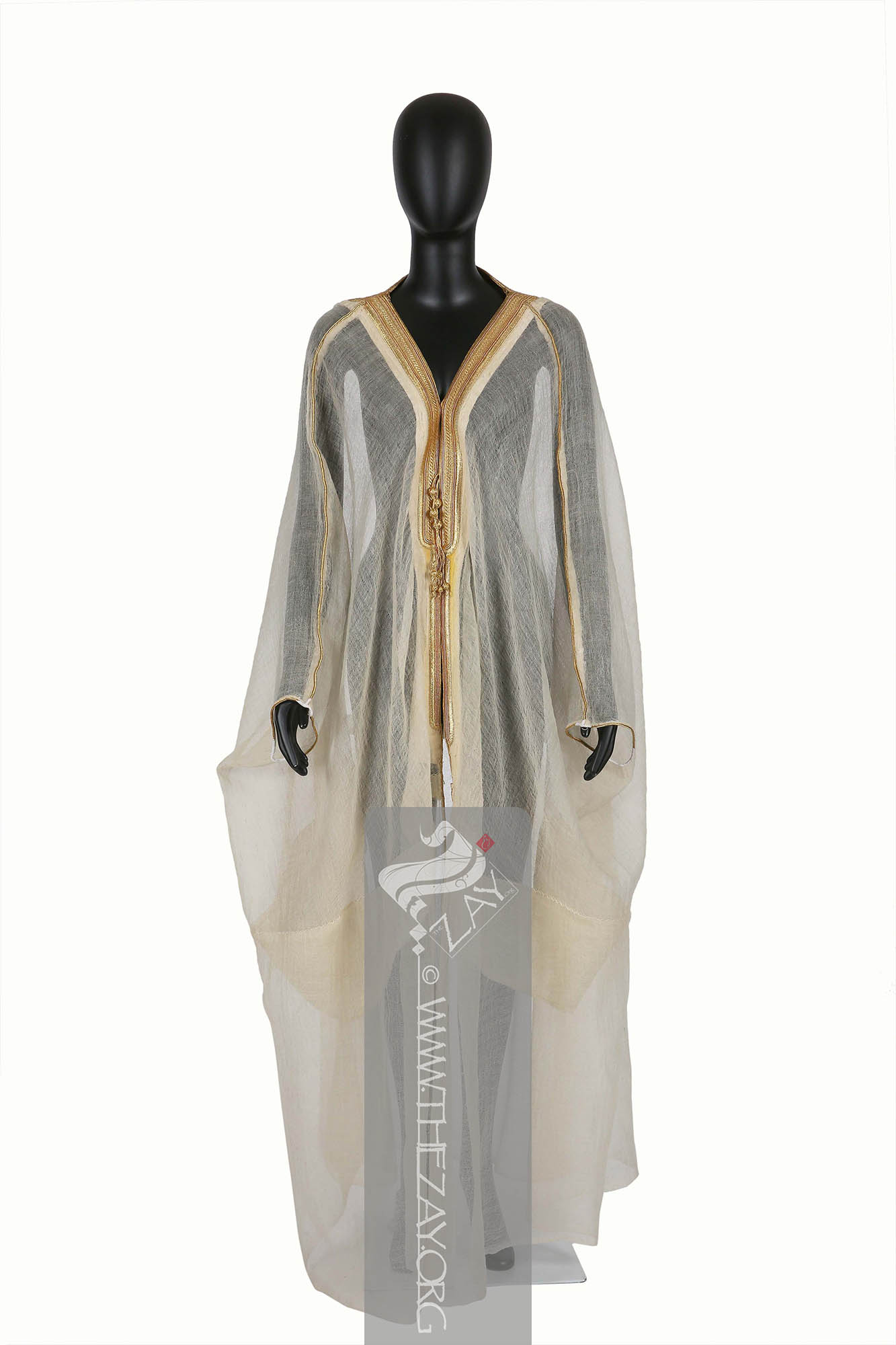
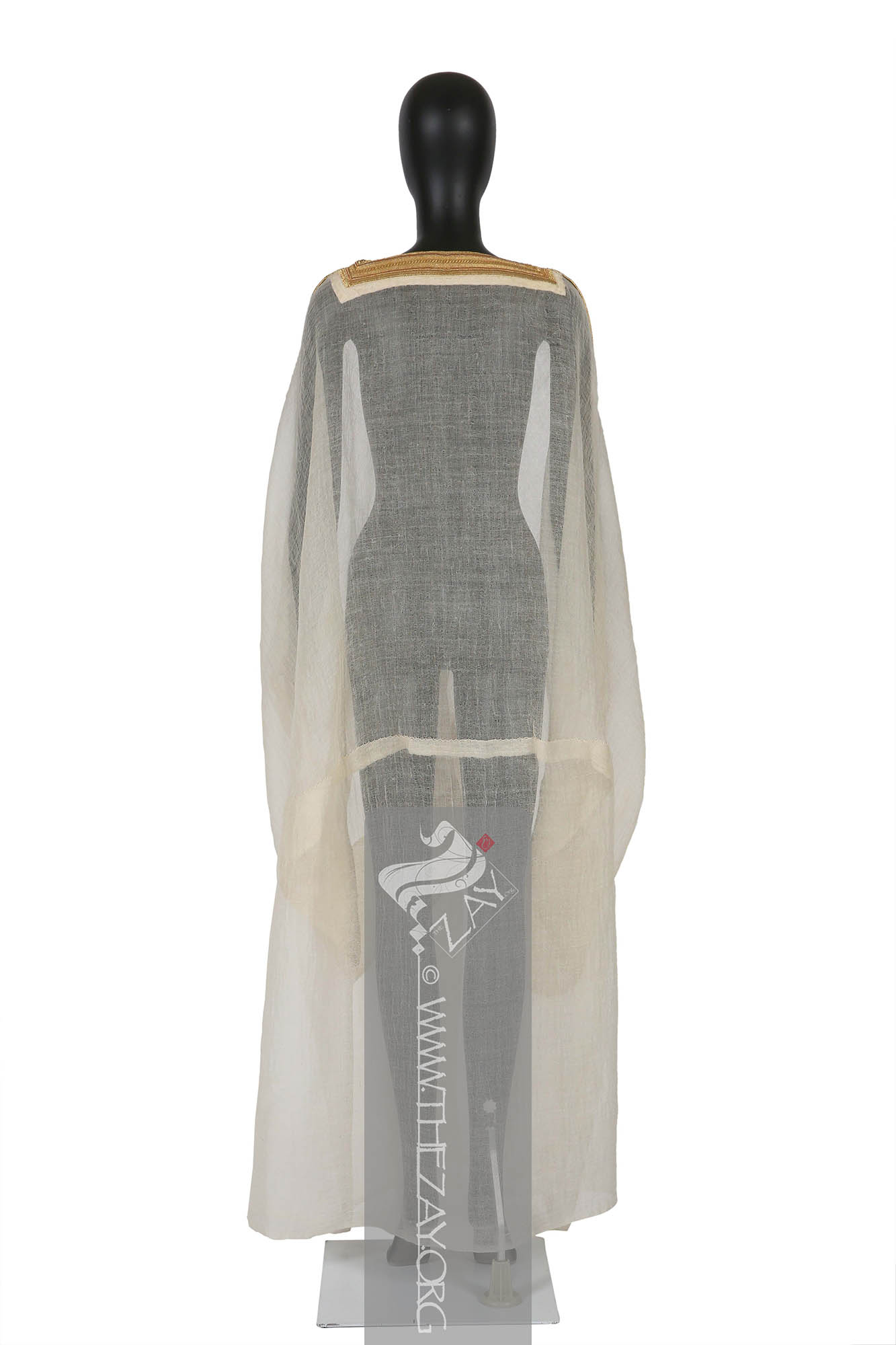
This is a front open men’s cloak (‘abayah
‘Abāyah: (Arabic: cloak, Pl. ‘abāyāt, or ‘Ibī. In Classical Arabic: ‘abā’ah, pl: ‘abā’āt, synonyms: ‘Abā, ‘abāh, ‘abāt, dafah
Daffah : (Arabic: side, synonyms: ‘Abā, ‘abāyah, ‘abāh, ‘abāt, bisht or mishlaḥ), long, wide, and sleeveless outer cloak worn in public by both sexes. In time this article of dress evolved and changed in shape, style, and function., bisht
Bisht: (Arabic: bjd or bjād: cloak, Akkadian: bishtu or Persian: back, pl. bshūt synonyms: ‘Abā,‘abāyah, ‘abāh, ‘abāt, dafah
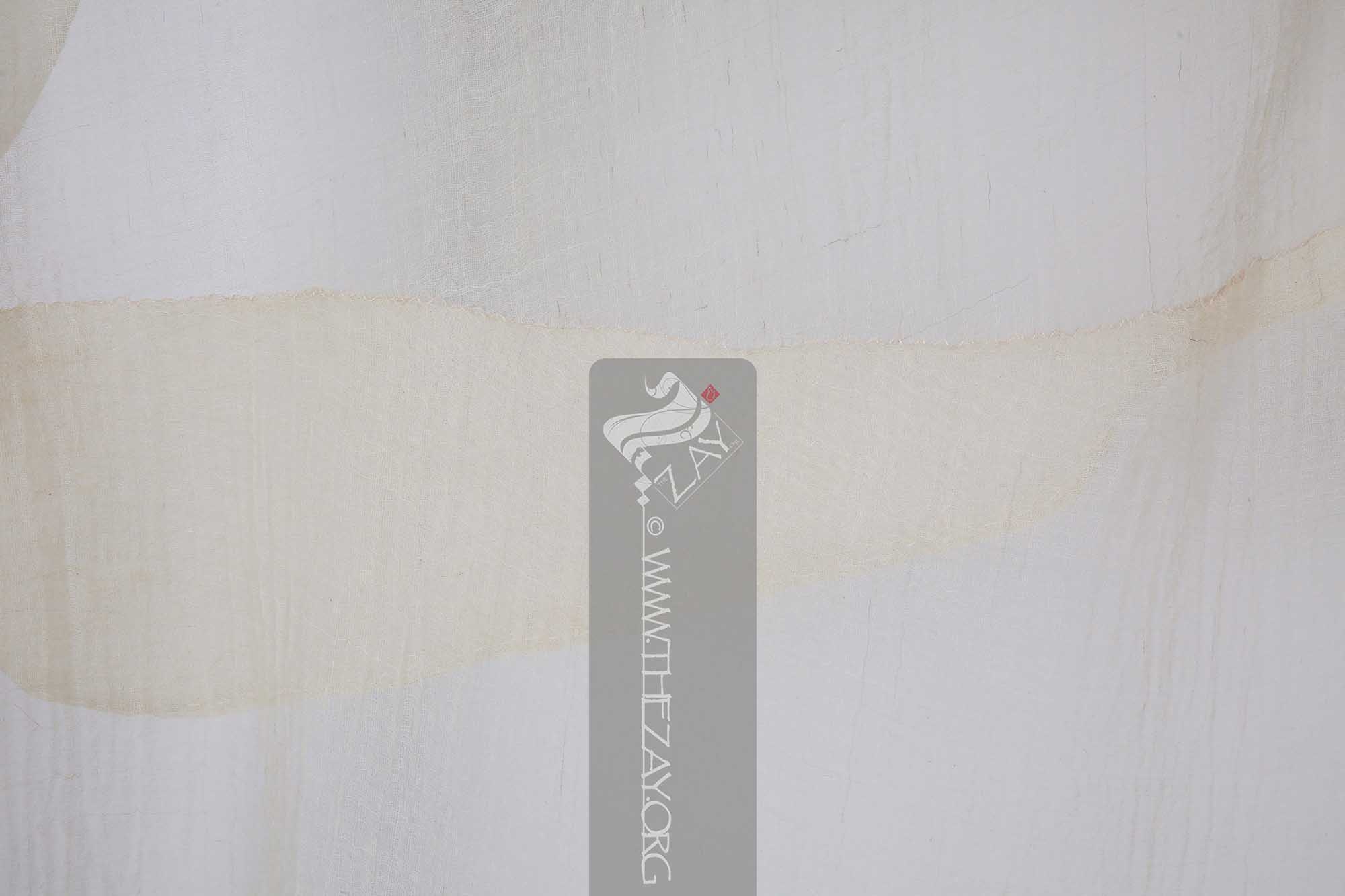
Daffah : (Arabic: side, synonyms: ‘Abā, ‘abāyah, ‘abāh, ‘abāt, bisht or mishlaḥ), long, wide, and sleeveless outer cloak worn in public by both sexes. In time this article of dress evolved and changed in shape, style, and function., or mishlaḥ), long, wide, and sleeveless outer cloak worn in public by men. In time this article of dress evolved and changed in shape, style, and function., or mishlaḥ), long, wide, and sleeveless outer cloak worn in public by both sexes. In time this article of dress evolved and changed in shape, style, and function.) constructed of undyed possibly goat hair yarn featuring metal thread (kalabdun
Kalabdūn: (Hindustani: kalabattu / kalabattun gold or silver threads; or Dravidian and Sanskrit: pattu or patt – a kind of fine fibre or silk; or Sanskrit: kalavatu – fine material), the gold wire used in embroidery and other embellishments on textiles and fabrics.
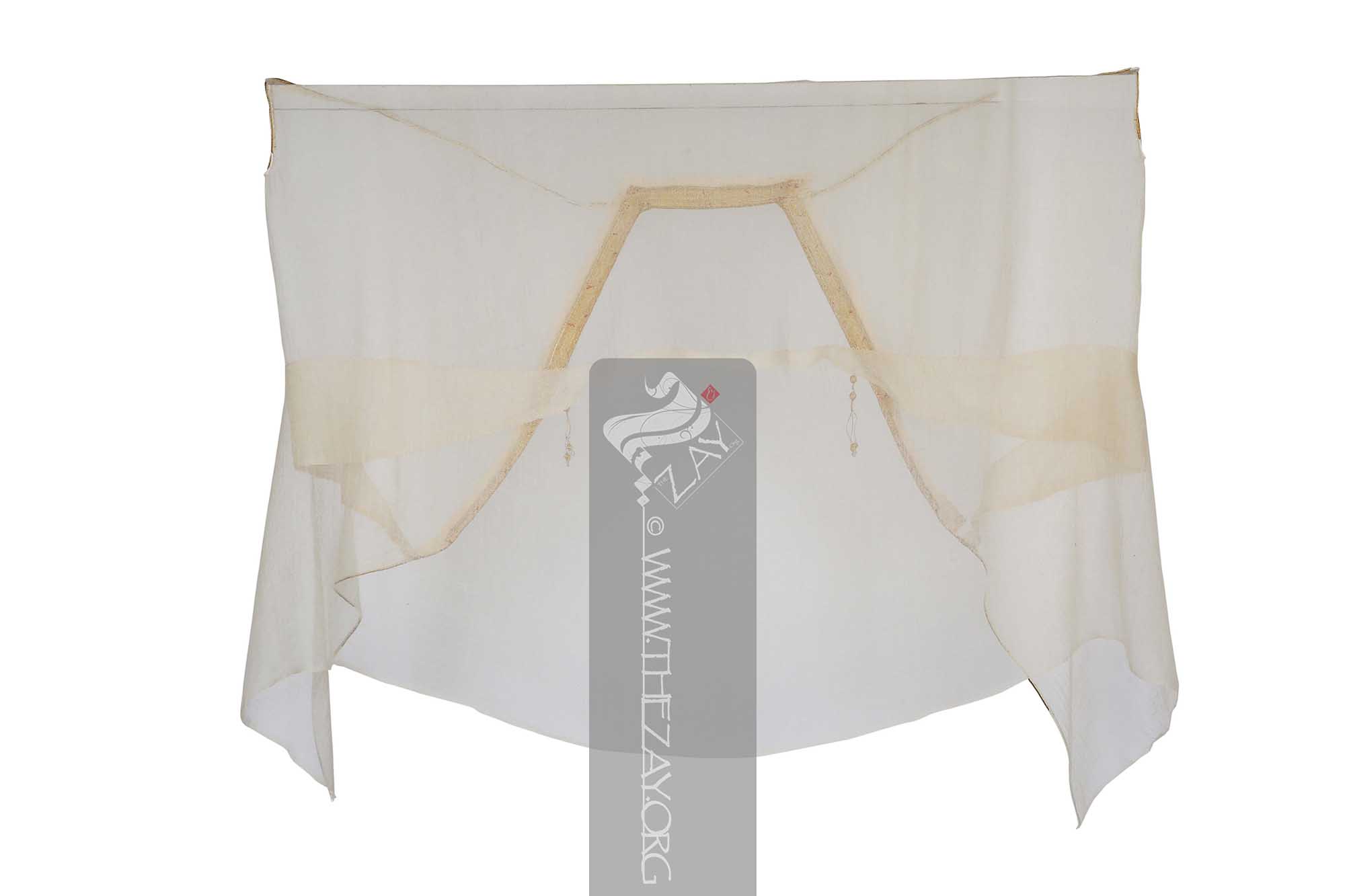
The ‘abayah ‘Abāyah: (Arabic: cloak, Pl. ‘abāyāt, or ‘Ibī. In Classical Arabic: ‘abā’ah, pl: ‘abā’āt, synonyms: ‘Abā, ‘abāh, ‘abāt, dafah Daffah : (Arabic: side, synonyms: ‘Abā, ‘abāyah, ‘abāh, ‘abāt, bisht or mishlaḥ), long, wide, and sleeveless outer cloak worn in public by both sexes. In time this article of dress evolved and changed in shape, style, and function., bisht Bisht: (Arabic: bjd or bjād: cloak, Akkadian: bishtu or Persian: back, pl. bshūt synonyms: ‘Abā,‘abāyah, ‘abāh, ‘abāt, dafah Daffah : (Arabic: side, synonyms: ‘Abā, ‘abāyah, ‘abāh, ‘abāt, bisht or mishlaḥ), long, wide, and sleeveless outer cloak worn in public by both sexes. In time this article of dress evolved and changed in shape, style, and function., or mishlaḥ), long, wide, and sleeveless outer cloak worn in public by men. In time this article of dress evolved and changed in shape, style, and function., or mishlaḥ), long, wide, and sleeveless outer cloak worn in public by both sexes. In time this article of dress evolved and changed in shape, style, and function. is essentially constructed of two uncut panels of similar-looking fabrics, stitched to each other horizontally along the (weft Weft: one of the two basic components used in weaving that transforms thread or yarns into a piece of fabric. It is the crosswise thread on a loom that is passed over and under the warp threads.). Following this, the two (warp Warp: One of the two basic components used in weaving which transforms thread or yarns to a piece of fabric. The warp is the set of yarns stretched longitudinally in place on a loom before the weft Weft: one of the two basic components used in weaving that transforms thread or yarns into a piece of fabric. It is the crosswise thread on a loom that is passed over and under the warp threads. is introduced during the weaving process. ) ends are then folded and brought to the middle, and stitched on the top along the (selvedge Selvedge: (English: Self-finished edge or self-edge: a dialect forming transition), an edge produced on woven fabric during manufacture that prevents it from unravelling. Traditionally the term selvage applied to only loom woven fabric, presently it could be applied to flat knitted fabric too. ), thus giving it a structure of a square-shaped front open garment.
A sliver is then cut through the top corners of the vertically folded sides to create the armholes.
A braided kalabdun
Kalabdūn: (Hindustani: kalabattu / kalabattun gold or silver threads; or Dravidian and Sanskrit: pattu or patt – a kind of fine fibre or silk; or Sanskrit: kalavatu – fine material), the gold wire used in embroidery and other embellishments on textiles and fabrics.
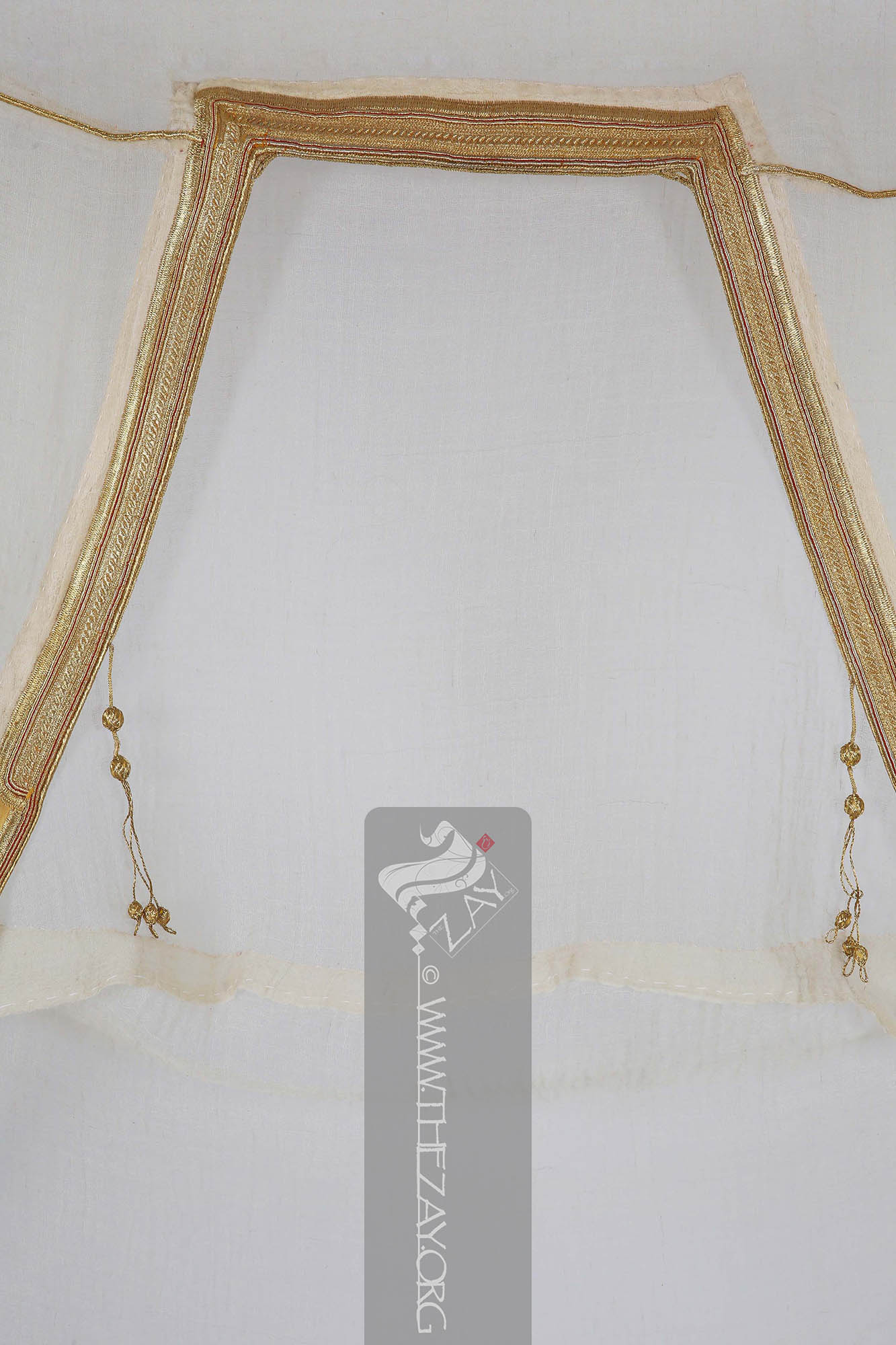
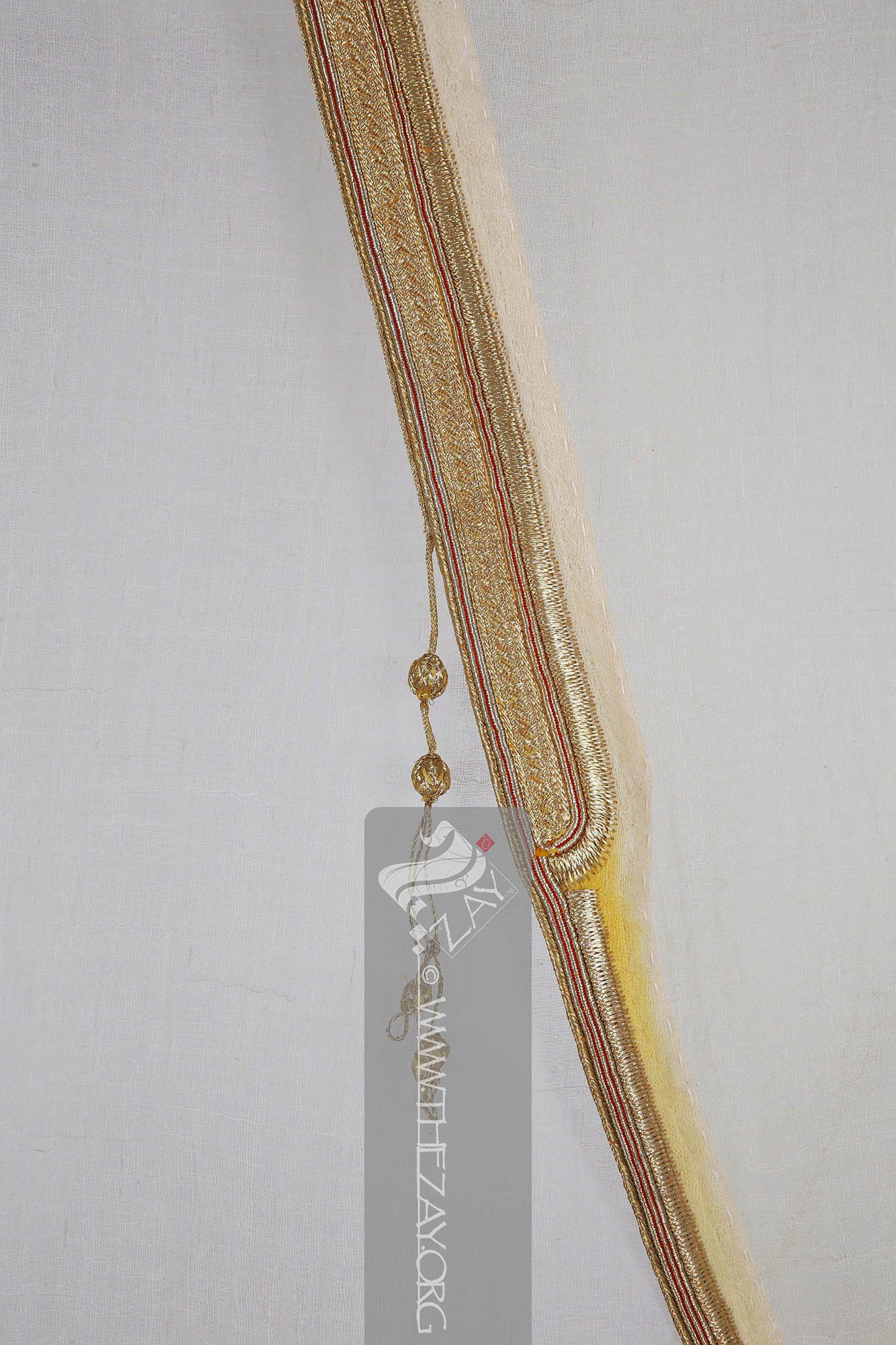
The neckline, both in the front and the back, is embellished with embroidered gold kalabdun
Kalabdūn: (Hindustani: kalabattu / kalabattun gold or silver threads; or Dravidian and Sanskrit: pattu or patt – a kind of fine fibre or silk; or Sanskrit: kalavatu – fine material), the gold wire used in embroidery and other embellishments on textiles and fabrics. Herringbone_stitch: a decorative stitch that creates a V-shaped pattern, resembling fish bones. It's commonly used in embroidery, sewing, and quilting to join fabrics or for decorative detailing. The stitch is worked diagonally and often gives a clean, attractive finish.
A braided metal tassel (balabil) on either side of the opening is attached in the front (yoke Yoke: (Synonym: Bodice_Yoke), a structured pattern fitted at the shoulders defining the structure of women’s garments. Introduced in c. 1880s it defines the transition between the upper and lower parts of the garments and can now be found stitched-in where the blouse is separated from the skirt by a horizontal seam. ) to be used for fastening. The ‘abayah ‘Abāyah: (Arabic: cloak, Pl. ‘abāyāt, or ‘Ibī. In Classical Arabic: ‘abā’ah, pl: ‘abā’āt, synonyms: ‘Abā, ‘abāh, ‘abāt, dafah Daffah : (Arabic: side, synonyms: ‘Abā, ‘abāyah, ‘abāh, ‘abāt, bisht or mishlaḥ), long, wide, and sleeveless outer cloak worn in public by both sexes. In time this article of dress evolved and changed in shape, style, and function., bisht Bisht: (Arabic: bjd or bjād: cloak, Akkadian: bishtu or Persian: back, pl. bshūt synonyms: ‘Abā,‘abāyah, ‘abāh, ‘abāt, dafah Daffah : (Arabic: side, synonyms: ‘Abā, ‘abāyah, ‘abāh, ‘abāt, bisht or mishlaḥ), long, wide, and sleeveless outer cloak worn in public by both sexes. In time this article of dress evolved and changed in shape, style, and function., or mishlaḥ), long, wide, and sleeveless outer cloak worn in public by men. In time this article of dress evolved and changed in shape, style, and function., or mishlaḥ), long, wide, and sleeveless outer cloak worn in public by both sexes. In time this article of dress evolved and changed in shape, style, and function. is unlined and is hand-stitched, featuring a superior quality of craftsmanship.
Interesting, a similar piece in black – ZI1992.500638.2 IRAQ – is also part of the collection.
In the late 19th century, ‘abayah ‘Abāyah: (Arabic: cloak, Pl. ‘abāyāt, or ‘Ibī. In Classical Arabic: ‘abā’ah, pl: ‘abā’āt, synonyms: ‘Abā, ‘abāh, ‘abāt, dafah Daffah : (Arabic: side, synonyms: ‘Abā, ‘abāyah, ‘abāh, ‘abāt, bisht or mishlaḥ), long, wide, and sleeveless outer cloak worn in public by both sexes. In time this article of dress evolved and changed in shape, style, and function., bisht Bisht: (Arabic: bjd or bjād: cloak, Akkadian: bishtu or Persian: back, pl. bshūt synonyms: ‘Abā,‘abāyah, ‘abāh, ‘abāt, dafah Daffah : (Arabic: side, synonyms: ‘Abā, ‘abāyah, ‘abāh, ‘abāt, bisht or mishlaḥ), long, wide, and sleeveless outer cloak worn in public by both sexes. In time this article of dress evolved and changed in shape, style, and function., or mishlaḥ), long, wide, and sleeveless outer cloak worn in public by men. In time this article of dress evolved and changed in shape, style, and function., or mishlaḥ), long, wide, and sleeveless outer cloak worn in public by both sexes. In time this article of dress evolved and changed in shape, style, and function. such as this, but made of silk, would often be imported all across the Arab world from Syria. While Syria gained renown as one of the foremost weaving hubs in the Arab world, with a special emphasis on luxurious fabrics such as silk pieces, such as these would, on the other hand would often be locally produced, especially to be worn during the winter.
Links
Charuga: (Possibly Kurdish), a mantle-like embroidered women’s traditional garment from the Qaraqosh region in northern Iraq, traditionally fastened at the shoulder. Historically worn by field workers, it helped conceal dust and dirt, making them less visible during labour, it is a festive garment worn sparingly during festivals and other special occasions.
from Northern Iraq Has Arrived at the TRC!, www.trc-leiden.nl/trc/index.php/en/blog/1378-the-charugaCharuga: (Possibly Kurdish), a mantle-like embroidered women’s traditional garment from the Qaraqosh region in northern Iraq, traditionally fastened at the shoulder. Historically worn by field workers, it helped conceal dust and dirt, making them less visible during labour, it is a festive garment worn sparingly during festivals and other special occasions.
-from-northern-iraq-has-arrvied-at-the-trc. Accessed 29 Jan. 2024.