


1 of 6
| Local Name | Izar |
| Object Category | Overgarment |
| Gender | Female |
| Date of object | c. 20th century |
| Place Of orgin | Iraq |
| Region | Syria, Lebanon, Jordan, Palestine, Egypt, Iraq, Türkiye et al |
| Object Range | - |
| Dimensions | Length: 101 cm Width: 206 cm |
| Materials | Silk Metal |
| Technique | Machine Stitched Woven |
| Color | |
| Motif | Floral |
| Provenance | Gifted, Khawla Khalid Diab, Boston 2018 |
| Location | The Zay Zay: (Arabic: costume, Pl. azyaā’), a set of clothes in a style typical of a particular country or historical period. Initiative |
| Status | In Storage |
| ZI number | ZI2018.500239.1 IRAQ |
Object Note
Part of a lot with two more items (ZI2018.500239.2 IRAQ and ZI2018.500239.3 IRAQ) also in the collection.
Object History
This item was gifted to Dr. Reem El Mutwalli by Khawla Khalid-Diab, a family friend from Iraq, in 1965 and was eventually added to The Zay Zay: (Arabic: costume, Pl. azyaā’), a set of clothes in a style typical of a particular country or historical period. Initiative collections later.
Born in Baghdad in 1939, Khawla was the oldest daughter of a senior judge and his socialite wife. She began her career as a pharmacist after coming of age during Iraq’s cultural and political heyday – the 1950s and 60s. She emigrated to the United States of America in 1980 and settled in Boston, Massachusetts, where she continued pursuing her career in pharmaceuticals.
Today, she and her husband are parents to three children and seven grandchildren. Khawla, with her passion for literature, cuisine, and fine arts, has remained an active member of the Arab community in the Boston area.
This item might have been presented as a gift from a Jewish family to Khawla's father, a prominent figure in the diverse Baghdadi community that encompassed various faiths and ethnic backgrounds.
Object Features
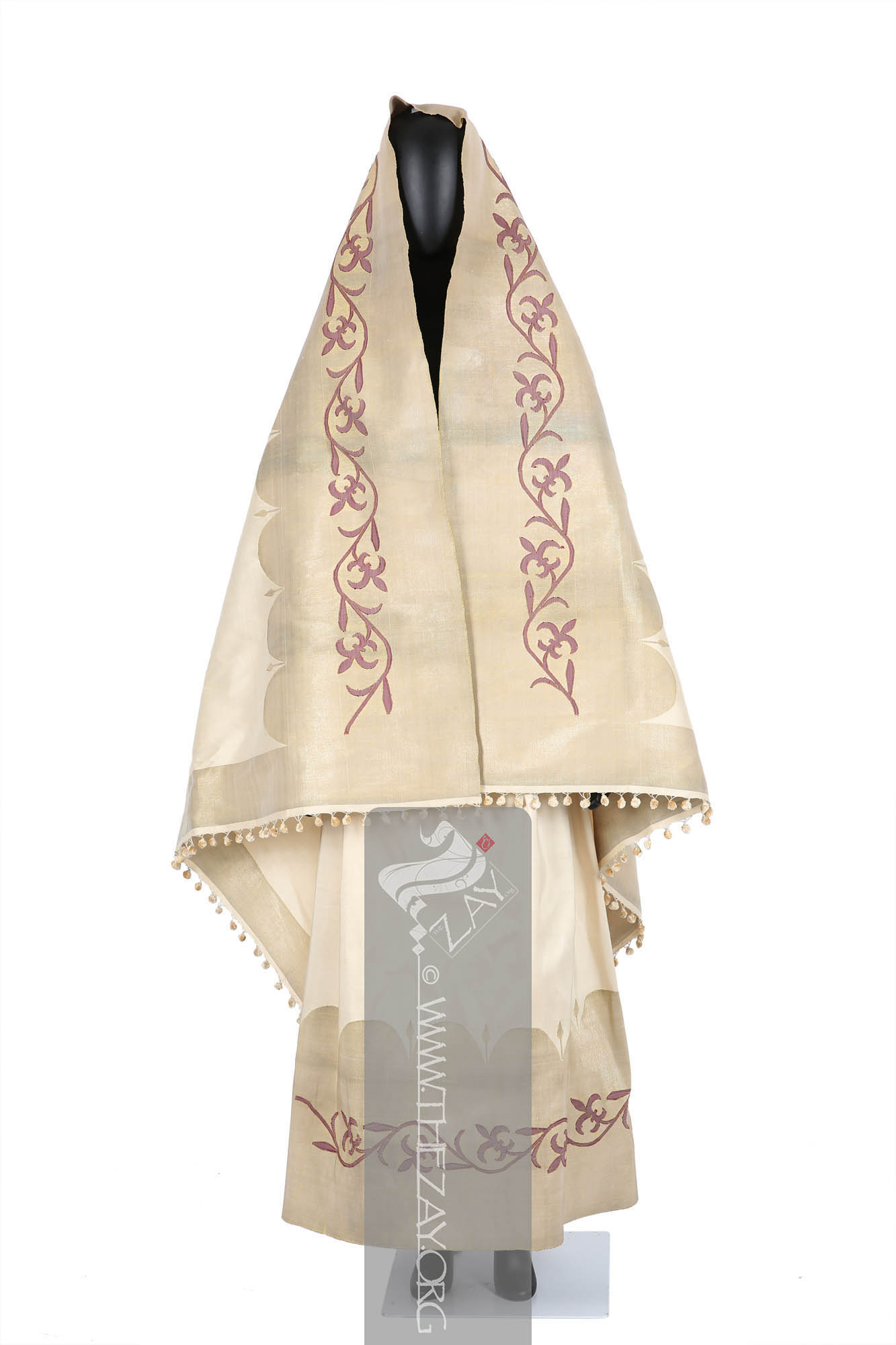
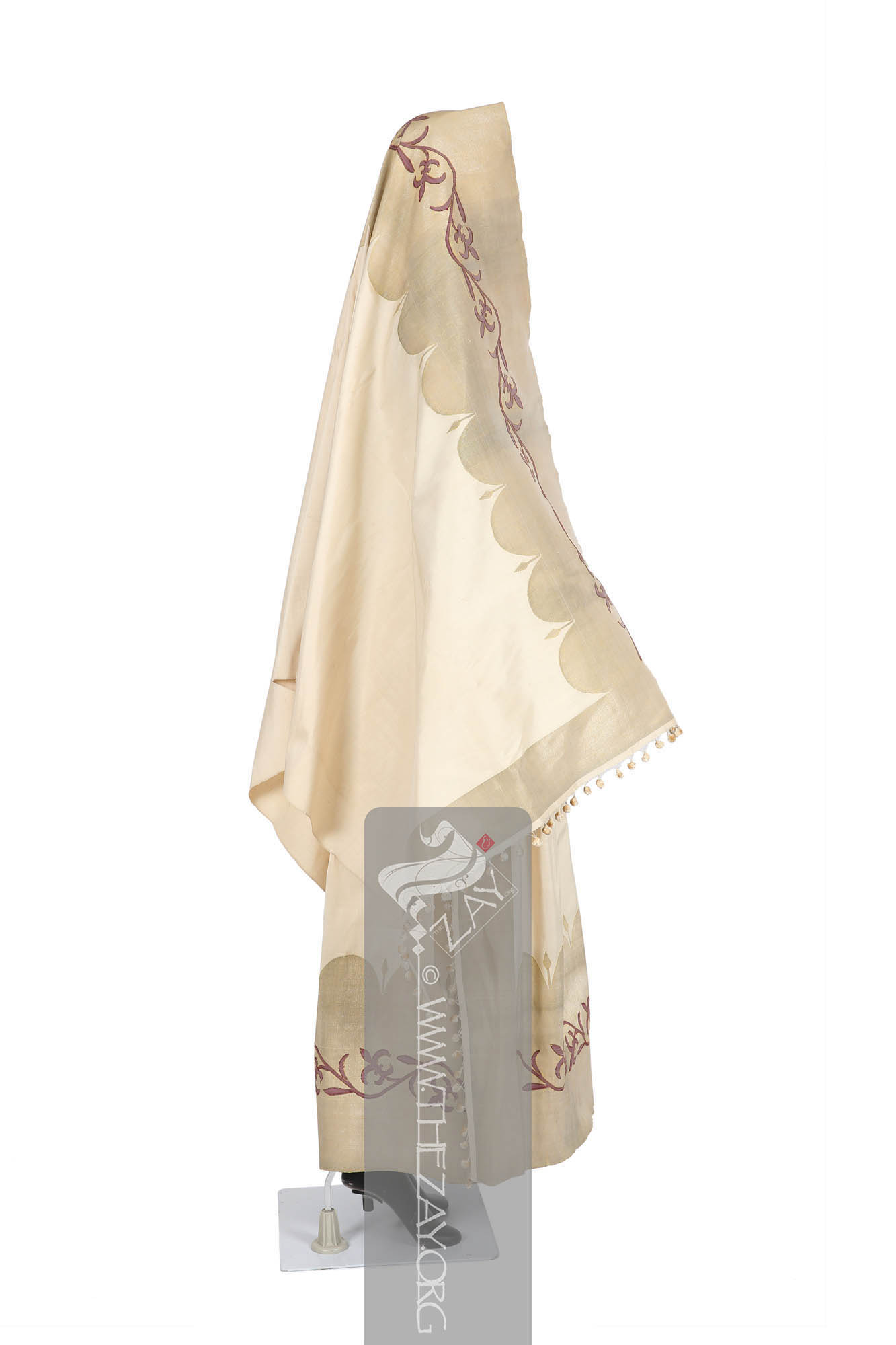
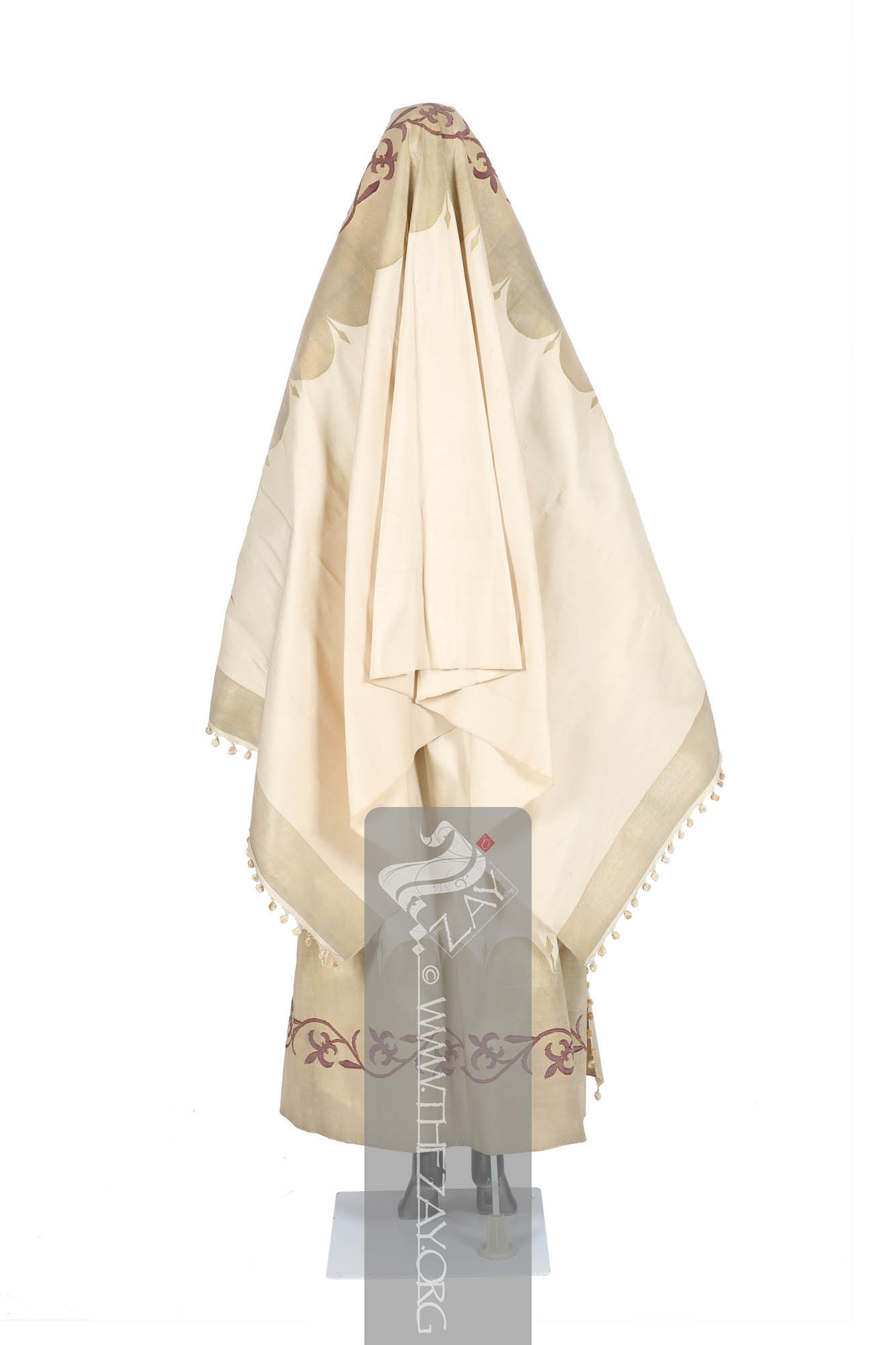
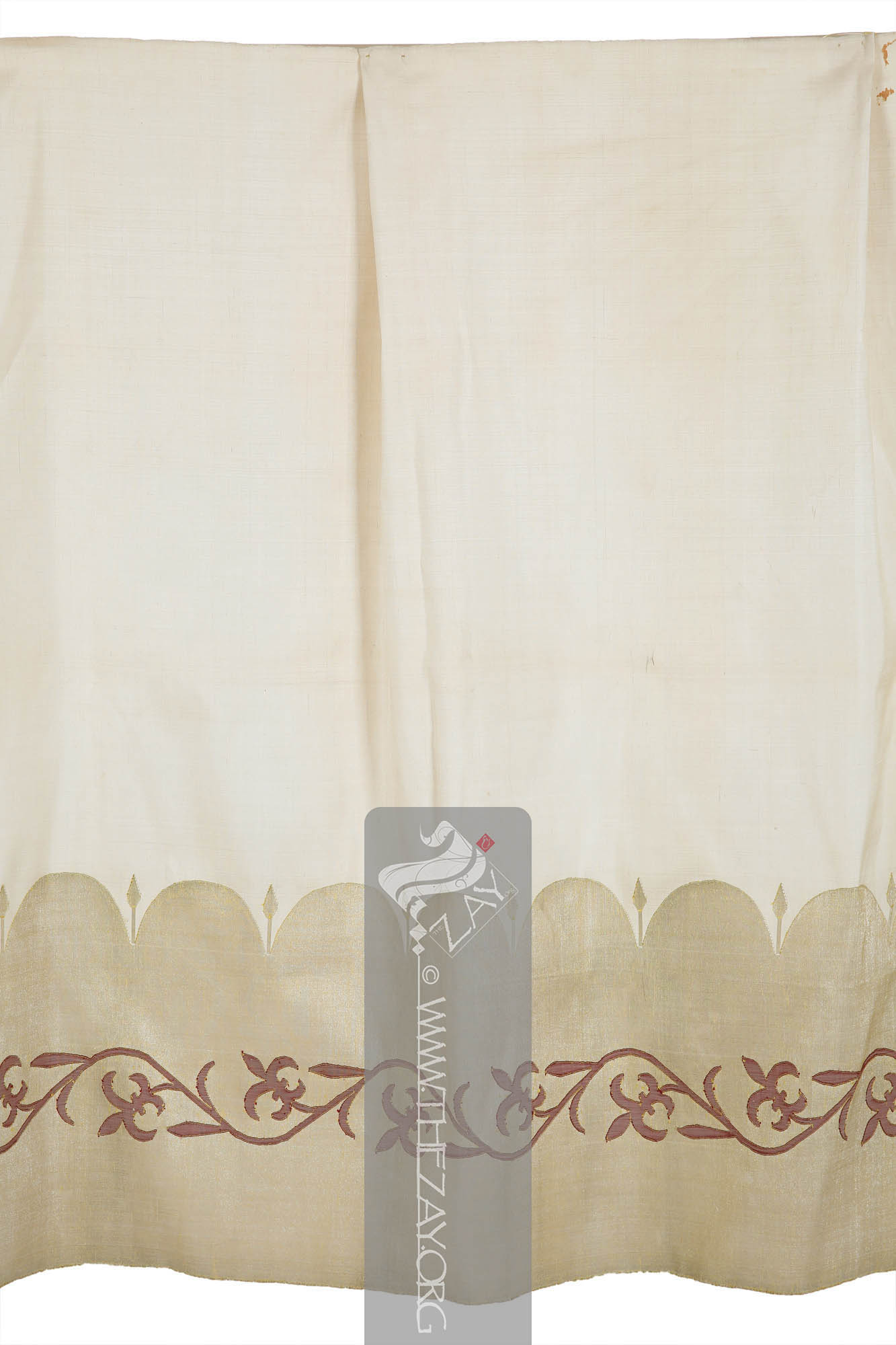
This is a woven silk brocade
Brocade: (Italian: brocco – twisted thread), is a richly decorative fabric woven with an intricate raised pattern. Its origins can be traced back to ancient China, where it was made for the imperial court. It later spread to Europe during the Renaissance and became popular in couture and decorative arts. cloak (izar
Izār: (Arabic: azar: to support and strengthen, synonyms: wizrah
Wizrah: (Arabic: small garment, synonyms: izār, wizār, fūṭah), refers to a loincloth wrapped around the lower half of the body, between the navel and the knee. Known in the Arabian Peninsula, Iraq, the Horn of Africa (Somalia, Somaliland, Djibouti, Ethiopia, and Eritrea), Indonesia, Malaysia, Bangladesh, Pakistan, and countries in some parts of East Africa and in India., wizār, fūṭah, sharshaf
Sharshaf: (Ottoman Turkic: çarsaf – bed sheet; Synonym: mlaya, mlyaya, sharsaf), a set of large cloth usually used as a body wrap by women in public. Mlāyah: (Arabic; Synonym: ‘izār, çarsaf, sharshaf
Sharshaf: (Ottoman Turkic: çarsaf – bed sheet; Synonym: mlaya, mlyaya, sharsaf), a set of large cloth usually used as a body wrap by women in public. Sharshaf: (Ottoman Turkic: çarsaf – bed sheet; Synonym: mlaya, mlyaya, sharsaf), a set of large cloth usually used as a body wrap by women in public. Kalabdūn: (Hindustani: kalabattu / kalabattun gold or silver threads; or Dravidian and Sanskrit: pattu or patt – a kind of fine fibre or silk; or Sanskrit: kalavatu – fine material), the gold wire used in embroidery and other embellishments on textiles and fabrics.
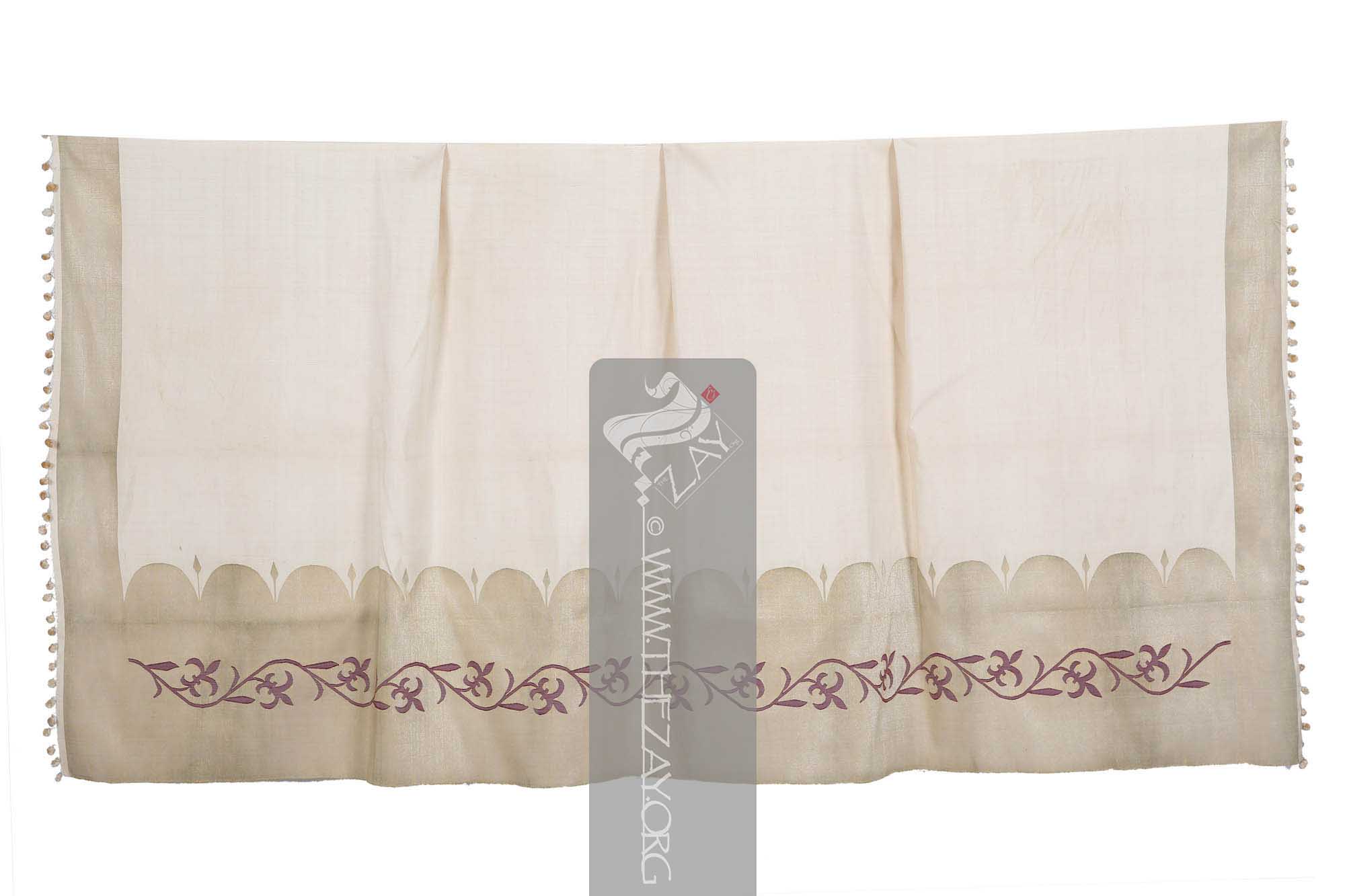
It is a set of two identical panels of (selvedge
Selvedge: (English: Self-finished edge or self-edge: a dialect forming transition), an edge produced on woven fabric during manufacture that prevents it from unravelling. Traditionally the term selvage applied to only loom woven fabric, presently it could be applied to flat knitted fabric too. ) to selvedge
Selvedge: (English: Self-finished edge or self-edge: a dialect forming transition), an edge produced on woven fabric during manufacture that prevents it from unravelling. Traditionally the term selvage applied to only loom woven fabric, presently it could be applied to flat knitted fabric too. (lancé
Lancé: (French: lancé – spear; Synonym: fil_coupé, lancé_ découpé, ghall ), a weaving technique where patterns are woven in, with extra weft
Weft: one of the two basic components used in weaving that transforms thread or yarns into a piece of fabric. It is the crosswise thread on a loom that is passed over and under the warp threads. yarns on the back and later clipped off and then lifted from the back to the fabric's face creating a delicate tactile fringe effect on the fabric, resembling embroidery. Ghall: (Arabic; Synonym: fil_coupé, lance_ découpé, lancé), a weaving technique where patterns are woven in, with extra weft
Weft: one of the two basic components used in weaving that transforms thread or yarns into a piece of fabric. It is the crosswise thread on a loom that is passed over and under the warp threads. yarns on the back and later clipped off and then lifted from the back to the fabric's face creating a delicate tactile fringe effect on the fabric, resembling embroidery.
This pattern is layered over a wide, scalloped border woven with gold yarn. An arrowhead pattern is alternately repeated between two curves of the scalloped border.
Two identical pieces of fabric such as these were often either hand stitched along their (weft
Weft: one of the two basic components used in weaving that transforms thread or yarns into a piece of fabric. It is the crosswise thread on a loom that is passed over and under the warp threads.) edges to each other to form a stitched version of the izar
Izār: (Arabic: azar: to support and strengthen, synonyms: wizrah
Wizrah: (Arabic: small garment, synonyms: izār, wizār, fūṭah), refers to a loincloth wrapped around the lower half of the body, between the navel and the knee. Known in the Arabian Peninsula, Iraq, the Horn of Africa (Somalia, Somaliland, Djibouti, Ethiopia, and Eritrea), Indonesia, Malaysia, Bangladesh, Pakistan, and countries in some parts of East Africa and in India., wizār, fūṭah, sharshaf
Sharshaf: (Ottoman Turkic: çarsaf – bed sheet; Synonym: mlaya, mlyaya, sharsaf), a set of large cloth usually used as a body wrap by women in public.
Interestingly, lance_découpé fabrics such as this were often woven in Syria, especially in Damascus and Aleppo, which were the two major weaving hubs of the Levant Arab region.
While referred to as the çarşaf / sharsaf in Syria, it is important to note that this term originates from Ottoman Turkic and literally translates to 'bed sheet'. In Ottoman Turkey, the Arab cloak, or (‘abayah ‘Abāyah: (Arabic: cloak, Pl. ‘abāyāt, or ‘Ibī. In Classical Arabic: ‘abā’ah, pl: ‘abā’āt, synonyms: ‘Abā, ‘abāh, ‘abāt, dafah Daffah : (Arabic: side, synonyms: ‘Abā, ‘abāyah, ‘abāh, ‘abāt, bisht or mishlaḥ), long, wide, and sleeveless outer cloak worn in public by both sexes. In time this article of dress evolved and changed in shape, style, and function., bisht Bisht: (Arabic: bjd or bjād: cloak, Akkadian: bishtu or Persian: back, pl. bshūt synonyms: ‘Abā,‘abāyah, ‘abāh, ‘abāt, dafah Daffah : (Arabic: side, synonyms: ‘Abā, ‘abāyah, ‘abāh, ‘abāt, bisht or mishlaḥ), long, wide, and sleeveless outer cloak worn in public by both sexes. In time this article of dress evolved and changed in shape, style, and function., or mishlaḥ), long, wide, and sleeveless outer cloak worn in public by men. In time this article of dress evolved and changed in shape, style, and function., or mishlaḥ), long, wide, and sleeveless outer cloak worn in public by both sexes. In time this article of dress evolved and changed in shape, style, and function.), was also called çarşaf.
It's worth mentioning that while the ‘abayah ‘Abāyah: (Arabic: cloak, Pl. ‘abāyāt, or ‘Ibī. In Classical Arabic: ‘abā’ah, pl: ‘abā’āt, synonyms: ‘Abā, ‘abāh, ‘abāt, dafah Daffah : (Arabic: side, synonyms: ‘Abā, ‘abāyah, ‘abāh, ‘abāt, bisht or mishlaḥ), long, wide, and sleeveless outer cloak worn in public by both sexes. In time this article of dress evolved and changed in shape, style, and function., bisht Bisht: (Arabic: bjd or bjād: cloak, Akkadian: bishtu or Persian: back, pl. bshūt synonyms: ‘Abā,‘abāyah, ‘abāh, ‘abāt, dafah Daffah : (Arabic: side, synonyms: ‘Abā, ‘abāyah, ‘abāh, ‘abāt, bisht or mishlaḥ), long, wide, and sleeveless outer cloak worn in public by both sexes. In time this article of dress evolved and changed in shape, style, and function., or mishlaḥ), long, wide, and sleeveless outer cloak worn in public by men. In time this article of dress evolved and changed in shape, style, and function., or mishlaḥ), long, wide, and sleeveless outer cloak worn in public by both sexes. In time this article of dress evolved and changed in shape, style, and function. is a sewn garment, the çarşaf is often unstitched. Although stitched çarşaf such as this also existed, it was not the same as the ‘abayah ‘Abāyah: (Arabic: cloak, Pl. ‘abāyāt, or ‘Ibī. In Classical Arabic: ‘abā’ah, pl: ‘abā’āt, synonyms: ‘Abā, ‘abāh, ‘abāt, dafah Daffah : (Arabic: side, synonyms: ‘Abā, ‘abāyah, ‘abāh, ‘abāt, bisht or mishlaḥ), long, wide, and sleeveless outer cloak worn in public by both sexes. In time this article of dress evolved and changed in shape, style, and function., bisht Bisht: (Arabic: bjd or bjād: cloak, Akkadian: bishtu or Persian: back, pl. bshūt synonyms: ‘Abā,‘abāyah, ‘abāh, ‘abāt, dafah Daffah : (Arabic: side, synonyms: ‘Abā, ‘abāyah, ‘abāh, ‘abāt, bisht or mishlaḥ), long, wide, and sleeveless outer cloak worn in public by both sexes. In time this article of dress evolved and changed in shape, style, and function., or mishlaḥ), long, wide, and sleeveless outer cloak worn in public by men. In time this article of dress evolved and changed in shape, style, and function., or mishlaḥ), long, wide, and sleeveless outer cloak worn in public by both sexes. In time this article of dress evolved and changed in shape, style, and function.. It is intriguing to observe how this Turkic term has evolved into a colloquial expression in the Arab region, especially in Syria, likely due to its historical connection to the Ottoman Empire.
Furthermore, owing to the extensive Arabic vocabulary, there exist regional variations in terminology for the same garment. While some references identify the complete ensemble as a çarşaf / sharsaf, others assert that the torso covering is the çarşaf and the skirt is the izar
Izār: (Arabic: azar: to support and strengthen, synonyms: wizrah
Wizrah: (Arabic: small garment, synonyms: izār, wizār, fūṭah), refers to a loincloth wrapped around the lower half of the body, between the navel and the knee. Known in the Arabian Peninsula, Iraq, the Horn of Africa (Somalia, Somaliland, Djibouti, Ethiopia, and Eritrea), Indonesia, Malaysia, Bangladesh, Pakistan, and countries in some parts of East Africa and in India., wizār, fūṭah, sharshaf
Sharshaf: (Ottoman Turkic: çarsaf – bed sheet; Synonym: mlaya, mlyaya, sharsaf), a set of large cloth usually used as a body wrap by women in public.
The latter group tends to refer to the entire ensemble as (mlayah
Mlāyah: (Arabic; Synonym: ‘izār, çarsaf, sharshaf
Sharshaf: (Ottoman Turkic: çarsaf – bed sheet; Synonym: mlaya, mlyaya, sharsaf), a set of large cloth usually used as a body wrap by women in public. Izār: (Arabic: azar: to support and strengthen, synonyms: wizrah
Wizrah: (Arabic: small garment, synonyms: izār, wizār, fūṭah), refers to a loincloth wrapped around the lower half of the body, between the navel and the knee. Known in the Arabian Peninsula, Iraq, the Horn of Africa (Somalia, Somaliland, Djibouti, Ethiopia, and Eritrea), Indonesia, Malaysia, Bangladesh, Pakistan, and countries in some parts of East Africa and in India., wizār, fūṭah, sharshaf
Sharshaf: (Ottoman Turkic: çarsaf – bed sheet; Synonym: mlaya, mlyaya, sharsaf), a set of large cloth usually used as a body wrap by women in public.
Moreover, comparable drapes are frequently observed among the women of North African nations like Algeria, Libya, and Tunisia. While the fabrics, weaves, and even dimensions may vary from those in the Levant, they are draped around the body in a similar fashion, secured by belts and sizable fibula brooches.
Links
Charuga: (Possibly Kurdish), a mantle-like embroidered women’s traditional garment from the Qaraqosh region in northern Iraq, traditionally fastened at the shoulder. Historically worn by field workers, it helped conceal dust and dirt, making them less visible during labour, it is a festive garment worn sparingly during festivals and other special occasions.
from Northern Iraq Has Arrived at the TRC!, www.trc-leiden.nl/trc/index.php/en/blog/1378-the-charugaCharuga: (Possibly Kurdish), a mantle-like embroidered women’s traditional garment from the Qaraqosh region in northern Iraq, traditionally fastened at the shoulder. Historically worn by field workers, it helped conceal dust and dirt, making them less visible during labour, it is a festive garment worn sparingly during festivals and other special occasions.
-from-northern-iraq-has-arrvied-at-the-trc. Accessed 29 Jan. 2024.