

The previous two instalments in this series examined the lifecycle of objects within museum and collection management, beginning with the broader international frameworks that inform professional practice. Part One focused on the principal pre-acquisition considerations involved in evaluating objects for potential inclusion within a collection, including collection relevance, institutional objectives, provenance, material and physical condition, and financial feasibility. Part Two then followed the object beyond acquisition, using The Zay Zay: (Arabic: costume, Pl. azyaā’), a set of clothes in a style typical of a particular country or historical period. Initiative as a case study to examine post-acquisition processes broadly informed by established international collections management standards such as SPECTRUM.
The present segment extends this discussion further into the post-acquisition lifecycle. Drawing on the practices of The Zay Zay: (Arabic: costume, Pl. azyaā’), a set of clothes in a style typical of a particular country or historical period. Initiative, it considers how objects acquire intellectual and interpretive value within a collection through curatorial research, scholarship, educational engagement and other forms of responsible and ethical activation. The focus therefore shifts from the process through which an object is acquired, documented and cared for to the ways in which it is subsequently researched, interpreted and meaningfully brought into circulation as a source of cultural knowledge.
Following formal acquisition and accession, a parallel stage for documentation takes place within the collection, undertaken and maintained by the Inventory Steward: Violeta. While the object is being prepared for external scanning and digitisation, a permanent individual digital record keeping template is generated for each formally acquired object. This template is used to establish the object’s core documentary record and structured framework for consolidating its identification, research, provenance, condition and other relevant collection information.
After photography, scanning and digitisation, the object is returned to the collection and enters a further stage of curatorial and research-based processing. As noted previously, digitisation may take place considerably after an object’s initial acquisition and formal integration into the collection. Given the cost associated with high-resolution photography and scanning, objects are often consolidated into batches for external processing, allowing the digitisation workflow to be undertaken in a more efficient and cost-effective manner. Consequently, an object may enter the curatorial research process well before its scheduled photography and digitisation, reflecting the non-linear nature of collection documentation and research workflows.
Upon the object’s return, the curatorial research team, headed by Rajrupa D under the direct supervision of Founder and CEO Dr Reem El Mutwalli, undertakes a detailed examination of the object. This stage involves the systematic study of its material and visual characteristics, historical context, function and associated provenance. Relevant finding are documented as part of the object’s permanent research record, including a concise provenance and historical brief that can support future scholarship, interpretation and collections management.
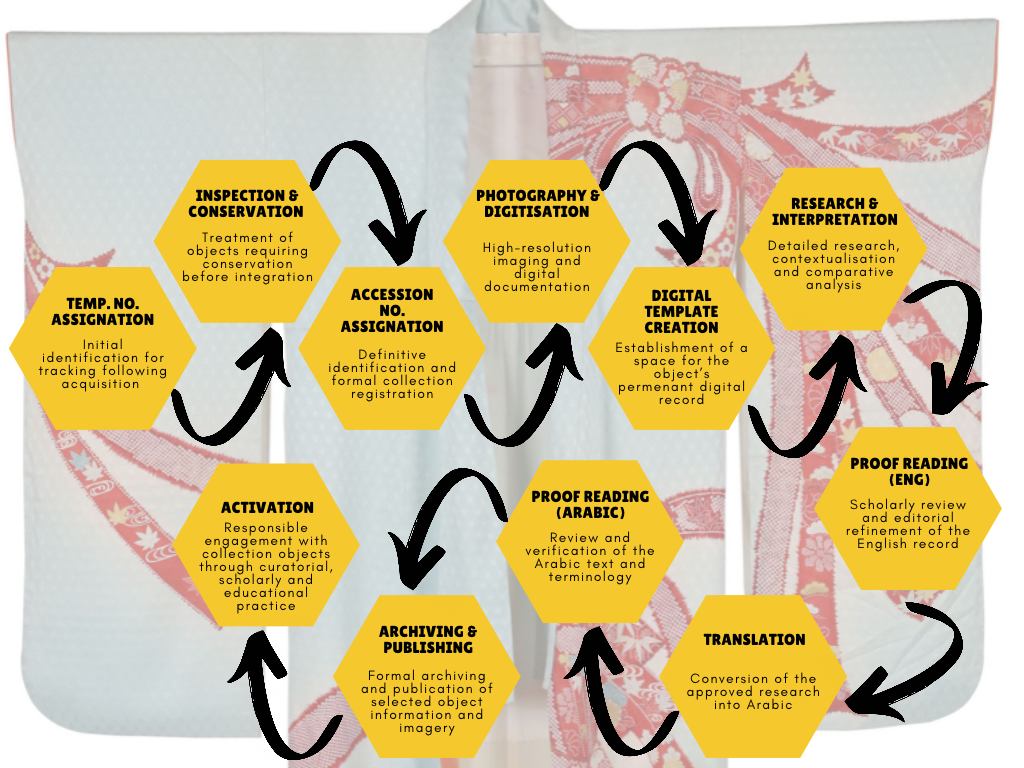
The research process also incorporates comparative analysis, situating each object in relation to comparable or contemporary examples where relevant. Such comparisons may consider similarities and distinctions in form, construction, material, ornamentation, function, chronology and regional context, thereby contributing to a more nuanced understanding of the object’s historical and cultural significance within the wider collection.
The research process also provides an opportunity to identify, verify and document relevant terminology associated with an object. Where required, preliminary etymological research is undertaken to examine the origins, linguistic development and historical usage of particular terms, contributing to a more nuanced understanding of the object’s nomenclature, history and evolving cultural context.
The completed research subsequently undergoes review and editorial refinement under the supervision of Dr Reem El Mutwalli. Her contribution extends beyond editorial oversight to include additional research, the incorporation of relevant oral-history accounts, and contextual insights drawn from her own experience with particular objects and their acquisition histories. This process allows documented research to be supplemented, where appropriate, by forms of knowledge that may not be captured within conventional written or archival sources.
Following approval, the English-language research is transferred to the editorial department, headed by AD, for translation into Arabic. This translation process involves more than linguistic conversion; particular attention is given to specialised terminology, nomenclature and the etymological development of relevant terms. The Arabic text is therefore subject to its own process of research and verification, undertaken by AD under Dr Reem’s supervision.
The production of the bilingual research record consequently involves sustained coordination between the English-language research and Arabic editorial team. Terminology, interpretation and contextual information are reviewed across both language versions to establish a coherent and consolidated body of research. The interactive process can be among the most time-intensive stages of object documentation, reflecting the importance of maintaining both linguistic accuracy and scholarly consistency across the collection’s bilingual records.
Once the research has been completed and the object’s digital record populated with the relevant information in both English and Arabic, the resulting data is formally archived, with selected information subsequently published on The Zay Zay: (Arabic: costume, Pl. azyaā’), a set of clothes in a style typical of a particular country or historical period. Initiative’s website alongside the object’s high-resolution images. Where photography and scanning have not yet been completed, a low-resolution image may be used as a temporary visual reference within the digital record and, where appropriate, on the website. This placeholder image is subsequently replaced with high-resolution photographic record once the object undergoes its scheduled digitisation process, ensuring that the digital record is progressively updated as the object moves through the collection’s documentation workflow.
The archival and publication stages are undertaken collaboratively by the research and Arabic editorial teams, with responsibilities coordinated across both functions. The archival process is managed and supervised by Rajrupa D., Head of Research, while the publication to The Zay Zay: (Arabic: costume, Pl. azyaā’), a set of clothes in a style typical of a particular country or historical period. Initiative’s website is overseen by the Arabic editorial supervisor AD, who is also responsible for the organisation’s backend website management.
The research team assumes responsibility for external requests involving scholarly access as well as the educational and other forms of responsible use of objects within the collection, following the completion of the research and documentation stages. For temporary displays and exhibitions, objects are shortlisted in accordance with the specific curatorial framework of the proposed project. The research team subsequently prepares the relevant research materials and supporting literature, ensuring that the interpretation of each object is informed by its documented history, material characteristics and wider cultural context.
The associated logistical arrangements are coordinated by Violeta, The Zay Zay: (Arabic: costume, Pl. azyaā’), a set of clothes in a style typical of a particular country or historical period.’s Inventory Steward, and Christeta of Operations and Logistics Support, while matters relating to insurance and indemnity are generally overseen by Founder Dr Reem. The activation of collection objects for exhibition purposes is subject to prior consideration and approval of the proposed exhibition’s purpose and curatorial objectives. This process involves careful assessment by both the research team and the Founder to ensure that the proposed use is appropriate to the object, consistent with the collection’s institutional objectives, and capable of supporting responsible interpretation and engagement.
Finally, it is important to recognise that collections management practice is not uniform across museums and collecting organisations. While SPECTRUM provides an internationally recognised framework for structuring and documenting key aspects of collections care, institutions that draw upon its procedures do not necessarily implement every procedure in an identical or perspective manner. Rather SPECTRUM informed practices are adapted and applied in conjunction with each institution’s own policies; resources, collecting priorities and operational requirements. The value of such a framework therefore lies not in rigid adherence, but in its capacity to provide a coherent professional foundation that can be meaningfully adapted to different collecting contexts. Ultimately, effective collections management depends upon the considered relationship between established professional standards and the particular responsibilities, resources and objectives of an individual collection. It is through this balance that an object can be responsibly acquired, documented, preserved, researched and ultimately activated as a source of knowledge, ensuring that collections remain not merely repositories of objects, but dynamic and sustainable sites of cultural memory and scholarship.