

Museum professionals are frequently asked what their work entails within a collection. Equally common are questions about how museums and private collections acquire artefacts, and what happens to these objects once they enter a collection. Although such questions may appear seeming straightforward, they touch upon a complex network of professional practices that extends well beyond the visible presentation of objects to the public.
For those working within the museum and collections sector, the processes involved may seem routine. Yet the work undertaken by curatorial professionals encompasses a remarkable broad and interdisciplinary field. Research, provenance, investigation, documentation, collections management, conservation, interpretation, exhibition development, scholarship and public engagement may all form part of the lifecycle of an object within a collection. Each of these areas requires its own body of knowledge, methodologies and professional considerations, while often intersecting with disciplines beyond the traditional boundaries of art history and museology.
This breadth can make the role of the curator particularly difficult to articulate to audiences outside the museum profession. The term “curator” is often associated primarily with exhibitions and the interpretation of objects on display, while much of the intellectual and practical labour that makes such interpretation possible remains largely unseen. An object’s appearance in an exhibition is therefore only one stage within a considerably longer process – one that may begin with acquisition and continue through research, documentation, care, interpretation and, ultimately the creation of new forms of knowledge around the object.
Understanding this wider lifecycle is essential to appreciating not only what museums and collections do, but also the diverse professional expertise required to transform an artefact from an isolated material object into a researched, documented and meaningful cultural resource.
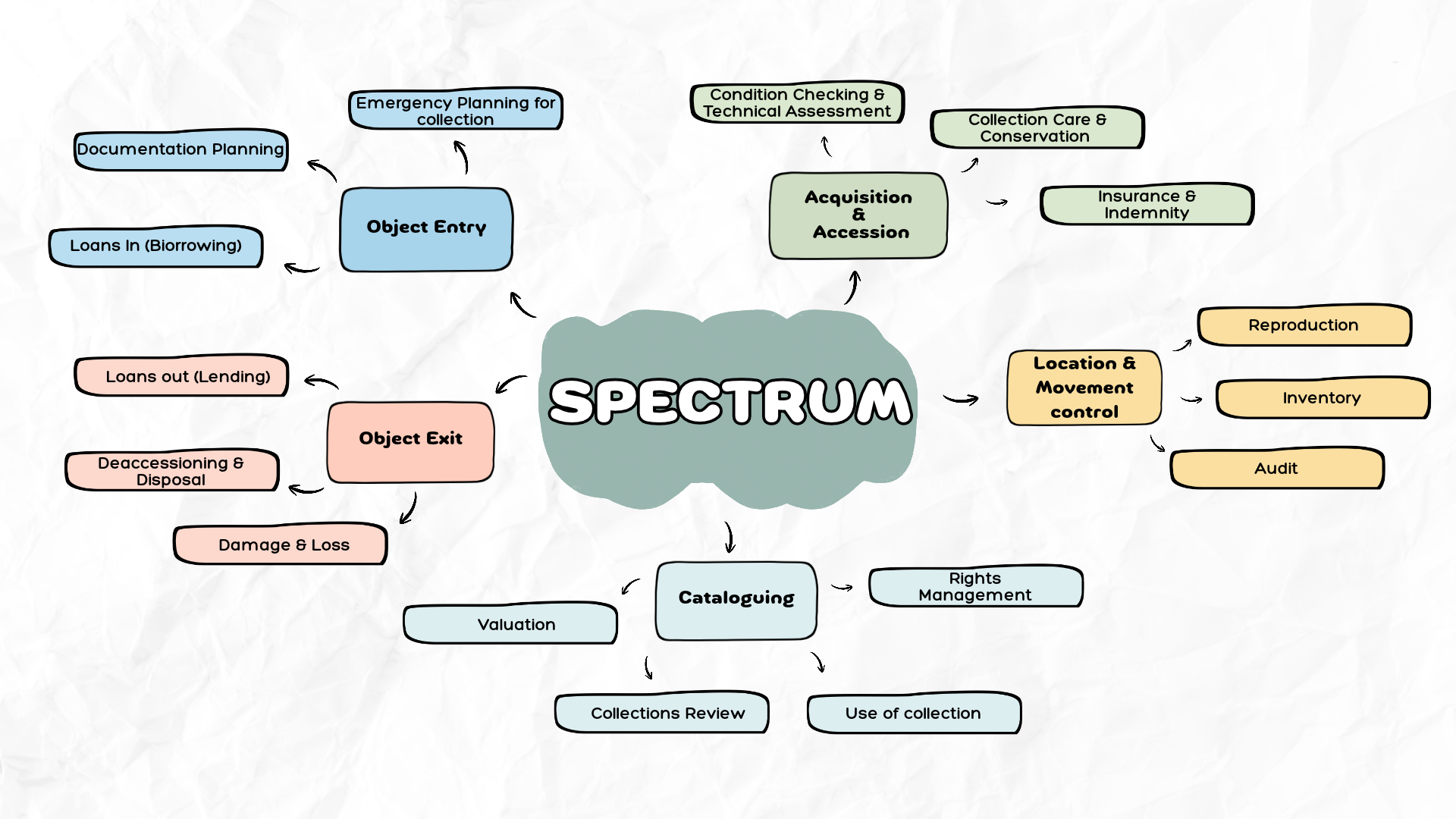
Like many professionally managed collections, The Zay Zay: (Arabic: costume, Pl. azyaā’), a set of clothes in a style typical of a particular country or historical period. Initiative broadly follows the structured collection-management framework informed by SPECTRUM standards. For those unfamiliar with SPECTRUM, it is one of the widely used internationally recognised frameworks that provides practical, tried-and-tested guidance for the management and documentation of museum collections. Rather that prescribing a single method of working, SPECTRUM sets out a series of procedures that reflect the principal activities involved in managing objects throughout their lifecycle.
These procedures encompass both routine and periodic aspects of collections care. Everyday activities may include moving objects between locations, recording changes in location, and maintaining accurate object documentation, while less frequent processes can include activities such as reviewing and updating insurance arrangements. Collectively, these activities form part of a systematic approach to ensuring that objects remain appropriately documented, traceable, accessible and cared for throughout their time within a collection.
SPECTRUM currently identifies 21 principal procedures, providing a comprehensive framework through which collections professionals can structure and monitor the various stages of an object’s journey – from acquisition and documentation through to use, movement, research, loan and, where applicable, eventual disposal.
While the procedures that follow an object’s acquisition are an important part of collection practice, the work that precedes acquisition is no less significant. In many respects, an object’s journey into a collection begins long before it physically crosses the threshold. The process begins with the identification of an object considered potentially relevant to the collection. For researchers and curators, this is rarely a passive exercise. Objects of potential interest may emerge through research, fieldwork, networks of collections and scholars, commissions, donations, dealers, auctions, private holdings or other forms of professional engagements. Their role is therefore partly one of continual observation: remaining attentive to objects that may contribute meaningfully to the collection’s existing holdings, address areas of research or documentation, or strengthen its representation of particular histories and material cultures.
Requisite
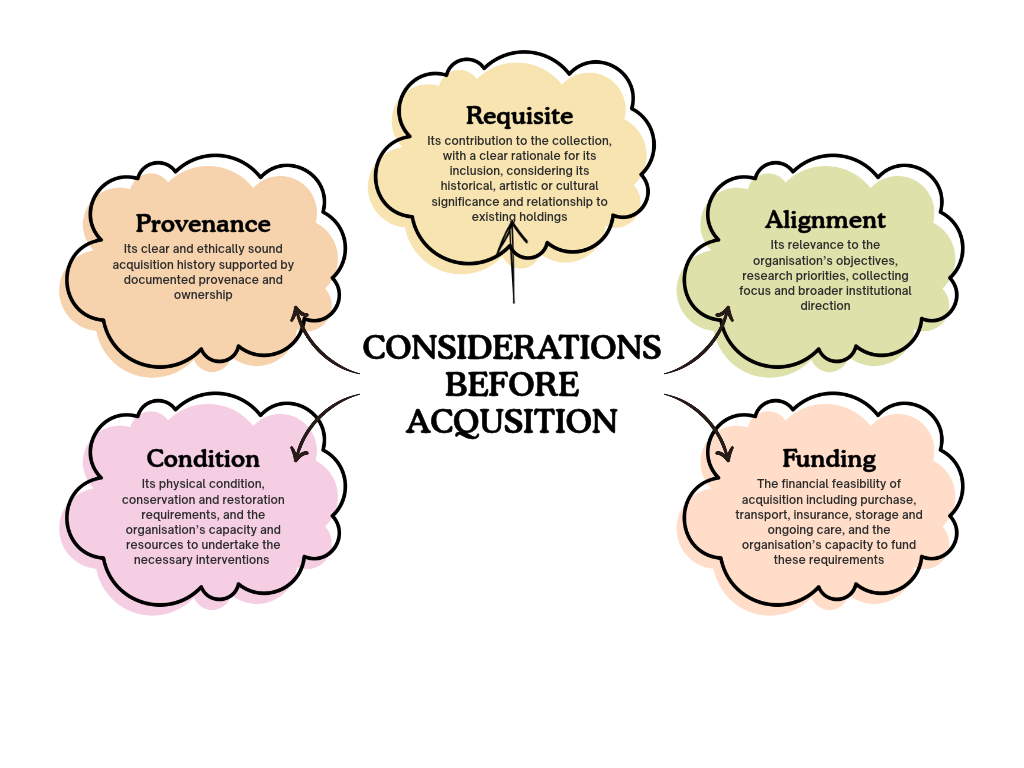
Identifying a potential acquisition initiates a series of questions, assessments and justifications. The first concerns the object’s place within the collection itself: does the object fulfil a meaningful need, and can a clear rationale be established for its inclusion? Curators must therefore consider not only the object’s historical, artistic, or cultural significance, but also its relationship to the existing holdings. An object may be compelling in its own right, yet its acquisition may offer limited value if the collection already contains objects that perform a substantially similar function in terms of chronology, geography, material, typology or historical representation.
At The Zay Zay: (Arabic: costume, Pl. azyaā’), a set of clothes in a style typical of a particular country or historical period. Initiative, the assessment of potential acquisitions takes place within a collection that already contains a substantial number of objects of comparable historical, cultural, and material significance. This is, in part, a reflection of the collection’s distinctive acquisition history: a significant portion of its holdings have entered the collection through gifts and donations from dedicated followers, supporters and patrons. Such contributions have played an important role in shaping the breadth and character of the collection, while also creating the need for careful consideration of how prospective acquisitions relate to an already extensive and continually developing body of material.
Alignment
A second related consideration concerns the object’s alignment with the institution’s broader mission and vision. Although these two assessments may initially appear interchangeable, they address distinct aspects of the acquisition process. The first evaluates the object in relation to the collection itself – what it contributes, what gap it may address, and whether its inclusion strengthens or meaningfully expands the existing body of material. The second considers the object within the wider intellectual and institutional framework – whether its acquisition supports the organisation’s stated objectives, areas of research, collecting priorities and long-term direction.
For The Zay Zay: (Arabic: costume, Pl. azyaā’), a set of clothes in a style typical of a particular country or historical period. Initiative, these considerations are anchored in the institution’s stated mission and vision. Its mission centres on the preservation of cultural heritage through the collection by documenting and archiving historical Arab dress and the stories associated with these material forms. Its vision extends this work beyond preservation alone, seeking to foster global cross-cultural dialogue and, in doing so, inspire and engage creative minds. These principles provide an institutional framework against which potential acquisitions can be considered – not only for their individual significance, but also for their capacity to contribute to the broader cultural, scholarly and interpretive objective of the collection.
Taken together, these considerations ensure that acquisition is not simply a matter of identifying an interesting or significant object. Rather, each potential acquisition must be understood both as an individual artefact with its own historical and material significance and as a prospective component of a larger, evolving body of knowledge.
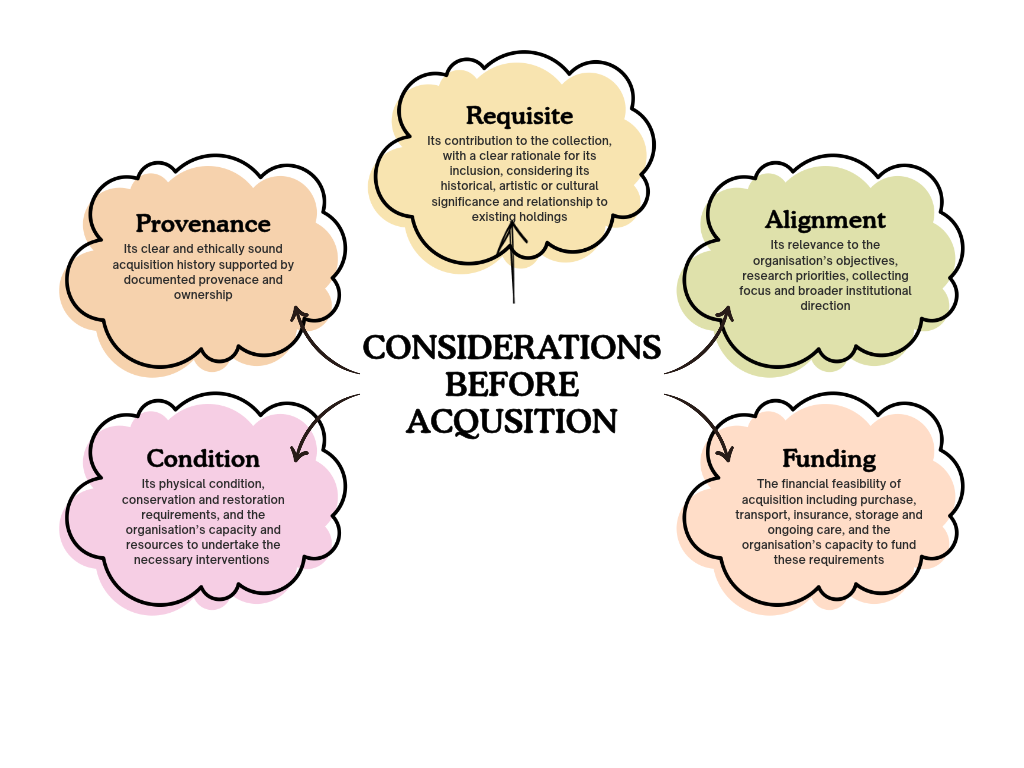
Once a potential acquisition has been identified, a more intensive process of investigation begins. Its provenance, condition, material characteristics, and funding must be carefully considered before the object can be evaluated for acquisition. What may appear to an external observer as the simple addition of an artefact to a collection is, in practice, the beginning of a carefully considered process of research, assessment and documentation.
The following section would turn to the procedures outlined above and examine the object’s journey beyond the point of formal acquisition. Particular attention will be given to the practices that sustain an object throughout its subsequent lifecycle within the collection, including care, preventive conservation, restoration, documentation, digital archiving, research and ethical use. Together these processes reveal how acquisition marks not an endpoint, but the beginning of an ongoing institutional responsibility through which an object is preserved, understood and continually activated as a source of cultural knowledge.