

Author Dr Reem Tariq
Ṭariq: (Arabic; Synonym: tulle_bi_talli
Tūlle_bi_tallī: (French: Tulle – a city in France where fine material for veil was first made; Turkish: tel – wire; Synonym: tariq; talli; badla; khus_dozi ), series of small metal knots made on a woven net ground as embellishment. The term is commonly used in the North African Arab region specifically in Egypt.
Co Authored and Edited by Rajrupa Das
While the previous part outlined the structural and comparative foundations of draped garments, this third part turns to historically grounded case studies that illuminate how these shared material grammars were localized and re-signified. Through examination of the kanga, the Sudanese tobe Tobe: (Arabic: thawb, Pl. Athwāb/thībān), can be pronounced thawb or thobe based on locale. The standard Arabic word for ‘fabric’ or ‘garment’. It can refer to a qamīs-like tunic worn by men and women in the Arabian Peninsula, Iraq, the southern and south-western ports and islands of Iran, and some countries in East and West Africa. More specifically, it can refer to the square-shaped Bedouin overgarment worn by women. , and the Indian sari, this section explores how wrapped textiles became embedded within particular social, economic, and symbolic worlds.
These cases demonstrate that unstitched garments did not circulate as finished cultural forms but as adaptable materials whose meanings were shaped through port cities, riverine systems, and regional traditions. By tracing these trajectories, Part III highlights the multiplicity of pathways through which draped garments acquired enduring social significance.
Case Study#1: The Kanga and the role of port cities
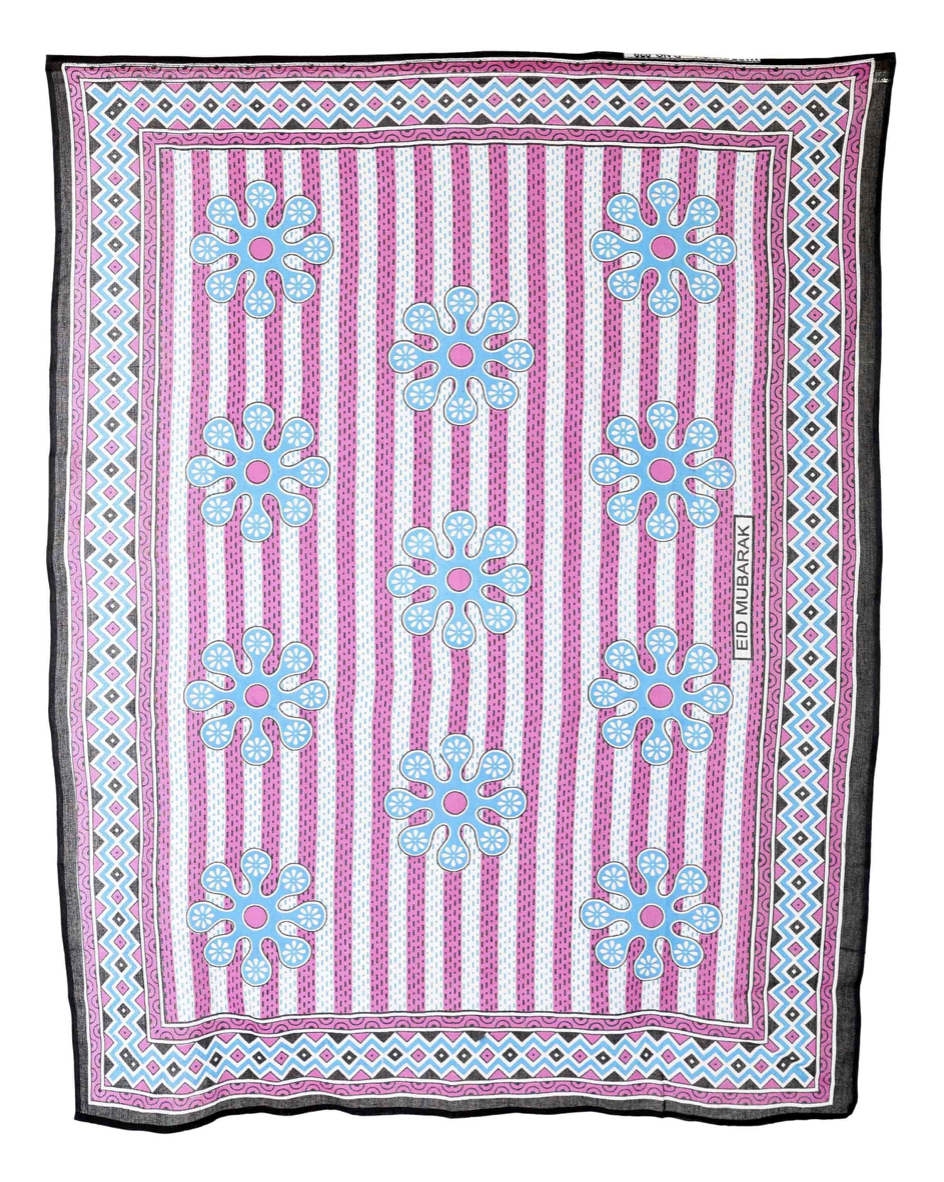
The kanga emerged in its recognizable modern form during the nineteenth century along the Swahili coast, a region long shaped by Indian Ocean commerce and cosmopolitan exchange. Early iterations drew upon imported materials, notably unbleached American cotton (merikani) and kerchief squares (lenços) circulating through Portuguese and Indo-Oceanic trade networks. By the late nineteenth and early twentieth centuries, the production of printed kangas – distinguished by their characteristic borders and inscribed proverbs – had expanded, initially through manufacture in India and subsequently through local printing industries in East Africa. This trajectory evidences direct material linkages to global textile markets, particularly Indian and American cloth imports, as well as processes of technological transfer, including block-printing and later roller-printing techniques.
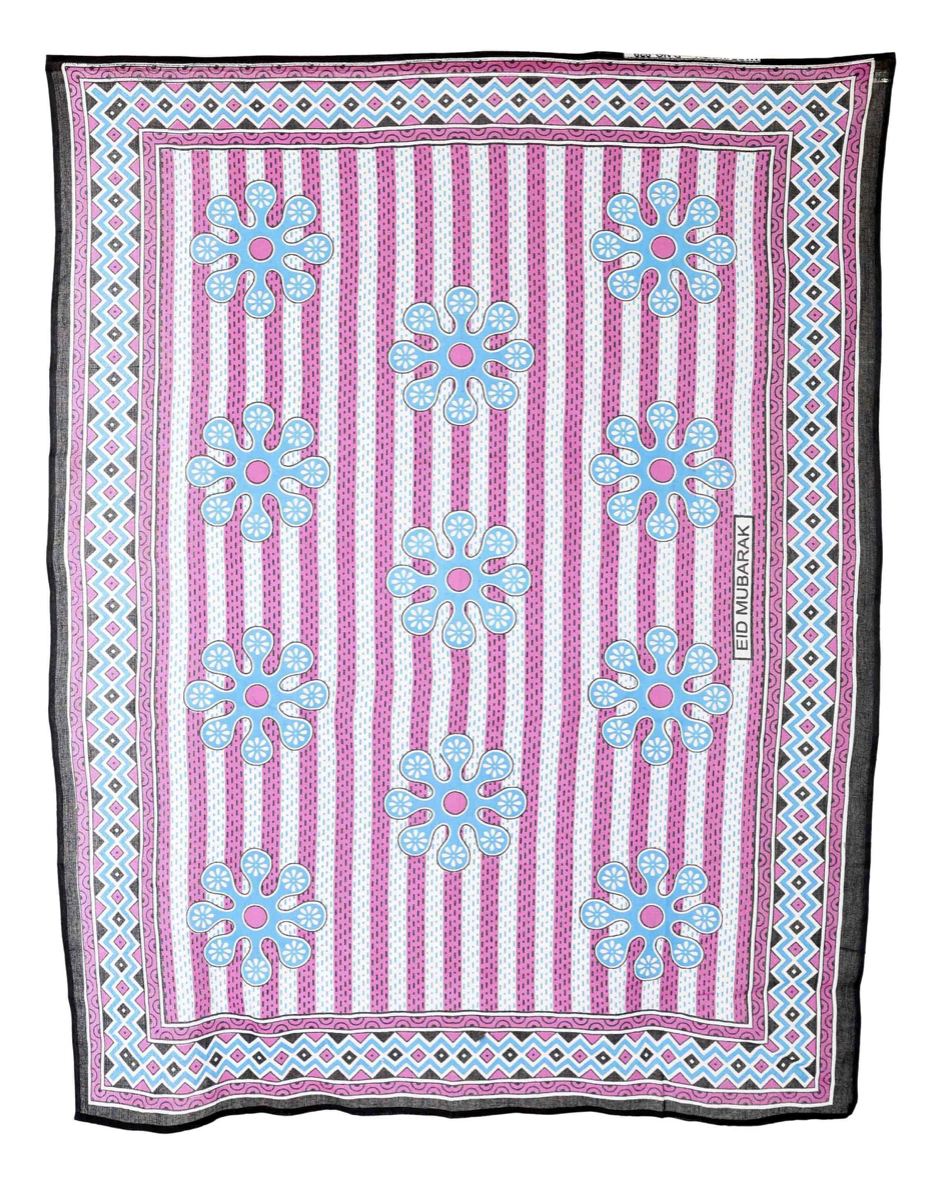
Printed Fabric, Dar es Salaam, Tanzania, c. 21st century; ZI2022.501009.3 AFRICA; The Zay Zay: (Arabic: costume, Pl. azyaā’), a set of clothes in a style typical of a particular country or historical period. Initiative
Beyond their material production, kangas developed a complex social semiotics. Through jina or proverbial inscriptions, they acquired explicit communicative functions, operating simultaneously as garments and as textual media. Over time, the kanga became a central element of women’s public dress across the Swahili coast and its hinterlands, embodying both economic value and social meaning. Its evolution exemplifies the indigenization of imported textiles through the creation of locally resonant aesthetics and culturally specific modes of use.
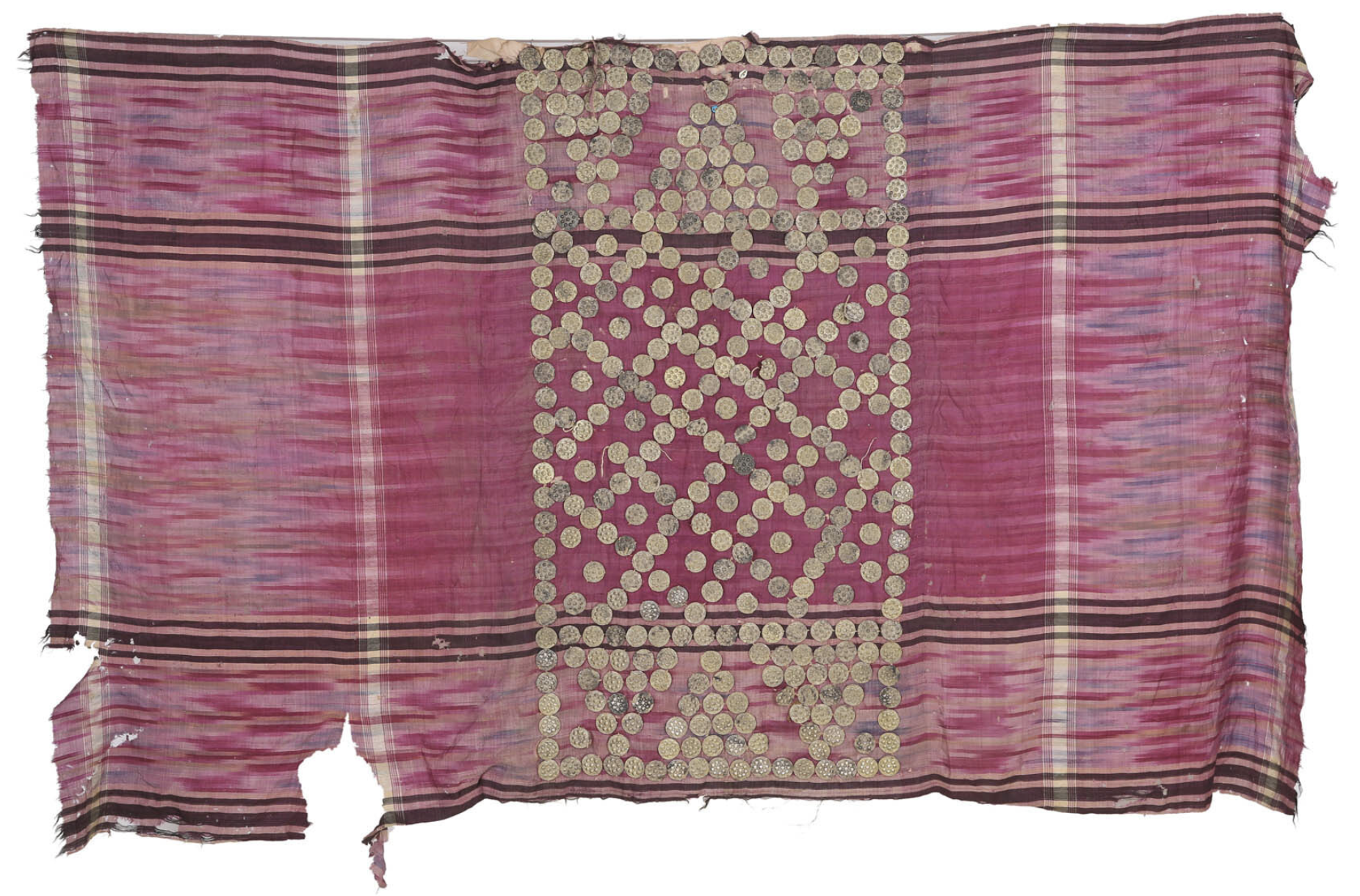
Metal Embellished Silk Ceremonial Bath cloth, Iraq, c. early 20th century; ZI1967.500633 IRAQ ; The Zay Zay: (Arabic: costume, Pl. azyaā’), a set of clothes in a style typical of a particular country or historical period. Initiative
The kanga offers an instructive comparative framework for understanding the diffusion of the izar
Izār: (Arabic: azar: to support and strengthen, synonyms: wizrah
Wizrah: (Arabic: small garment, synonyms: izār, wizār, fūṭah), refers to a loincloth wrapped around the lower half of the body, between the navel and the knee. Known in the Arabian Peninsula, Iraq, the Horn of Africa (Somalia, Somaliland, Djibouti, Ethiopia, and Eritrea), Indonesia, Malaysia, Bangladesh, Pakistan, and countries in some parts of East Africa and in India., wizār, fūṭah, sharshaf
Sharshaf: (Ottoman Turkic: çarsaf – bed sheet; Synonym: mlaya, mlyaya, sharsaf), a set of large cloth usually used as a body wrap by women in public. Izār: (Arabic: azar: to support and strengthen, synonyms: wizrah
Wizrah: (Arabic: small garment, synonyms: izār, wizār, fūṭah), refers to a loincloth wrapped around the lower half of the body, between the navel and the knee. Known in the Arabian Peninsula, Iraq, the Horn of Africa (Somalia, Somaliland, Djibouti, Ethiopia, and Eritrea), Indonesia, Malaysia, Bangladesh, Pakistan, and countries in some parts of East Africa and in India., wizār, fūṭah, sharshaf
Sharshaf: (Ottoman Turkic: çarsaf – bed sheet; Synonym: mlaya, mlyaya, sharsaf), a set of large cloth usually used as a body wrap by women in public.
Case Study#2: The Sudanese Tobe Tobe: (Arabic: thawb, Pl. Athwāb/thībān), can be pronounced thawb or thobe based on locale. The standard Arabic word for ‘fabric’ or ‘garment’. It can refer to a qamīs-like tunic worn by men and women in the Arabian Peninsula, Iraq, the southern and south-western ports and islands of Iran, and some countries in East and West Africa. More specifically, it can refer to the square-shaped Bedouin overgarment worn by women. /Toub and the Nile Valley continuities
The Sudanese tobe Tobe: (Arabic: thawb, Pl. Athwāb/thībān), can be pronounced thawb or thobe based on locale. The standard Arabic word for ‘fabric’ or ‘garment’. It can refer to a qamīs-like tunic worn by men and women in the Arabian Peninsula, Iraq, the southern and south-western ports and islands of Iran, and some countries in East and West Africa. More specifically, it can refer to the square-shaped Bedouin overgarment worn by women. or toub is widely understood as a culturally deep-rooted garment with antecedents in long-standing Nile Valley draping traditions. Contemporary heritage discourse, including UNESCO-oriented summaries, alongside Sudanese scholarly literature, emphasizes both the garment’s antiquity and its subsequent stylistic transformations. These include the adoption of indigo Indigo: (Latin: Indigo – India, synonym: nil Nīl: (Latin: indigo), Arabised term for Indigo, a natural dye belonging to the ‘Indigofera Tinctoria’ species of plants that have been cultivated in East Asia, Egypt, India, and Peru since antiquity. According to Pliny the Elder, it was named after India as it was the source of the dye.), a natural dye belonging to the ‘Indigofera Tinctoria’ species of plants that has been cultivated in East Asia, Egypt, India, and Peru since antiquity. According to Pliny the Elder, it was named after India as it was the source of the dye. -dyed textiles, the incorporation of embroidery, and the increasing use of imported fabrics, each of which reflects shifting aesthetic preferences and economic conditions over time. The tobe Tobe: (Arabic: thawb, Pl. Athwāb/thībān), can be pronounced thawb or thobe based on locale. The standard Arabic word for ‘fabric’ or ‘garment’. It can refer to a qamīs-like tunic worn by men and women in the Arabian Peninsula, Iraq, the southern and south-western ports and islands of Iran, and some countries in East and West Africa. More specifically, it can refer to the square-shaped Bedouin overgarment worn by women. ’s extended length and its function as a combined body and head covering articulate a mode of drapery distinct from shorter waist wraps, while remaining connected to them through a shared technical grammar of unstitched cloth, modular draping, and bodily enclosure.
From a comparative perspective, the tobe Tobe: (Arabic: thawb, Pl. Athwāb/thībān), can be pronounced thawb or thobe based on locale. The standard Arabic word for ‘fabric’ or ‘garment’. It can refer to a qamīs-like tunic worn by men and women in the Arabian Peninsula, Iraq, the southern and south-western ports and islands of Iran, and some countries in East and West Africa. More specifically, it can refer to the square-shaped Bedouin overgarment worn by women. illuminates a historical trajectory that differs markedly from that of the kanga. Whereas the kanga emerged through port-city dynamics and the circulation of printed panels within maritime trade networks, the tobe Tobe: (Arabic: thawb, Pl. Athwāb/thībān), can be pronounced thawb or thobe based on locale. The standard Arabic word for ‘fabric’ or ‘garment’. It can refer to a qamīs-like tunic worn by men and women in the Arabian Peninsula, Iraq, the southern and south-western ports and islands of Iran, and some countries in East and West Africa. More specifically, it can refer to the square-shaped Bedouin overgarment worn by women. exemplifies the persistence of older, riverine sartorial traditions that later absorbed commercially produced textiles. This contrast underscores how differing ecological and economic pathways – riverine versus maritime – generated distinct yet interconnected forms of wrapped dress, each shaped by local histories while participating in broader regional textile systems.
Case Study#3: The Indian Sari and South Asian draped traditions – continuity, specialization, and interaction
The sari constitutes one of the most enduring draped garments of South Asia, characterized by a long rectangular length of cloth whose width and draping configurations vary across region, period, and social context. With deep roots in antiquity, the sari functions both as an item of everyday dress and as a garment of high ceremonial significance. Scholarly studies of South Asian dress emphasize not only the antiquity of the sari but also its internal diversity, shaped by regional draping styles, material choices, and caste- and class-inflected modes of wear. This internal differentiation underscores the sari’s capacity for adaptation within a stable technical framework of unstitched cloth and modular draping.
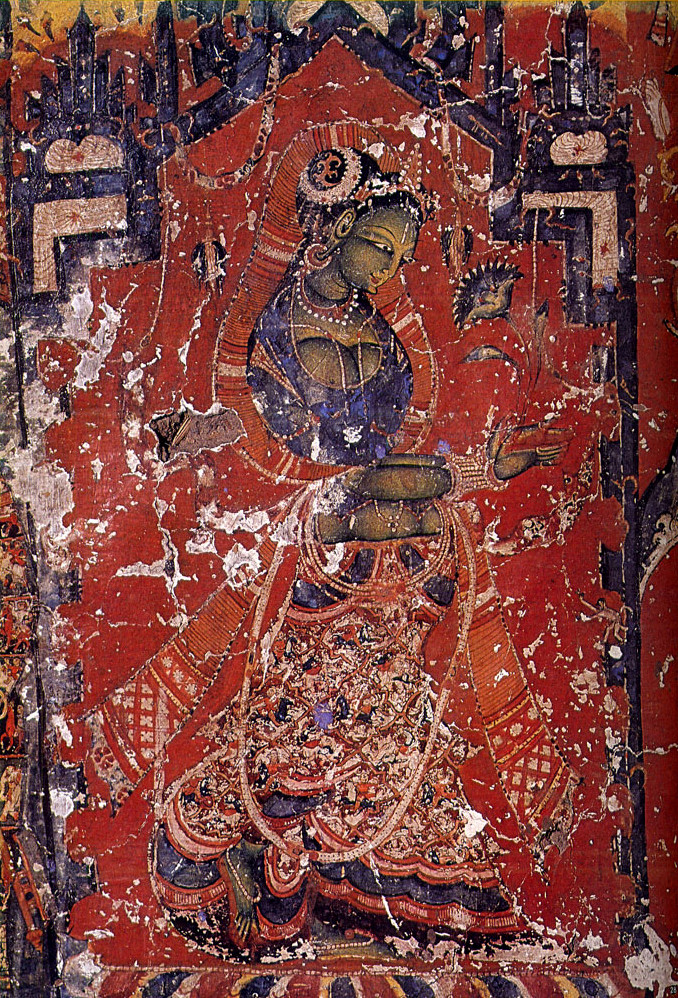
Green Tara Tarā: A kind of turban traditionally worn by Lori speaking ethnic women over their scarves. , Ladakh, India, c. 11th century; Source: Sumtsek hall at Alci monastery, Ladakh, India; Wikimedia Commons
Interactions between South Asian draped traditions and African and Arabian wrappers were facilitated primarily through Indian Ocean trade networks. Indian port exports – including cotton textiles and printed fabrics from the Coromandel Coast and other production centres – supplied markets in East Africa and the Arabian Peninsula over several centuries. Printed cloths, kerchiefs, and later factory-produced lengths originating in South Asia were incorporated directly into East African wrapped garments such as the kanga and kitenge, while South Asian migrant communities along the Swahili coast transmitted both textile materials and embodied knowledge of wrapping techniques. Although the sari as a complete draping system remained anchored within South Asian cultural practice, its constituent materials and certain draping cues entered broader coastal sartorial repertoires.
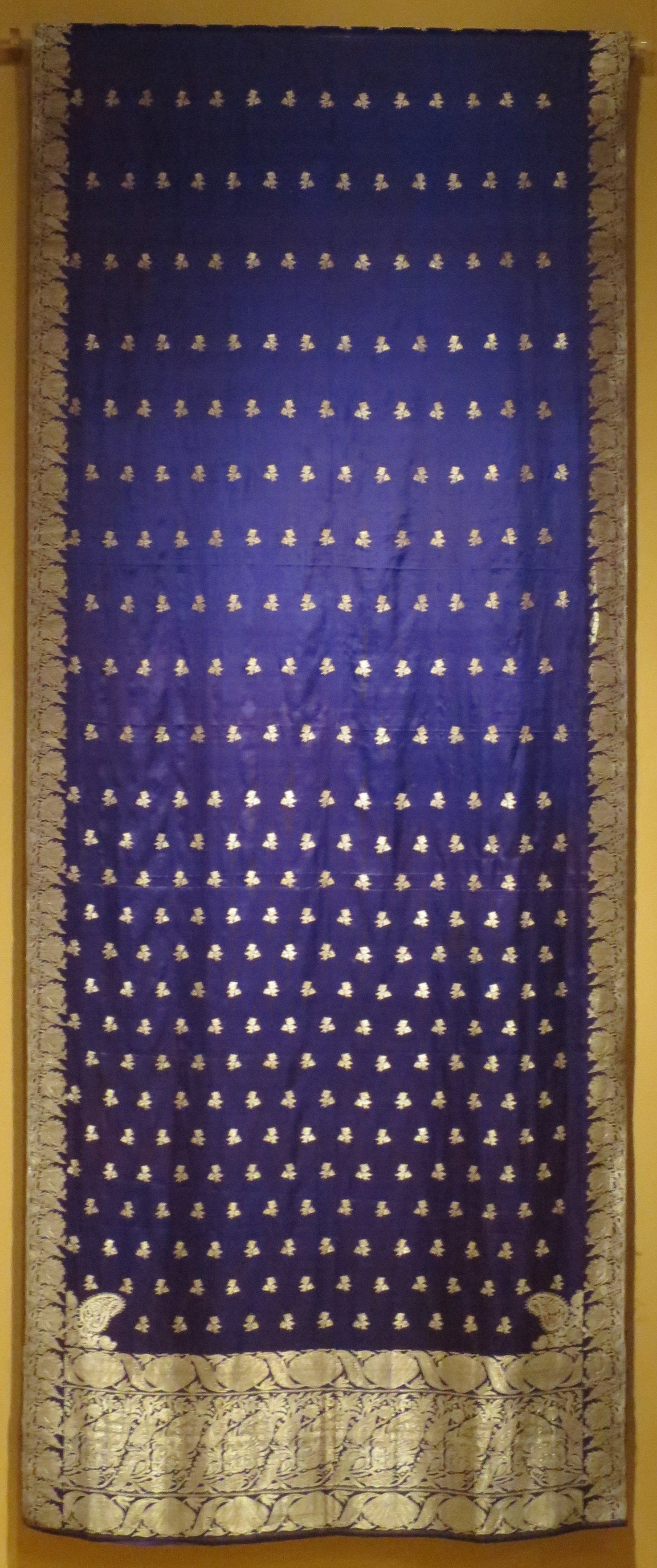
Sari from India, Banaras, India, c. 1950s; Source: Honolulu Museum of Art; Acc. No: 5375.1Wikimedia Commons
The available evidence does not support a linear or unidirectional model of derivation – for example, from sari to kanga – but instead points to patterns of reciprocal influence and sustained textile circulation. The sari and garments of the izar
Izār: (Arabic: azar: to support and strengthen, synonyms: wizrah
Wizrah: (Arabic: small garment, synonyms: izār, wizār, fūṭah), refers to a loincloth wrapped around the lower half of the body, between the navel and the knee. Known in the Arabian Peninsula, Iraq, the Horn of Africa (Somalia, Somaliland, Djibouti, Ethiopia, and Eritrea), Indonesia, Malaysia, Bangladesh, Pakistan, and countries in some parts of East Africa and in India., wizār, fūṭah, sharshaf
Sharshaf: (Ottoman Turkic: çarsaf – bed sheet; Synonym: mlaya, mlyaya, sharsaf), a set of large cloth usually used as a body wrap by women in public.
The case studies presented here underscore the multiplicity of pathways through which draped garments emerged and endured. Whether shaped by maritime trade, riverine continuity, or internal regional specialization, each example demonstrates how shared material grammars were refracted through local histories and social structures. Rather than suggesting linear diffusion, these cases point to reciprocal influence, selective adoption, and contextual reinterpretation.
The final part of this series will synthesize these insights by examining the mechanisms that enabled such connections, including trade, migration, technology, and symbolic reuse. It will also address future directions for research and conclude with a broader reflection on the izar
Izār: (Arabic: azar: to support and strengthen, synonyms: wizrah
Wizrah: (Arabic: small garment, synonyms: izār, wizār, fūṭah), refers to a loincloth wrapped around the lower half of the body, between the navel and the knee. Known in the Arabian Peninsula, Iraq, the Horn of Africa (Somalia, Somaliland, Djibouti, Ethiopia, and Eritrea), Indonesia, Malaysia, Bangladesh, Pakistan, and countries in some parts of East Africa and in India., wizār, fūṭah, sharshaf
Sharshaf: (Ottoman Turkic: çarsaf – bed sheet; Synonym: mlaya, mlyaya, sharsaf), a set of large cloth usually used as a body wrap by women in public.