

Introduction
Dress has long functioned as a mobile archive of cultural exchange, encoding histories of migration, trade, and imperial contact within its materials, forms, and terminologies. Across the premodern and early modern worlds, transregional trade routes – particularly those linking Central Asia, the Mediterranean basin, North Africa, and the Indian Ocean – facilitated not only the circulation of commodities but also the transmission of aesthetic conventions, technical knowledge, and linguistic vocabularies. Within this context, garments rarely emerged as isolated, locally bounded phenomena; rather, they evolved through processes of adaptation, appropriation, and reinterpretation as they moved across geographies and social systems.
The ghlilah Ghlīlah: (diminutive of the Arabic: ghlālah: waistcoat, synonyms: sadār, sadrīyah, sadārah, strah) short or medium length waistcoat worn generally with balloon pants (sarwāl mdawar) also known as (sarawāl chlqah)., a waistcoat-like garment widely worn by women in Algeria from the early modern period onward, offers a compelling case study of these dynamics. Although commonly understood today as a distinctly North African – and more specifically Arab – garment, the ghlilah Ghlīlah: (diminutive of the Arabic: ghlālah: waistcoat, synonyms: sadār, sadrīyah, sadārah, strah) short or medium length waistcoat worn generally with balloon pants (sarwāl mdawar) also known as (sarawāl chlqah). embodies a layered genealogy that points to deeper transregional connections. Its form, decorative vocabulary, and nomenclature reveal affinities with Central Asian, Ottoman, Mediterranean, and even South Asian vestimentary traditions, shaped by centuries of commercial exchange and imperial entanglement. Moreover, the phonetic and etymological resonances between ghlilah Ghlīlah: (diminutive of the Arabic: ghlālah: waistcoat, synonyms: sadār, sadrīyah, sadārah, strah) short or medium length waistcoat worn generally with balloon pants (sarwāl mdawar) also known as (sarawāl chlqah)., Turkish yelek Yelek: (Old Anatolian: yélek – Vest; Synonyms: Jelick, Jilek), short waist or hip length vest traditionally worn by both Ottoman men and women throughout the empire. Ranging from sleeveless to full sleeves, these vests were usually front open and without any fastenings. Often cepken jackets were used as yelek. , and European terms such as gilet and chaleco underscore the extent to which language itself travelled alongside textiles and tailoring practices.
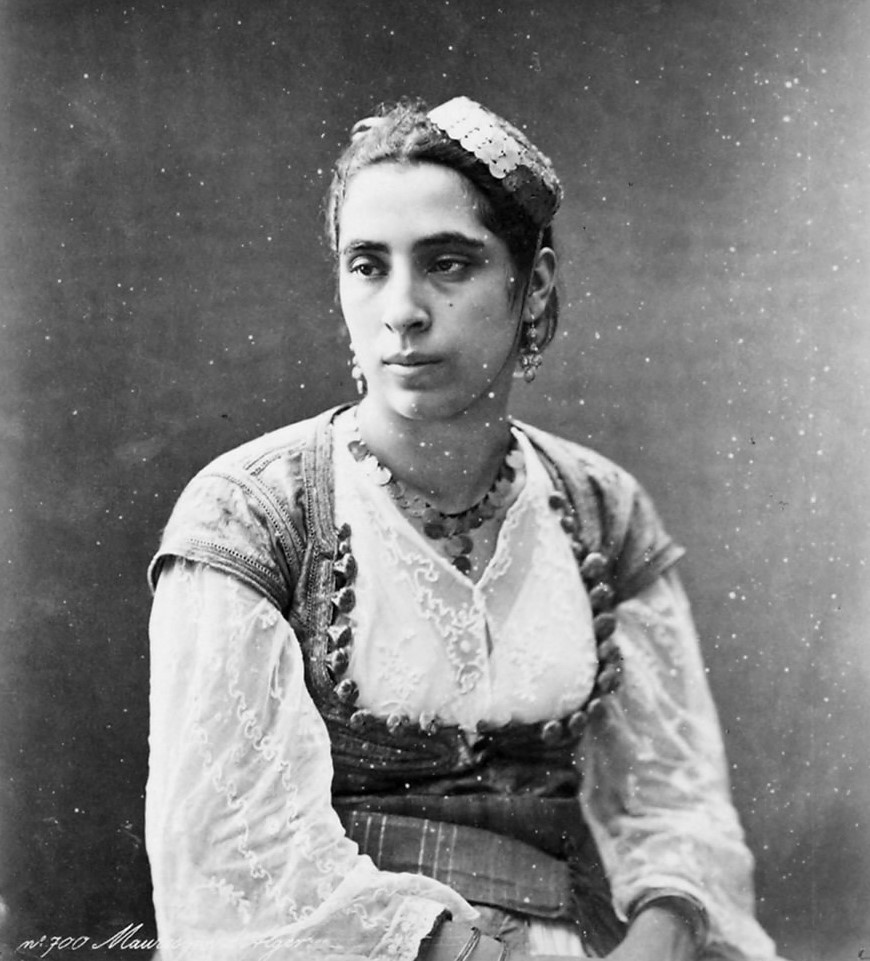
Mauresque d'Alger en ghlila 1884, Algérie, c. 1884, Algeria; Wikimedia
This article examines the ghlilah Ghlīlah: (diminutive of the Arabic: ghlālah: waistcoat, synonyms: sadār, sadrīyah, sadārah, strah) short or medium length waistcoat worn generally with balloon pants (sarwāl mdawar) also known as (sarawāl chlqah). as a material and linguistic artifact situated at the intersection of trade routes and shared cultural identities. By tracing its documented history in Algeria, its stylistic evolution under Ottoman influence, and its semantic parallels across multiple linguistic families, the study argues that the ghlilah Ghlīlah: (diminutive of the Arabic: ghlālah: waistcoat, synonyms: sadār, sadrīyah, sadārah, strah) short or medium length waistcoat worn generally with balloon pants (sarwāl mdawar) also known as (sarawāl chlqah). exemplifies how garments become sites of collective belonging that transcend ethnic, religious, and regional boundaries. In doing so, it situates the ghlilah Ghlīlah: (diminutive of the Arabic: ghlālah: waistcoat, synonyms: sadār, sadrīyah, sadārah, strah) short or medium length waistcoat worn generally with balloon pants (sarwāl mdawar) also known as (sarawāl chlqah). within a broader framework of transregional sartorial exchange, emphasizing the role of trade networks in shaping both the physical form and cultural meaning of dress.
The Ghlilah Ghlīlah: (diminutive of the Arabic: ghlālah: waistcoat, synonyms: sadār, sadrīyah, sadārah, strah) short or medium length waistcoat worn generally with balloon pants (sarwāl mdawar) also known as (sarawāl chlqah).: Form, Function, and Early Documentation
The term ghlilah Ghlīlah: (diminutive of the Arabic: ghlālah: waistcoat, synonyms: sadār, sadrīyah, sadārah, strah) short or medium length waistcoat worn generally with balloon pants (sarwāl mdawar) also known as (sarawāl chlqah). derives from the Arabic ghilālah, a word historically associated with undergarments worn across social, ethnic, and religious divisions. This linguistic openness reflects the garment’s function as a unifying vestimentary element within Algerian society, cutting across communal boundaries. Yet, despite its cultural prominence, reconstructing the historical development of the ghlilah Ghlīlah: (diminutive of the Arabic: ghlālah: waistcoat, synonyms: sadār, sadrīyah, sadārah, strah) short or medium length waistcoat worn generally with balloon pants (sarwāl mdawar) also known as (sarawāl chlqah). remains challenging due to the scarcity of documentary and visual sources prior to the French colonial period.
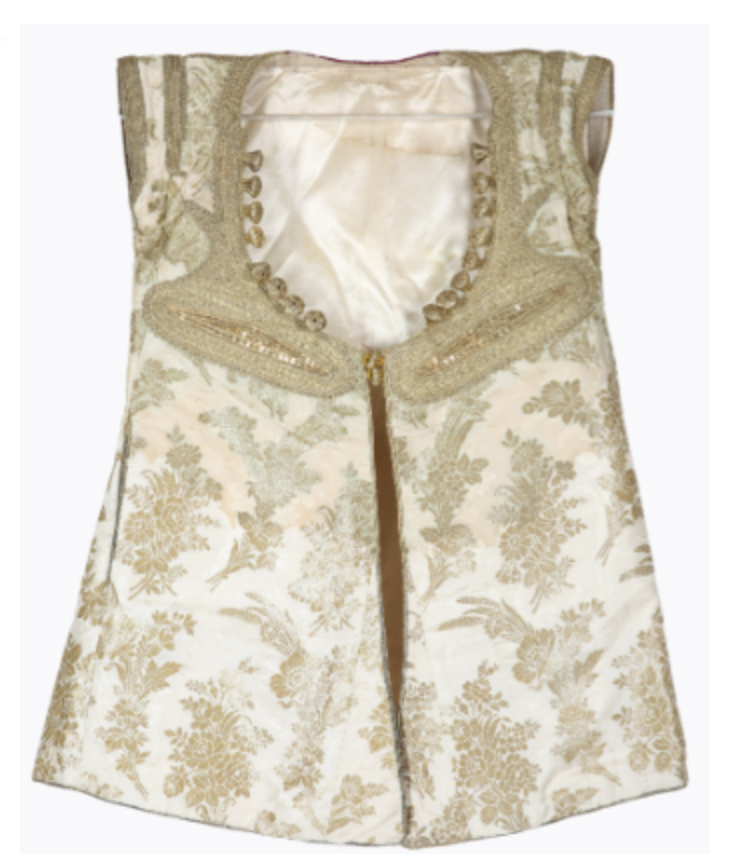
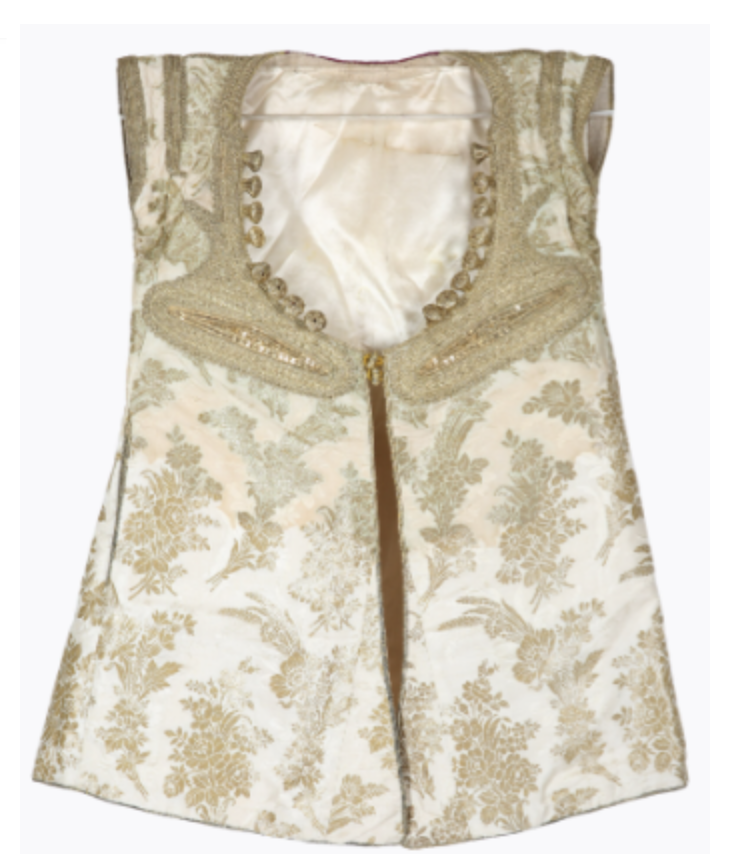
Metal embellished silk brocade Brocade: (Italian: brocco – twisted thread), is a richly decorative fabric woven with an intricate raised pattern. Its origins can be traced back to ancient China, where it was made for the imperial court. It later spread to Europe during the Renaissance and became popular in couture and decorative arts. vest, Algeria, c. 1900s; Acc No: ZI2021.500873 ALGERIA; The Zay Zay: (Arabic: costume, Pl. azyaā’), a set of clothes in a style typical of a particular country or historical period. Initiative
One of the earliest Western accounts of dress in Algiers appears in the writings of the Spanish friar Diego de Haëdo, published circa 1612, based on observations made between 1578 and 1581. Haëdo describes the ghlilah Ghlīlah: (diminutive of the Arabic: ghlālah: waistcoat, synonyms: sadār, sadrīyah, sadārah, strah) short or medium length waistcoat worn generally with balloon pants (sarwāl mdawar) also known as (sarawāl chlqah). as a waistcoat fashioned from luxurious textiles such as satin Sātin: (Arabic: Zaytuni: from Chinese port of Zayton in Quanzhou province where it was exported from and acquired by Arab merchants), one of the three basic types of woven fabric with a glossy top surface and a dull back. Originated in China and was fundamentally woven in silk., velvet, or damask Dāmāsk: (Arabic: Damascus – a city in Syria), is a luxurious fabric woven with reversible patterns typically in silk, wool, linen, or cotton. Originating in China, the fabric was perhaps introduced to European traders at Damascus – a major trading post on the Silk Road with a thriving local silk industry. , extending to mid-leg length and featuring a wide neckline fastened just above the breasts with prominent gold or silver buttons. The garment existed in both sleeveless and elbow-length-sleeved variants and was often worn over a sheer-sleeved undergarment, paired with voluminous trousers. At certain moments, the term ghlilah Ghlīlah: (diminutive of the Arabic: ghlālah: waistcoat, synonyms: sadār, sadrīyah, sadārah, strah) short or medium length waistcoat worn generally with balloon pants (sarwāl mdawar) also known as (sarawāl chlqah). appears to have been functionally descriptive, referring specifically to its role in supporting the bosom.
By the nineteenth century, the ghlilah Ghlīlah: (diminutive of the Arabic: ghlālah: waistcoat, synonyms: sadār, sadrīyah, sadārah, strah) short or medium length waistcoat worn generally with balloon pants (sarwāl mdawar) also known as (sarawāl chlqah). had become a commonplace item in the everyday wardrobe of Algerian women. Nevertheless, prevailing norms of modesty required it to be concealed beneath the ḥāyik, a full-body cloak worn in public. This layering practice underscores the garment’s dual role as both an intimate, functional item and a visually expressive component of domestic and private life.
Transregional Origins and Ottoman Mediation
Scholars widely agree that the waistcoat or vest form originated in the Eurasian steppes during antiquity and was disseminated across Eastern and Northern Europe by the Scythians, a Central Asian semi-nomadic polity. While vest-like garments were well established in these regions, their integration into Mediterranean dress systems appears to have occurred significantly later. Byzantine adoption and appropriation of open-front coats worn by Persian soldiers during the 12th CE marked a critical moment in this transmission, transforming a military garment into a fashionable elite item.
These developments profoundly influenced later Ottoman dress culture, which in turn played a decisive role in shaping North African costume. Ottoman expansion into the Maghreb – beginning with Egypt in 1517 and extending to Algeria, Libya, and Tunisia over the course of the century – facilitated the large-scale circulation of textiles, tailoring techniques, and decorative motifs. In Algeria, heavily embroidered waistcoats were adopted by both men and women and gradually localized through the incorporation of regional aesthetics and craftsmanship.
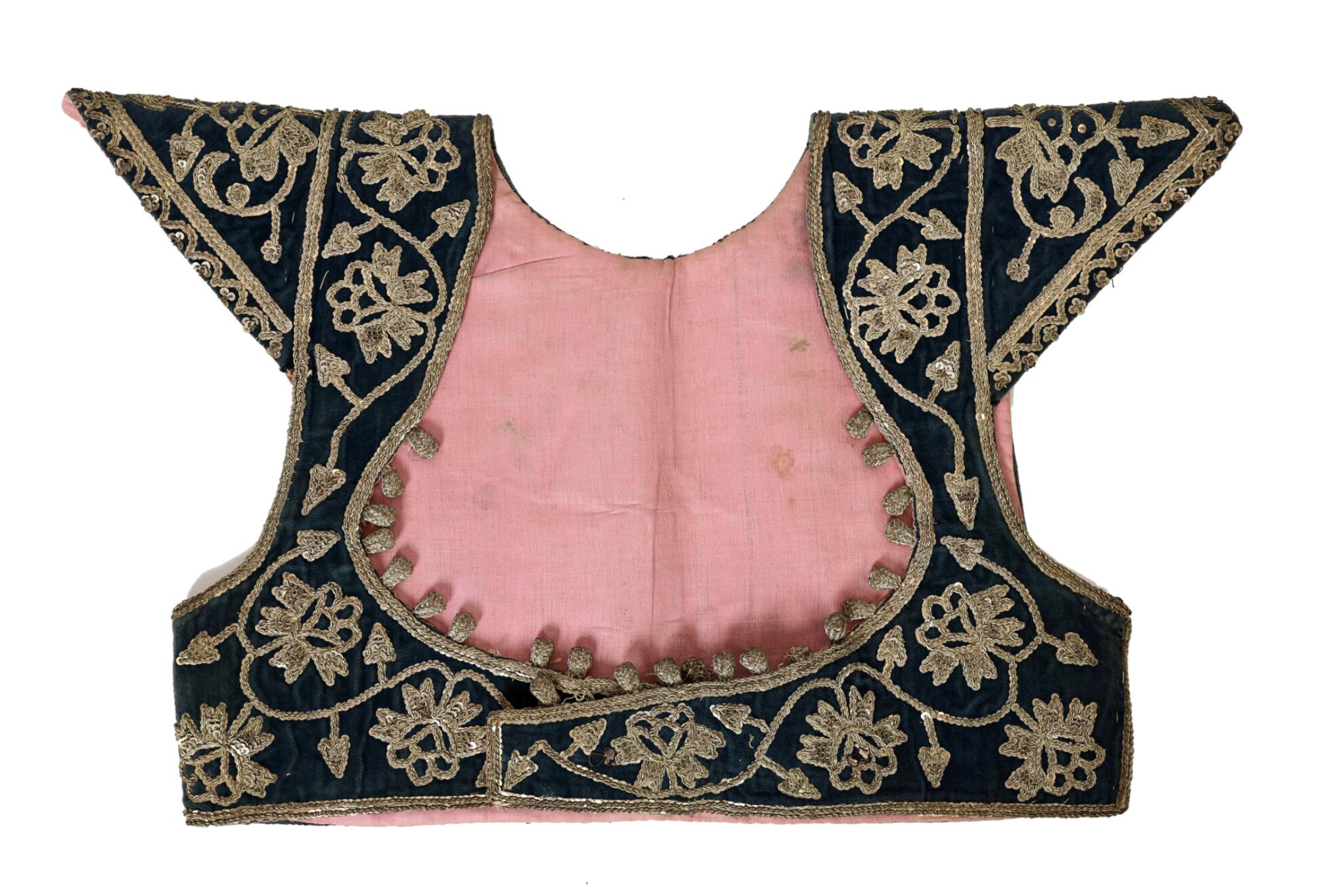
Embellished velvet waistcoat, Tunisia, c. late 19th – early 20th century; Acc. No: ZI2023.501013.3 TUNIS; The Zay Zay: (Arabic: costume, Pl. azyaā’), a set of clothes in a style typical of a particular country or historical period. Initiative
The most elaborate forms of the ghlilah Ghlīlah: (diminutive of the Arabic: ghlālah: waistcoat, synonyms: sadār, sadrīyah, sadārah, strah) short or medium length waistcoat worn generally with balloon pants (sarwāl mdawar) also known as (sarawāl chlqah). emerged in Algeria’s coastal cities, where Mediterranean trade routes intersected with Ottoman administrative networks. Embroidery practices in Algiers exhibit strong affinities with Turkish styles, particularly in their use of metal-thread embroidery, while also reflecting the city’s multicultural composition. Tunisia developed related garments such as the farmla, shaped by both Ottoman and Andalusian influences, whereas Morocco – outside direct Ottoman control – produced parallel open-front tunic forms with comparatively less Levantine influence.
Craft, Symbolism, and Social Differentiation
Haëdo identifies two principal variants of the women’s ghlilah Ghlīlah: (diminutive of the Arabic: ghlālah: waistcoat, synonyms: sadār, sadrīyah, sadārah, strah) short or medium length waistcoat worn generally with balloon pants (sarwāl mdawar) also known as (sarawāl chlqah).: a more modest local form, likely derived from a 15thcentury Algerian prototype, and a more elaborate version closely aligned with the Ottoman models. The local variant featured a higher, straight neckline, while the Ottoman-influenced form displayed a deeper, curved neckline, a feature observable in surviving nineteenth-century examples. Both variants employed detachable sleeves, allowing wearers to adapt the garment to seasonal and climatic conditions.
The gold and silver thread embroidery characteristic of these garments was likely produced by local Jewish silversmiths, many of whom settled in the Maghreb following the Andalusian exodus after 1492. Among the recurring decorative elements is an elongated oval or triangular motif on the front yoke Yoke: (Synonym: Bodice_Yoke), a structured pattern fitted at the shoulders defining the structure of women’s garments. Introduced in c. 1880s it defines the transition between the upper and lower parts of the garments and can now be found stitched-in where the blouse is separated from the skirt by a horizontal seam. , widely interpreted as a talismanic representation of the “evil eye.” This motif, attested across the Mediterranean and Near Eastern worlds since antiquity, transcended religious boundaries and remained culturally resonant within both Jewish and Islamic traditions. Variations in the quality and density of such embroidery further signalled economic and social distinctions among wearers.
Linguistic Circulation and Phonetic Affinities
The ghlilah Ghlīlah: (diminutive of the Arabic: ghlālah: waistcoat, synonyms: sadār, sadrīyah, sadārah, strah) short or medium length waistcoat worn generally with balloon pants (sarwāl mdawar) also known as (sarawāl chlqah).’s transregional character is further evidenced by its linguistic entanglements. A close parallel exists in the Turkish yelek Yelek: (Old Anatolian: yélek – Vest; Synonyms: Jelick, Jilek), short waist or hip length vest traditionally worn by both Ottoman men and women throughout the empire. Ranging from sleeveless to full sleeves, these vests were usually front open and without any fastenings. Often cepken jackets were used as yelek. , a waistcoat whose etymology derives from the Proto-Turkic yel (“wind”), emphasizing its function as a protective outer layer. The term yelek Yelek: (Old Anatolian: yélek – Vest; Synonyms: Jelick, Jilek), short waist or hip length vest traditionally worn by both Ottoman men and women throughout the empire. Ranging from sleeveless to full sleeves, these vests were usually front open and without any fastenings. Often cepken jackets were used as yelek. entered European vocabularies through French and Italian mediation, ultimately giving rise to the French gilet and the Spanish chaleco (via Portuguese jaleco). Notably, the Spanish chaleco also bears phonetic resemblance to “calico,” a term derived from South Asian textile traditions.
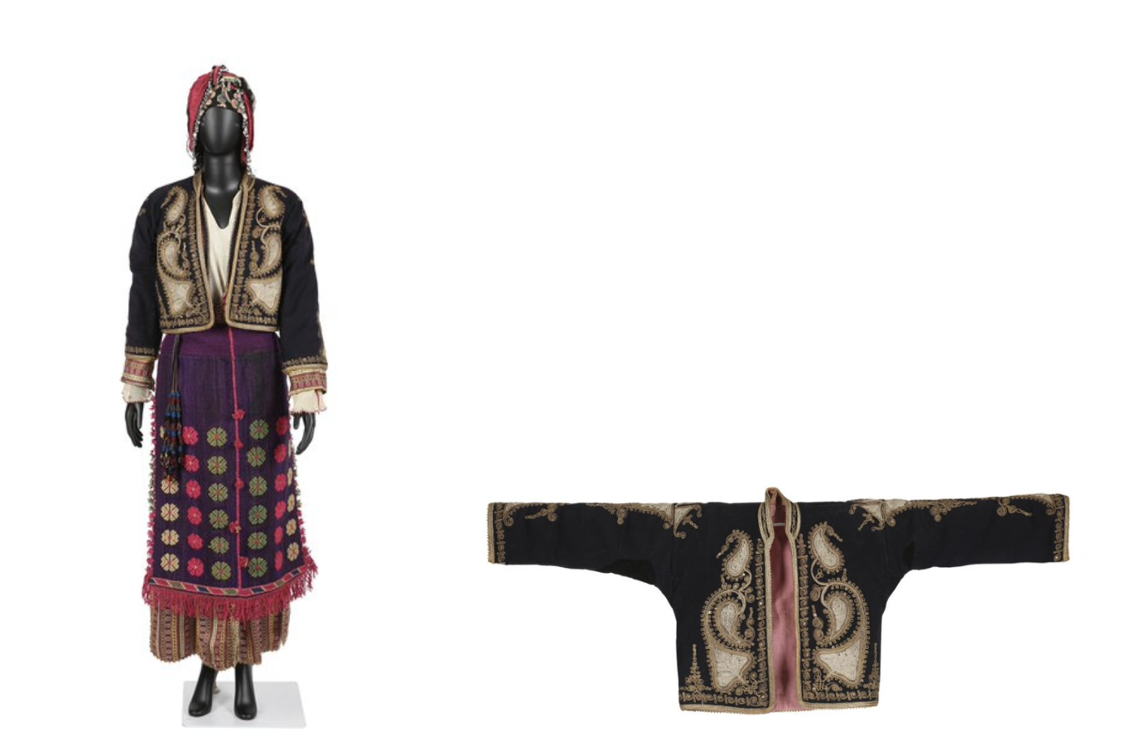
Metal embroidered felt waistcoat, Türkiye, c. 19th century; Acc. No: ZI2018.500642a ASIA; The Zay Zay: (Arabic: costume, Pl. azyaā’), a set of clothes in a style typical of a particular country or historical period. Initiative
From the 17th century onward, printed cottons from the Coromandel Coast circulated widely in European markets, providing an affordable alternative to the costly silk brocades traditionally used for waistcoats. While the etymological roots of ghlilah Ghlīlah: (diminutive of the Arabic: ghlālah: waistcoat, synonyms: sadār, sadrīyah, sadārah, strah) short or medium length waistcoat worn generally with balloon pants (sarwāl mdawar) also known as (sarawāl chlqah). most plausibly align with Turkic and Ottoman linguistic pathways rather than South Asian ones, the convergence of phonetic similarity and material availability suggests that Indian textiles played a significant role in the garment’s later evolution. Language, textile, and form thus intersected within shared commercial networks, reinforcing the ghlilah Ghlīlah: (diminutive of the Arabic: ghlālah: waistcoat, synonyms: sadār, sadrīyah, sadārah, strah) short or medium length waistcoat worn generally with balloon pants (sarwāl mdawar) also known as (sarawāl chlqah).’s position as a product of global exchange.
Conclusion
The ghlilah Ghlīlah: (diminutive of the Arabic: ghlālah: waistcoat, synonyms: sadār, sadrīyah, sadārah, strah) short or medium length waistcoat worn generally with balloon pants (sarwāl mdawar) also known as (sarawāl chlqah). exemplifies how garments function as repositories of transregional histories, shaped by trade routes that facilitated the movement of textiles, techniques, symbols, and words across vast geographies. Although today it is often understood as a distinctly North African and Arab garment, its deeper genealogy reveals a complex journey beginning in Central Asia, mediated through Byzantine and Ottoman sartorial systems, and localized within the urban cultures of the Maghreb. Trade networks—spanning the Mediterranean and extending into the Indian Ocean—were instrumental in forging the shared cultural identities embedded in the ghlilah Ghlīlah: (diminutive of the Arabic: ghlālah: waistcoat, synonyms: sadār, sadrīyah, sadārah, strah) short or medium length waistcoat worn generally with balloon pants (sarwāl mdawar) also known as (sarawāl chlqah).’s form and meaning.
Equally significant are the garment’s linguistic resonances, which mirror its material circulation. The phonetic and semantic affinities linking ghlilah Ghlīlah: (diminutive of the Arabic: ghlālah: waistcoat, synonyms: sadār, sadrīyah, sadārah, strah) short or medium length waistcoat worn generally with balloon pants (sarwāl mdawar) also known as (sarawāl chlqah)., yelek Yelek: (Old Anatolian: yélek – Vest; Synonyms: Jelick, Jilek), short waist or hip length vest traditionally worn by both Ottoman men and women throughout the empire. Ranging from sleeveless to full sleeves, these vests were usually front open and without any fastenings. Often cepken jackets were used as yelek. , gilet, and chaleco underscore the mobility of vestimentary vocabularies and the permeability of cultural boundaries. In this sense, the ghlilah Ghlīlah: (diminutive of the Arabic: ghlālah: waistcoat, synonyms: sadār, sadrīyah, sadārah, strah) short or medium length waistcoat worn generally with balloon pants (sarwāl mdawar) also known as (sarawāl chlqah). is not merely an item of dress but a material expression of interconnected worlds, in which fashion served as both a medium of appropriation and a marker of collective belonging. Through its enduring presence in Algerian women’s dress, the ghlilah Ghlīlah: (diminutive of the Arabic: ghlālah: waistcoat, synonyms: sadār, sadrīyah, sadārah, strah) short or medium length waistcoat worn generally with balloon pants (sarwāl mdawar) also known as (sarawāl chlqah). stands as a testament to the role of trade routes in shaping shared cultural identities across time and space.