

Introduction
In recent years, artificial intelligence has steadily moved from the margins to the centre of conversations surrounding museums, archives, and cultural institutions. Once perceived as a tool confined to data analytics or administrative efficiency, AI is now being explored as a creative and interpretive medium – one capable of expanding how heritage is preserved, presented, and experienced. In a previous article, we examined the broader implications of AI’s integration into museums and collections, with particular emphasis on its potential to enhance accessibility, documentation, and public engagement.
Among the most compelling applications of this evolving technology is the 3D recreation and recontextualization of artefacts. It is within this space – where technology meets memory – that The Zay
Zay: (Arabic: costume, Pl. azyaā’), a set of clothes in a style typical of a particular country or historical period. Initiative, founded by Dr. Reem Tariq
Ṭariq: (Arabic; Synonym: tulle_bi_talli
Tūlle_bi_tallī: (French: Tulle – a city in France where fine material for veil was first made; Turkish: tel – wire; Synonym: tariq; talli; badla; khus_dozi ), series of small metal knots made on a woven net ground as embellishment. The term is commonly used in the North African Arab region specifically in Egypt. Ṭariq: (Arabic; Synonym: tulle_bi_talli
Tūlle_bi_tallī: (French: Tulle – a city in France where fine material for veil was first made; Turkish: tel – wire; Synonym: tariq; talli; badla; khus_dozi ), series of small metal knots made on a woven net ground as embellishment. The term is commonly used in the North African Arab region specifically in Egypt.
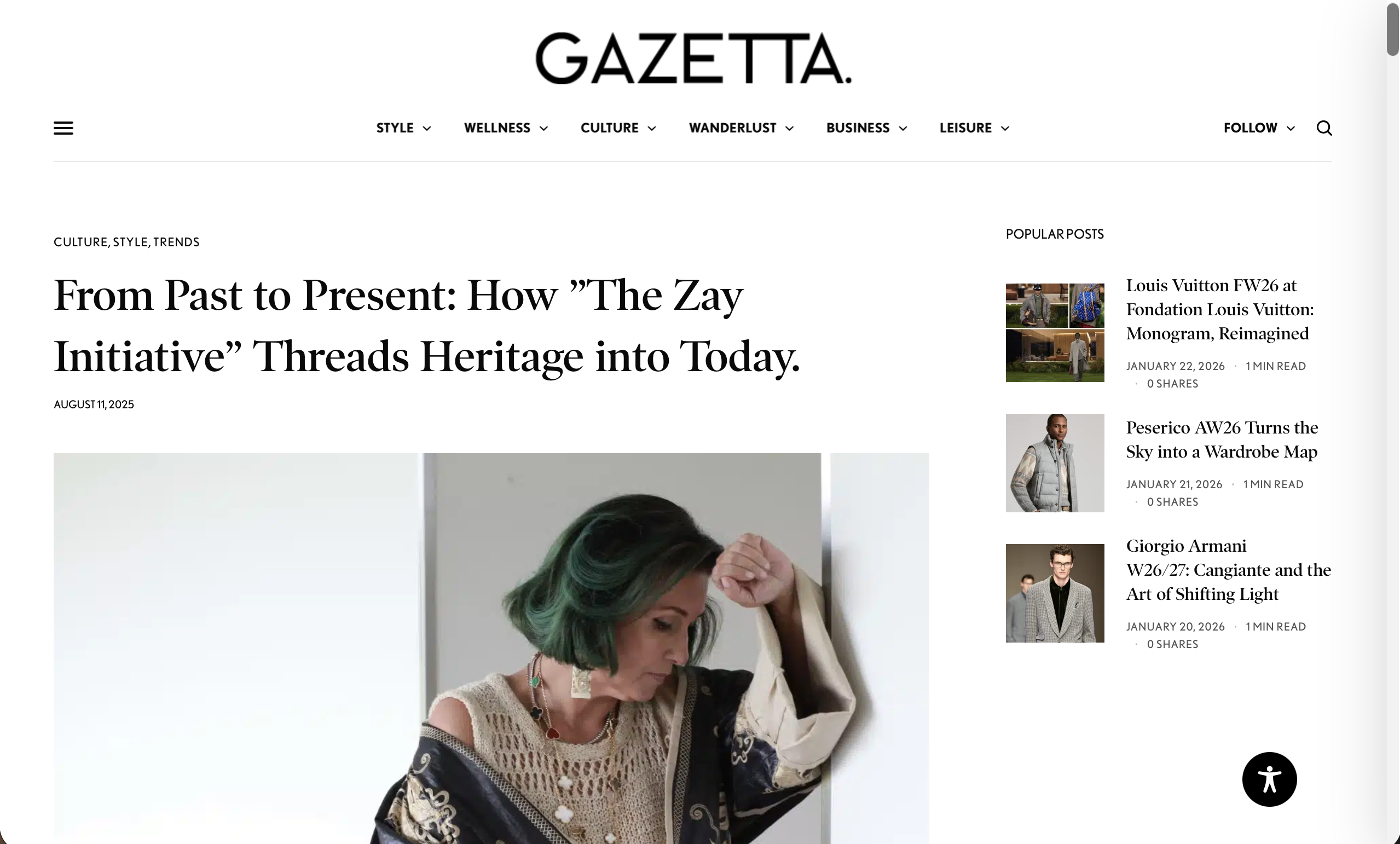
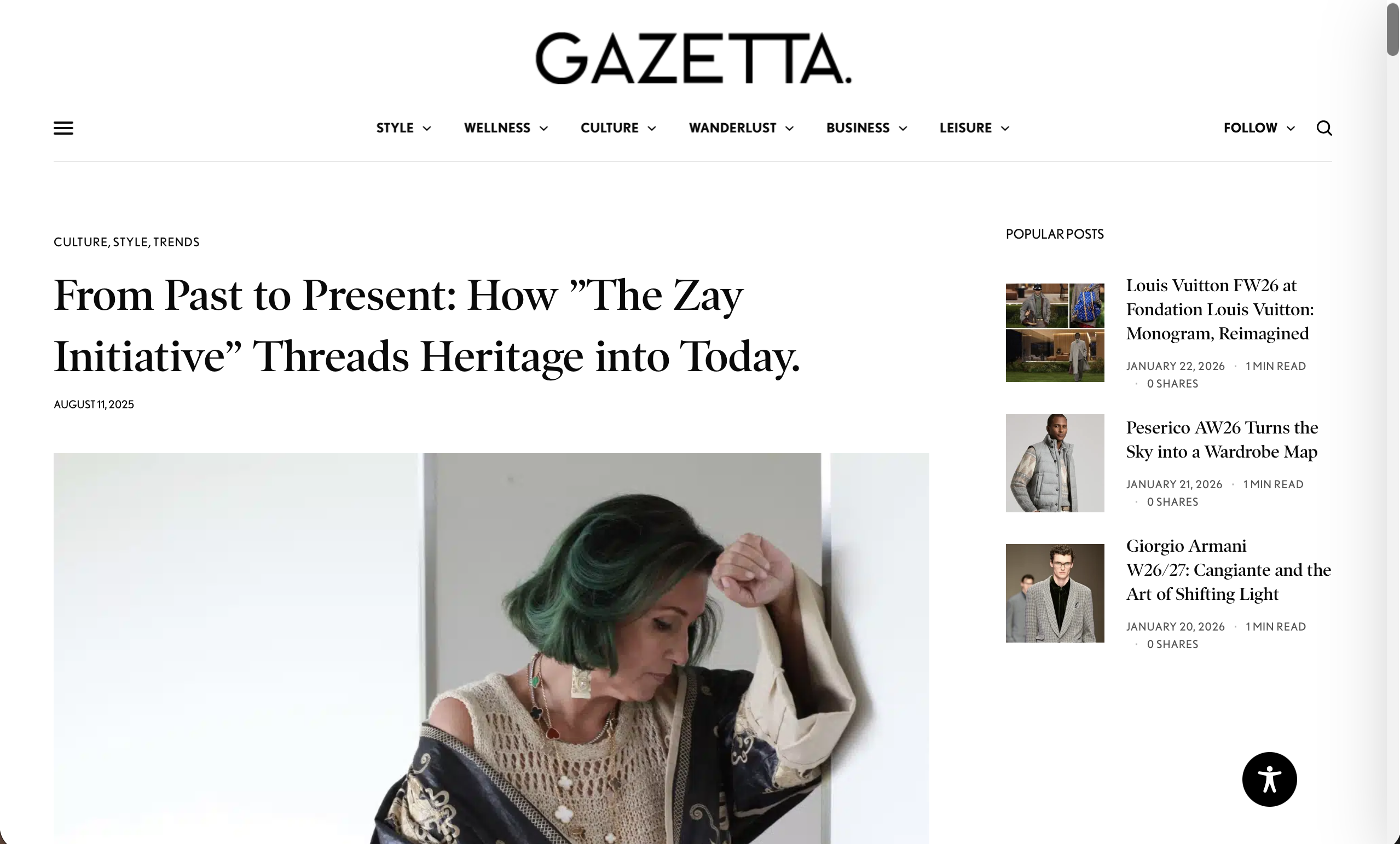
Screenshot of the story from ezine Gazetta
Intrigued by this approach, we at The Zay Zay: (Arabic: costume, Pl. azyaā’), a set of clothes in a style typical of a particular country or historical period. Initiative sat down with Manuela to understand her background, her relationship with Gazetta, and the ideas that led her to write about The Zay Zay: (Arabic: costume, Pl. azyaā’), a set of clothes in a style typical of a particular country or historical period.. What emerged was a conversation that extended beyond fashion or technology, touching on sustainability, education, and the responsibility of cultural storytelling in a rapidly accelerating world.
Gazetta: A Hybrid Editorial Model
Q: Could you tell us a little about Gazetta and your involvement with it? Are you full-time with the magazine?
Manuela:“I began collaborating with Gazetta about two years ago. It’s a digital magazine – completely online – focused on lifestyle and what I would describe as curated luxuries. What makes Gazetta distinctive is that it is AI-curated but human-touched. We constantly seek new ideas, drawing from tradition while engaging with contemporary life and present-day realities. I’m not full-time; I contribute as a collaborator.”
This hybrid editorial model mirrors the philosophy behind the article on The Zay Zay: (Arabic: costume, Pl. azyaā’), a set of clothes in a style typical of a particular country or historical period. Initiative itself. AI functions not as an autonomous author, but as a collaborator – supporting human creativity rather than replacing it. The result is an editorial space where experimentation and sensitivity coexist.
A Life Informed by Culture and Aesthetics
Q: Could you share a little about your background?
Manuela:“I’m based in Italy, where I work as a teacher – I’ve been teaching for over twenty years. I’m also an image consultant and colour consultant. I teach foreign languages and culture, and languages have always been a passion of mine. Fashion has also been part of my life from an early age; my family owned a company producing luxury trimmings in Italy.”
Her personal history is shaped by both continuity and rupture.
“After my father passed away, the company faced difficulties, but I still try to carry that tradition forward in another way. I love engaging with people from different nationalities and backgrounds. While I’m deeply connected to Italian tradition, I’m equally drawn to Arabic culture. Over time, I’ve developed collaborations in Dubai, across the region, and in the United States, where Gazetta is based.”
This cross-cultural sensibility would later inform her approach to The Zay Zay: (Arabic: costume, Pl. azyaā’), a set of clothes in a style typical of a particular country or historical period. Initiative.
Encountering The Zay Zay: (Arabic: costume, Pl. azyaā’), a set of clothes in a style typical of a particular country or historical period. Initiative
Q: How did you first come to know about Dr. Reem and The Zay Zay: (Arabic: costume, Pl. azyaā’), a set of clothes in a style typical of a particular country or historical period. Initiative?
Manuela:“I’ve always been interested in cultural heritage, particularly within the Emirati and broader Arab context. While speaking with our editor-in-chief, Dina Yassin – who is a luxury brand consultant and a visionary in artificial intelligence – I shared an idea about creating something that could blend tradition and modernity. She mentioned Dr. Reem and The Zay Zay: (Arabic: costume, Pl. azyaā’), a set of clothes in a style typical of a particular country or historical period. Initiative; I believe they had collaborated in the past.”
Curiosity quickly turned into admiration.
“I visited The Zay Zay: (Arabic: costume, Pl. azyaā’), a set of clothes in a style typical of a particular country or historical period.’s website and explored the online archive. I was genuinely impressed by the quality of the garments and the sheer scope of the collection. It’s extraordinary. I knew I wanted to do something meaningful, but I didn’t want it to be just another interview. Dr. Reem has been interviewed many times, and I felt the initiative deserved a different kind of engagement.”
Choosing Reinterpretation Over Documentation
Screenshot of the story from ezine Gazetta
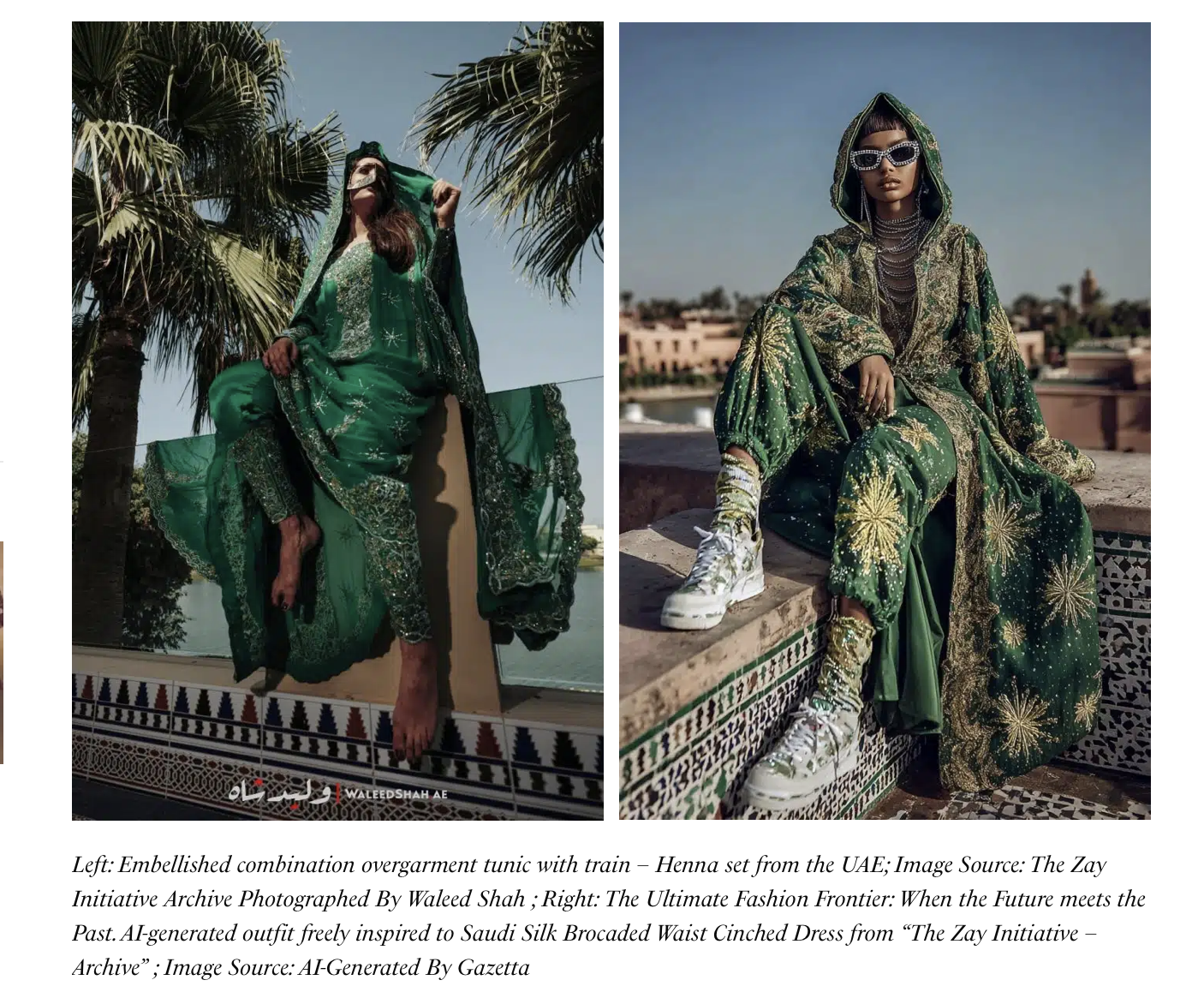
Rather than approaching the archive as a static historical record, Manuela proposed a conceptual shift: selecting garments from The Zay Zay: (Arabic: costume, Pl. azyaā’), a set of clothes in a style typical of a particular country or historical period. collection and reimagining them through AI-generated visuals. The aim was not alteration, but translation – bringing historical silhouettes into a contemporary visual language.
With the support of Gazetta’s editor-in-chief, AI became a tool for creative mediation.
“It wasn’t about replacing the original pieces,” Manuela explains. “It was about showing how they can still speak – how tradition can exist within today’s visual and cultural vocabulary.”
This approach resonated strongly with The Zay Zay: (Arabic: costume, Pl. azyaā’), a set of clothes in a style typical of a particular country or historical period. Initiative’s own mission: safeguarding dress traditions while encouraging new forms of engagement.
Conclusion: Setting the Stage for Deeper Inquiry
The collaboration between Gazetta and The Zay Zay: (Arabic: costume, Pl. azyaā’), a set of clothes in a style typical of a particular country or historical period. Initiative marks more than a successful editorial experiment. It signals a shift in how heritage can be narrated – one that embraces technology without abandoning authenticity. Through Manuela’s lens, AI became a bridge rather than a boundary, allowing historical garments to be re-seen and re-felt by contemporary audiences.
Yet this first conversation only begins to uncover the broader implications of such work. In the next part of this series, we will explore AI’s role in academia and curatorial practice, its relationship to sustainability, and how museums and fashion institutions might integrate these tools responsibly. We will also delve deeper into Manuela’s vision for exhibitions that juxtapose historical artefacts with AI-generated reinterpretations, offering audiences a new way to experience continuity across time.