

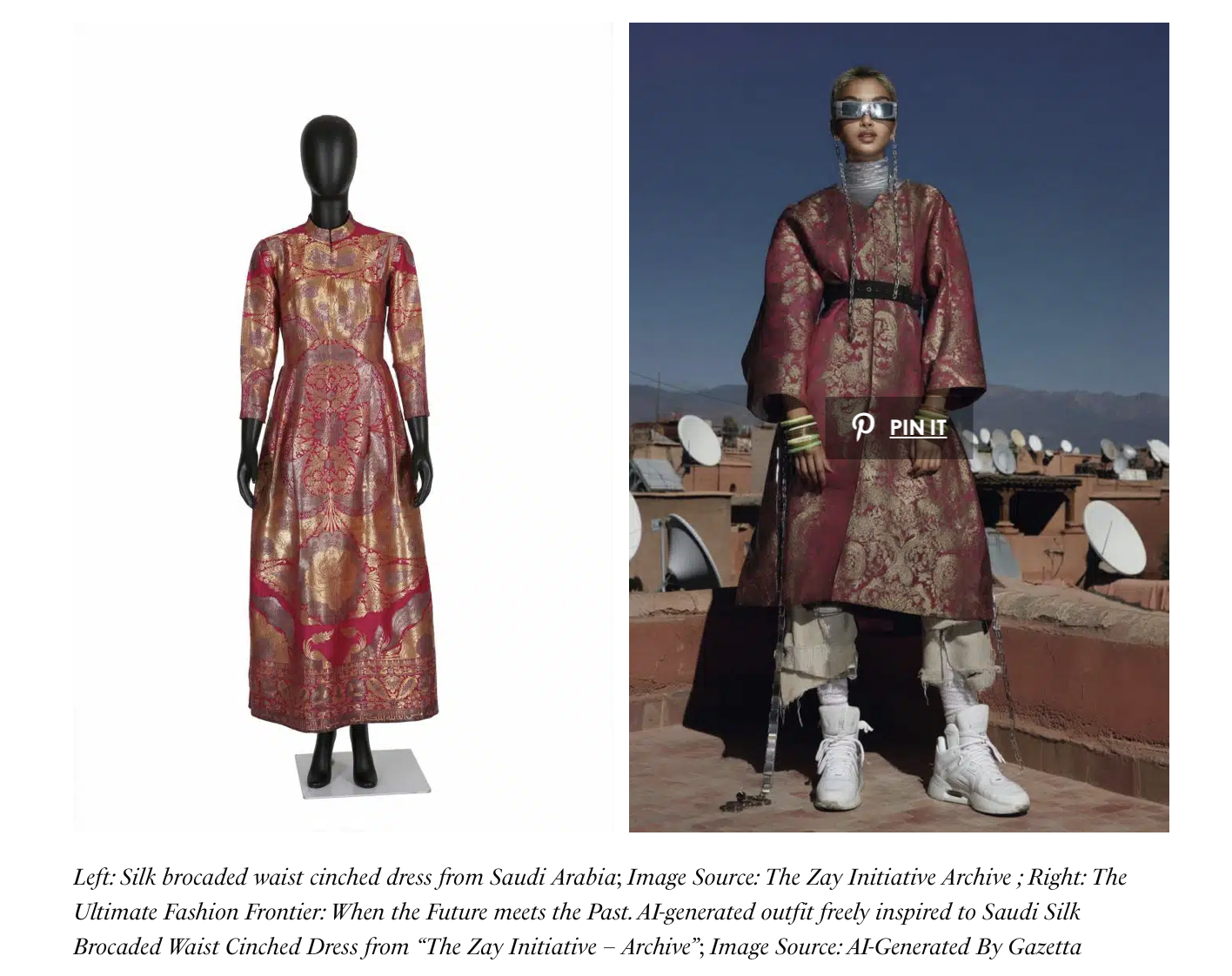
In August 2025, the lifestyle e-zine Gazetta published a feature tracing the trajectory of Dr. Reem Tariq
Ṭariq: (Arabic; Synonym: tulle_bi_talli
Tūlle_bi_tallī: (French: Tulle – a city in France where fine material for veil was first made; Turkish: tel – wire; Synonym: tariq; talli; badla; khus_dozi ), series of small metal knots made on a woven net ground as embellishment. The term is commonly used in the North African Arab region specifically in Egypt. Ṭariq: (Arabic; Synonym: tulle_bi_talli
Tūlle_bi_tallī: (French: Tulle – a city in France where fine material for veil was first made; Turkish: tel – wire; Synonym: tariq; talli; badla; khus_dozi ), series of small metal knots made on a woven net ground as embellishment. The term is commonly used in the North African Arab region specifically in Egypt.
The images accompanying Gazetta’s feature were produced using photographs of selected garments from The Zay Zay: (Arabic: costume, Pl. azyaā’), a set of clothes in a style typical of a particular country or historical period. Initiative’s collection. These original photographs had been taken with the garments mounted on mannequins, in keeping with standard museum documentation practices. Gazetta subsequently employed these images to generate visualizations of the garments as worn on models, situating them within stylized and visually striking backdrops. This process marked a significant moment for The Zay Zay: (Arabic: costume, Pl. azyaā’), a set of clothes in a style typical of a particular country or historical period. Initiative, as it represented the first instance in which items from the collection were presented with a contemporary visual inflection without compromising their structural integrity or material specificity.
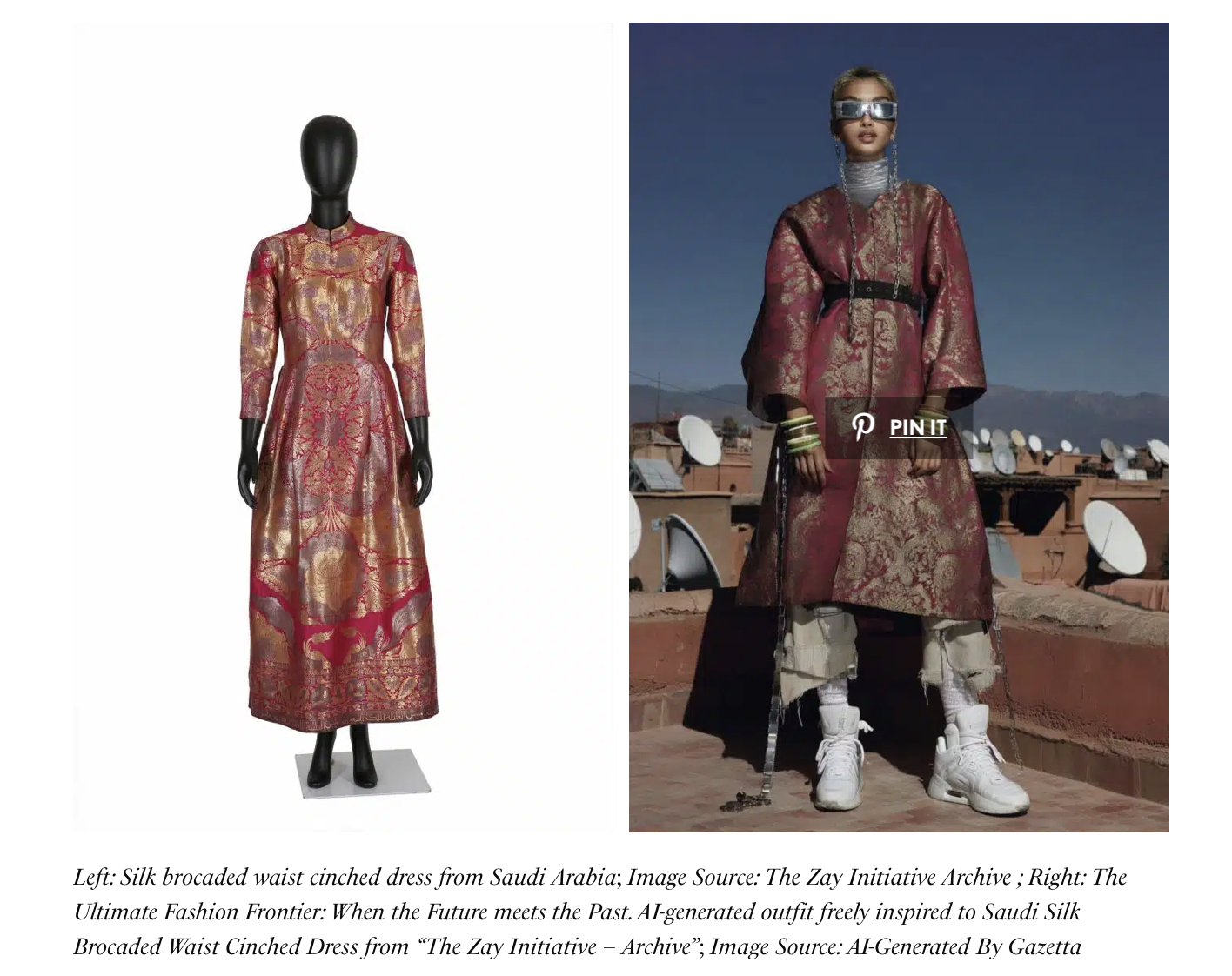
A screenshot from Gazetta’s article
This development is particularly notable when considering The Zay Zay: (Arabic: costume, Pl. azyaā’), a set of clothes in a style typical of a particular country or historical period. Initiative’s earlier experimental collaboration with the American University of Sharjah, which sought to produce three-dimensional digital renderings of select garments. While that project did not fully achieve its intended outcomes, it nonetheless yielded valuable insights, revealing that the technical and interpretive limitations of 3D imaging currently outweigh its benefits for the accurate representation of complex historical dresses. In this sense, the initiative functioned less as a failure than as a critical diagnostic exercise, clarifying the constraints of existing digital visualization tools.
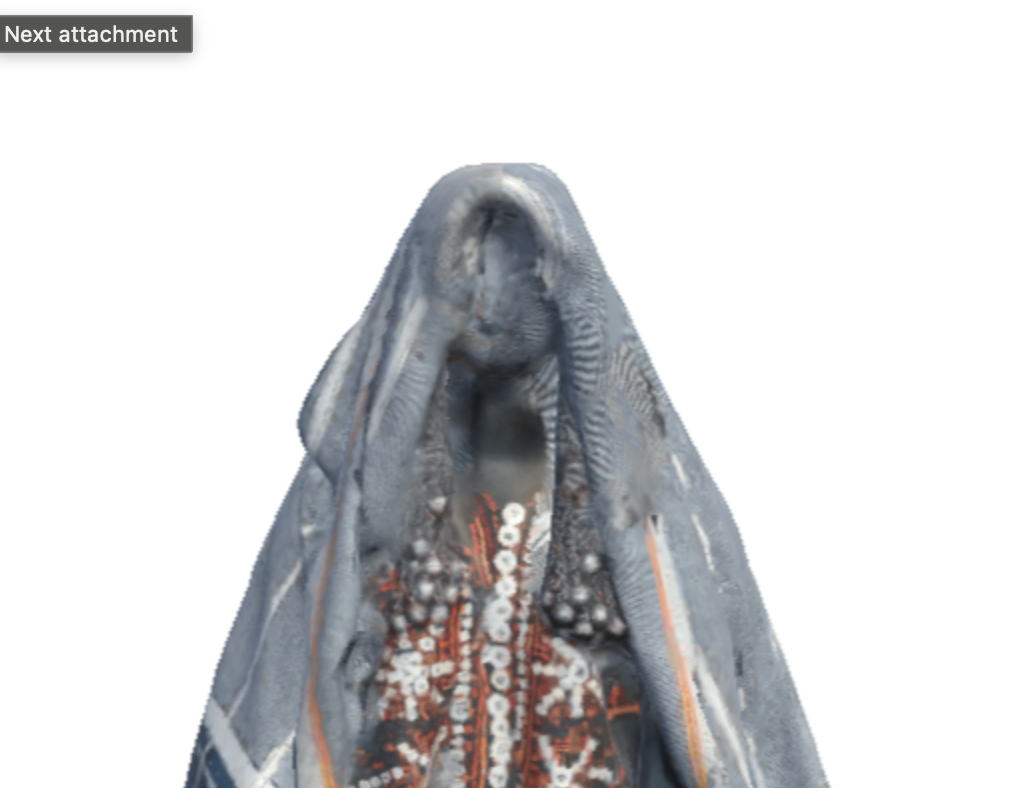
A screenshot of a sample from The Zay Zay: (Arabic: costume, Pl. azyaā’), a set of clothes in a style typical of a particular country or historical period. Initiative’s 3D rendering project in collaboration with AUS
For contextual clarity, it is important to note that the limited outcomes of The Zay Zay: (Arabic: costume, Pl. azyaā’), a set of clothes in a style typical of a particular country or historical period. Initiative’s 3D imaging project should not be interpreted as evidence that three-dimensional visualisation of dress and textile artefacts is inherently unattainable. On the contrary, numerous successful applications of 3D imaging are evident across contemporary visual cultures, including film and media production, digital game design, and select museum and institutional contexts.
Within film and media, three-dimensional rendering of dress and textiles is often constrained by the fact that costumes are physically produced and subsequently worn by actors, thereby reducing the need for fully simulated digital garments. In contrast, digital game design relies extensively on 3D modelling of clothing and bodies, as exemplified by franchises such as Assassin’s Creed developed by Ubisoft. Across both domains, however, a critical and determining factor is the scale of financial investment available.

Assassin's Creed Origins Launch Trailer; Ubisoft
Large production studios and game development companies possess the financial and technical resources necessary to support high-resolution, labour-intensive 3D modelling, for which such visualisation constitutes a core component of the final product.
For example, during a mid-2025 shareholder meeting, Ubisoft’s CEO disclosed that the development of Assassin’s Creed Shadows – the latest instalment in the franchise, set in 16th century feudal Japan – required an investment of US$ 116 million.
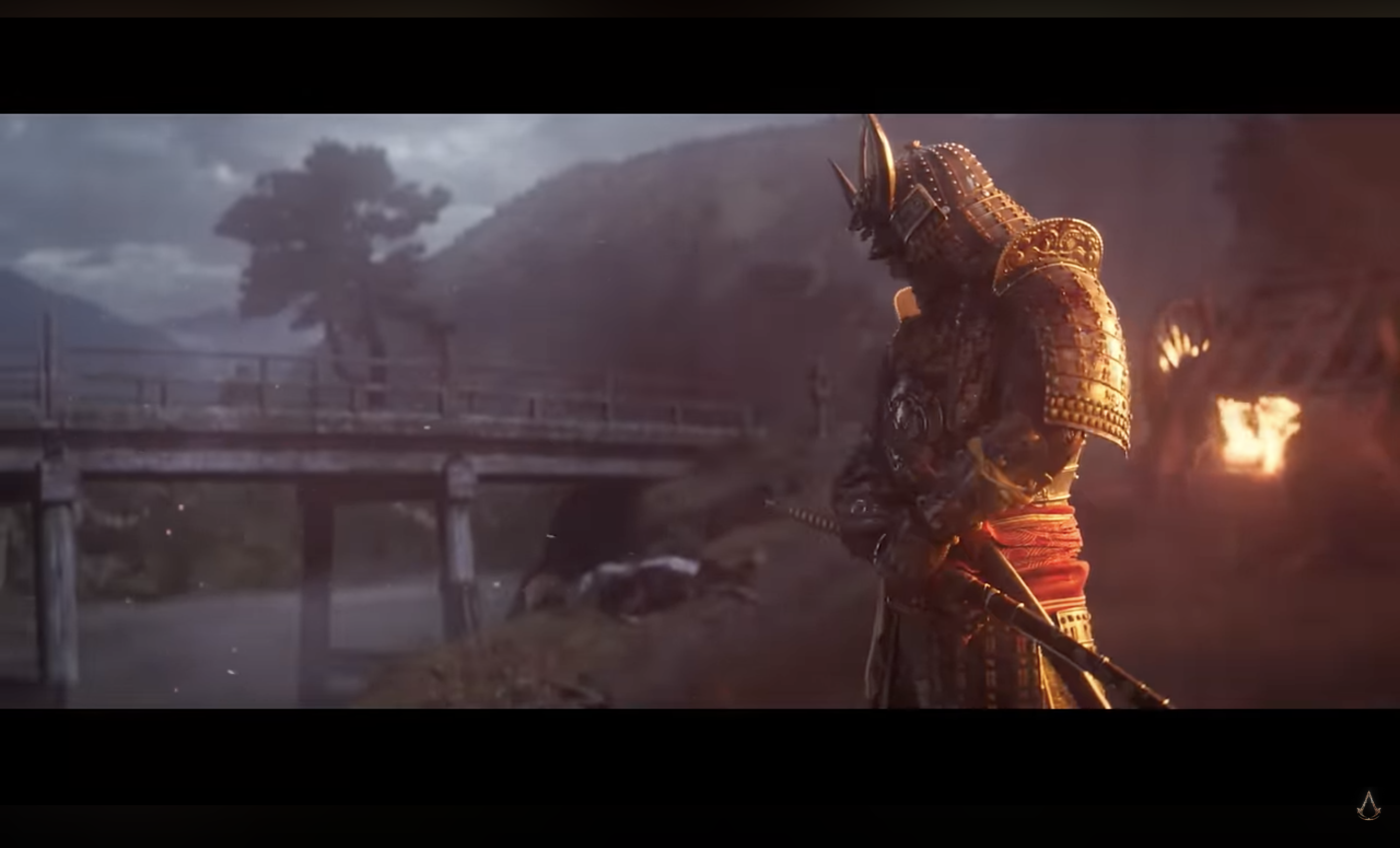 Assassin’s Creed Shadows: Official World Premier Trailer; Ubisoft
Similarly, Sony Interactive Entertainment, the developer of the God of War franchise, reportedly allocated a budget of approximately US$200 million to its November 2022 release God of War Ragnarök. Drawing on Norse mythology and situated in a mythologized vision of ancient Scandinavia – often associated with the Viking era – the production exemplifies the extraordinary scale of financial and technical resources typically available to contemporary video game development and, more broadly, to large-scale commercial entertainment industries.

God Of War Ragnarök - PlayStation Showcase 2021 Reveal Trailer | PS5 Games; Sony Interactive Entertainment
Although high-quality 3D rendering is often associated with large production budgets, notable exceptions exist. Ghost of Tsushima, developed by Sucker Punch Productions and published by Sony Interactive Entertainment in 2020, is set in feudal Japan during the first Mongol invasions (1274 – 1281) and demonstrates a high level of visual and technical refinement despite an estimated budget of approximately US$60 million. In this respect, the game represents a comparatively rare example of outstanding 3D rendering achieved within a relatively modest production budget.

Ghost of Tsushima - Official Trailer | The Game Awards; Sony Interactive Entertainment
By comparison, most museums and heritage institutions operate within significantly more constrained budgets. For comparative context, the Metropolitan Museum of Art in New York reported an operating budget of approximately US$ 402 million for the 2023 – 2024 fiscal year. This figure represents the annual cost of sustaining one of the world’s leading encyclopaedic museums including conservation and research, exhibitions, staffing, and other overheads; and is supported through a complex funding structure that includes public subsidies, endowment income, private donations, memberships, and admissions revenue. When set against this institutional baseline, the estimated US$ 116 million development cost of a single Ubisoft title underscores the markedly different financial scales and funding logics that govern major cultural heritage institutions and large-scale commercial digital production projects.
As a result, the systematic 3D rendering of artefacts – particularly complex, draped forms such as garments and textiles – remains largely inaccessible. Even among leading, well-funded museums, such initiatives are typically limited to a small number of carefully selected objects rather than entire collections.
This structural constraint was further evidenced during a preliminary site visit undertaken by The Zay Zay: (Arabic: costume, Pl. azyaā’), a set of clothes in a style typical of a particular country or historical period. Initiative to the laboratories of Sorbonne University Abu Dhabi, where recently acquired technologies were being tested for the 3D rendering of historical artefacts. Although the institution had successfully produced holographic visualisations of select objects, the process required substantial investments of time, technical expertise, and financial resources. Such demands render large-scale or routine implementation of comparable technologies impractical for independent or medium-sized collections such as The Zay Zay: (Arabic: costume, Pl. azyaā’), a set of clothes in a style typical of a particular country or historical period. Initiative.
Taken together, the examples discussed in this part foreground the material, financial, and institutional asymmetries that shape the possibilities of digital visualization in contemporary collections practice. While high-fidelity 3D rendering has been successfully deployed within commercial entertainment industries – particularly video game development – such achievements are underpinned by levels of investment that remain structurally out of reach for most museums and independent heritage initiatives. The Zay Zay: (Arabic: costume, Pl. azyaā’), a set of clothes in a style typical of a particular country or historical period. Initiative’s earlier experiments with 3D imaging, alongside observations from institutional laboratories, underscore the practical limitations that continue to constrain the routine digital representation of complex, draped garments. At the same time, these constraints set the stage for the emergence of alternative visual strategies. The following part therefore turns to the use of AI-generated imagery in Gazetta’s feature, examining both its capacity to approximate earlier aspirations of digital dress visualization and the methodological questions it raises regarding historical accuracy, temporal specificity, and the epistemological status of such images within heritage and scholarly contexts.