


1 of 7
| Local Name | Sarwal, Shirwal |
| Object Category | Pants |
| Gender | Female |
| Date of object | c. 1989 |
| Place Of orgin | UAE |
| Region | Al Ain |
| Object Range | UAE, Oman, Qatar, Bahrain, Iran et al |
| Dimensions | Length : 103 cm Width : 50 cm |
| Materials | Silk Cotton Metal |
| Technique | Hand Stitched Hand Embroidered Print |
| Color | |
| Motif | Floral Geometric |
| Provenance | Purchased, Halimah Isa al Sayigh, Al Ain 1989 |
| Location | The Zay Zay: (Arabic: costume, Pl. azyaā’), a set of clothes in a style typical of a particular country or historical period. Initiative |
| Status | In storage |
| ZI number | ZI1989.500726 UAE |
Object History
This piece was purchased by Dr. Reem Tariq
Ṭariq: (Arabic; Synonym: tulle_bi_talli
Tūlle_bi_tallī: (French: Tulle – a city in France where fine material for veil was first made; Turkish: tel – wire; Synonym: tariq; talli; badla; khus_dozi ), series of small metal knots made on a woven net ground as embellishment. The term is commonly used in the North African Arab region specifically in Egypt. Ṭariq: (Arabic; Synonym: tulle_bi_talli
Tūlle_bi_tallī: (French: Tulle – a city in France where fine material for veil was first made; Turkish: tel – wire; Synonym: tariq; talli; badla; khus_dozi ), series of small metal knots made on a woven net ground as embellishment. The term is commonly used in the North African Arab region specifically in Egypt.
Halimah Isa Al Sayigh, also known as Um ‘Um: (Arabic: mother), a sign of respect or formality, women are not addressed by their own names, rather as mother of, then adding the name of the eldest son as in Um Mohammed. Also can mean: with, for example (‘um mishakhiṣ) meaning with gold embellishment. Hamdan, was born in Al Ain in the 1950s.
She did not receive any formal education and was married to her paternal cousin in her early teens and was. the mother of five daughters and three sons. Despite her lack of formal education, her exposure to a life of privilege and social distinction due to her family’s prominence and affluence in society rendered her capable of engaging in basic conversational exchanges in languages such as English.
Dr. Reem first encountered Um ‘Um: (Arabic: mother), a sign of respect or formality, women are not addressed by their own names, rather as mother of, then adding the name of the eldest son as in Um Mohammed. Also can mean: with, for example (‘um mishakhiṣ) meaning with gold embellishment. Hamdan during one of her numerous visits to the palace of Sheikha Hamda bint Mohammed Al Nahyan, the maternal aunt of the then President of the United Arab Emirates, Sheikh Khalifa bin Zayed Al Nahyan. These visits were conducted as part of Dr. Reem's PhD research.
Sheikha Hamda played a pivotal role in supporting Dr. Reem’s research project by actively encouraging and facilitating her engagement with members of her entourage, as well as visiting guests. She granted Dr. Reem access to her daily open receptions, or majlis, held in both Al Ain and Abu Dhabi, providing valuable opportunities for interaction and data collection.
During one such visit, Dr. Reem and Um
‘Um: (Arabic: mother), a sign of respect or formality, women are not addressed by their own names, rather as mother of, then adding the name of the eldest son as in Um Mohammed. Also can mean: with, for example (‘um mishakhiṣ) meaning with gold embellishment. Hamdan engaged in a discussion about the former’s research on traditional Emirati clothing. A few days later, Um
‘Um: (Arabic: mother), a sign of respect or formality, women are not addressed by their own names, rather as mother of, then adding the name of the eldest son as in Um Mohammed. Also can mean: with, for example (‘um mishakhiṣ) meaning with gold embellishment. Hamdan graciously sent this item to Dr. Reem, which subsequently became part of The Zay
Zay: (Arabic: costume, Pl. azyaā’), a set of clothes in a style typical of a particular country or historical period. Initiative collection representing the UAE, called the Sultani
Sulṭānī: (Arabic: sultān: king). In the UAE the term denotes to silk satin fabric in multiple vertical striped colours, commonly used for tunics (kanadir) and underpants (sarāwīl). Also refers to book: Sultani, Traditions Renewed, Changes in women’s traditional dress In the United Arab Emirates during the reign of the late Shaykh Zāyid Bin Sultan āl Nahyān, 1966-2004, By Dr. Reem Tariq
Ṭariq: (Arabic; Synonym: tulle_bi_talli
Tūlle_bi_tallī: (French: Tulle – a city in France where fine material for veil was first made; Turkish: tel – wire; Synonym: tariq; talli; badla; khus_dozi ), series of small metal knots made on a woven net ground as embellishment. The term is commonly used in the North African Arab region specifically in Egypt.
It is worth noting that due to the prevailing notions of modesty in Arab cultures, garments of this nature are particularly rare, as they are traditionally regarded as undergarments and thus intimate articles of clothing. We at the Initiative shall always remain grateful to Sheikha Hamda and her support, and to Um ‘Um: (Arabic: mother), a sign of respect or formality, women are not addressed by their own names, rather as mother of, then adding the name of the eldest son as in Um Mohammed. Also can mean: with, for example (‘um mishakhiṣ) meaning with gold embellishment. Hamdan for her generous contribution to the collection.
Object Features
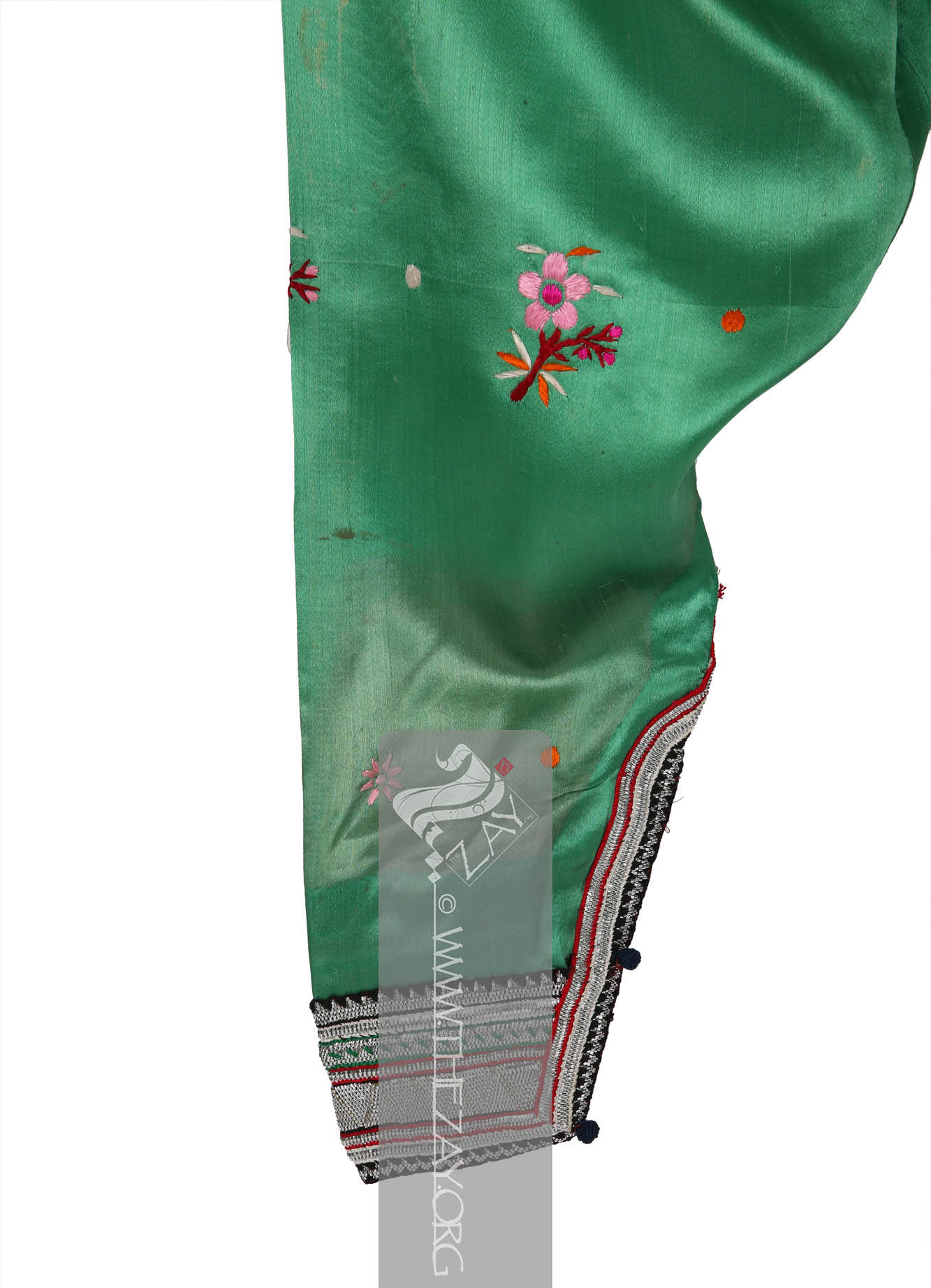
This is a pair of trousers (sarwal
Ṣarwāl: (Farsi: shalvār; Synonym: salwar, shirwāl), trousers featuring tapering ankles and drawstring closure of Central Asian origin. They disseminated in the Indian subcontinent between c.1st-3rd century BCE. Although exact period of its arrival in the Arab world is disputed their widespread adoption is confirmed from the 12th century.
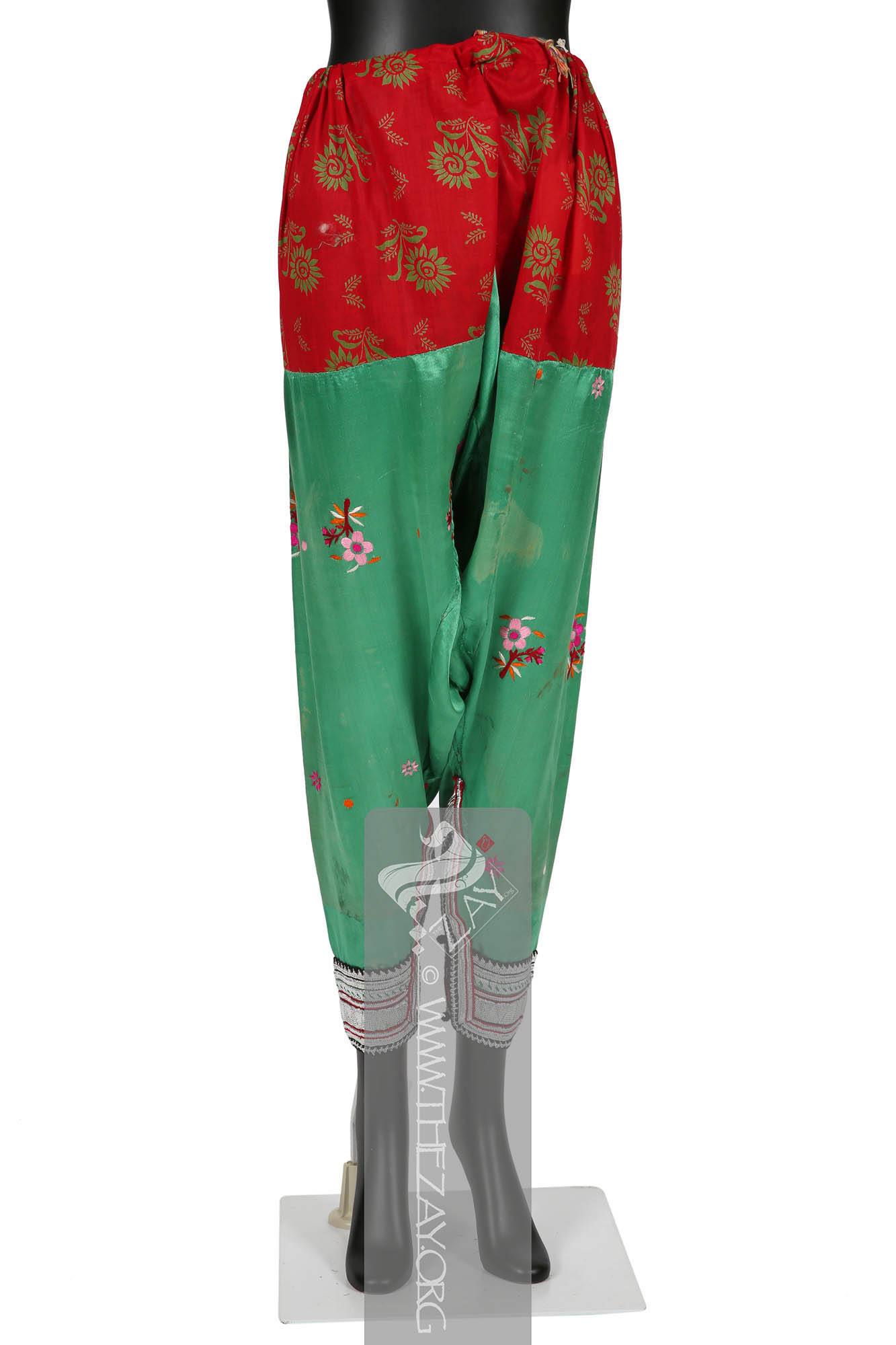
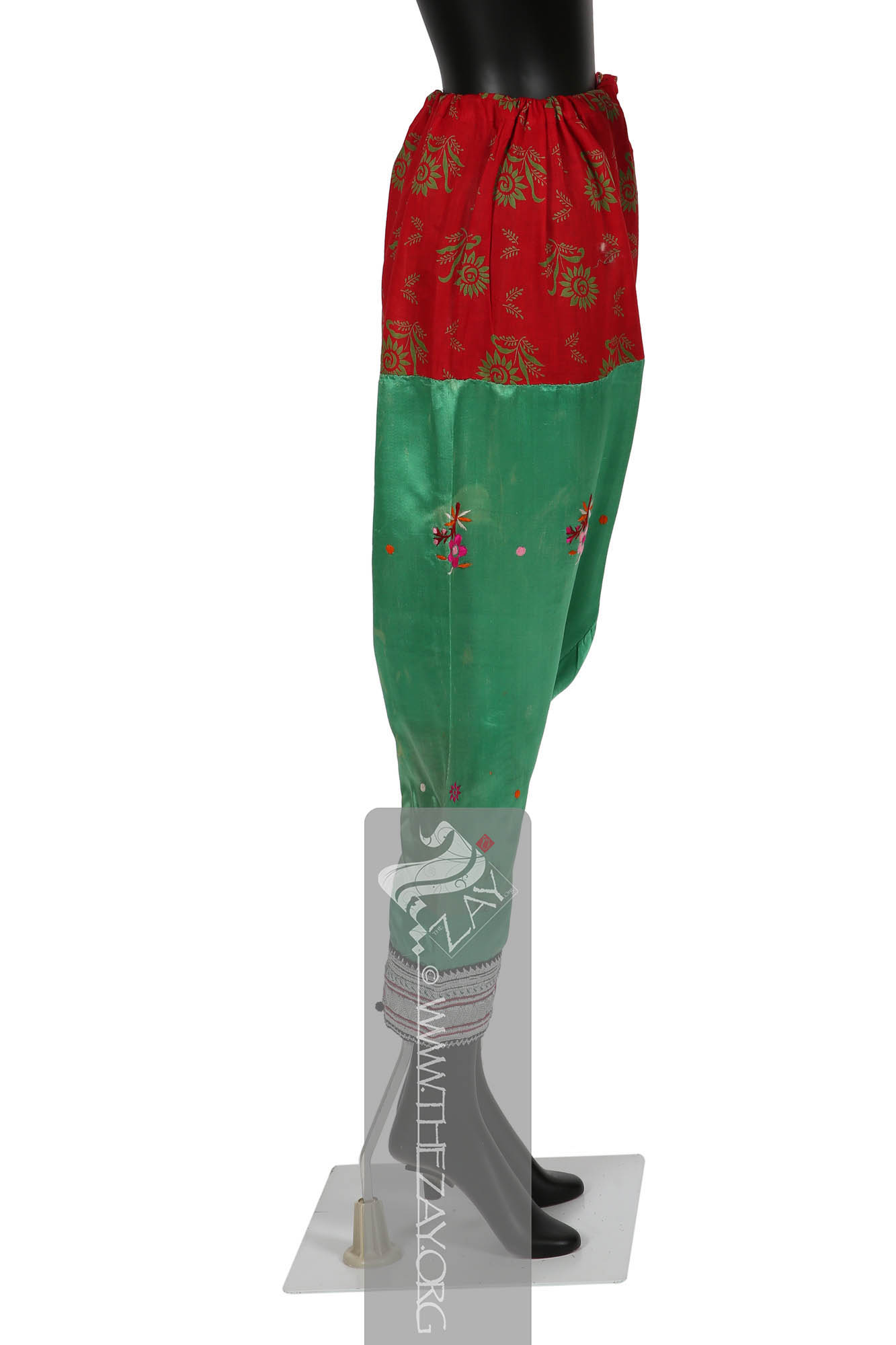
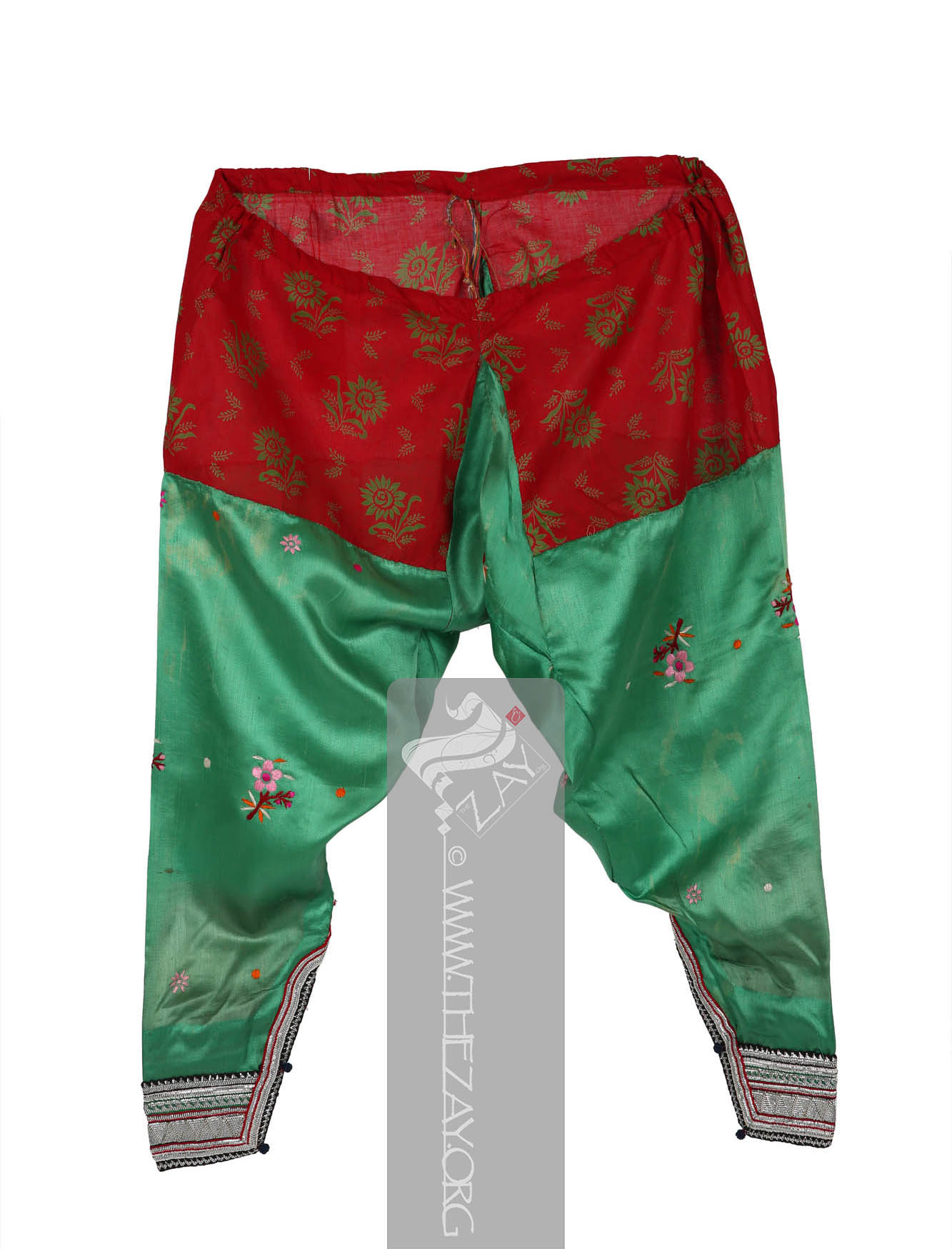
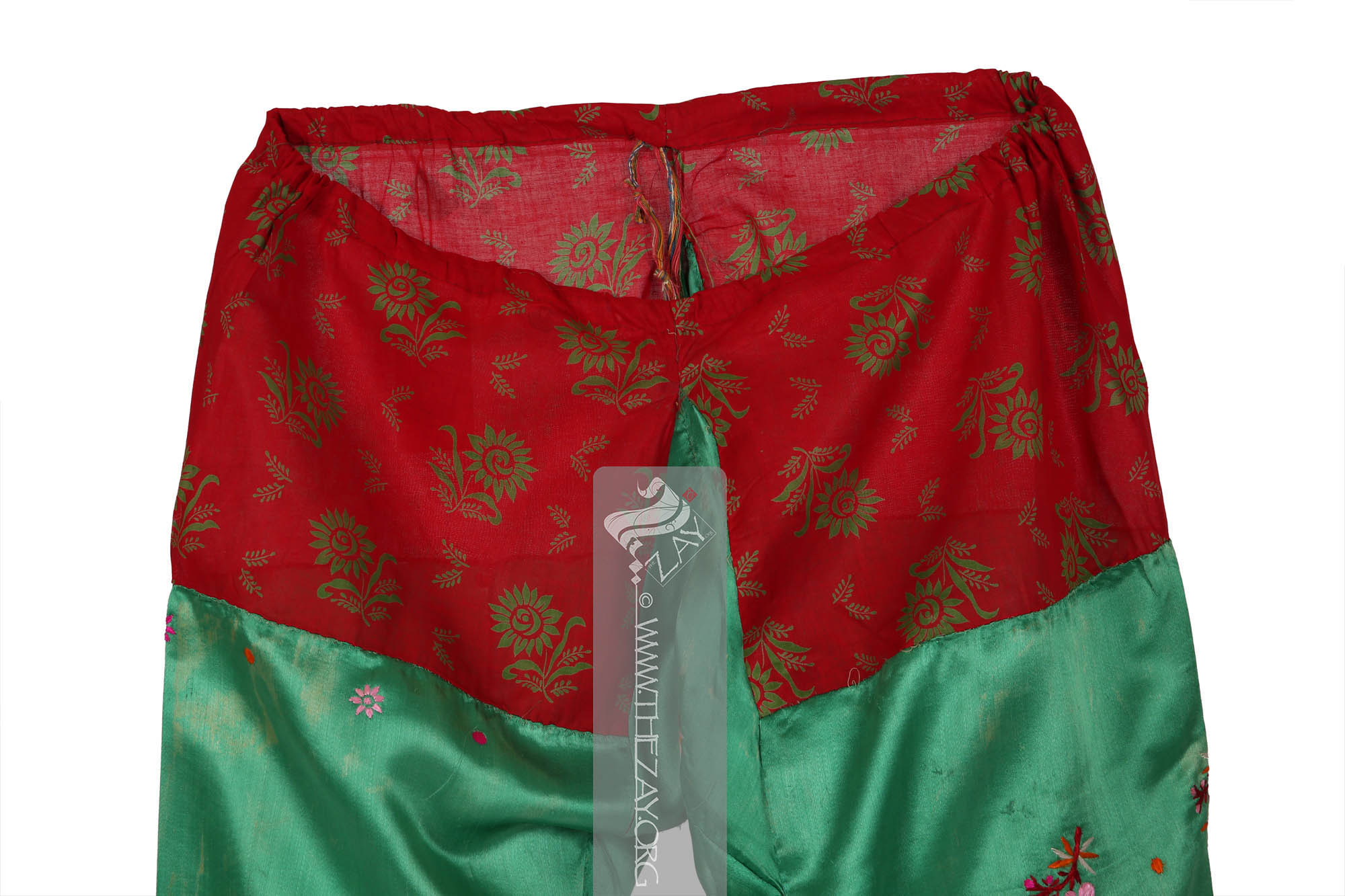
Constructed of a combination of two different fabric panels – a red cotton with printed floral and foliage patterns in green and a green silk with embroidered floral and geometric patterns – the piece features wide slitted embroidered cuffs (badlah
Bādlah: (Hindustani: badal – cloud from Sanskirt: vārdala – water; Synonym: tariq; talli
Tallī: (Turkish: tel – wire, string), Gulf Arab – a woven braided trimming made with metal wire, threads and ribbons often sewn on detachable panels used as embellishments. Other – (Synonym: tulle_bi_talli
Tūlle_bi_tallī: (French: Tulle – a city in France where fine material for veil was first made; Turkish: tel – wire; Synonym: tariq; talli; badla; khus_dozi ), series of small metal knots made on a woven net ground as embellishment. The term is commonly used in the North African Arab region specifically in Egypt. Tūlle_bi_tallī: (French: Tulle – a city in France where fine material for veil was first made; Turkish: tel – wire; Synonym: tariq; talli; badla; khus_dozi ), series of small metal knots made on a woven net ground as embellishment. The term is commonly used in the North African Arab region specifically in Egypt. Khus_dozi: (Arabic: khus – straw from Akkadian – kikkišu – piled up reed; Persian: dozi – needlework; Synonym: tariq; talli
Tallī: (Turkish: tel – wire, string), Gulf Arab – a woven braided trimming made with metal wire, threads and ribbons often sewn on detachable panels used as embellishments. Other – (Synonym: tulle_bi_talli
Tūlle_bi_tallī: (French: Tulle – a city in France where fine material for veil was first made; Turkish: tel – wire; Synonym: tariq; talli; badla; khus_dozi ), series of small metal knots made on a woven net ground as embellishment. The term is commonly used in the North African Arab region specifically in Egypt. Tūlle_bi_tallī: (French: Tulle – a city in France where fine material for veil was first made; Turkish: tel – wire; Synonym: tariq; talli; badla; khus_dozi ), series of small metal knots made on a woven net ground as embellishment. The term is commonly used in the North African Arab region specifically in Egypt. Tallī: (Turkish: tel – wire, string), Gulf Arab – a woven braided trimming made with metal wire, threads and ribbons often sewn on detachable panels used as embellishments. Other – (Synonym: tulle_bi_talli
Tūlle_bi_tallī: (French: Tulle – a city in France where fine material for veil was first made; Turkish: tel – wire; Synonym: tariq; talli; badla; khus_dozi ), series of small metal knots made on a woven net ground as embellishment. The term is commonly used in the North African Arab region specifically in Egypt.
While the top half of the piece is printed in a combination of floral patterns alternated with sporadic foliage repeats in green over a bright red base, the bottom half is constructed of a green silk fabric of (satin Sātin: (Arabic: Zaytuni: from Chinese port of Zayton in Quanzhou province where it was exported from and acquired by Arab merchants), one of the three basic types of woven fabric with a glossy top surface and a dull back. Originated in China and was fundamentally woven in silk.) weave. This panel, which primarily covers the legs of the wearer are embellished with (satin_stitch Satin_stitch: (Synonym: Damask Stitch), is a type of flat embroidery stitch that creates a satin like smooth and shiny surface by closely spaced stitches, covering an entire area or shape.) style embroidery featuring sporadic repeats of a small floral pattern in combination with a small polka dot pattern and a long floral arrangement that looks like a bird in flight, colloquially known as the (bu_tayrah Bū_ṭayrah: (Arabic, bū: diminutive of abū: father, ṭayr: bird). The term is used in the UAE to refer to a Chinese silk fabric, embroidered in floral motifs resembling birds in flight. It’s a sheer light format used for overgarments (athwāb), while the opaque satin Sātin: (Arabic: Zaytuni: from Chinese port of Zayton in Quanzhou province where it was exported from and acquired by Arab merchants), one of the three basic types of woven fabric with a glossy top surface and a dull back. Originated in China and was fundamentally woven in silk. silk is used for tunics (kanādīr) and the lower more visible parts of underpants (sarāwīl).).
A popular floral pattern within both the Arab and Iranian populations on both sides of the Gulf, this pattern is believed to be of Chinese and/or Central Asian origin, which found a second home in the region. Silk floss Floss: (Old French: flosche – nap of velvet), is a type of silk fibre obtained from the cocoons of wild silkworms. It is characterized by its long, fluffy fibers that are not tightly woven, making it ideal for use in various textile applications such as embroidery, lace-making, and sewing. thread in a multitude of colours – orange, ivory, burgundy and shades of pink – has been used in satin_stitch Satin_stitch: (Synonym: Damask Stitch), is a type of flat embroidery stitch that creates a satin like smooth and shiny surface by closely spaced stitches, covering an entire area or shape. technique to depict the embroidered patterns over the fabric.
The cuffs are embellished with wide bands embroidered with talli
Tallī: (Turkish: tel – wire, string), Gulf Arab – a woven braided trimming made with metal wire, threads and ribbons often sewn on detachable panels used as embellishments. Other – (Synonym: tulle_bi_talli
Tūlle_bi_tallī: (French: Tulle – a city in France where fine material for veil was first made; Turkish: tel – wire; Synonym: tariq; talli; badla; khus_dozi ), series of small metal knots made on a woven net ground as embellishment. The term is commonly used in the North African Arab region specifically in Egypt. Tallī: (Turkish: tel – wire, string), Gulf Arab – a woven braided trimming made with metal wire, threads and ribbons often sewn on detachable panels used as embellishments. Other – (Synonym: tulle_bi_talli
Tūlle_bi_tallī: (French: Tulle – a city in France where fine material for veil was first made; Turkish: tel – wire; Synonym: tariq; talli; badla; khus_dozi ), series of small metal knots made on a woven net ground as embellishment. The term is commonly used in the North African Arab region specifically in Egypt.
The outermost segment along the slitted edge and the bottom features a thin strip of talli
Tallī: (Turkish: tel – wire, string), Gulf Arab – a woven braided trimming made with metal wire, threads and ribbons often sewn on detachable panels used as embellishments. Other – (Synonym: tulle_bi_talli
Tūlle_bi_tallī: (French: Tulle – a city in France where fine material for veil was first made; Turkish: tel – wire; Synonym: tariq; talli; badla; khus_dozi ), series of small metal knots made on a woven net ground as embellishment. The term is commonly used in the North African Arab region specifically in Egypt. Tallī: (Turkish: tel – wire, string), Gulf Arab – a woven braided trimming made with metal wire, threads and ribbons often sewn on detachable panels used as embellishments. Other – (Synonym: tulle_bi_talli
Tūlle_bi_tallī: (French: Tulle – a city in France where fine material for veil was first made; Turkish: tel – wire; Synonym: tariq; talli; badla; khus_dozi ), series of small metal knots made on a woven net ground as embellishment. The term is commonly used in the North African Arab region specifically in Egypt.
From the top of the horizontal panels, the first strip of talli
Tallī: (Turkish: tel – wire, string), Gulf Arab – a woven braided trimming made with metal wire, threads and ribbons often sewn on detachable panels used as embellishments. Other – (Synonym: tulle_bi_talli
Tūlle_bi_tallī: (French: Tulle – a city in France where fine material for veil was first made; Turkish: tel – wire; Synonym: tariq; talli; badla; khus_dozi ), series of small metal knots made on a woven net ground as embellishment. The term is commonly used in the North African Arab region specifically in Egypt. Tallī: (Turkish: tel – wire, string), Gulf Arab – a woven braided trimming made with metal wire, threads and ribbons often sewn on detachable panels used as embellishments. Other – (Synonym: tulle_bi_talli
Tūlle_bi_tallī: (French: Tulle – a city in France where fine material for veil was first made; Turkish: tel – wire; Synonym: tariq; talli; badla; khus_dozi ), series of small metal knots made on a woven net ground as embellishment. The term is commonly used in the North African Arab region specifically in Egypt. Tallī: (Turkish: tel – wire, string), Gulf Arab – a woven braided trimming made with metal wire, threads and ribbons often sewn on detachable panels used as embellishments. Other – (Synonym: tulle_bi_talli
Tūlle_bi_tallī: (French: Tulle – a city in France where fine material for veil was first made; Turkish: tel – wire; Synonym: tariq; talli; badla; khus_dozi ), series of small metal knots made on a woven net ground as embellishment. The term is commonly used in the North African Arab region specifically in Egypt.
The fifth and central band, which is the widest among all, is characterized by a trapezium shape. This band incorporates two rows of repeated triangular motifs. The triangles in one row are oriented in the opposite direction to those in the other row, resulting in an interlocking arrangement. The talli
Tallī: (Turkish: tel – wire, string), Gulf Arab – a woven braided trimming made with metal wire, threads and ribbons often sewn on detachable panels used as embellishments. Other – (Synonym: tulle_bi_talli
Tūlle_bi_tallī: (French: Tulle – a city in France where fine material for veil was first made; Turkish: tel – wire; Synonym: tariq; talli; badla; khus_dozi ), series of small metal knots made on a woven net ground as embellishment. The term is commonly used in the North African Arab region specifically in Egypt. Tallī: (Turkish: tel – wire, string), Gulf Arab – a woven braided trimming made with metal wire, threads and ribbons often sewn on detachable panels used as embellishments. Other – (Synonym: tulle_bi_talli
Tūlle_bi_tallī: (French: Tulle – a city in France where fine material for veil was first made; Turkish: tel – wire; Synonym: tariq; talli; badla; khus_dozi ), series of small metal knots made on a woven net ground as embellishment. The term is commonly used in the North African Arab region specifically in Egypt.
A series of (frog_fastner) style ball-shaped buttons in blue silk (passementerie
Passementerie: (French: passement – braid), decorative trimmings or edgings for textile, often made of threads of silk, cotton, or precious metals such as gold and silver, generally braided or twisted into cords. Ṣarwāl: (Farsi: shalvār; Synonym: salwar, shirwāl), trousers featuring tapering ankles and drawstring closure of Central Asian origin. They disseminated in the Indian subcontinent between c.1st-3rd century BCE. Although exact period of its arrival in the Arab world is disputed their widespread adoption is confirmed from the 12th century.
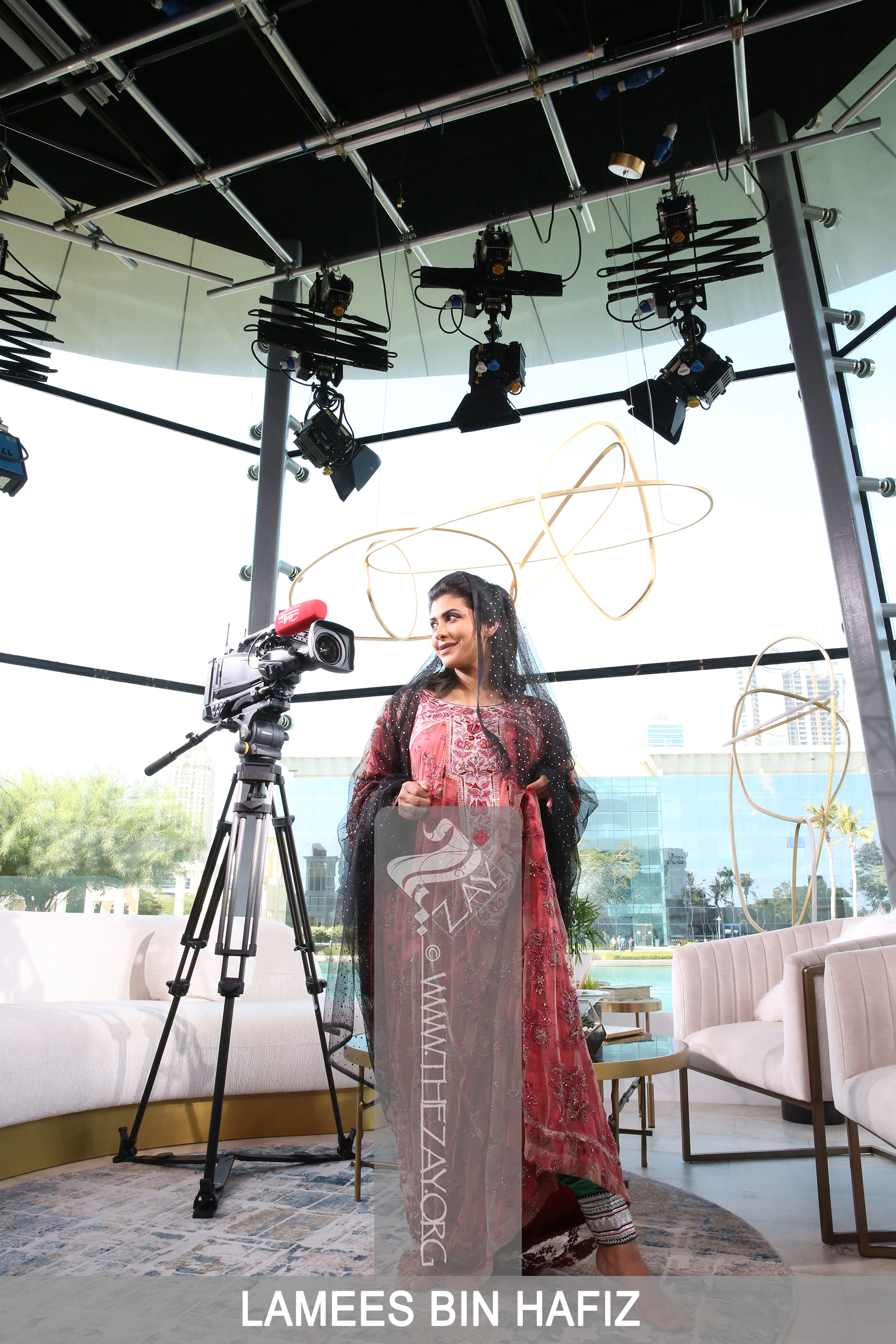
It is worth noting that these embellished broad cuffed sarwal
Ṣarwāl: (Farsi: shalvār; Synonym: salwar, shirwāl), trousers featuring tapering ankles and drawstring closure of Central Asian origin. They disseminated in the Indian subcontinent between c.1st-3rd century BCE. Although exact period of its arrival in the Arab world is disputed their widespread adoption is confirmed from the 12th century. Tallī: (Turkish: tel – wire, string), Gulf Arab – a woven braided trimming made with metal wire, threads and ribbons often sewn on detachable panels used as embellishments. Other – (Synonym: tulle_bi_talli
Tūlle_bi_tallī: (French: Tulle – a city in France where fine material for veil was first made; Turkish: tel – wire; Synonym: tariq; talli; badla; khus_dozi ), series of small metal knots made on a woven net ground as embellishment. The term is commonly used in the North African Arab region specifically in Egypt. Khus_dozi: (Arabic: khus – straw from Akkadian – kikkišu – piled up reed; Persian: dozi – needlework; Synonym: tariq; talli
Tallī: (Turkish: tel – wire, string), Gulf Arab – a woven braided trimming made with metal wire, threads and ribbons often sewn on detachable panels used as embellishments. Other – (Synonym: tulle_bi_talli
Tūlle_bi_tallī: (French: Tulle – a city in France where fine material for veil was first made; Turkish: tel – wire; Synonym: tariq; talli; badla; khus_dozi ), series of small metal knots made on a woven net ground as embellishment. The term is commonly used in the North African Arab region specifically in Egypt. Tūlle_bi_tallī: (French: Tulle – a city in France where fine material for veil was first made; Turkish: tel – wire; Synonym: tariq; talli; badla; khus_dozi ), series of small metal knots made on a woven net ground as embellishment. The term is commonly used in the North African Arab region specifically in Egypt.
With cross-cultural lineages running deep between the communities living on either side of the Gulf, it is thus no wonder that material culture such as this has found firm grounds on both sides.