

1 of 8
| Local Name | Qmijah |
| Object Category | Tunic dress |
| Gender | Female |
| Date of object | c. late 19th – early 20th century |
| Place Of orgin | Tunisia |
| Region | Tunisia |
| Object Range | Tunisia |
| Dimensions | Length: 107 cm Width: 68 cm |
| Materials | Silk Metal |
| Technique | Hand Stitched Hand Embroidered Woven |
| Color | |
| Motif | Abstract Geometric Floral |
| Provenance | Purchased, Dealer, France 2020 |
| Location | The Zay Zay: (Arabic: costume, Pl. azyaā’), a set of clothes in a style typical of a particular country or historical period. Initiative |
| Status | In Storage |
| ZI number | ZI2020.500862 TUNIS |
Object History
This piece was purchased by Dr. Reem Tariq
Ṭariq: (Arabic; Synonym: tulle_bi_talli
Tūlle_bi_tallī: (French: Tulle – a city in France where fine material for veil was first made; Turkish: tel – wire; Synonym: tariq; talli; badla; khus_dozi ), series of small metal knots made on a woven net ground as embellishment. The term is commonly used in the North African Arab region specifically in Egypt. Ṭariq: (Arabic; Synonym: tulle_bi_talli
Tūlle_bi_tallī: (French: Tulle – a city in France where fine material for veil was first made; Turkish: tel – wire; Synonym: tariq; talli; badla; khus_dozi ), series of small metal knots made on a woven net ground as embellishment. The term is commonly used in the North African Arab region specifically in Egypt.
Object Features
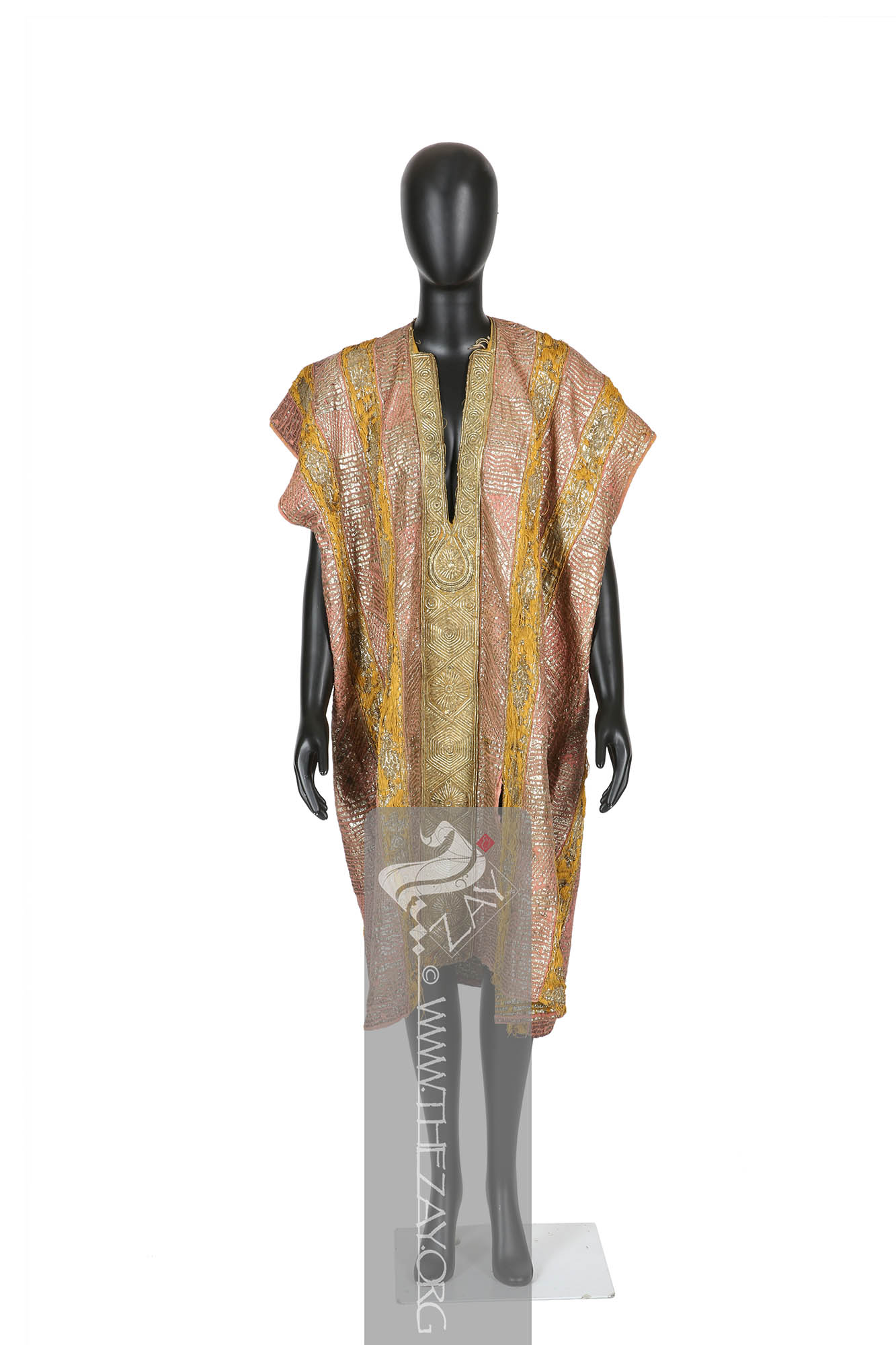
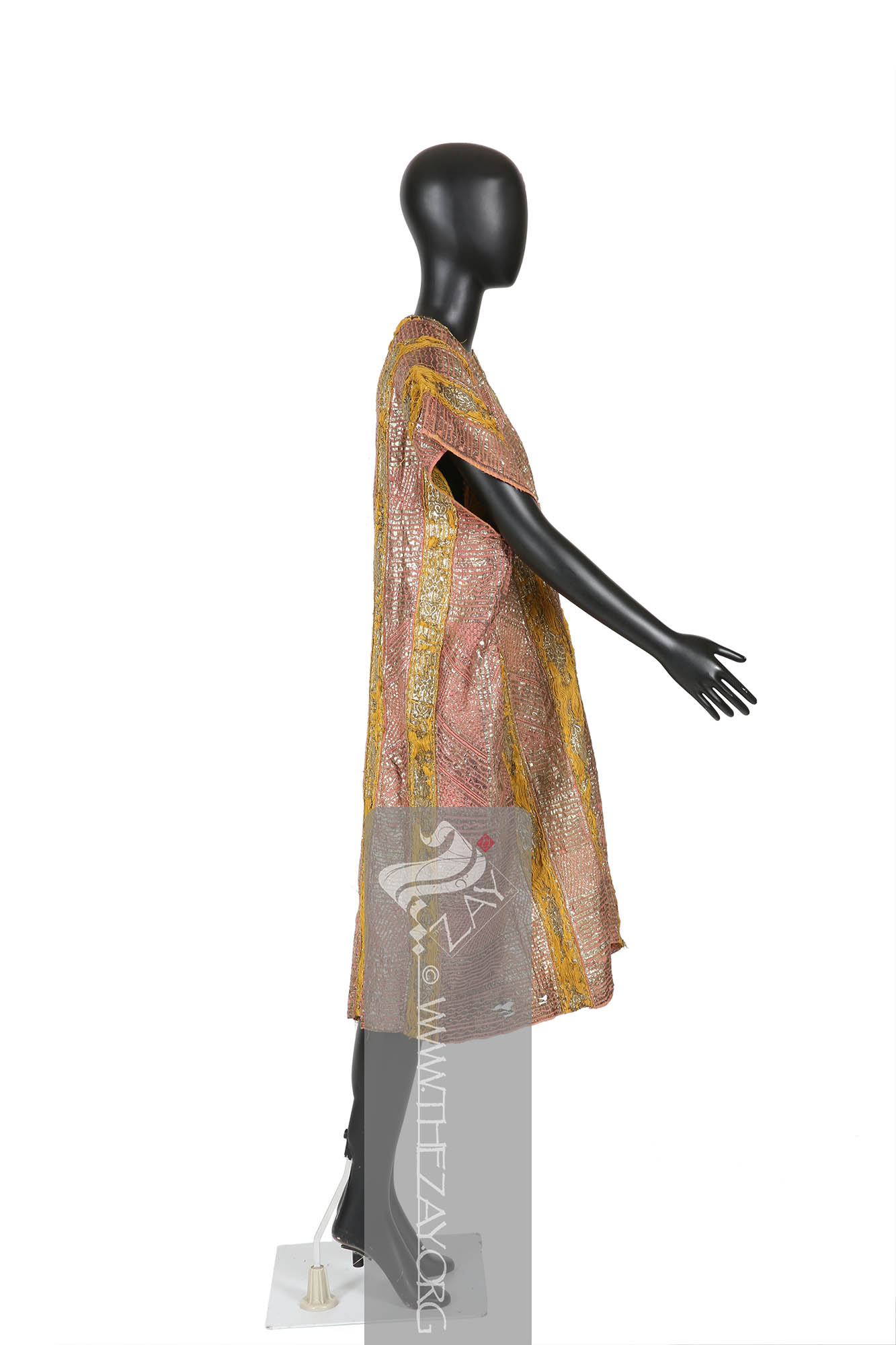
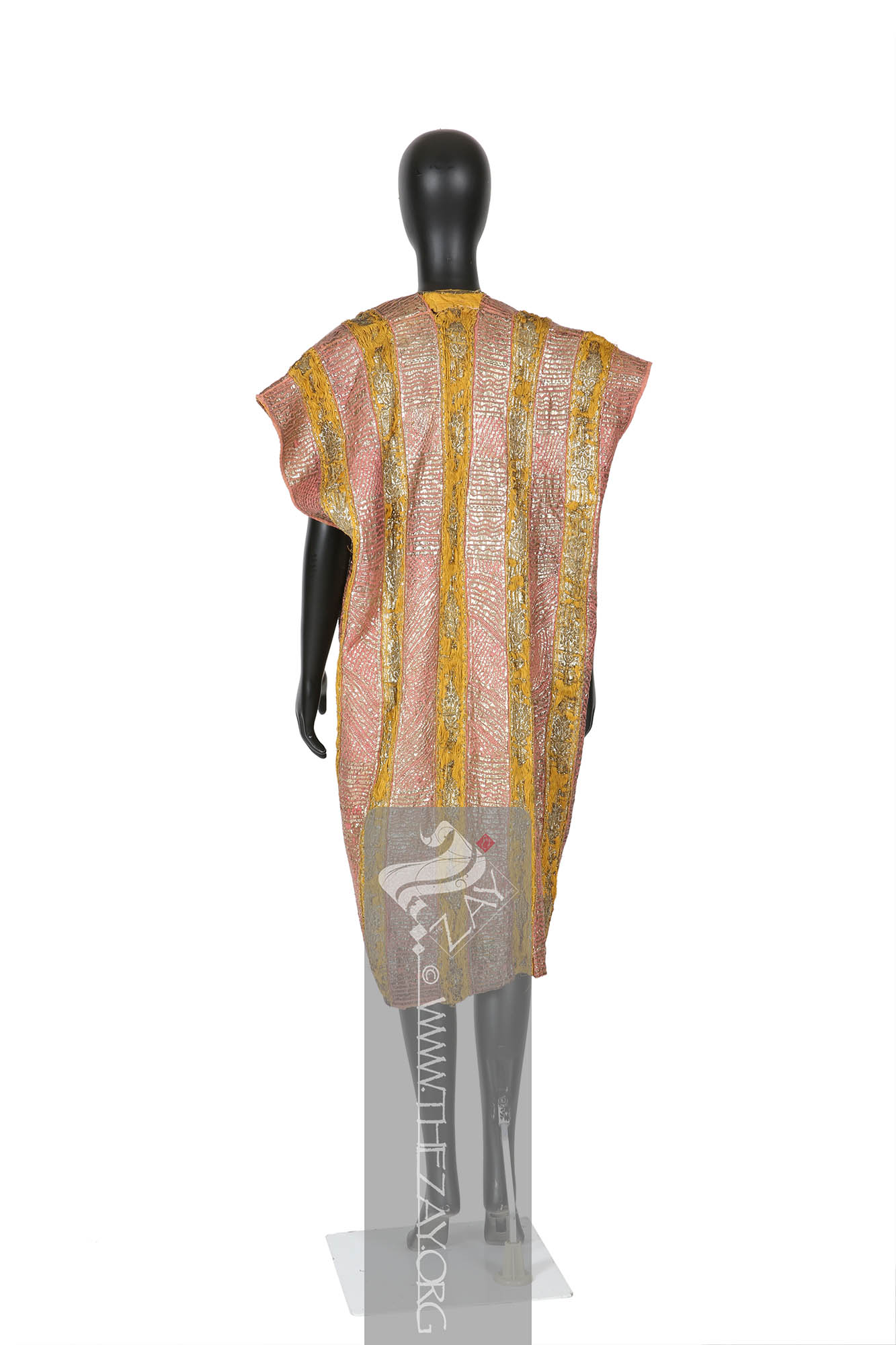
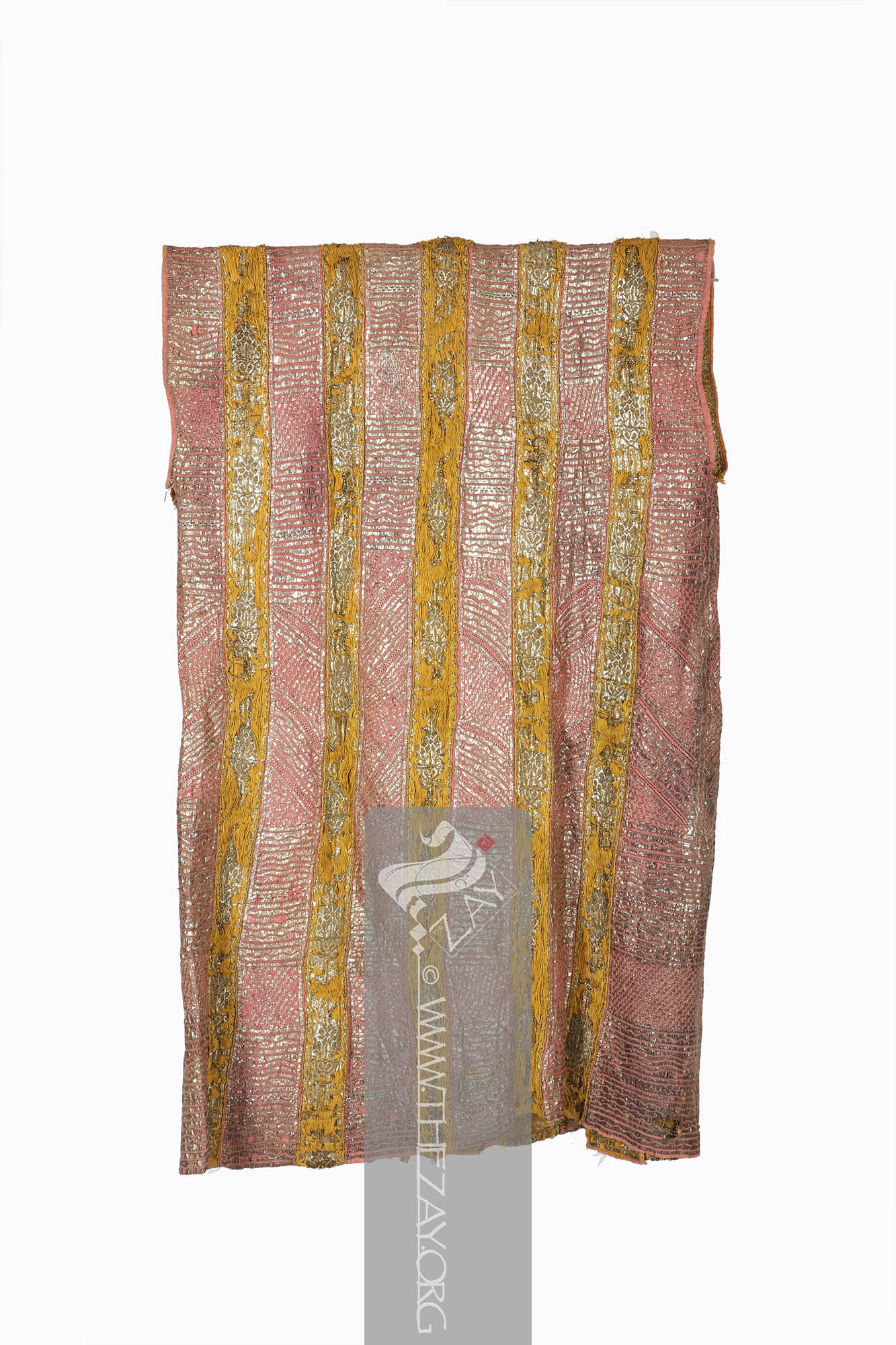
This is a loose rectangular women’s ceremonial tunic dress (qmijah
Qmijah: (Possibly late Latin: Camishia – Linen Undergarment; Synonym: kameez, qamīs, gmijah), a traditional loose fitting long tunic or shirt worn by both men and women in the Near and Middle East, South and Central Asia. Typically extending below the waist it is usually paired with a pair of trousers.
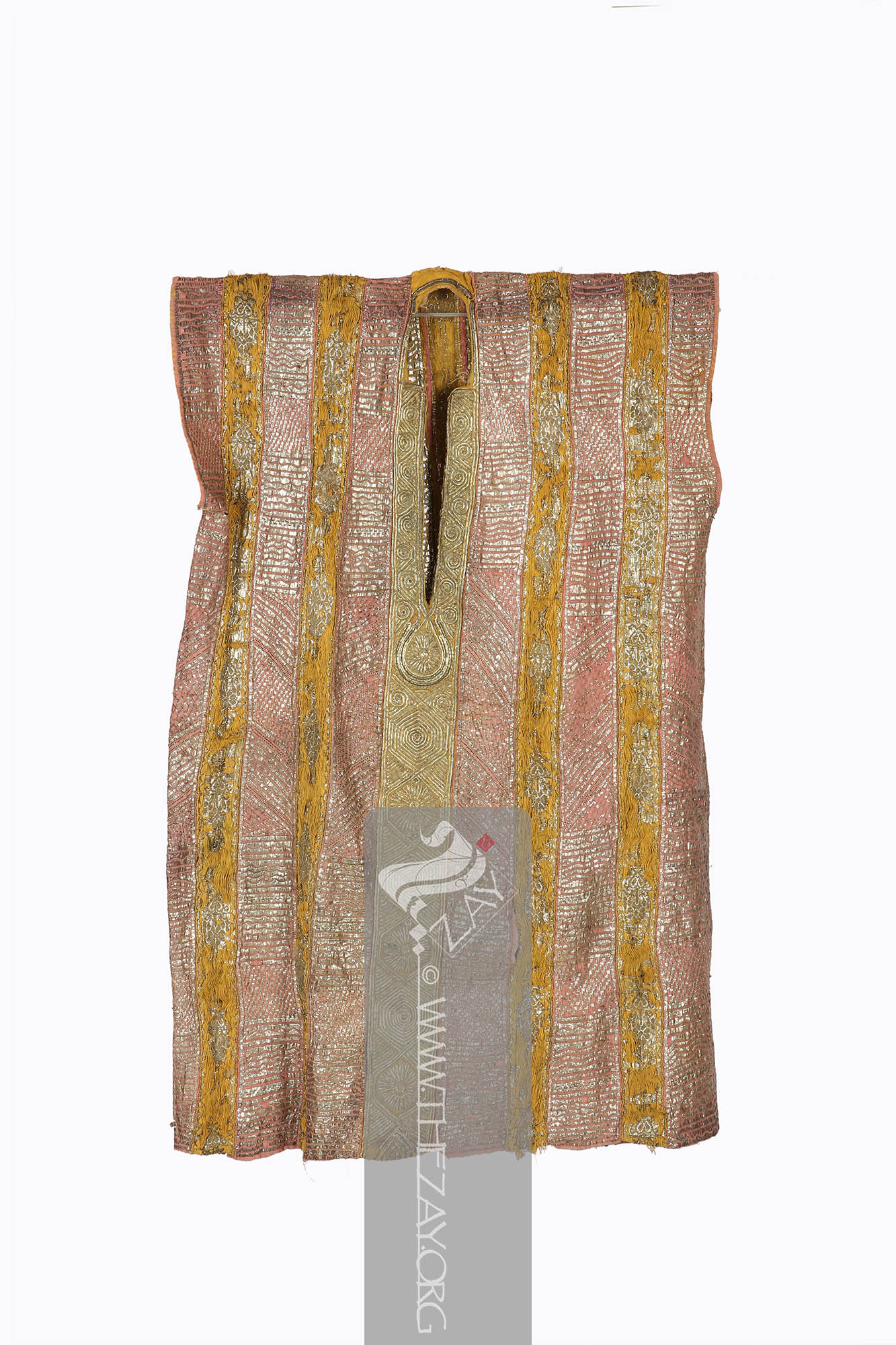
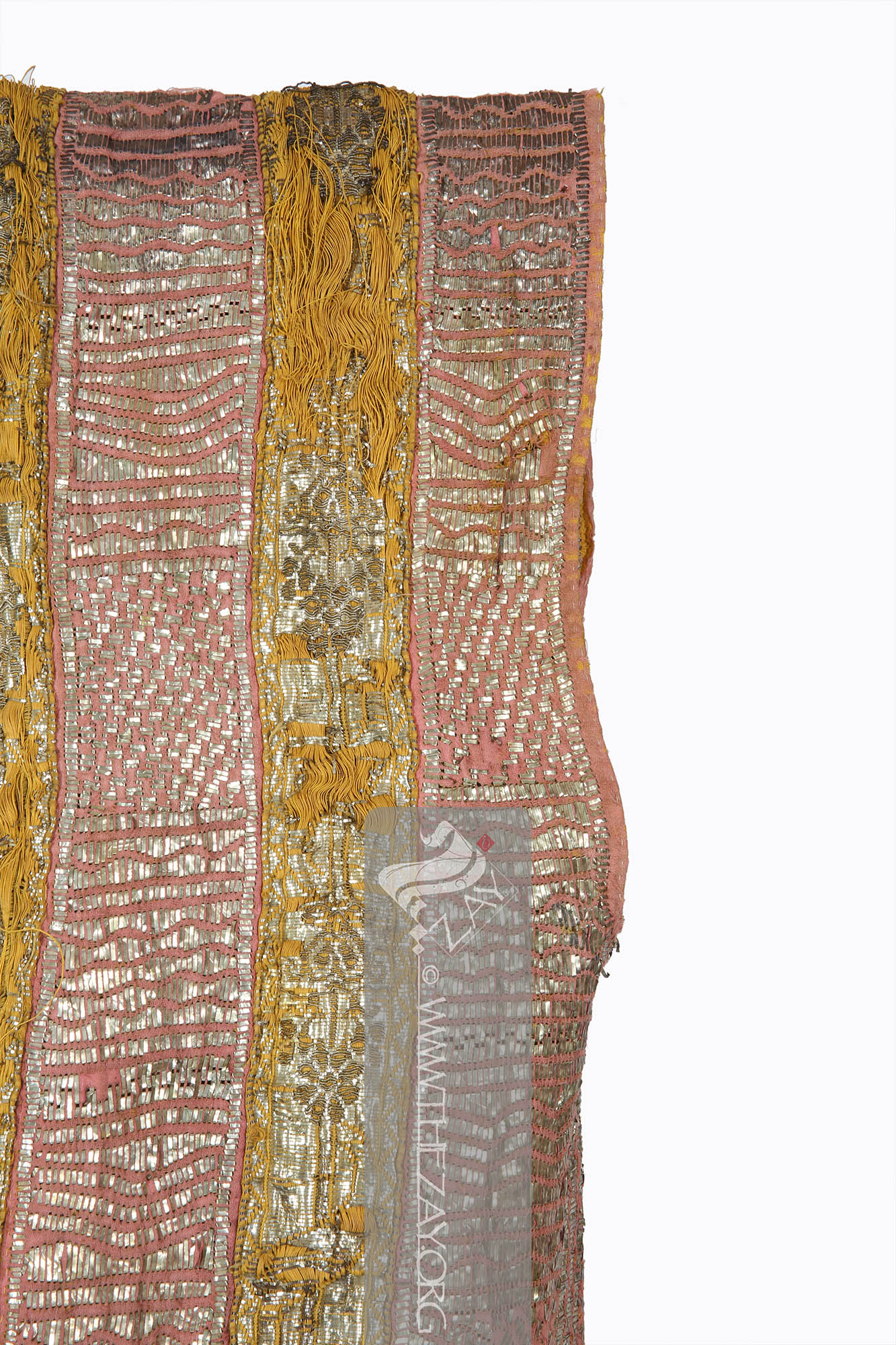
Wide strips of yellow and pink satin Sātin: (Arabic: Zaytuni: from Chinese port of Zayton in Quanzhou province where it was exported from and acquired by Arab merchants), one of the three basic types of woven fabric with a glossy top surface and a dull back. Originated in China and was fundamentally woven in silk. strips are stitched to each other into a single rectangular panel. The panel has been folded vertically and is stitched along the side seams, with a hole cut in the center and a slit along the base.
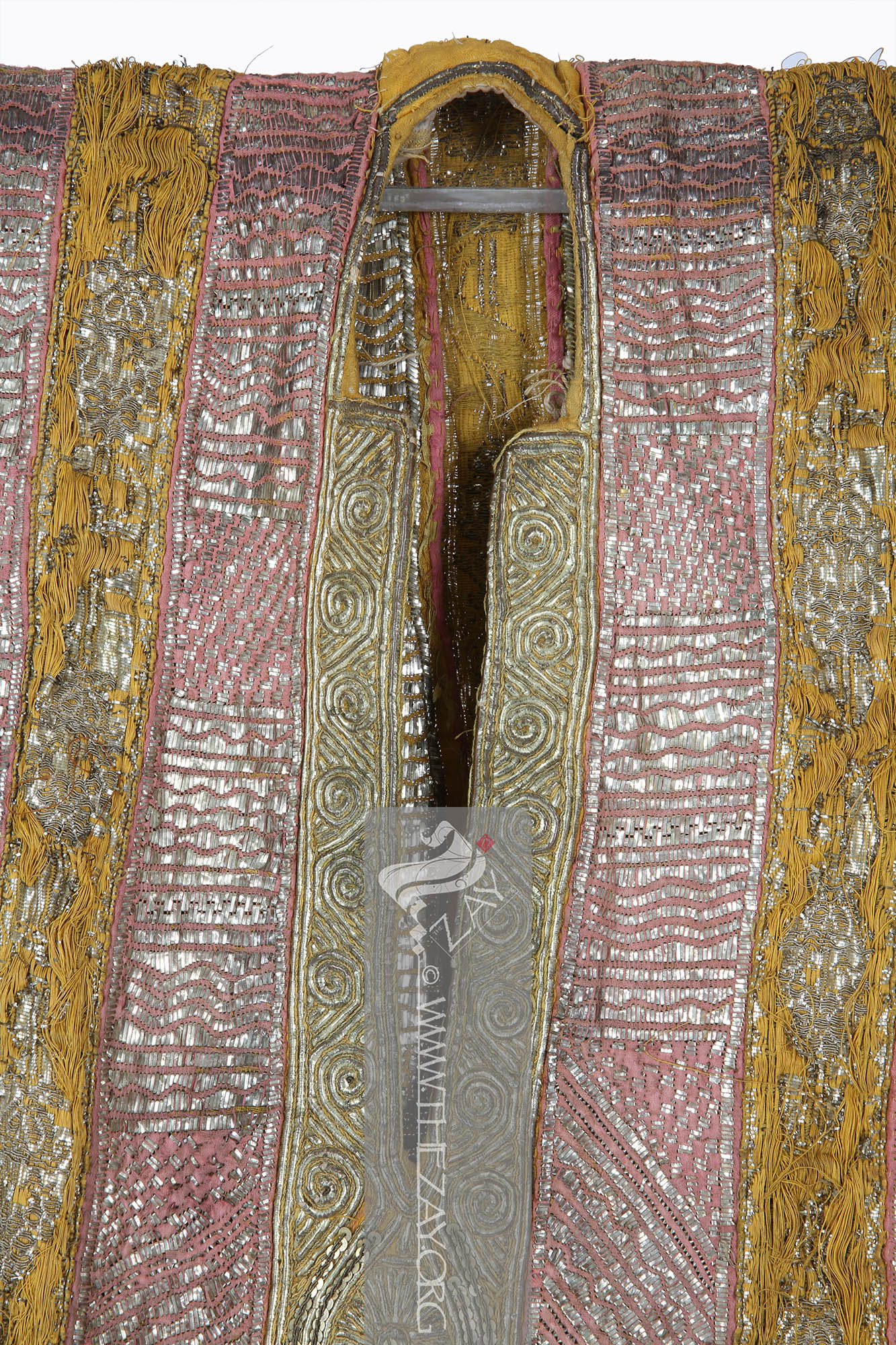
The field of the qmijjah is adorned with tal embroidery using (couching
Couching: (Latin: collocare – Place together), in needlework and embroidery couching is a technique in which yarn or other materials are laid across the surface of the ground fabric and fastened in place with small stitches of the same or a different yarn Barmaqalli: (Arabic), a form of metal thread embroidery using flat or plate threads.
The central panel over a yellow base has floral and geometric patterns alternately repeated in a vertical series within hexagonal cartouches. While one hexagon encases a large floral pattern, the other encases a concentric loop. Two triangular patterns with diagonally arranged parallel lines are features between the hexagons.
The neckline of the piece on both sides of the front opening features a wavy central vine with loops. While the central panel is layered with embroidered tal over a raised surface using the couching
Couching: (Latin: collocare – Place together), in needlework and embroidery couching is a technique in which yarn or other materials are laid across the surface of the ground fabric and fastened in place with small stitches of the same or a different yarn Barmaqalli: (Arabic), a form of metal thread embroidery using flat or plate threads.
The uniqueness of the central panel in comparison to the rest of the piece is in its decorative pattern. It is treated as the most important element in the tunic, as it can be seen under the waistcoat that is worn over it, which is often left open in the front.
The piece is completely hand-stitched and hand-embroidered and has no lining. Additionally, the yellow panels, along with their embroidered patterns, are mostly damaged and frayed, testifying to their years of usage.
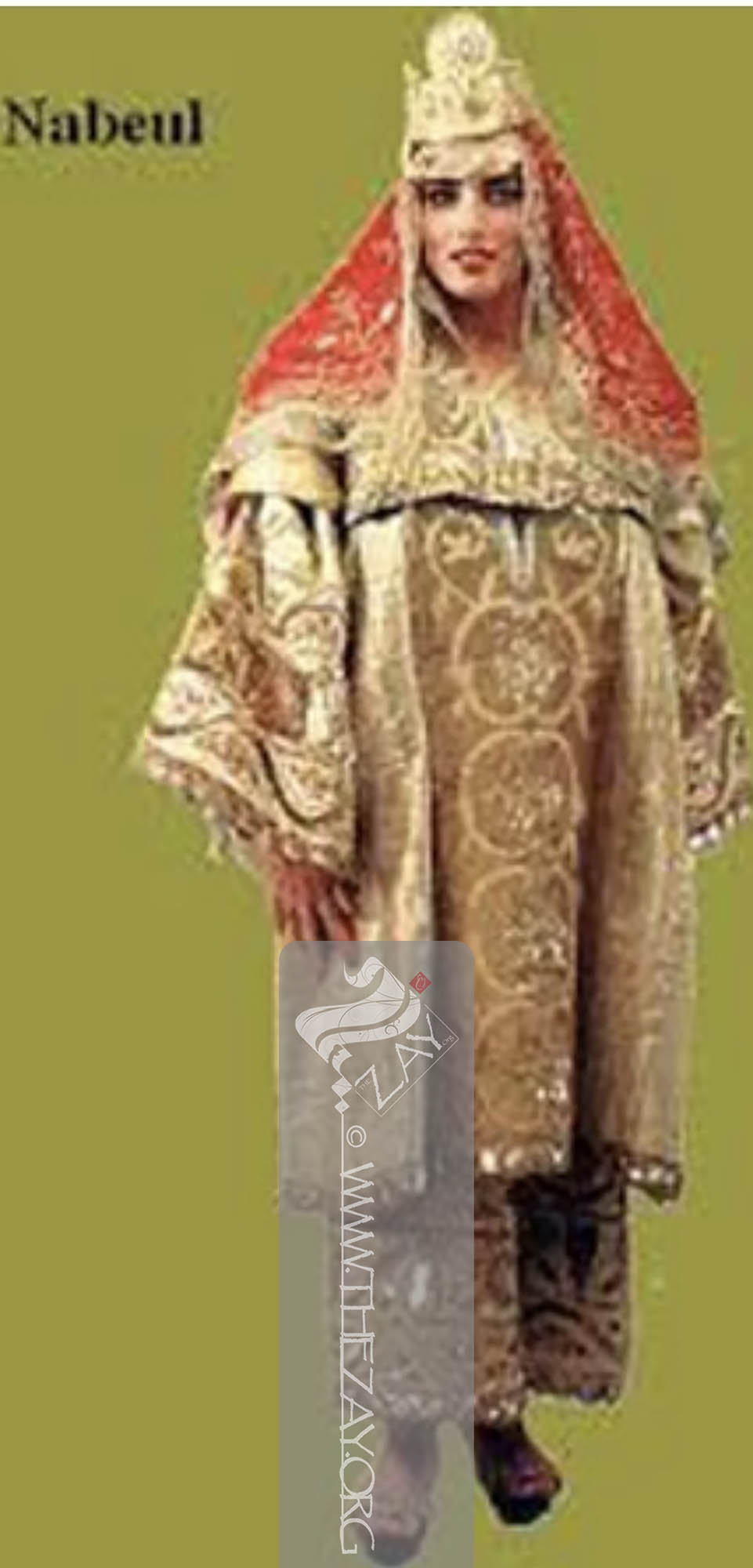
Although limited information is available about this particular piece, it bears a notable resemblance to garments originating from Nabeul, Tunisia.
Links
Skhāb: (Arabic: al sukhābah - necklace or chain; Or skhaba – commotion or noise referring to the strong and distinctive fragrance that spreads around the wearer), a traditional necklace for decoration and perfume, made of small beads crafted from a mixture of fragrant herbs and spices, dates back to the Berber era, and women in southern Tunisia still wear it at weddings and special occasions, and keep it in their closet to perfume their clothes.