

1 of 6
| Local Name | Qmijah |
| Object Category | Overgarment |
| Gender | Female |
| Date of object | c. early 19th century |
| Place Of orgin | Libya |
| Region | Libya |
| Dimensions | Length: 124 cm Width: 138 cm |
| Materials | Silk Linen |
| Technique | Hand Stitched Hand Embroidered |
| Color | |
| Motif | Floral |
| Provenance | Purchased, Dealer, France 2023 |
| Location | The Zay Zay: (Arabic: costume, Pl. azyaā’), a set of clothes in a style typical of a particular country or historical period. Initiative |
| Status | In Storage |
| ZI number | ZI2023.501022.2 LIBYA |
Object Note
Part of a lot along with one other item (ZI2023.501022.1 LIBYA) also in the collection.
Object History
This piece was purchased by Dr. Reem Tariq
Ṭariq: (Arabic; Synonym: tulle_bi_talli
Tūlle_bi_tallī: (French: Tulle – a city in France where fine material for veil was first made; Turkish: tel – wire; Synonym: tariq; talli; badla; khus_dozi ), series of small metal knots made on a woven net ground as embellishment. The term is commonly used in the North African Arab region specifically in Egypt. Ṭariq: (Arabic; Synonym: tulle_bi_talli
Tūlle_bi_tallī: (French: Tulle – a city in France where fine material for veil was first made; Turkish: tel – wire; Synonym: tariq; talli; badla; khus_dozi ), series of small metal knots made on a woven net ground as embellishment. The term is commonly used in the North African Arab region specifically in Egypt.
Object Features
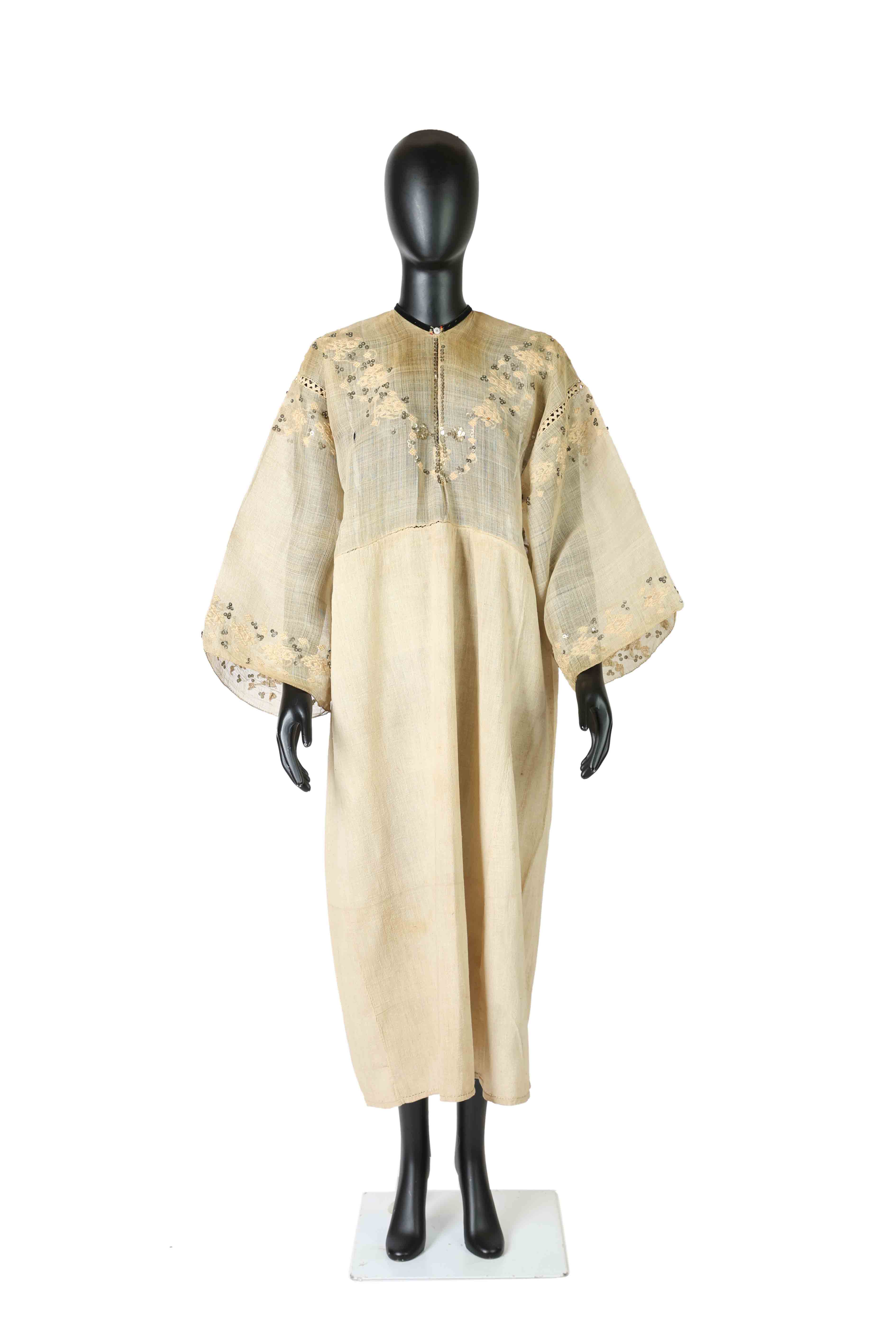
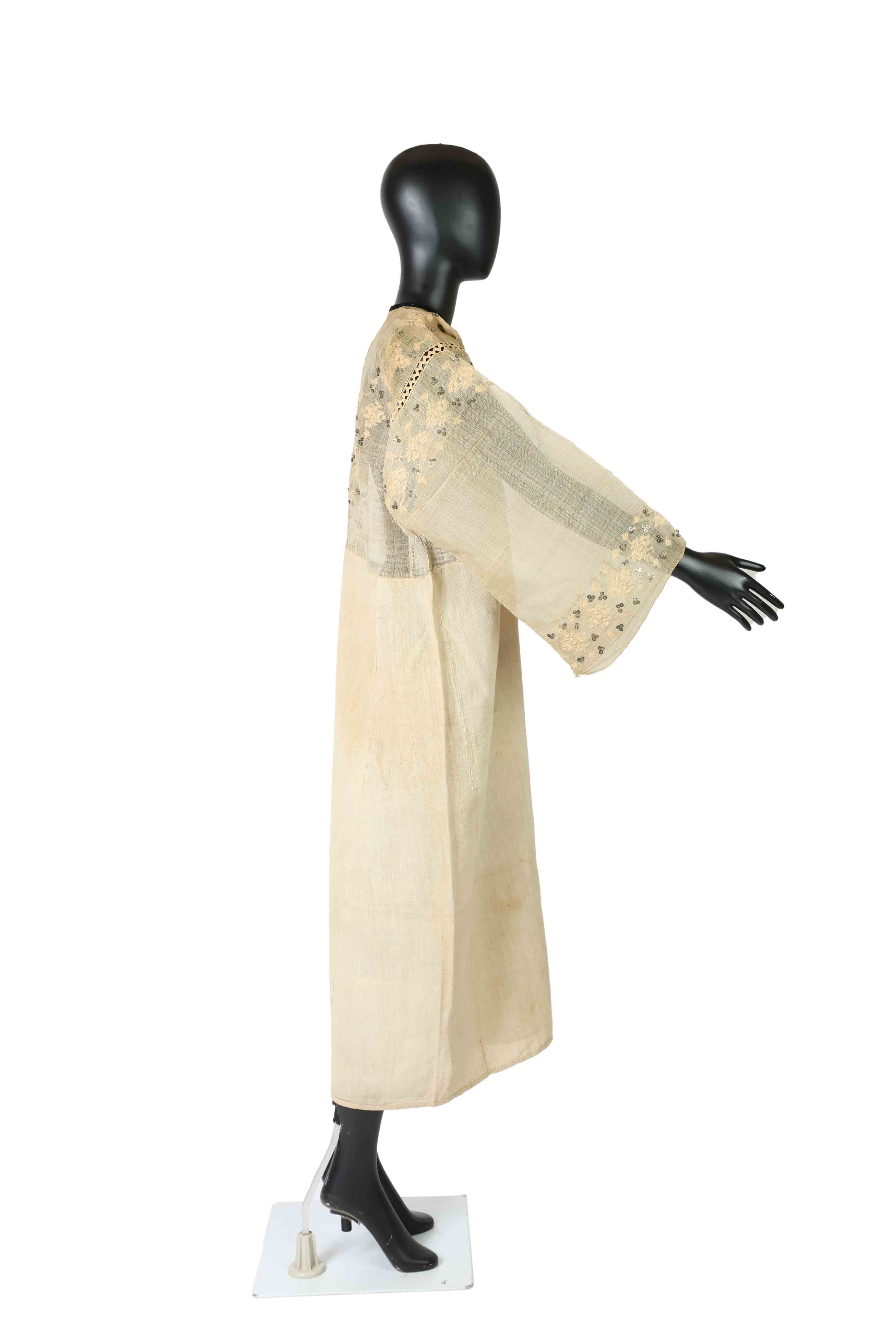
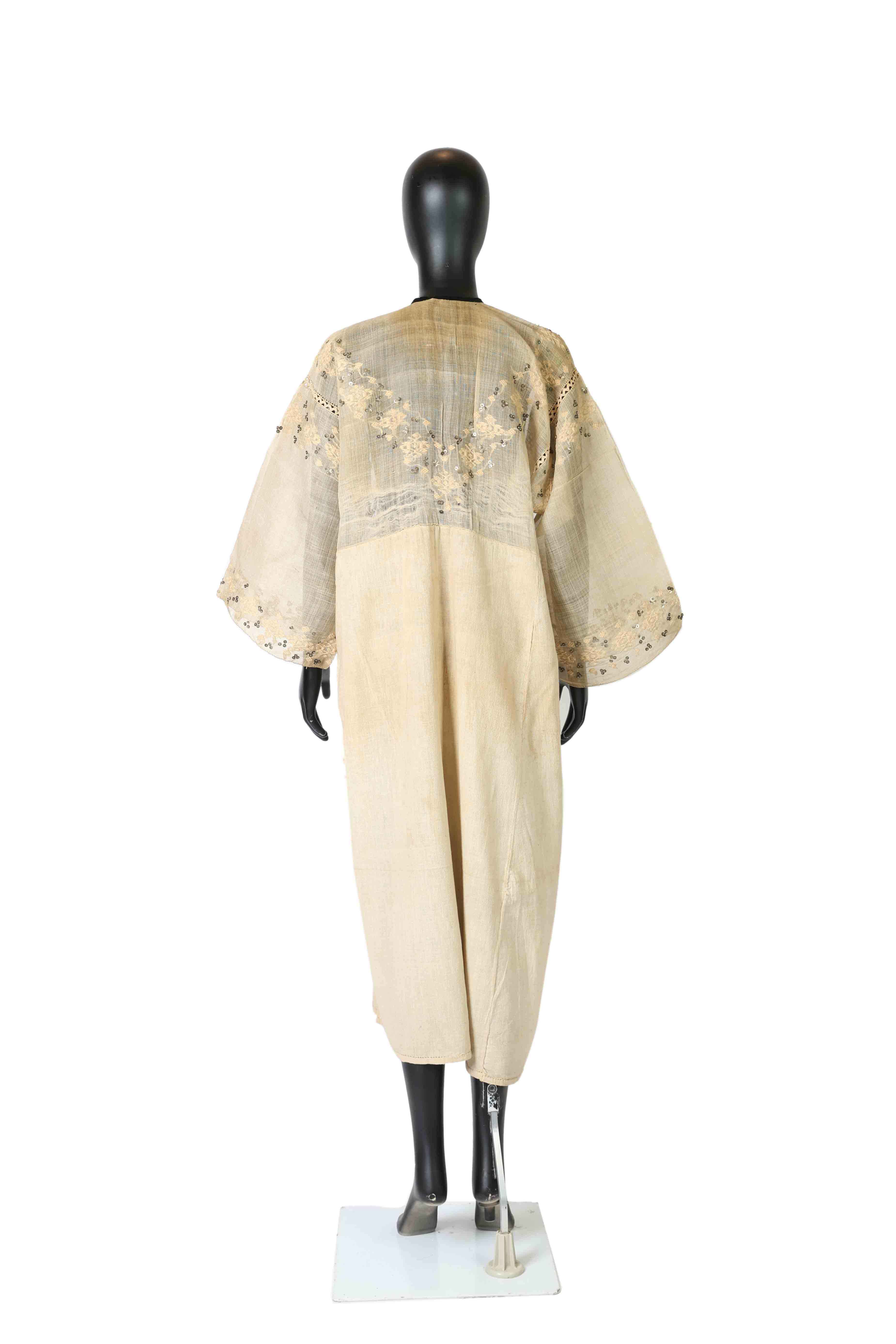
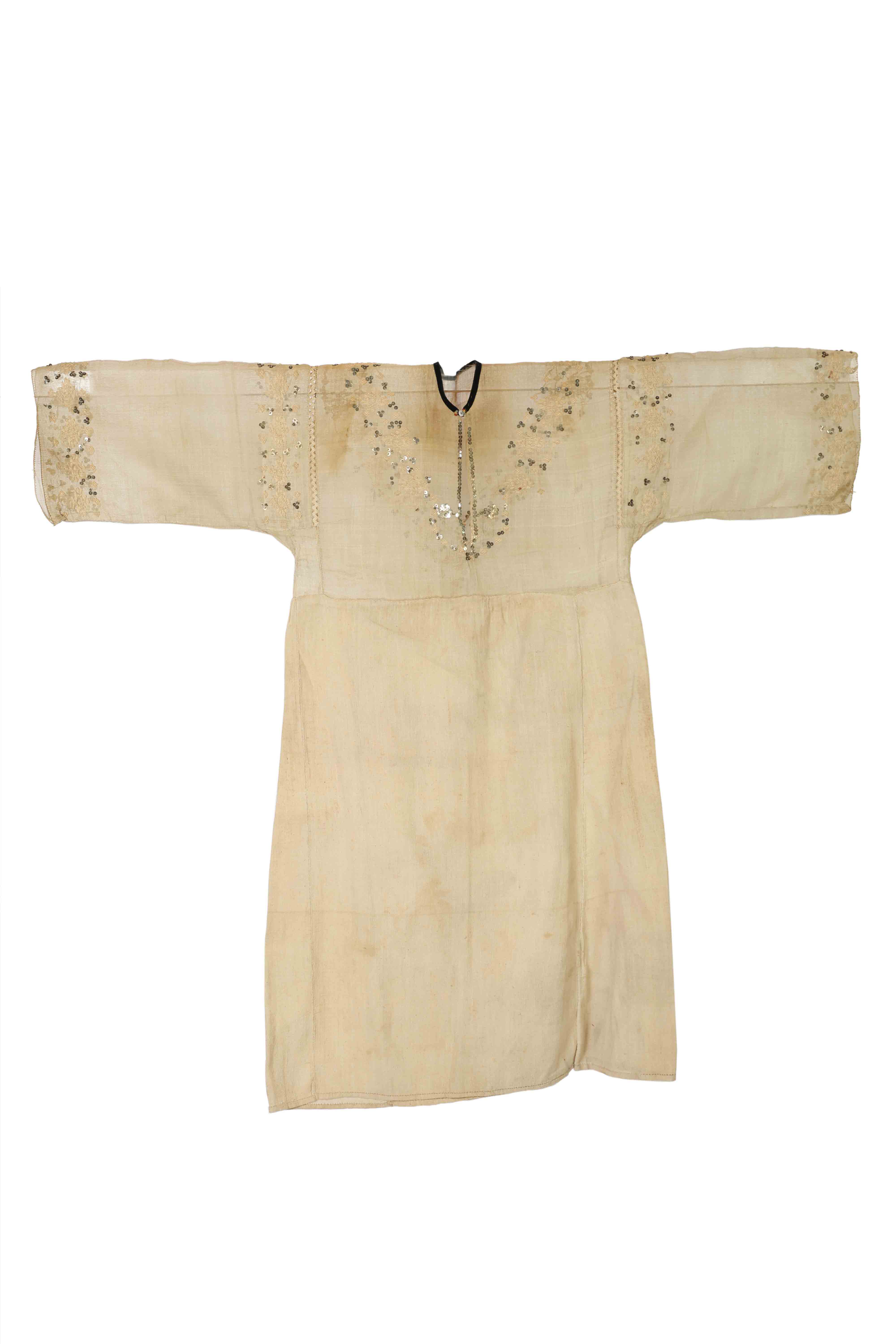
This is an ivory tunic style under robe (qmijah
Qmijah: (Possibly late Latin: Camishia – Linen Undergarment; Synonym: kameez, qamīs, gmijah), a traditional loose fitting long tunic or shirt worn by both men and women in the Near and Middle East, South and Central Asia. Typically extending below the waist it is usually paired with a pair of trousers.
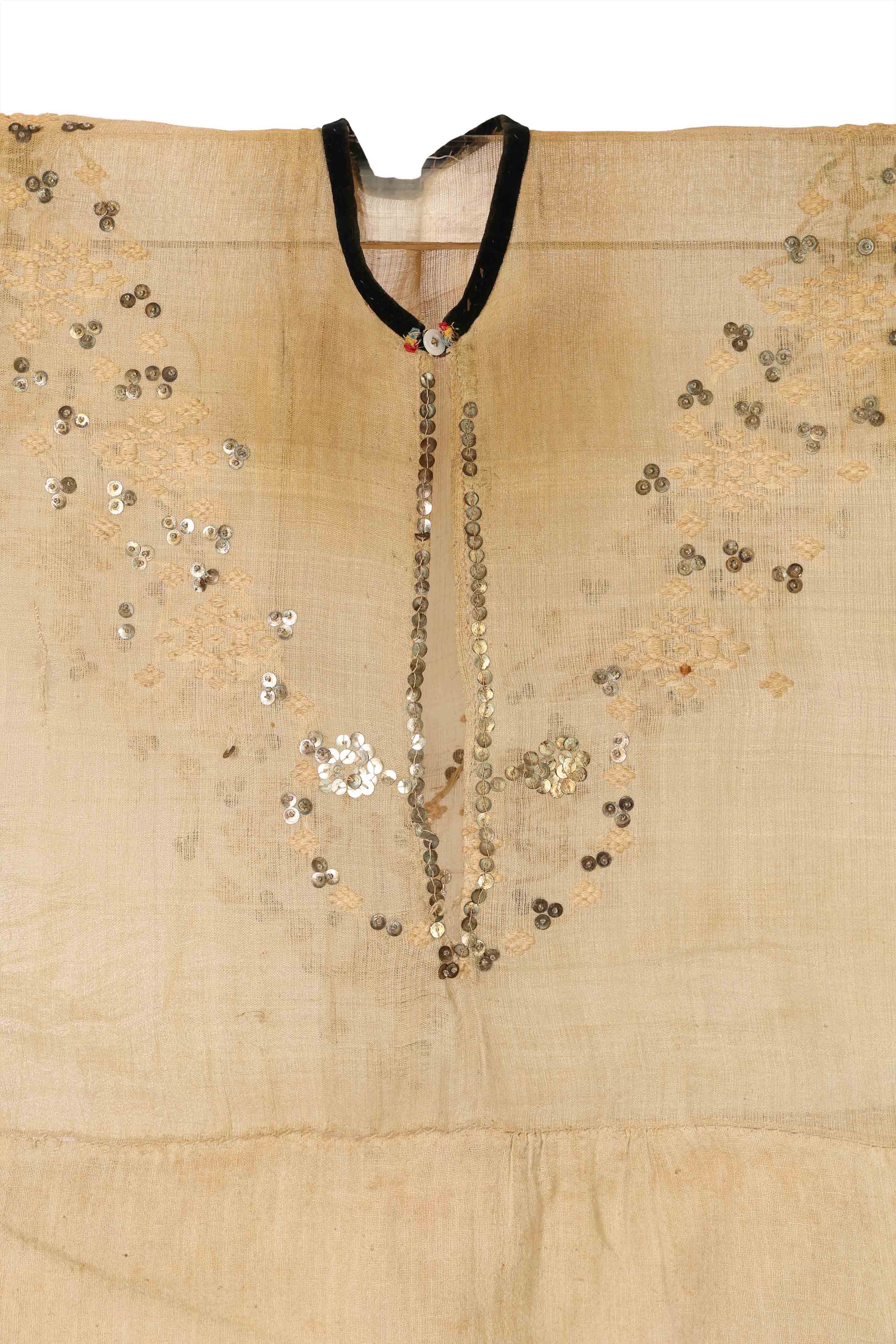
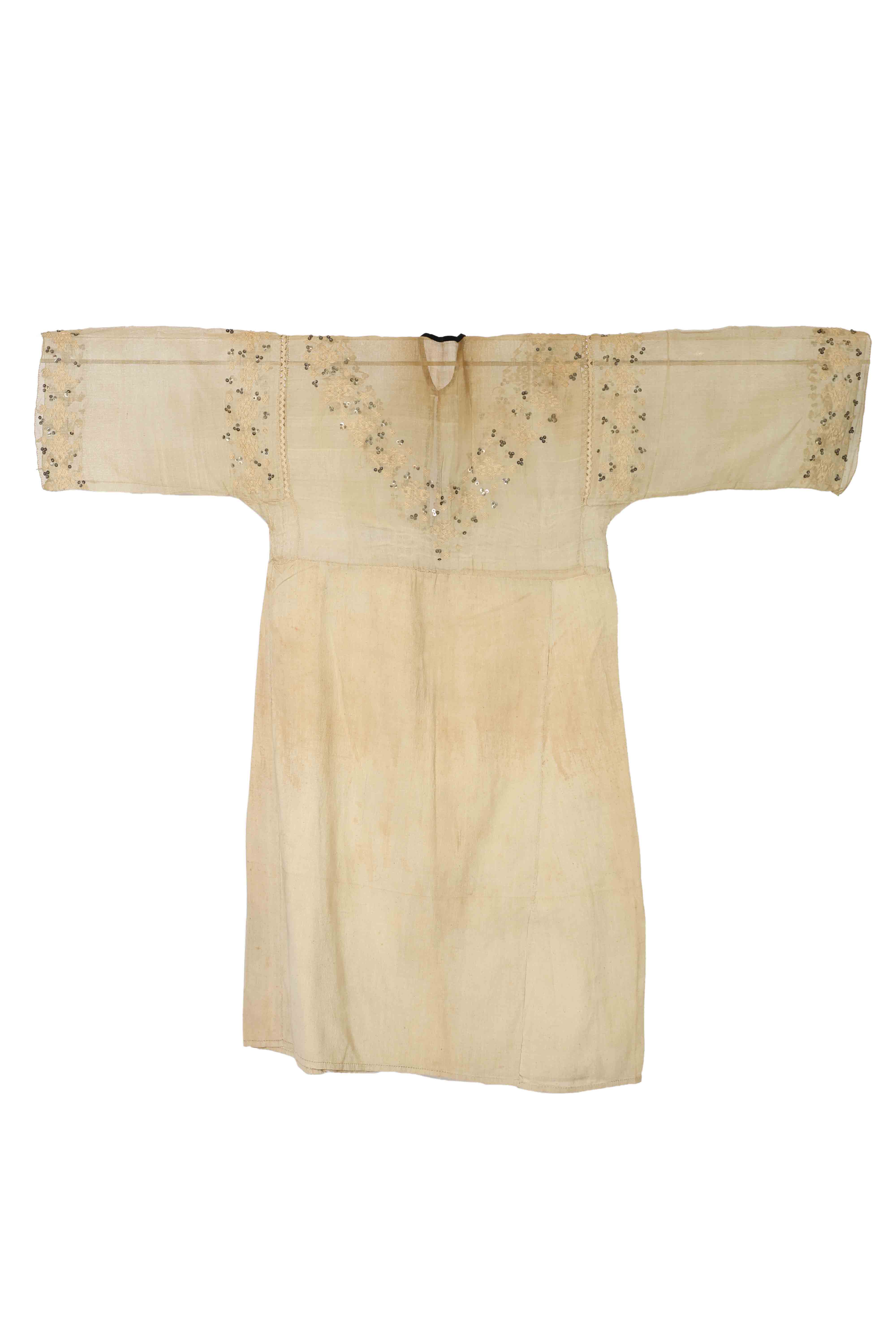
The (yoke Yoke: (Synonym: Bodice_Yoke), a structured pattern fitted at the shoulders defining the structure of women’s garments. Introduced in c. 1880s it defines the transition between the upper and lower parts of the garments and can now be found stitched-in where the blouse is separated from the skirt by a horizontal seam. ) and sleeves of the dress are constructed of ivory silk gauze Gauze: (English), very fine wire mesh transparent fabric of silk, linen, or cotton. fabric. It is embellished with (chain_stitch Chain_stitch: An embroidery technique where a looped stitch is made in a continuous chain-like pattern. Each stitch is formed by looping the thread through the previous stitch, creating a linked chain. ) style embroidered patterns featuring floral patterns in geometric style and arrangements and is highlighted with metal sequins.
It has a long front opening extending almost to the waist and with one button – a plastic button of possibly later addition – at the top. The neckline is small and round. It is trimmed with a black velvet ribbon. The two sides of the front opening are trimmed with sequins running vertically down along the opening on each side.
The sleeves are attached to the body of the piece by a zigzag-shaped cotton lace trimming along the seamline. The skirt of the garment is a plain thick (ecru
Ecru: (French: écru – raw), unbleached linen, often associated also with the colour of the fabric with an approximate hex code of #FEFEE0 in colour coordinates.
Interestingly, this piece is considered by some experts as a rare find and is believed to have been paired with sadriyah
Ṣadrīyah: (Arabic: waistcoat, synonyms: sdayrīyah, ṣdayrīyah, sadrīyah), an embellished hip-length sleeveless vest worn in the North African countries by the Arab and Berber men. It is often adorned with silk thread and cord embroidery and fastened in the front. Ridā: (Arabic; Synonym: khilalah, tizerzai
Tizerzai: (Berber; Synonym: khilalah), a woven panel of fabric traditionally used by women mostly of the Berber communities from the North African counties to drape around the body and knotted at the shoulders. Often, a silver fibula brooch would be used to fasten it and would pair it with a kitfyah. Testmāl: (Arabic: shoulder Synonym: kitfiyah), a woven headscarf or kerchief worn by Berber and Arab women of the North African countries. These are often paired and coordinated with a larger panel of fabric of the same make used to drape the body called the khilalah or tizerzai
Tizerzai: (Berber; Synonym: khilalah), a woven panel of fabric traditionally used by women mostly of the Berber communities from the North African counties to drape around the body and knotted at the shoulders. Often, a silver fibula brooch would be used to fasten it and would pair it with a kitfyah. Qmijah: (Possibly late Latin: Camishia – Linen Undergarment; Synonym: kameez, qamīs, gmijah), a traditional loose fitting long tunic or shirt worn by both men and women in the Near and Middle East, South and Central Asia. Typically extending below the waist it is usually paired with a pair of trousers.
Links