


1 of 5
| Local Name | Baqjeh, Bokcheh |
| Object Category | Accessory |
| Gender | Female |
| Date of object | c. 20th century |
| Place Of orgin | Iraq |
| Region | Iraq |
| Object Range | Kazakhstan, Turkmenistan, Tibet, Afghanistan, Iran, Uzbekistan, Kyrgyzstan, Tajikistan, Armenia, Azerbaijan, Georgia, Türkiye, Syria, Lebanon, Palestine, Jordan, Iraq, Bulgaria, Romania, Macedonia, Greece et al |
| Dimensions | Length: 79 cm Width: 112 cm |
| Materials | Silk |
| Technique | Hand Embroidered Machine Stitched Other |
| Color | |
| Motif | Floral Other |
| Provenance | Donated, Khawla Khalid Diab, Boston 2018 |
| Location | The Zay Zay: (Arabic: costume, Pl. azyaā’), a set of clothes in a style typical of a particular country or historical period. Initiative |
| Status | In Storage |
| ZI number | ZI2018.500239.3 IRAQ |
Object Note
Part of a lot with four more items (ZI2018.500239.1 IRAQ, ZI2018.500239.2 IRAQ, ZI2018.500239.3a IRAQ, and ZI2018.500239.3b IRAQ) also in the collection.
Object History
This item was donated to The Zay
Zay: (Arabic: costume, Pl. azyaā’), a set of clothes in a style typical of a particular country or historical period. Collection by Khawla Khalid-Diab, a family friend of the founder, Dr. Reem Tariq
Ṭariq: (Arabic; Synonym: tulle_bi_talli
Tūlle_bi_tallī: (French: Tulle – a city in France where fine material for veil was first made; Turkish: tel – wire; Synonym: tariq; talli; badla; khus_dozi ), series of small metal knots made on a woven net ground as embellishment. The term is commonly used in the North African Arab region specifically in Egypt. Ṭariq: (Arabic; Synonym: tulle_bi_talli
Tūlle_bi_tallī: (French: Tulle – a city in France where fine material for veil was first made; Turkish: tel – wire; Synonym: tariq; talli; badla; khus_dozi ), series of small metal knots made on a woven net ground as embellishment. The term is commonly used in the North African Arab region specifically in Egypt.
Born in Baghdad in 1939, Khawla was the oldest daughter of a senior judge and his socialite wife. She began her career as a pharmacist after coming of age during Iraq’s cultural and political heyday – the 1950s and 1960s.
She emigrated to the United States of America in 1980 and settled in Boston, Massachusetts, where she continued pursuing her career in pharmaceuticals. Today, she and her husband are parents to three children and seven grandchildren.
Khawla, with her passion for literature, cuisine, and fine arts, has remained an active member of the Arab community in the Boston area.
Object Features
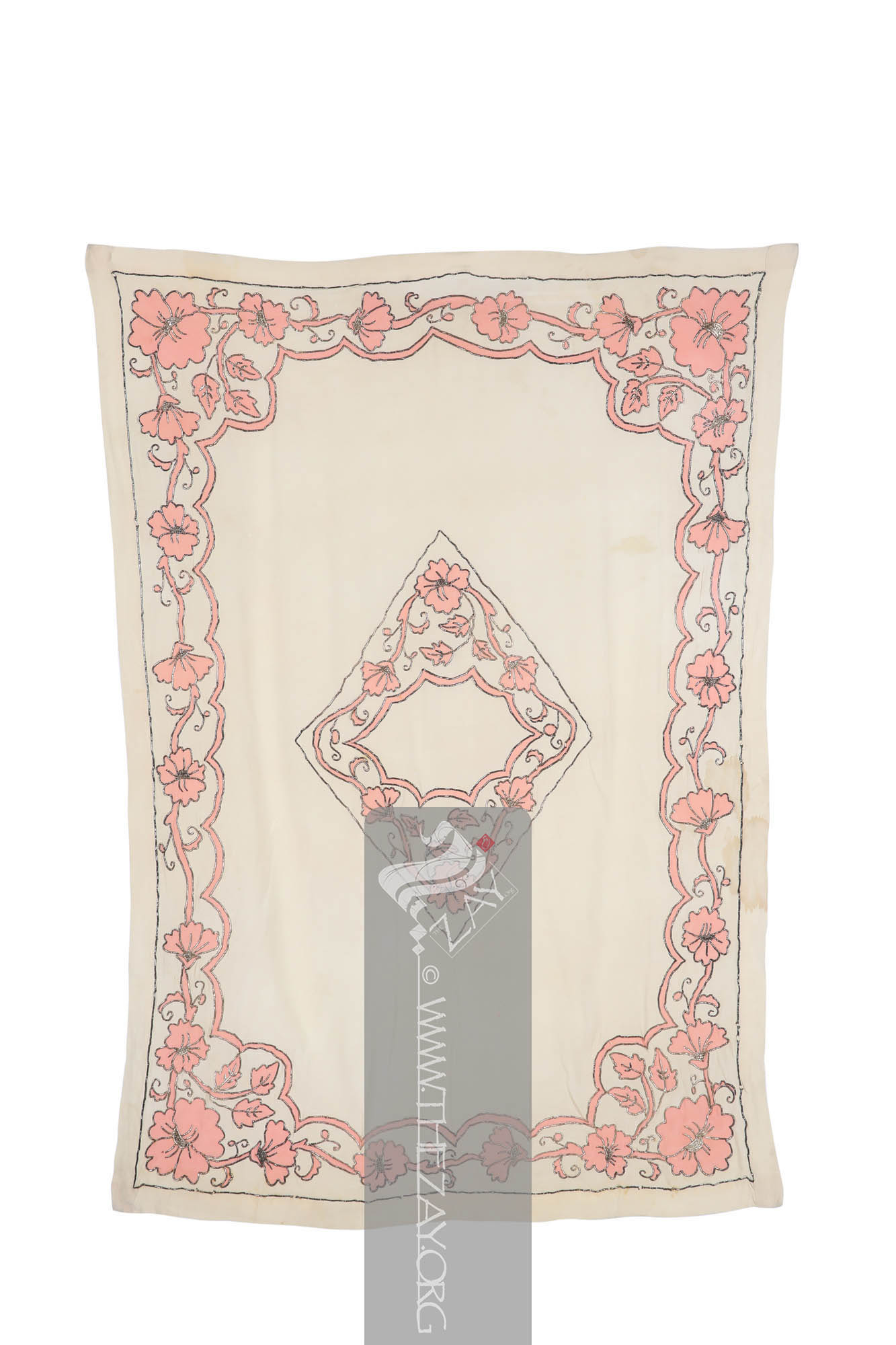
This is possibly a set of bridal ceremonial trousseau comprising a kerchief bag (baqjeh
Baqjeh: (Possibly Turkoman: bokcheh
Bokcheh: (Possibly Turkoman: an envelope like bag for bread; Synonym: baqjeh), a square-shaped fabric, adorned and folded into an envelope style bag, commonly present in bridal trousseaus across the Mediterranean and Central Asian regions. Originating from Turkic tradition, it has been embraced in the Mediterranean and Levant Arab world. Crepe: (Latin: crispus; Old French: crespe – curled or frizzed), is a lightweight, crinkled fabric with a pebbled texture woven from a hand spun untreated or ‘in the gum’ silk yarn.
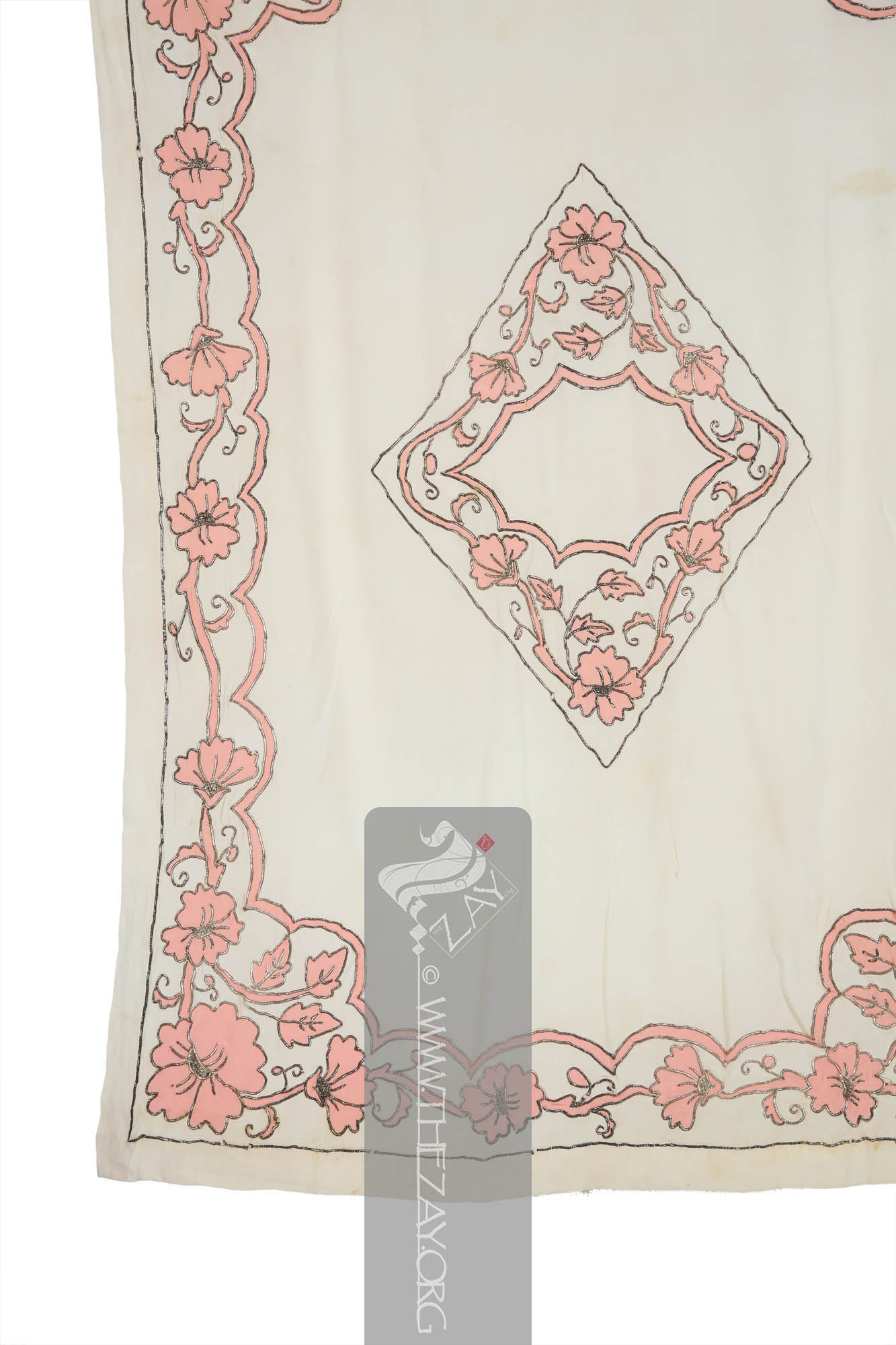
They feature appliqued
Appliqued: (French: appliquer – Apply), ornamental needlework where small pieces of decorative fabric are sewn on to a larger piece to form a pattern. floral motifs in pink crepe
Crepe: (Latin: crispus; Old French: crespe – curled or frizzed), is a lightweight, crinkled fabric with a pebbled texture woven from a hand spun untreated or ‘in the gum’ silk yarn. Lamella: (Latin: lāmella or lāmina – plate), a flat strip of metal yarn used as embroidery thread. Kalabdūn: (Hindustani: kalabattu / kalabattun gold or silver threads; or Dravidian and Sanskrit: pattu or patt – a kind of fine fibre or silk; or Sanskrit: kalavatu – fine material), the gold wire used in embroidery and other embellishments on textiles and fabrics. Overcast_stitch: (Synonym: whip_stitch
Whip_stitch: (Synonym: Overcast_stitch), one of the basic stitching techniques in embroidery with simple stitches are worked on the smallest area of the base material as possible. It is often used for hemming and closing unfinished edges.
The large baqjeh
Baqjeh: (Possibly Turkoman: bokcheh
Bokcheh: (Possibly Turkoman: an envelope like bag for bread; Synonym: baqjeh), a square-shaped fabric, adorned and folded into an envelope style bag, commonly present in bridal trousseaus across the Mediterranean and Central Asian regions. Originating from Turkic tradition, it has been embraced in the Mediterranean and Levant Arab world. Baqjeh: (Possibly Turkoman: bokcheh
Bokcheh: (Possibly Turkoman: an envelope like bag for bread; Synonym: baqjeh), a square-shaped fabric, adorned and folded into an envelope style bag, commonly present in bridal trousseaus across the Mediterranean and Central Asian regions. Originating from Turkic tradition, it has been embraced in the Mediterranean and Levant Arab world. Lamella: (Latin: lāmella or lāmina – plate), a flat strip of metal yarn used as embroidery thread. Kalabdūn: (Hindustani: kalabattu / kalabattun gold or silver threads; or Dravidian and Sanskrit: pattu or patt – a kind of fine fibre or silk; or Sanskrit: kalavatu – fine material), the gold wire used in embroidery and other embellishments on textiles and fabrics.
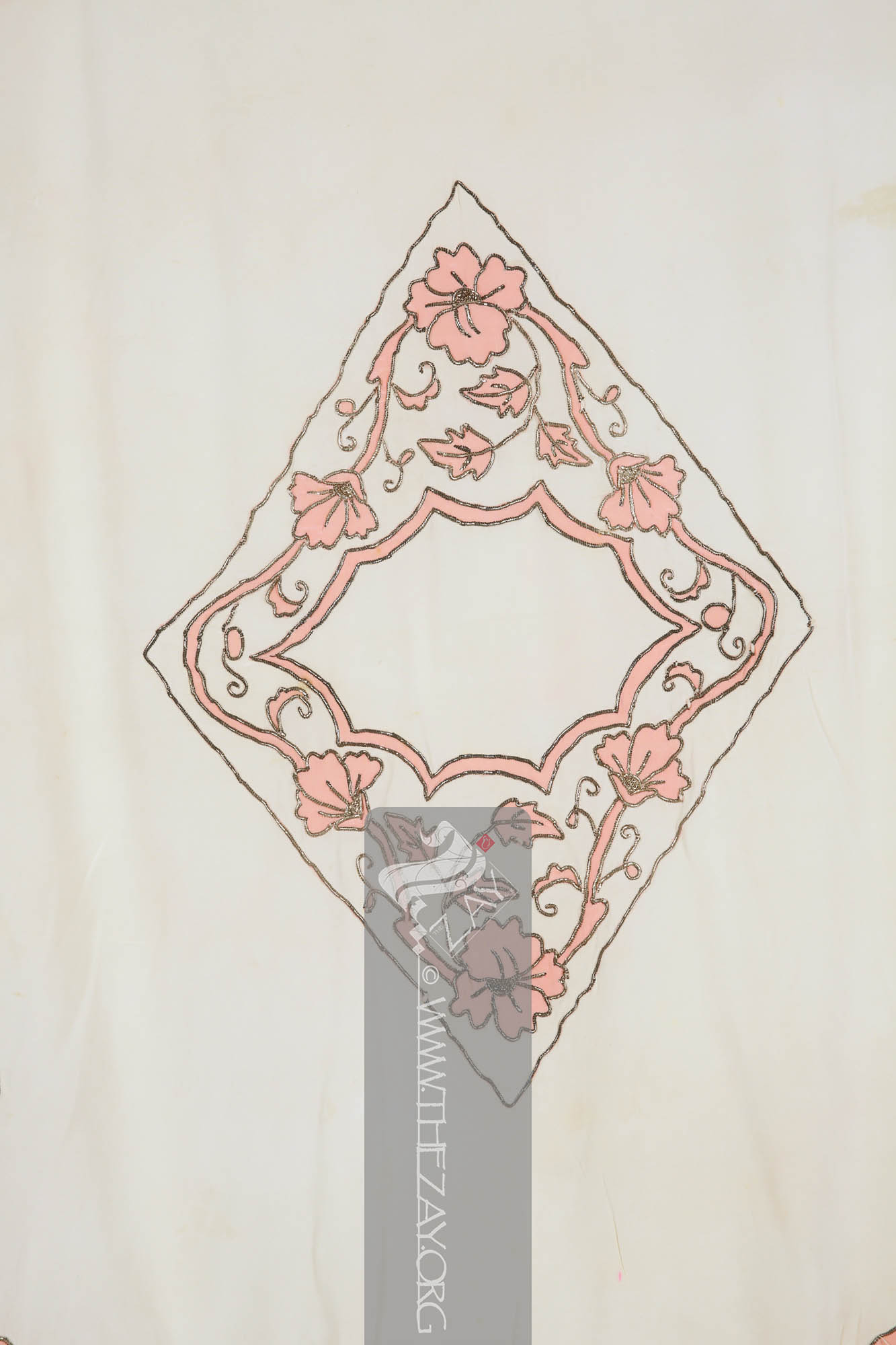
This encloses a floral bouquet on either side, mirroring each other and meeting in the centre. Each bouquet has a central large rose with flanking branches displaying foliage and smaller floral motifs along their lengths.
Enclosed within the bouquet is a large star-like form with scalloped edges. It has an ivory crepe
Crepe: (Latin: crispus; Old French: crespe – curled or frizzed), is a lightweight, crinkled fabric with a pebbled texture woven from a hand spun untreated or ‘in the gum’ silk yarn.
The sleeves feature two thin lamella
Lamella: (Latin: lāmella or lāmina – plate), a flat strip of metal yarn used as embroidery thread. Kalabdūn: (Hindustani: kalabattu / kalabattun gold or silver threads; or Dravidian and Sanskrit: pattu or patt – a kind of fine fibre or silk; or Sanskrit: kalavatu – fine material), the gold wire used in embroidery and other embellishments on textiles and fabrics. Crepe: (Latin: crispus; Old French: crespe – curled or frizzed), is a lightweight, crinkled fabric with a pebbled texture woven from a hand spun untreated or ‘in the gum’ silk yarn. Lamella: (Latin: lāmella or lāmina – plate), a flat strip of metal yarn used as embroidery thread. Kalabdūn: (Hindustani: kalabattu / kalabattun gold or silver threads; or Dravidian and Sanskrit: pattu or patt – a kind of fine fibre or silk; or Sanskrit: kalavatu – fine material), the gold wire used in embroidery and other embellishments on textiles and fabrics. Lamella: (Latin: lāmella or lāmina – plate), a flat strip of metal yarn used as embroidery thread.
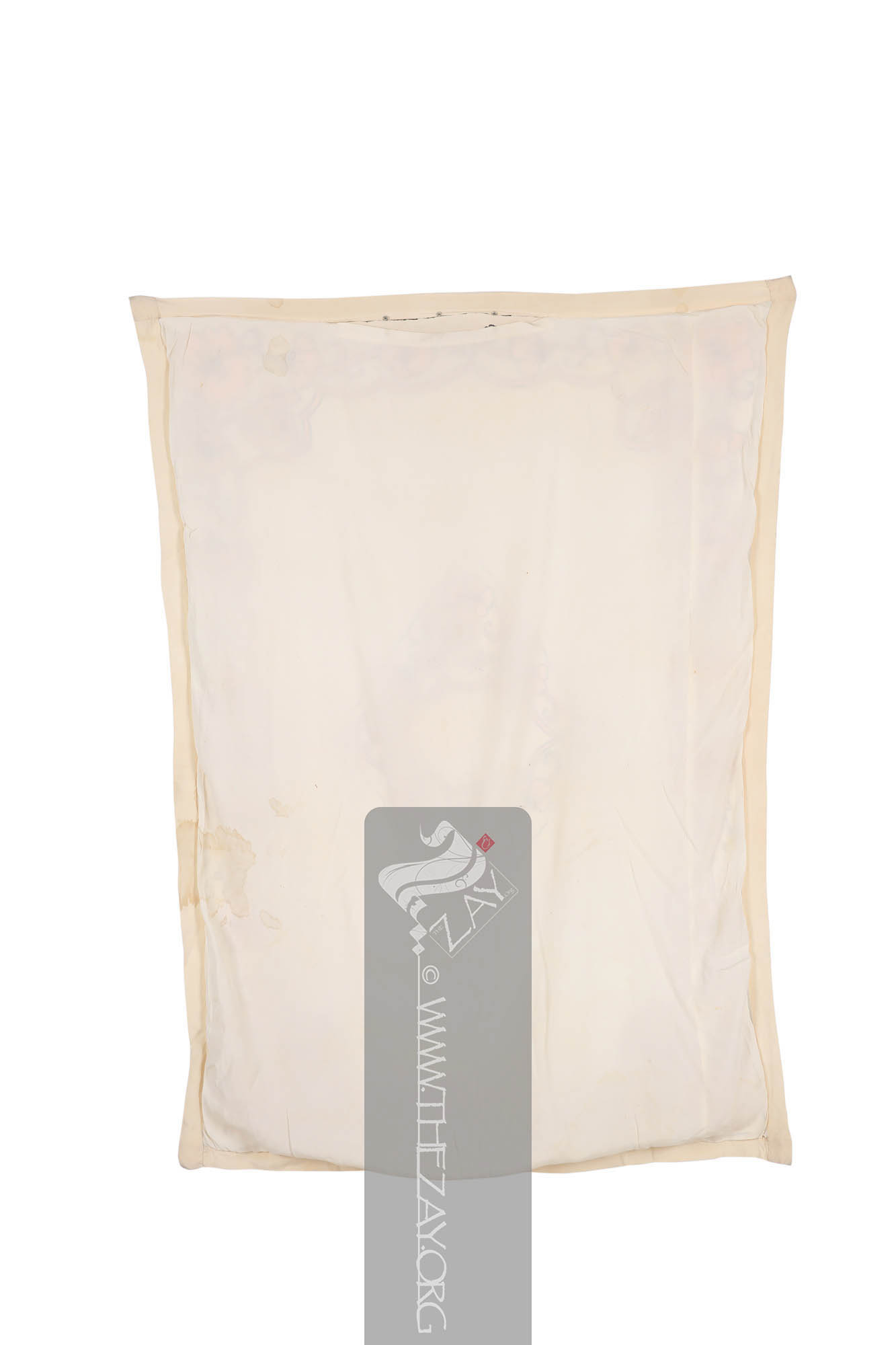
Each of the floral panels is further framed with a scalloped border also appliqued Appliqued: (French: appliquer – Apply), ornamental needlework where small pieces of decorative fabric are sewn on to a larger piece to form a pattern. and outlined. While both sleeves have several stains, one of them has been damaged and frayed along the stained parts.
The half-circle cushion cover is similarly embellished as the rest of the set with pink crepe
Crepe: (Latin: crispus; Old French: crespe – curled or frizzed), is a lightweight, crinkled fabric with a pebbled texture woven from a hand spun untreated or ‘in the gum’ silk yarn. Lamella: (Latin: lāmella or lāmina – plate), a flat strip of metal yarn used as embroidery thread. Kalabdūn: (Hindustani: kalabattu / kalabattun gold or silver threads; or Dravidian and Sanskrit: pattu or patt – a kind of fine fibre or silk; or Sanskrit: kalavatu – fine material), the gold wire used in embroidery and other embellishments on textiles and fabrics.
Each branch displays floral and foliage patterns along its way on both sides. While the flatter side of the pattern is framed with an appliqued
Appliqued: (French: appliquer – Apply), ornamental needlework where small pieces of decorative fabric are sewn on to a larger piece to form a pattern. and outlined scallop, the round side features a single line of lamella
Lamella: (Latin: lāmella or lāmina – plate), a flat strip of metal yarn used as embroidery thread. Kalabdūn: (Hindustani: kalabattu / kalabattun gold or silver threads; or Dravidian and Sanskrit: pattu or patt – a kind of fine fibre or silk; or Sanskrit: kalavatu – fine material), the gold wire used in embroidery and other embellishments on textiles and fabrics.
Links
Charuga: (Possibly Kurdish), a mantle-like embroidered women’s traditional garment from the Qaraqosh region in northern Iraq, traditionally fastened at the shoulder. Historically worn by field workers, it helped conceal dust and dirt, making them less visible during labour, it is a festive garment worn sparingly during festivals and other special occasions.
from Northern Iraq Has Arrived at the TRC!, www.trc-leiden.nl/trc/index.php/en/blog/1378-the-charugaCharuga: (Possibly Kurdish), a mantle-like embroidered women’s traditional garment from the Qaraqosh region in northern Iraq, traditionally fastened at the shoulder. Historically worn by field workers, it helped conceal dust and dirt, making them less visible during labour, it is a festive garment worn sparingly during festivals and other special occasions.
-from-northern-iraq-has-arrvied-at-the-trc. Accessed 29 Jan. 2024.