





1 of 13
| Local Name | Thawb_nashil; Thawb_nashil_zari_fadhah |
| Object Category | Overgarment |
| Gender | Female |
| Date of object | c. 1998 |
| Place Of orgin | Bahrain |
| Region | Muharraq |
| Object Range | Bahrain, Iraq, Kuwait, Qatar, Saudi Arabia, Oman, United Arab Emirates et al |
| Dimensions | Length: 92 cm Width: 99 cm |
| Materials | Silk Metal |
| Technique | Machine Embroidered Machine Stitched |
| Color | |
| Motif | Floral Geometric |
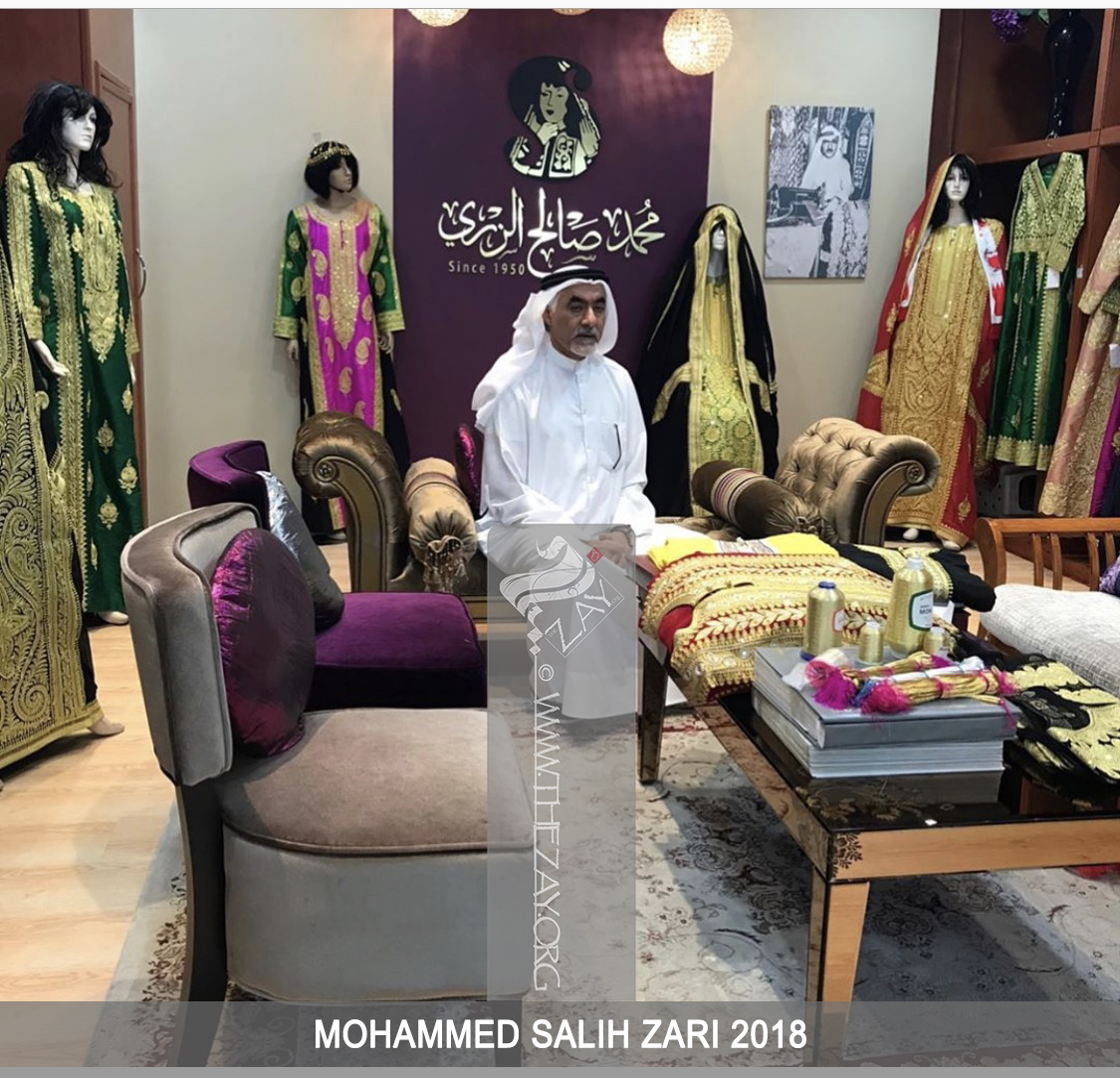
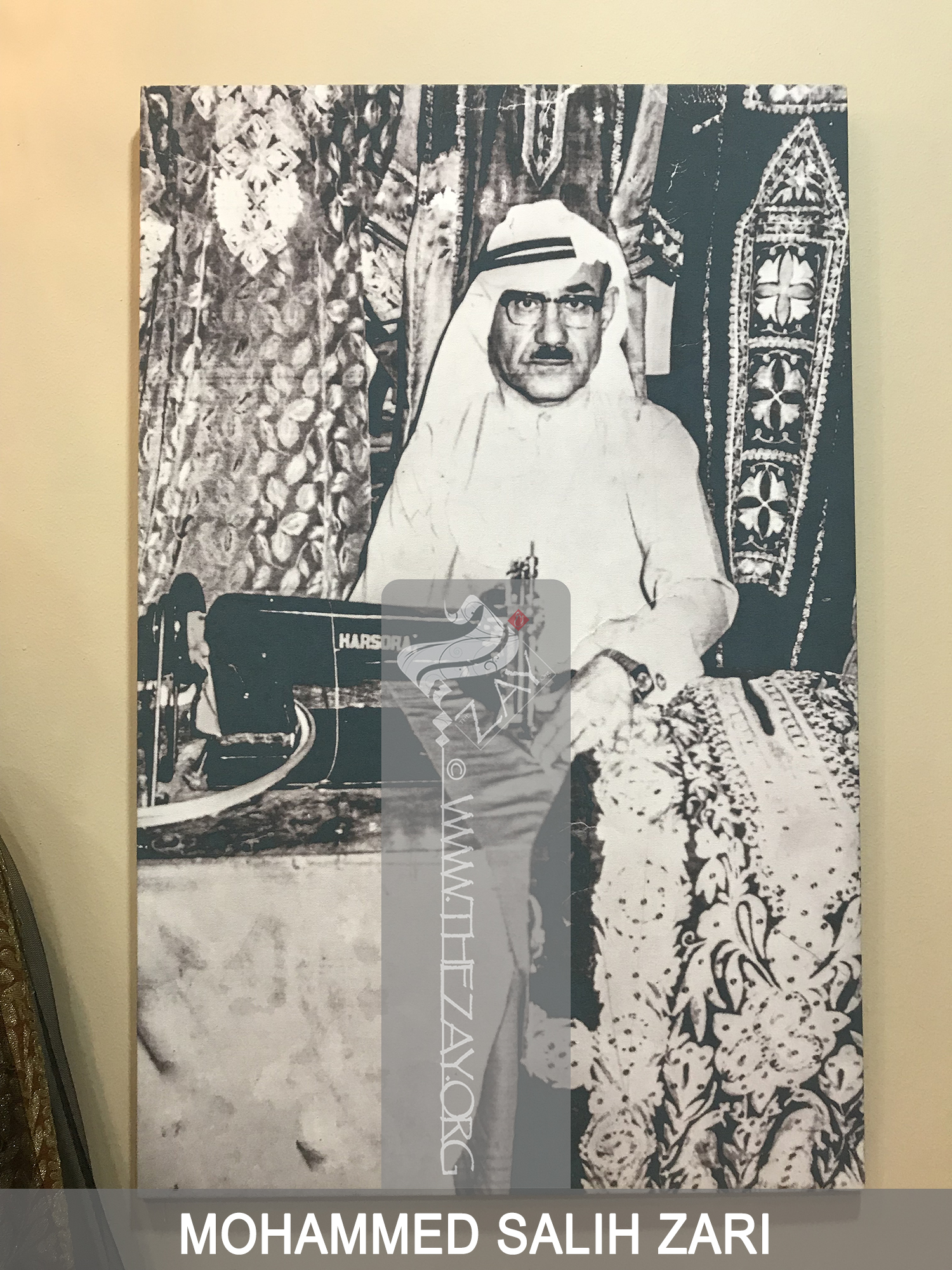
| Provenance | Purchased, Muhammad Salih Zari, Bahrain 2018 |
| Location | The Zay Zay: (Arabic: costume, Pl. azyaā’), a set of clothes in a style typical of a particular country or historical period. Initiative |
| Status | In storage |
| ZI number | ZI2018.500224.1 BAHRAIN |
Object Note
Part of a lot along with 3 more items (ZI2018.500224.2 BAHRAIN, ZI2018.500224.3 BAHRAIN, and ZI2018.500224.4 BAHRAIN), also in the collection.
Object History
This piece was purchased by Dr. Reem Tariq
Ṭariq: (Arabic; Synonym: tulle_bi_talli
Tūlle_bi_tallī: (French: Tulle – a city in France where fine material for veil was first made; Turkish: tel – wire; Synonym: tariq; talli; badla; khus_dozi ), series of small metal knots made on a woven net ground as embellishment. The term is commonly used in the North African Arab region specifically in Egypt. Ṭariq: (Arabic; Synonym: tulle_bi_talli
Tūlle_bi_tallī: (French: Tulle – a city in France where fine material for veil was first made; Turkish: tel – wire; Synonym: tariq; talli; badla; khus_dozi ), series of small metal knots made on a woven net ground as embellishment. The term is commonly used in the North African Arab region specifically in Egypt.
Dr Reem spent the day interviewing Mr P K who had arrived in Bahrain from India in the 1980s as a teenager. Upon arrival, PK joined Zari Zarī: (Persian two-syllables: zar: gold & dozi: embellishment), complex embroidery technique that uses metal alloy on silk, satin, or velvet, and may include pearls, beads, and precious stones. Colloquially in the Arab gulf region, the term (zarī) is loosely applied to any gilded thread, embellishment or gilded brocade fabric. Originated in ancient Persia it has been used extensively in Indian and Middle Eastern textiles for centuries. ’s business, initially working on the shop floor. Over time, he advanced to the role of a manager at the new store.
During their conversation, Dr Reem explained that the purpose of her visit was to acquire historical pieces made by the Zari Zarī: (Persian two-syllables: zar: gold & dozi: embellishment), complex embroidery technique that uses metal alloy on silk, satin, or velvet, and may include pearls, beads, and precious stones. Colloquially in the Arab gulf region, the term (zarī) is loosely applied to any gilded thread, embellishment or gilded brocade fabric. Originated in ancient Persia it has been used extensively in Indian and Middle Eastern textiles for centuries. family. Mr P.K. informed her that all he had were two discarded boxes of items and generously offered some of the pieces as gifts. Amongst these items was this particular piece that was ultimately purchased to be added to the collection of The Zay Zay: (Arabic: costume, Pl. azyaā’), a set of clothes in a style typical of a particular country or historical period. Initiative, further enhancing its cultural and historical value.
Object Features
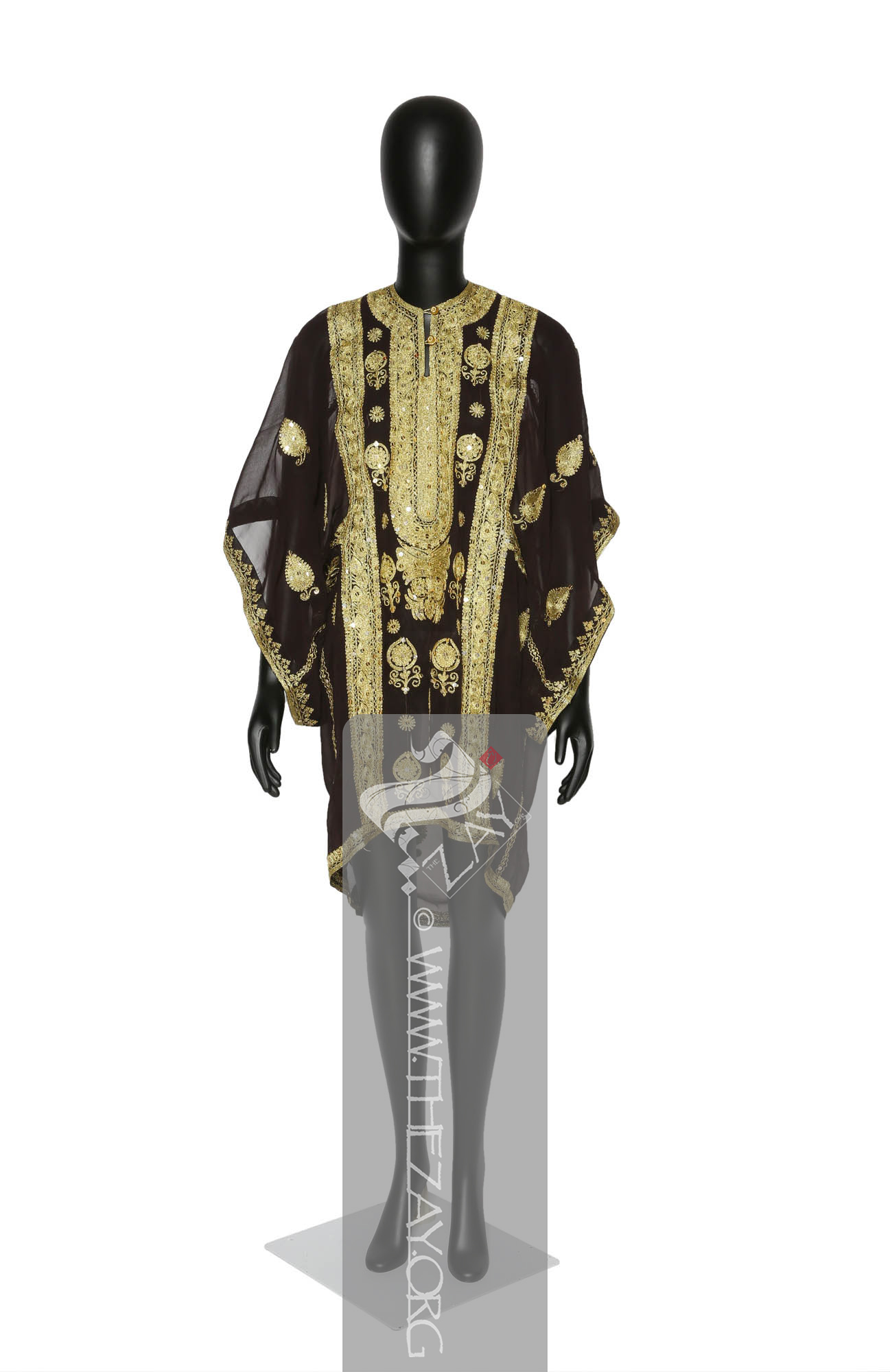
This is a traditional Gulf Arab style girl’s tunic robe (thawb
Thawb: (Arabic: thawb, Pl. Athwāb/thībān), can be pronounced thobe
Thobe: (Arabic: thawb, Pl. Athwāb/thībān), can be pronounced thawb or tobe
Tobe: (Arabic: thawb, Pl. Athwāb/thībān), can be pronounced thawb or thobe based on locale. The standard Arabic word for ‘fabric’ or ‘garment’. It can refer to a qamīs-like tunic worn by men and women in the Arabian Peninsula, Iraq, the southern and south-western ports and islands of Iran, and some countries in East and West Africa. More specifically, it can refer to the square-shaped Bedouin overgarment worn by women. based on locale. The standard Arabic word for ‘fabric’ or ‘garment’. It can also refer to a qamīs-like tunic worn by men and women in the Arabian Peninsula, Iraq, the southern and south-western ports and islands of Iran, and some countries in East and West Africa. More specifically, it can refer to the square-shaped Bedouin overgarment worn by women. or tobe
Tobe: (Arabic: thawb, Pl. Athwāb/thībān), can be pronounced thawb or thobe based on locale. The standard Arabic word for ‘fabric’ or ‘garment’. It can refer to a qamīs-like tunic worn by men and women in the Arabian Peninsula, Iraq, the southern and south-western ports and islands of Iran, and some countries in East and West Africa. More specifically, it can refer to the square-shaped Bedouin overgarment worn by women. based on locale. The standard Arabic word for ‘fabric’ or ‘garment’. It can also refer to a qamīs-like tunic worn by men and women in the Arabian Peninsula, Iraq, the southern and south-western ports and islands of Iran, and some countries in East and West Africa. More specifically, it can refer to the square-shaped Bedouin overgarment worn by women in the Arabian Gulf region. ), often locally referred to as the (Thawb_nashil_zari_fadhah
Thawb_nashil_zarī_faḍah: (Persian: zar – gold; to Hindustani – zari
Zarī: (Persian two-syllables: zar: gold & dozi: embellishment), complex embroidery technique that uses metal alloy on silk, satin, or velvet, and may include pearls, beads, and precious stones. Colloquially in the Arab gulf region, the term (zarī) is loosely applied to any gilded thread, embellishment or gilded brocade fabric. Originated in ancient Persia it has been used extensively in Indian and Middle Eastern textiles for centuries. – metal thread often precious or semi-precious for decorative purpose), a type of thawb_nashil but not synonymous to it. Unlike the nashil it is characterised by gilded metal thread embroidery along the front centre.
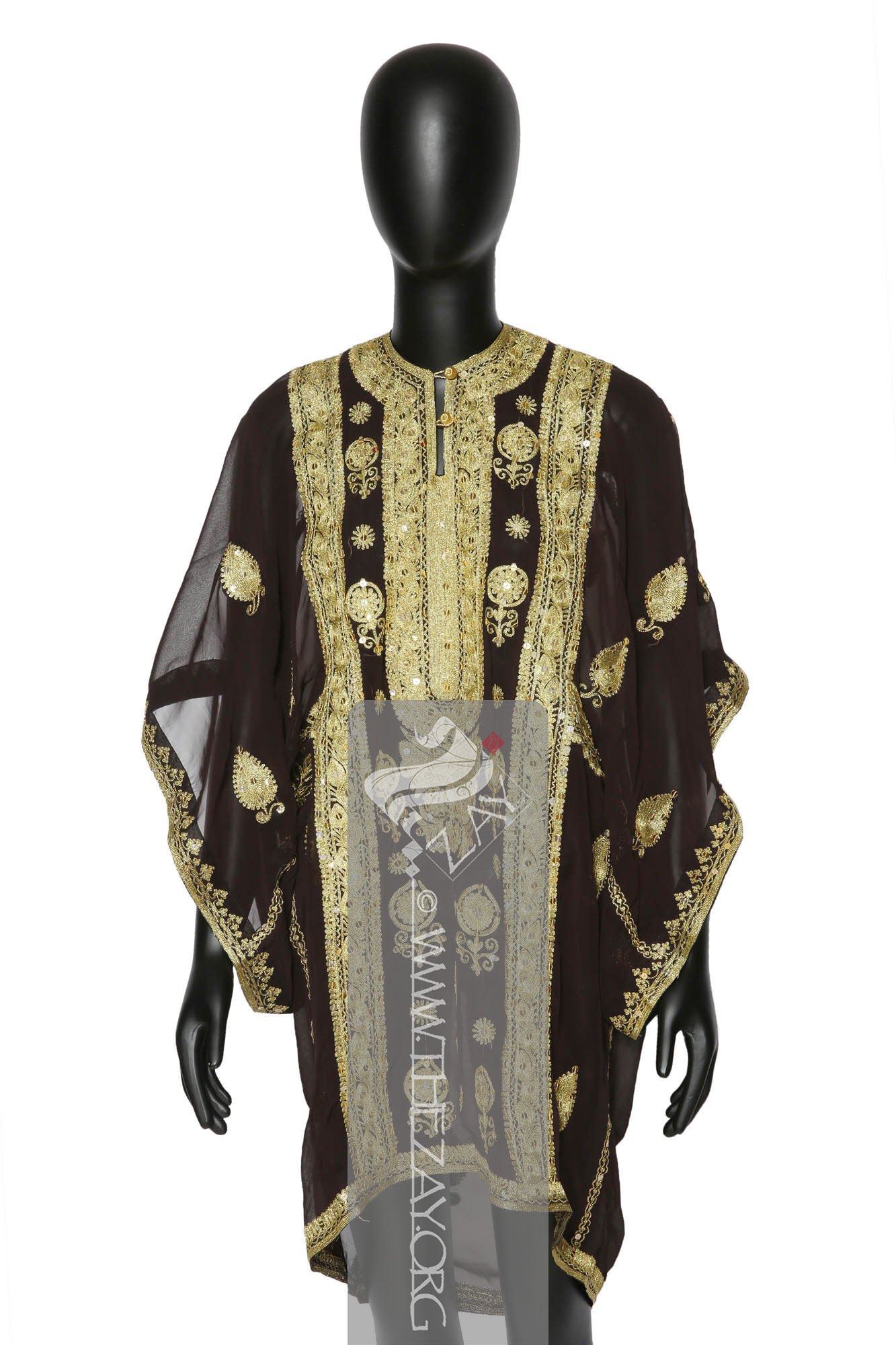
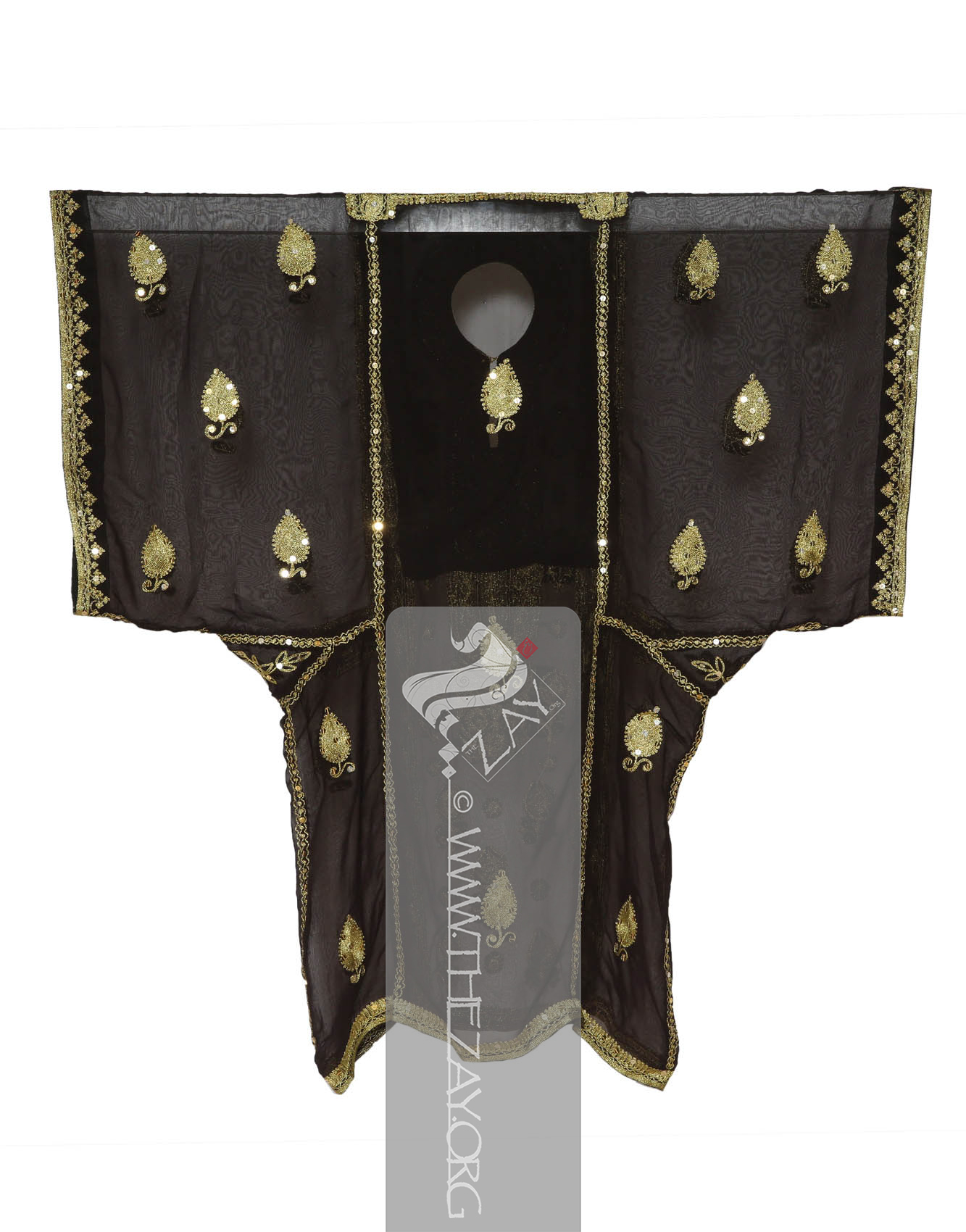
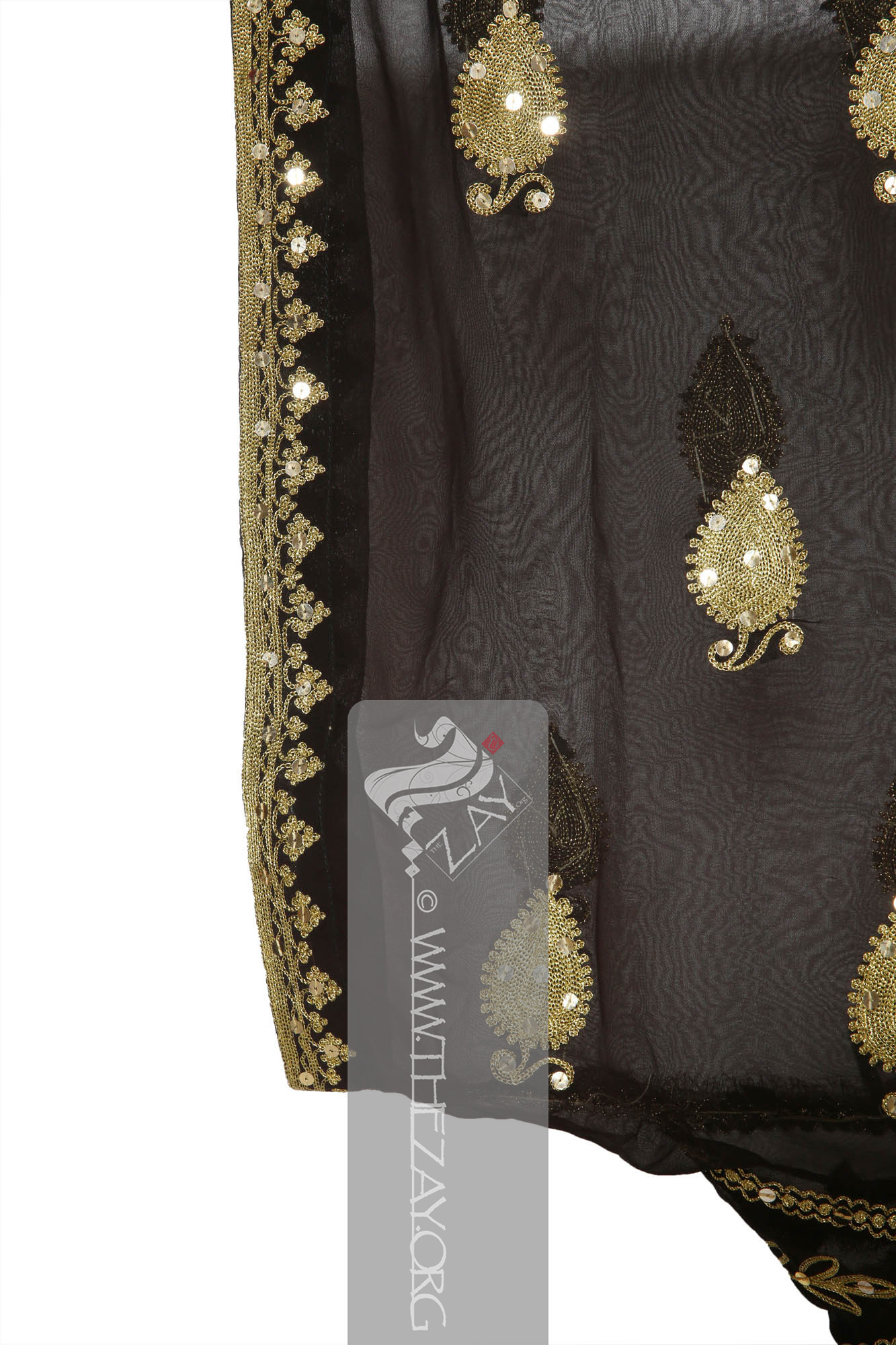
Constructed of black silk chiffon, the nashl features metal thread (zari Zarī: (Persian two-syllables: zar: gold & dozi: embellishment), complex embroidery technique that uses metal alloy on silk, satin, or velvet, and may include pearls, beads, and precious stones. Colloquially in the Arab gulf region, the term (zarī) is loosely applied to any gilded thread, embellishment or gilded brocade fabric. Originated in ancient Persia it has been used extensively in Indian and Middle Eastern textiles for centuries. ), possibly gilded silver, embellished with floral and foliage patterns executed primarily in (chain_stitch Chain_stitch: An embroidery technique where a looped stitch is made in a continuous chain-like pattern. Each stitch is formed by looping the thread through the previous stitch, creating a linked chain. ) style embroidery. The front central panel features the most elaborate embroidered embellishment, while the rest of the nashil has floral and foliage repeats.
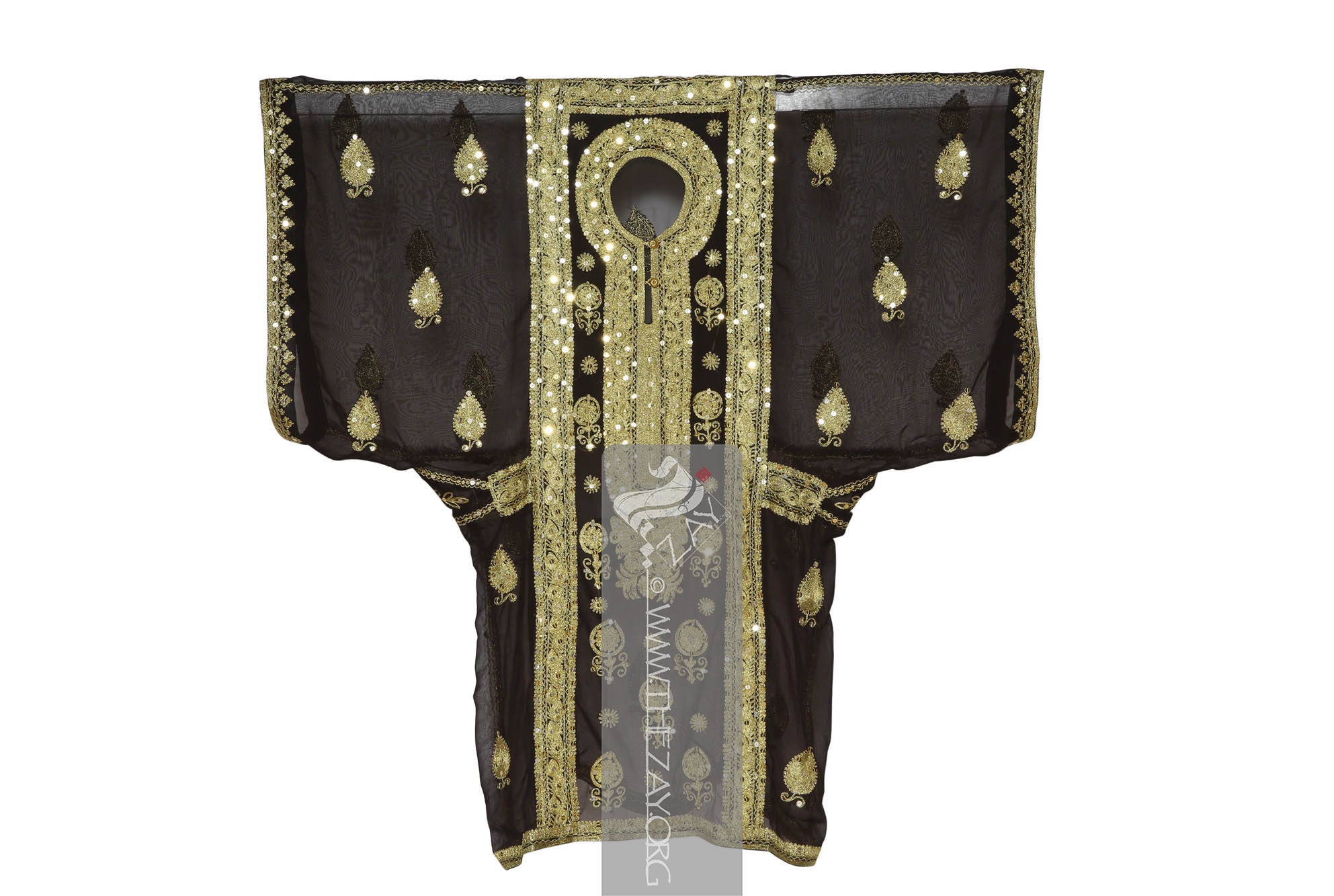
The design elements are primarily concentrated along the neckline and the front opening in a U-shaped pattern. It can be roughly divided into three segments. The central band with a chain_stitch Chain_stitch: An embroidery technique where a looped stitch is made in a continuous chain-like pattern. Each stitch is formed by looping the thread through the previous stitch, creating a linked chain. filled ground flanked by two bands of foliage repeats along a thin, wavy central vine, separated by a narrow, curvy zigzag band.
A wider band of similar foliage repeats adorn the side of the nashil from the shoulder to the front fall hemline. The band also branches as a connector at the waistline to the sleeves, giving way to the underarm gusset (bitan
Biṭan: (Arabic: underarms, plural of ibt
Ibṭ: (Arabic: underarm, singular of ibt), a triangular or rhomboidal piece of fabric or gusset inserted into the seam to add breadth or reduce stress from tight-fitting clothing. Used for underarms on tunic dresses, side sleeve panels.
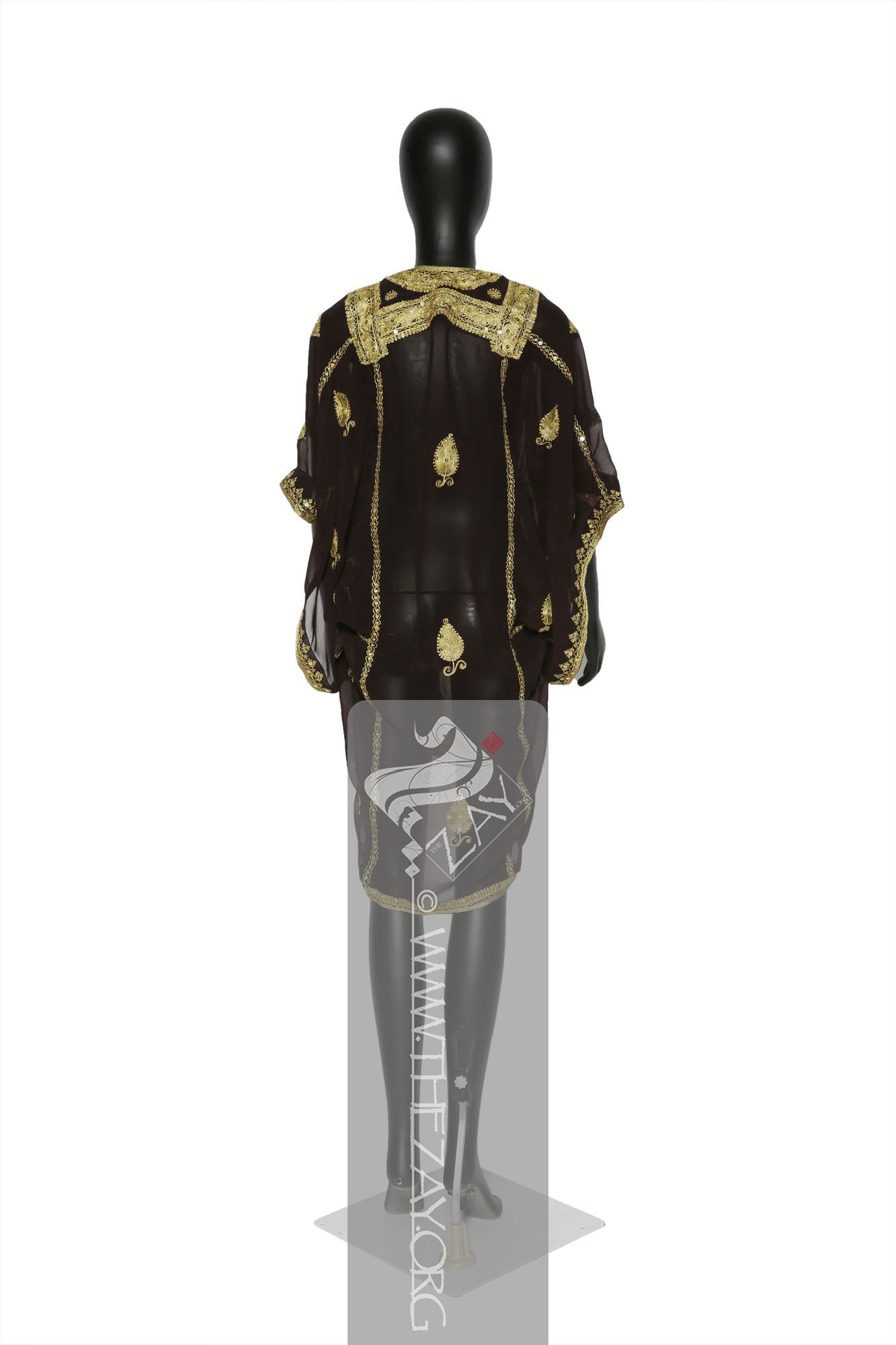
While the seamlines on the piece are adorned with a narrow band of scroll with sequined highlights between two thin zigzag lines, the field of the nashil is filled with sporadic repeats of three different floral patterns. The front central panel is adorned with a combination of a star-shaped floral pattern and a floral bouquet with flanking foliage, and along the rest of the field, both front and back are adorned with repeats of a teardrop-shaped foliage over a scroll-shaped base.
Although the piece lacks any apparent lining, the embellished portions have a thin black cotton (gauze
Gauze: (English), very fine wire mesh transparent fabric of silk, linen, or cotton.) fabric attached to the underside of the nashil to provide extra support to the embroidery and prevent the top fabric from fraying. Primarily a machine embroidered and machine stitched piece, the nashil has a pair of (frog_fastener
Frog_fastener: (Synonym: Chinese frog closure, frog closure), is a decorative and functional type of button used to fasten clothing. Said to have originated between c. 5th to 7th century China these buttons consist of a cord or braid looped through a decorative knot.
The embellishment technique that traditionally used precious metals such as silver and sometimes gold could be deemed as the physical manifestation of the traditional Arabic idiom ‘zinah wa khazinah’, which roughly translates to ‘beauty and wealth together’, since the decorative element both enhances the beauty of the garment and stands testament to the status of the wearer.
More Info
The thawb_nashil
Thawb_nashil: (Arabic: mnshal – fabric used for ceremonial litter headed for Mecca pilgrimage), a loose, often square-shaped tunic with wide sleeves, characterised by heavy embroidered embellishment along the front centre, popular amongst the women of the Gulf Arab countries.
The name of the garment is thought to originate either from the term mnshal, which refers to the vibrant and intricately decorated fabrics used to cover ceremonial litter carried by camels during Hajj pilgrimages to Mecca, or the decorative fabrics used to drape camel compartments for transporting women. Alternatively, some scholars suggest that the name derives from alnashil, meaning "pickpocket," alluding to the idea that these beautiful garments "steal" one’s heart.
Historically, the thawb_nashil
Thawb_nashil: (Arabic: mnshal – fabric used for ceremonial litter headed for Mecca pilgrimage), a loose, often square-shaped tunic with wide sleeves, characterised by heavy embroidered embellishment along the front centre, popular amongst the women of the Gulf Arab countries. Thawb_hāshmī: (Arabic: a direct reference to the Banu Hashim tribe of Saudi Arabia). It is a traditional Iraqi women's overgarment (thawb), closely resembling the (nashil) and Najdi (thawb).
The embroidery is completed before the neckline is cut, providing structural support during the embroidery process and signifying that the garment is new. This practice is significant, as it was customary in the region to reuse embroidered panels from older dresses. After sewing and embroidering with zari Zarī: (Persian two-syllables: zar: gold & dozi: embellishment), complex embroidery technique that uses metal alloy on silk, satin, or velvet, and may include pearls, beads, and precious stones. Colloquially in the Arab gulf region, the term (zarī) is loosely applied to any gilded thread, embellishment or gilded brocade fabric. Originated in ancient Persia it has been used extensively in Indian and Middle Eastern textiles for centuries. , artisans would hammer and burnish the embroidery to achieve a polished, smooth, and shiny finish.
Over time, the manufacturing process of the thawb_nashil
Thawb_nashil: (Arabic: mnshal – fabric used for ceremonial litter headed for Mecca pilgrimage), a loose, often square-shaped tunic with wide sleeves, characterised by heavy embroidered embellishment along the front centre, popular amongst the women of the Gulf Arab countries. Thawb_nashil: (Arabic: mnshal – fabric used for ceremonial litter headed for Mecca pilgrimage), a loose, often square-shaped tunic with wide sleeves, characterised by heavy embroidered embellishment along the front centre, popular amongst the women of the Gulf Arab countries.
One of the most renowned thawb_nashil
Thawb_nashil: (Arabic: mnshal – fabric used for ceremonial litter headed for Mecca pilgrimage), a loose, often square-shaped tunic with wide sleeves, characterised by heavy embroidered embellishment along the front centre, popular amongst the women of the Gulf Arab countries.
Links