

1 of 4
| Local Name | Shaylah |
| Object Category | Headwear |
| Gender | Female |
| Date of object | c. 20th century |
| Place Of orgin | UAE |
| Region | UAE |
| Object Range | UAE, Qatar, Oman, Bahrain, KSA, Kuwait, et al |
| Dimensions | Length: 22 cm Width: 84 cm |
| Materials | Silk Metal Other |
| Technique | Machine Embroidered Machine Stitched Hand Embroidered |
| Color | |
| Motif | Floral |
| Provenance | Purchased, Retail, Dubai 2022 |
| Location | The Zay Zay: (Arabic: costume, Pl. azyaā’), a set of clothes in a style typical of a particular country or historical period. Initiative |
| Status | Storage |
| ZI number | ZI2022.500996 UAE |
Object History
This piece was purchased by Dr. Reem Tariq
Ṭariq: (Arabic; Synonym: tulle_bi_talli
Tūlle_bi_tallī: (French: Tulle – a city in France where fine material for veil was first made; Turkish: tel – wire; Synonym: tariq; talli; badla; khus_dozi ), series of small metal knots made on a woven net ground as embellishment. The term is commonly used in the North African Arab region specifically in Egypt. Ṭariq: (Arabic; Synonym: tulle_bi_talli
Tūlle_bi_tallī: (French: Tulle – a city in France where fine material for veil was first made; Turkish: tel – wire; Synonym: tariq; talli; badla; khus_dozi ), series of small metal knots made on a woven net ground as embellishment. The term is commonly used in the North African Arab region specifically in Egypt.
Object Features
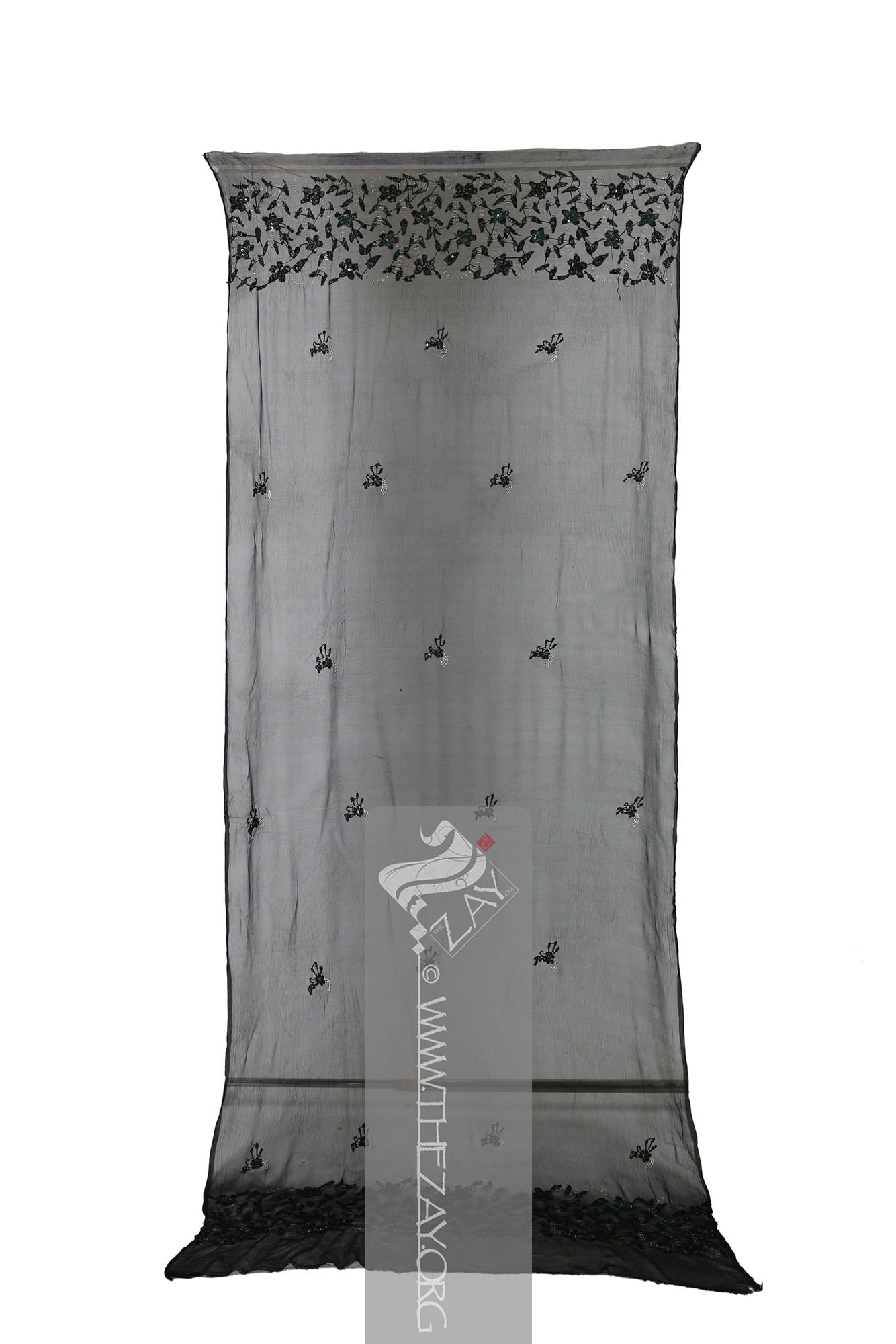
This is a traditional head scarf Scarf: (English), usually a rectangular piece of cloth loosely worn over the shoulders, upper body and arms, and sometimes also over the head. (shaylah Shaylah: (Colloquial Gulf Arabic), a length of fabric used as shawl, head cover or veil. Also known as (wigāyah) or (milfa’), generally made from sheer fabrics such as tulle (tūr), cotton gauze (wasmah Wasmah: (Arabic: woad), is derived from the woad herb (wasmah) used to dye the cotton gauze black. It is mainly used for headcovers or veils and overgarments in most of the Arab gulf region.) (nidwah) or (Nīl), or silk chiffon (sarī).) commonly worn by women of the countries of the Arabian Peninsula.
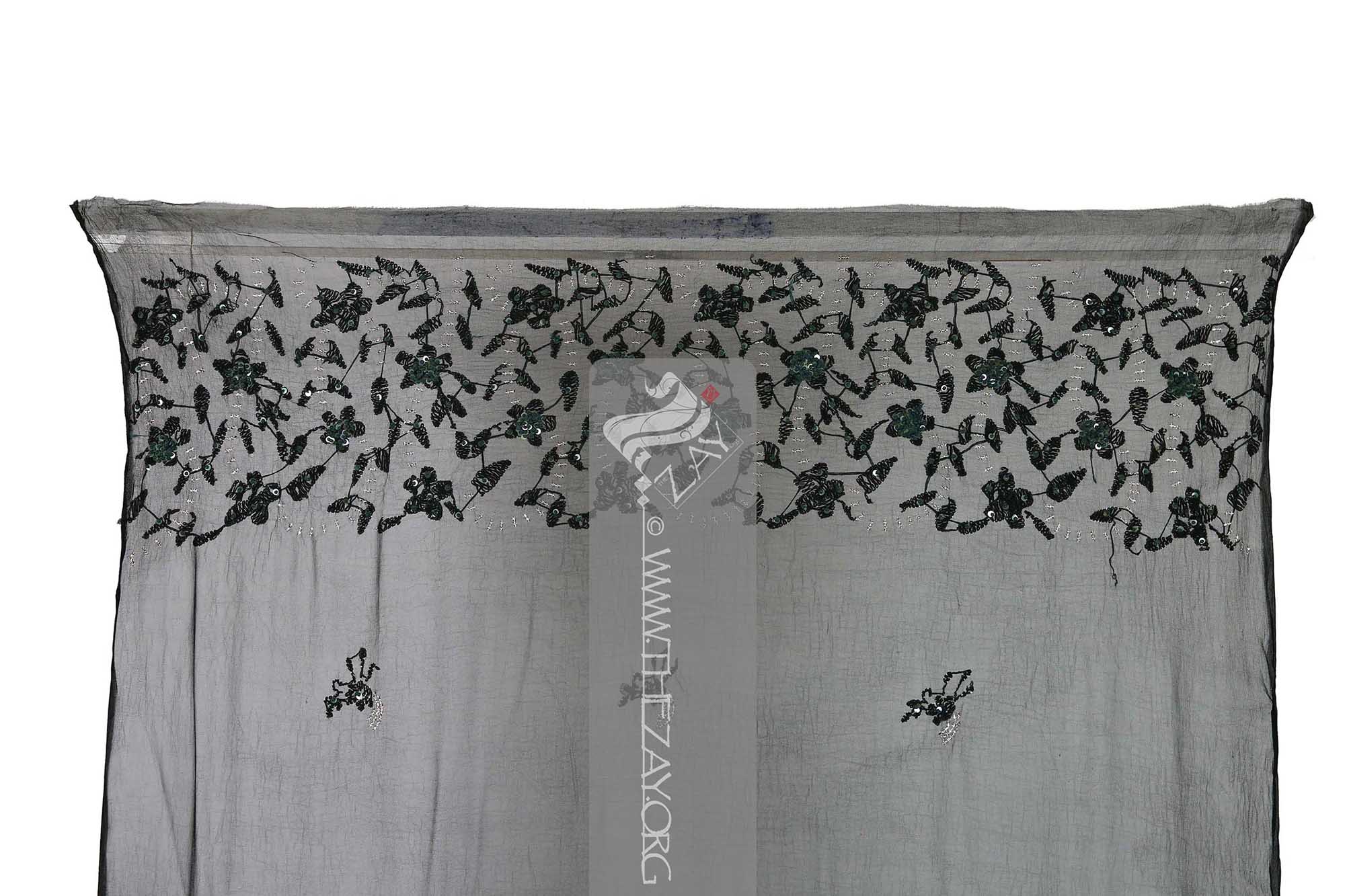
Constructed of a (selvedge Selvedge: (English: Self-finished edge or self-edge: a dialect forming transition), an edge produced on woven fabric during manufacture that prevents it from unravelling. Traditionally the term selvage applied to only loom woven fabric, presently it could be applied to flat knitted fabric too. ) to selvedge Selvedge: (English: Self-finished edge or self-edge: a dialect forming transition), an edge produced on woven fabric during manufacture that prevents it from unravelling. Traditionally the term selvage applied to only loom woven fabric, presently it could be applied to flat knitted fabric too. woven black silk (georgette Georgette: (French: Georgette de la Plante – a famous dressmaker), a lightweight, sheer fabric with a dull crimpled surface. It is usually made of silk but can also be made of synthetic fibers. Georgette was first introduced in the early 20th century and was named after the French dressmaker. ) fabric, the (warp Warp: One of the two basic components used in weaving which transforms thread or yarns to a piece of fabric. The warp is the set of yarns stretched longitudinally in place on a loom before the weft Weft: one of the two basic components used in weaving that transforms thread or yarns into a piece of fabric. It is the crosswise thread on a loom that is passed over and under the warp threads. is introduced during the weaving process. ) ends of the piece are machine stitched to give a neat finish. The field of the piece is adorned with patterns resembling a small floral bouquet repeated all over the central field, while a wide horizontal panel of floral and foliage arrangement adorns each warp Warp: One of the two basic components used in weaving which transforms thread or yarns to a piece of fabric. The warp is the set of yarns stretched longitudinally in place on a loom before the weft Weft: one of the two basic components used in weaving that transforms thread or yarns into a piece of fabric. It is the crosswise thread on a loom that is passed over and under the warp threads. is introduced during the weaving process. end.
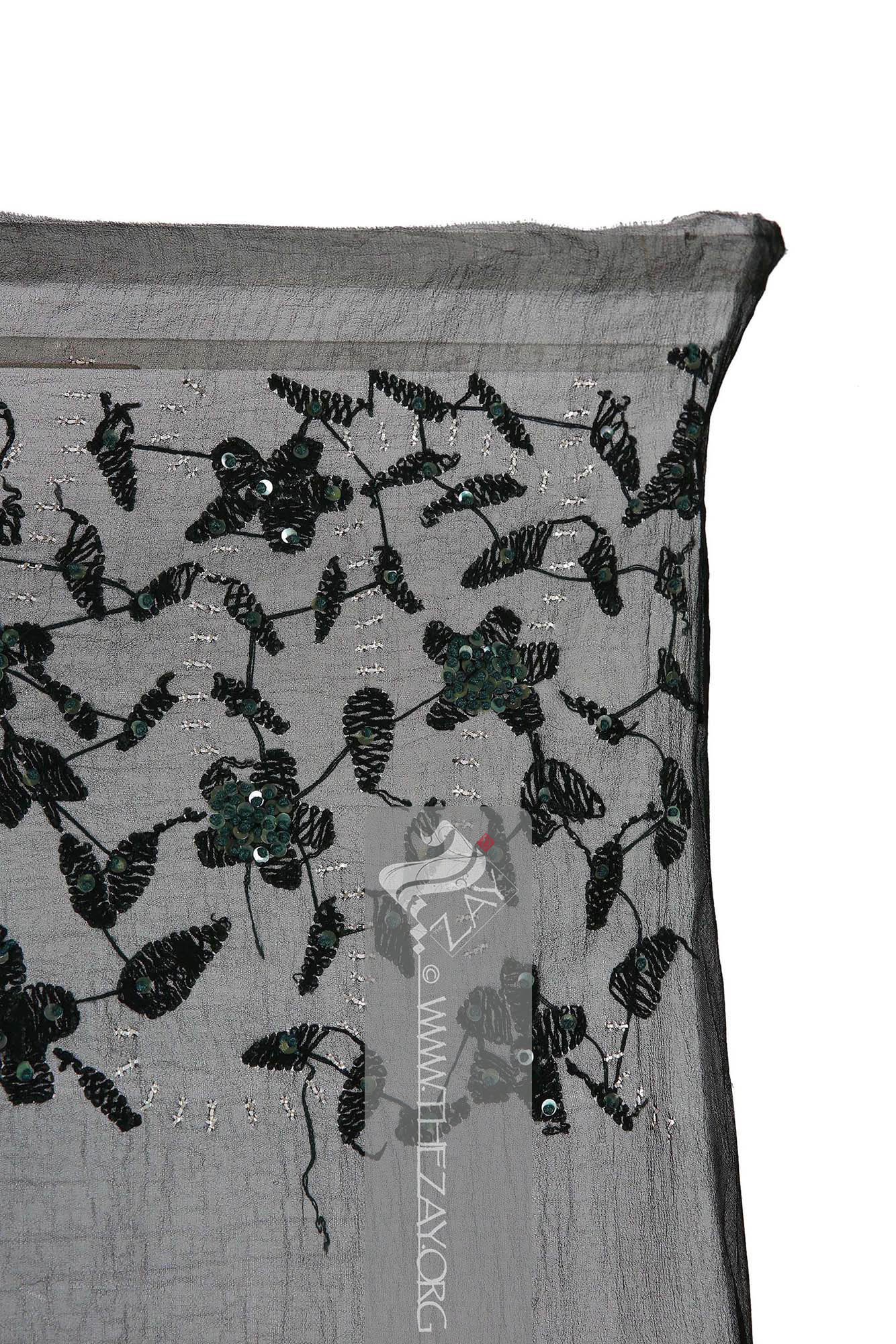
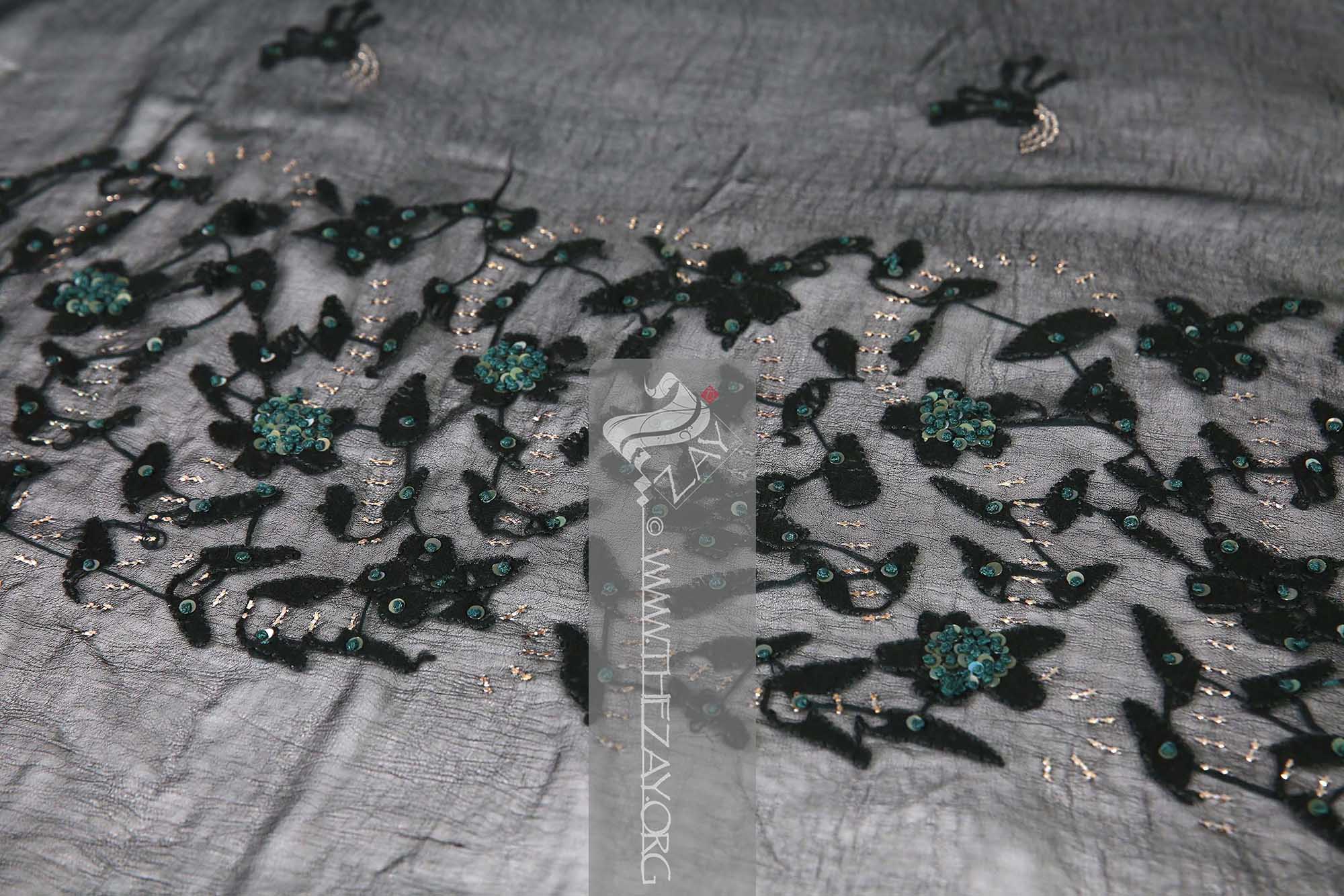
The small floral repeats across the central field of the shaylah Shaylah: (Colloquial Gulf Arabic), a length of fabric used as shawl, head cover or veil. Also known as (wigāyah) or (milfa’), generally made from sheer fabrics such as tulle (tūr), cotton gauze (wasmah Wasmah: (Arabic: woad), is derived from the woad herb (wasmah) used to dye the cotton gauze black. It is mainly used for headcovers or veils and overgarments in most of the Arab gulf region.) (nidwah) or (Nīl), or silk chiffon (sarī). are primarily in (chain_stitch Chain_stitch: An embroidery technique where a looped stitch is made in a continuous chain-like pattern. Each stitch is formed by looping the thread through the previous stitch, creating a linked chain. ) technique using two different shades of blue – deep and (turquoise Turquoise: (French: turquois – present day Türkiye; Synonyms: firuze, pheroza), is a naturally occurring opaque mineral mined in abundance in Khorasan province of Iran and has been used for making dye for centuries. The term is a derivative of the French word for the country Türkiye once called Turkey. ) – silk floss Floss: (Old French: flosche – nap of velvet), is a type of silk fibre obtained from the cocoons of wild silkworms. It is characterized by its long, fluffy fibers that are not tightly woven, making it ideal for use in various textile applications such as embroidery, lace-making, and sewing. threads in combination with hammered metal plates style (naqdah Naqdah: (Arabic: coins, synonyms: mnaghadah, naghdah, mnaghadah) Since silver was a form of currency, it came to refer to silver adorned garments. The term refers to articles decorated with silver (tallī) straw (khūs) in small coin-like dots. The (qāf) is pronounced (gha) colloquially.) embellishments. The horizontal panels on each warp Warp: One of the two basic components used in weaving which transforms thread or yarns to a piece of fabric. The warp is the set of yarns stretched longitudinally in place on a loom before the weft Weft: one of the two basic components used in weaving that transforms thread or yarns into a piece of fabric. It is the crosswise thread on a loom that is passed over and under the warp threads. is introduced during the weaving process. end depicting a floral and foliage arrangement with repeats of small (paisley Paisley: (Scottish Gaelic, Pàislig: a town in Scotland), often called buta, boteh, amli, or kalgi in the subcontinent and kazuwah in Arabic, is a Persian tear drop motif with a curved end specially in textiles. Its popularity and subsequent local production in 18th century at Paisley are responsible for its nomenclature.) patterns employ a combination of chain_stitch Chain_stitch: An embroidery technique where a looped stitch is made in a continuous chain-like pattern. Each stitch is formed by looping the thread through the previous stitch, creating a linked chain. style embroidery along with (French_knots) as well as naqdah Naqdah: (Arabic: coins, synonyms: mnaghadah, naghdah, mnaghadah) Since silver was a form of currency, it came to refer to silver adorned garments. The term refers to articles decorated with silver (tallī) straw (khūs) in small coin-like dots. The (qāf) is pronounced (gha) colloquially. and sequined embellishments.
Upon close inspection, it can be concluded that the piece is partially hand-embroidered and partially machine-embroidered.