

1 of 6
| Local Name | Shaylah, Shaylah mfasas, Shaylah fsus |
| Object Category | Headwear |
| Gender | Female |
| Date of object | c. 1982 |
| Place Of orgin | UAE |
| Region | Hatta - Dubai |
| Object Range | UAE, Qatar, Oman, Bahrain, KSA, Kuwait, et al |
| Dimensions | Length: 171 cm Width: 103 cm |
| Materials | Silk Other |
| Technique | Machine Embroidered Machine Stitched Other |
| Color | |
| Motif | Floral |
| Provenance | Purchased, Mariam Khalfan Mohammed Al Bidawawi, Hatta 2006 |
| Location | The Zay Zay: (Arabic: costume, Pl. azyaā’), a set of clothes in a style typical of a particular country or historical period. Initiative |
| Status | Storage |
| ZI number | ZI2006.500298 UAE |
Object History
This piece was purchased by Dr. Reem Tariq
Ṭariq: (Arabic; Synonym: tulle_bi_talli
Tūlle_bi_tallī: (French: Tulle – a city in France where fine material for veil was first made; Turkish: tel – wire; Synonym: tariq; talli; badla; khus_dozi ), series of small metal knots made on a woven net ground as embellishment. The term is commonly used in the North African Arab region specifically in Egypt. Ṭariq: (Arabic; Synonym: tulle_bi_talli
Tūlle_bi_tallī: (French: Tulle – a city in France where fine material for veil was first made; Turkish: tel – wire; Synonym: tariq; talli; badla; khus_dozi ), series of small metal knots made on a woven net ground as embellishment. The term is commonly used in the North African Arab region specifically in Egypt.
Ms. Mariam has maintained a longstanding and meaningful association with The Zay Zay: (Arabic: costume, Pl. azyaā’), a set of clothes in a style typical of a particular country or historical period. Initiative. Her initial contact with Dr. Reem was established via a social media platform, through which she generously offered her services as a volunteer, particularly in sourcing material culture from remote regions of the northern Emirates. Since then, she has played an instrumental role in furthering the Initiative’s mission. Her sustained contributions and commitment are deeply valued and have had a lasting impact on the development of the collection. We at The Zay Zay: (Arabic: costume, Pl. azyaā’), a set of clothes in a style typical of a particular country or historical period. shall be forever grateful for her gracious contributions and assistance.
Object Features
This is a traditional head scarf Scarf: (English), usually a rectangular piece of cloth loosely worn over the shoulders, upper body and arms, and sometimes also over the head. (shaylah Shaylah: (Colloquial Gulf Arabic), a length of fabric used as shawl, head cover or veil. Also known as (wigāyah) or (milfa’), generally made from sheer fabrics such as tulle (tūr), cotton gauze (wasmah Wasmah: (Arabic: woad), is derived from the woad herb (wasmah) used to dye the cotton gauze black. It is mainly used for headcovers or veils and overgarments in most of the Arab gulf region.) (nidwah) or (Nīl), or silk chiffon (sarī).) commonly worn by women of the countries of the Arabian Peninsula.
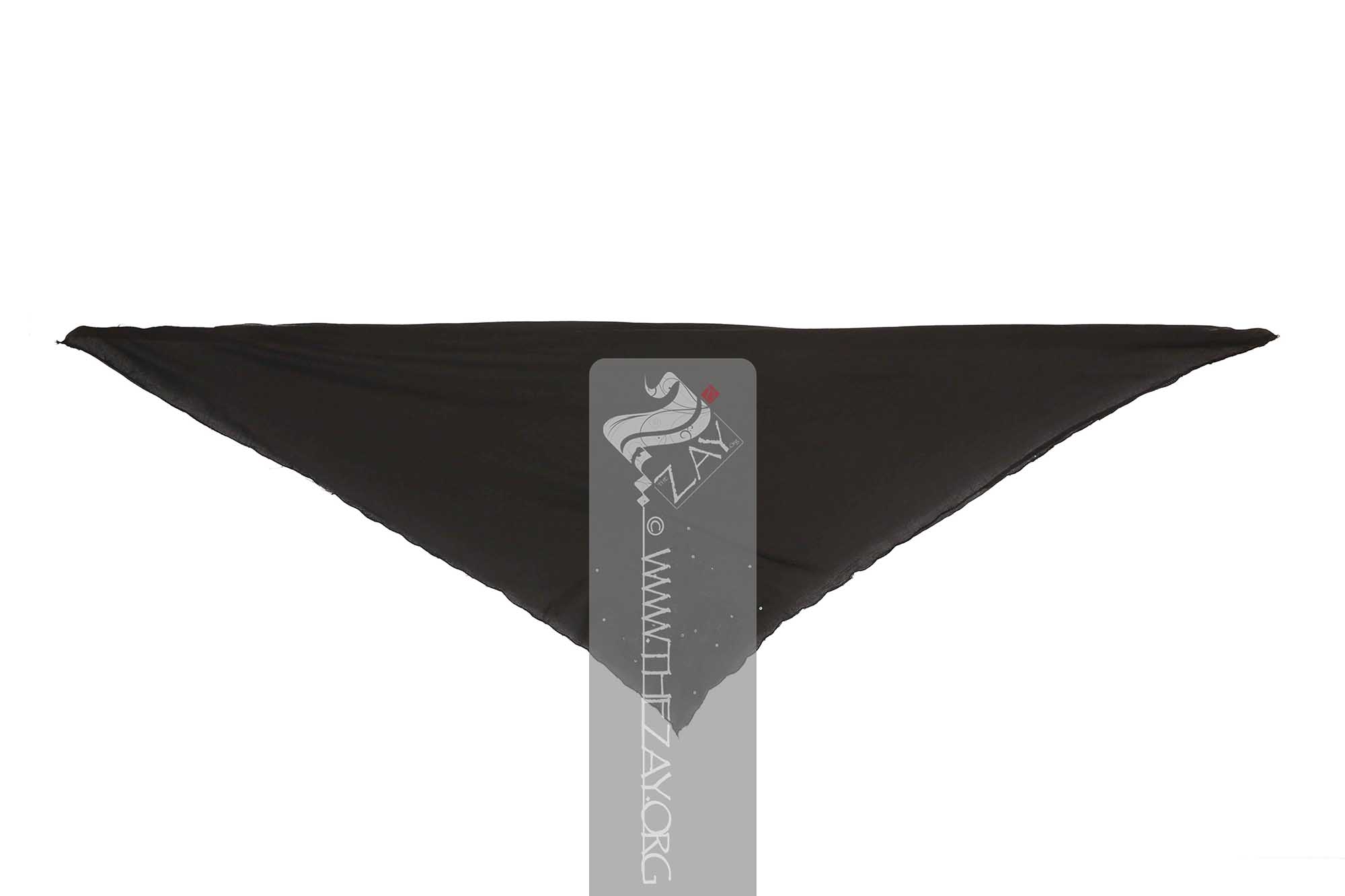
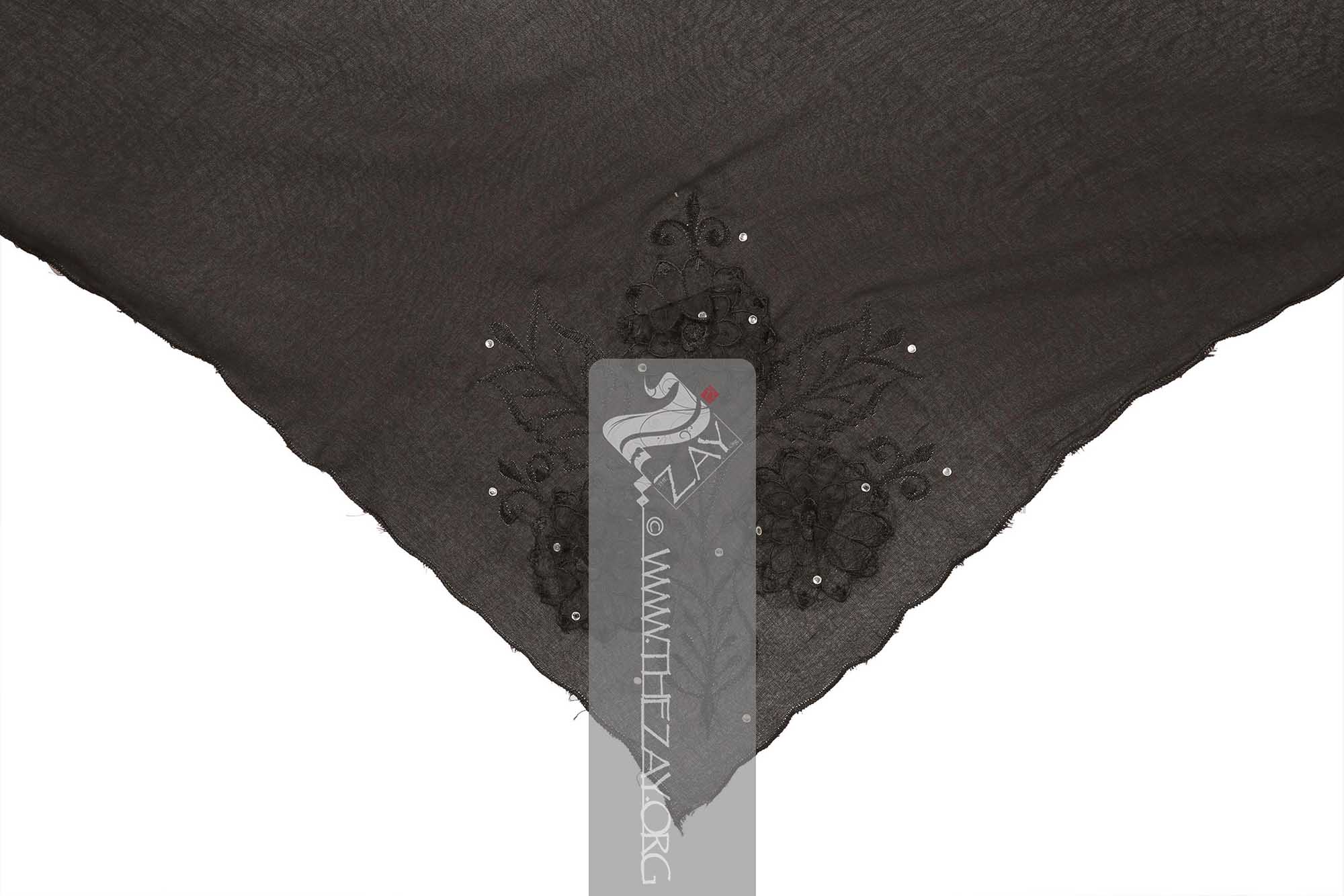
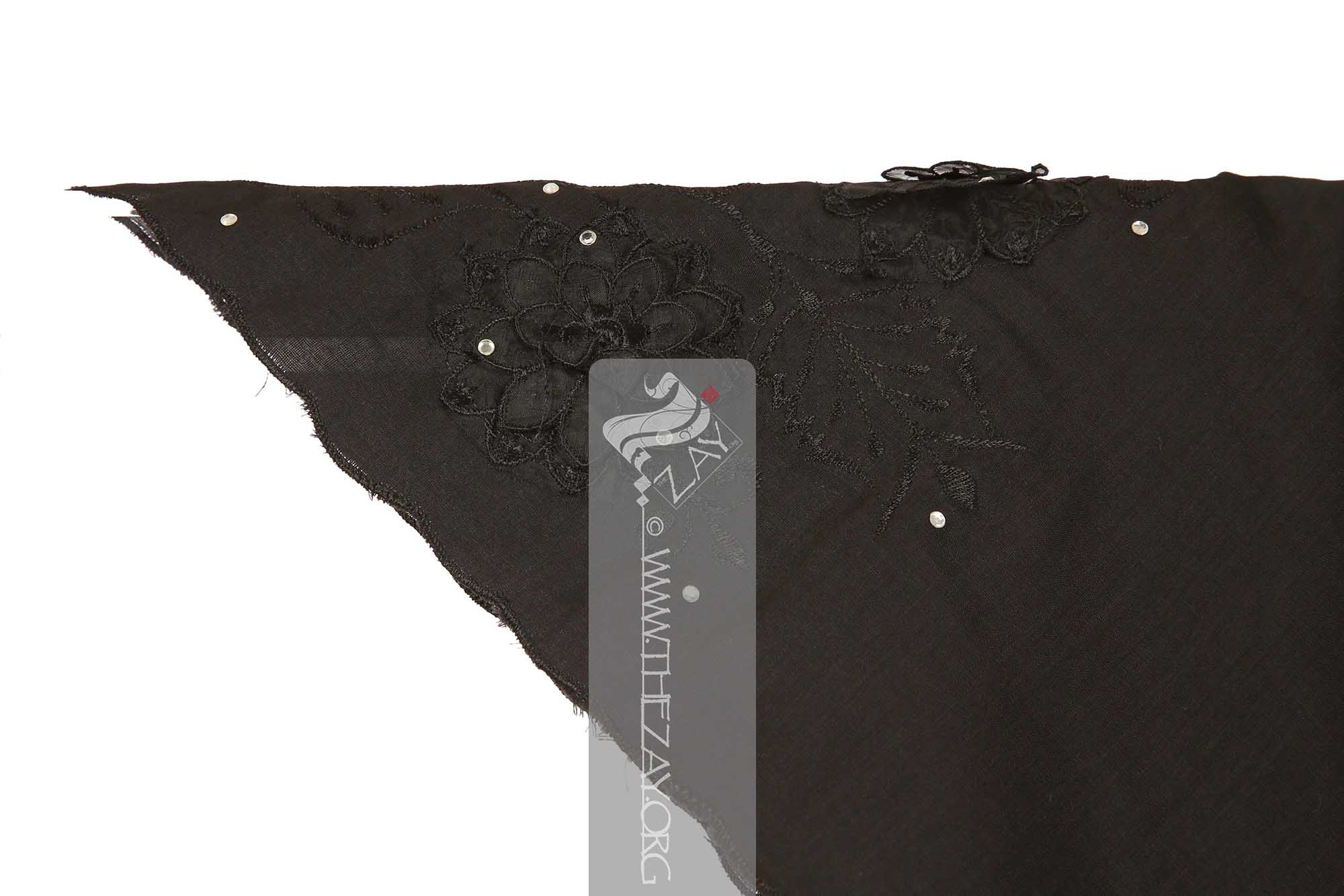
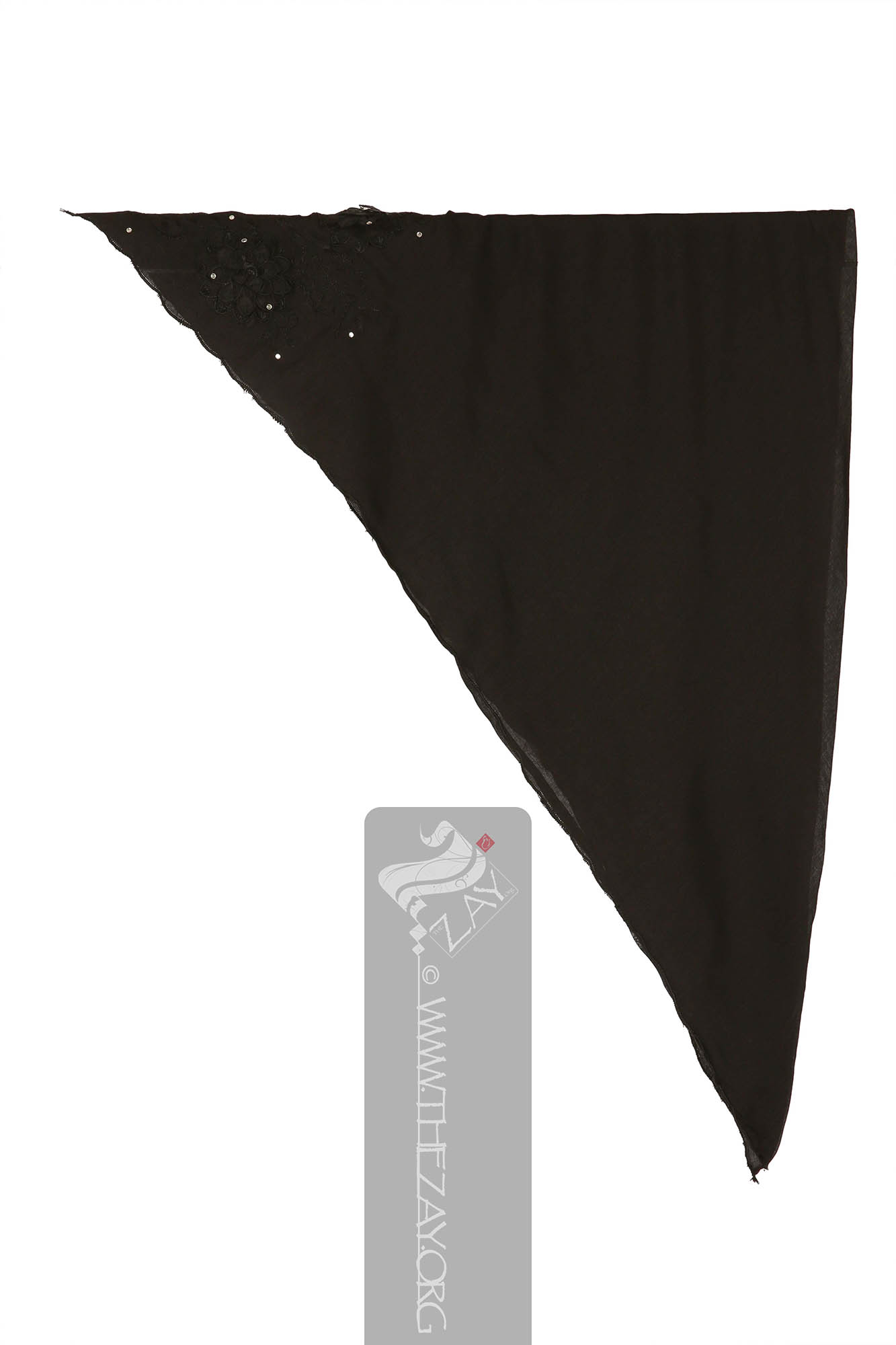
It is constructed of a square piece of a thinly woven plain black silk folded diagonally into a triangular shape and stitched at the edges. The two stitched sides have scalloped edges, which are finished with a (whip_stitch
Whip_stitch: (Synonym: Overcast_stitch), one of the basic stitching techniques in embroidery with simple stitches are worked on the smallest area of the base material as possible. It is often used for hemming and closing unfinished edges.
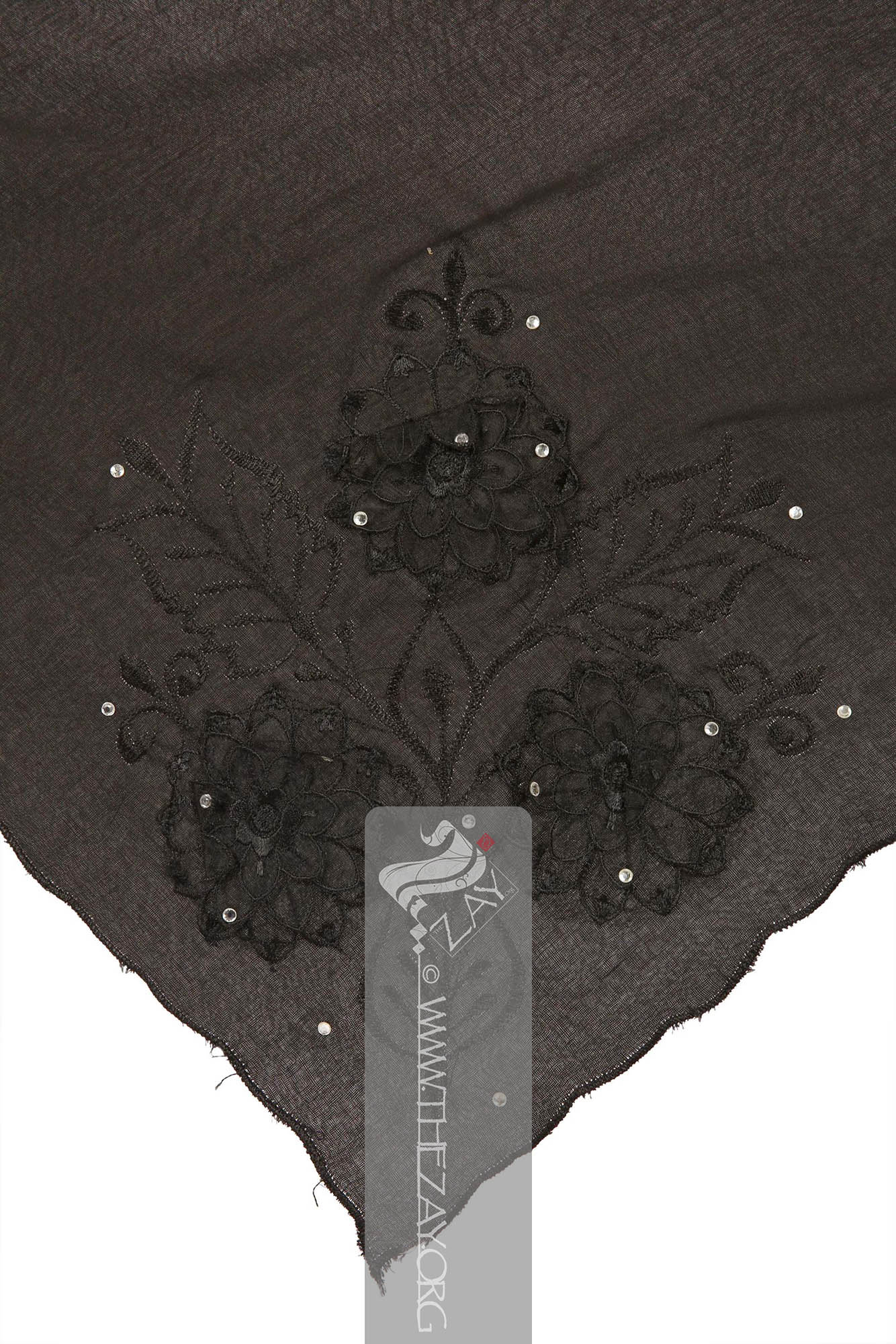
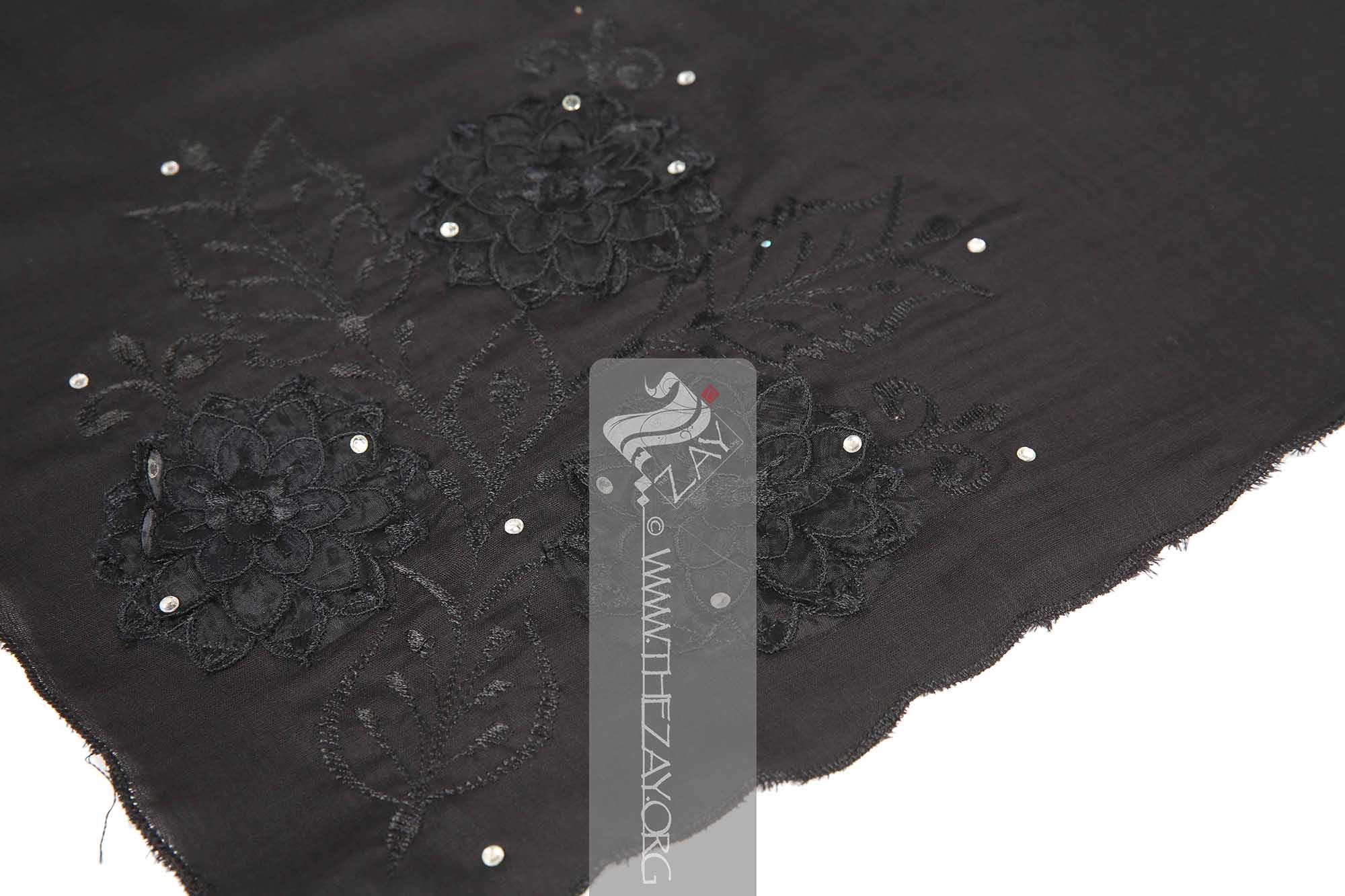
One of the corners is adorned with a large floral and foliage bouquet in black silk floss Floss: (Old French: flosche – nap of velvet), is a type of silk fibre obtained from the cocoons of wild silkworms. It is characterized by its long, fluffy fibers that are not tightly woven, making it ideal for use in various textile applications such as embroidery, lace-making, and sewing. thread using (satin_stitch Satin_stitch: (Synonym: Damask Stitch), is a type of flat embroidery stitch that creates a satin like smooth and shiny surface by closely spaced stitches, covering an entire area or shape.) style embroidery. Sprouting out of a tulip-shaped foliage pattern at the base, the central stem of the bouquet is divided into three parts.
While all three stems sport a large floral pattern with a (fleur_de_lis Fleur_de_lis: (French: fleur – flower; de – of; lis – lily), is a stylized lily or iris used as a decorative motif. It has been associated with the French monarchy since the 12th century. As a symbol for both the Virgin Mary and Saint Joseph, it has been used in heraldry, architecture, and art. ) at its top, the central stem forms a foliage pattern at the base of its floral pattern and divides itself further into two branches, each featuring a large dual leaf with smaller foliage. Each floral pattern is constructed of three sets of petals in three concentric layers.
Each set of petals is cut from a very sheer, finely woven tulle fabric with finished whip_stitched edges. These layers are then (appliqued Appliqued: (French: appliquer – Apply), ornamental needlework where small pieces of decorative fabric are sewn on to a larger piece to form a pattern.) to the ground fabric with the top set featuring a smaller floral pattern embroidered at its centre in satin_stitch Satin_stitch: (Synonym: Damask Stitch), is a type of flat embroidery stitch that creates a satin like smooth and shiny surface by closely spaced stitches, covering an entire area or shape. technique in black floss Floss: (Old French: flosche – nap of velvet), is a type of silk fibre obtained from the cocoons of wild silkworms. It is characterized by its long, fluffy fibers that are not tightly woven, making it ideal for use in various textile applications such as embroidery, lace-making, and sewing. thread.
Accents of small white diamante stick-ons are used to further highlight the embellishment. A thoroughly machine-stitched piece, it also sports a thoroughly machine-embroidered embellishment.
The distinctiveness of the piece lies in its shape, which diverges from the conventional rectangular forms typically employed in shaylah Shaylah: (Colloquial Gulf Arabic), a length of fabric used as shawl, head cover or veil. Also known as (wigāyah) or (milfa’), generally made from sheer fabrics such as tulle (tūr), cotton gauze (wasmah Wasmah: (Arabic: woad), is derived from the woad herb (wasmah) used to dye the cotton gauze black. It is mainly used for headcovers or veils and overgarments in most of the Arab gulf region.) (nidwah) or (Nīl), or silk chiffon (sarī).. This deviation may represent a possible later stylistic evolution. It may have been influenced by personal preferences, as it facilitates easier and efficient draping around the wearer’s head, allowing for secure fastening through pinning or tying while minimizing interference with the wearer’s mobility.