

1 of 4
| Local Name | Shaylah tur mnaghadah, Shaylah mnaghadah talli fadhah, Shaylah talli, Shaylah khusah |
| Object Category | Headwear |
| Gender | Female |
| Date of object | c. 20th century |
| Place Of orgin | UAE |
| Region | UAE |
| Object Range | UAE, Oman, Qatar, Bahrain, Kuwait, KSA, Iran et al |
| Dimensions | Length: 116 cm Width: 234 cm |
| Materials | Synthetic Metal |
| Technique | Woven Other |
| Color | |
| Motif | Floral Geometric |
| Provenance | Purchased, 1989 |
| Location | The Zay Zay: (Arabic: costume, Pl. azyaā’), a set of clothes in a style typical of a particular country or historical period. Initiative |
| Status | Storage |
| ZI number | ZI1989.500562 UAE |
Object History
This piece was purchased by Dr. Reem Tariq
Ṭariq: (Arabic; Synonym: tulle_bi_talli
Tūlle_bi_tallī: (French: Tulle – a city in France where fine material for veil was first made; Turkish: tel – wire; Synonym: tariq; talli; badla; khus_dozi ), series of small metal knots made on a woven net ground as embellishment. The term is commonly used in the North African Arab region specifically in Egypt. Ṭariq: (Arabic; Synonym: tulle_bi_talli
Tūlle_bi_tallī: (French: Tulle – a city in France where fine material for veil was first made; Turkish: tel – wire; Synonym: tariq; talli; badla; khus_dozi ), series of small metal knots made on a woven net ground as embellishment. The term is commonly used in the North African Arab region specifically in Egypt.
Object Features
This is a traditional head scarf
Scarf: (English), usually a rectangular piece of cloth loosely worn over the shoulders, upper body and arms, and sometimes also over the head. (shaylah
Shaylah: (Colloquial Gulf Arabic), a length of fabric used as shawl, head cover or veil. Also known as (wigāyah) or (milfa’), generally made from sheer fabrics such as tulle (tūr), cotton gauze (wasmah
Wasmah: (Arabic: woad), is derived from the woad herb (wasmah) used to dye the cotton gauze black. It is mainly used for headcovers or veils and overgarments in most of the Arab gulf region.) (nidwah) or (Nīl), or silk chiffon (sarī).) / (shaylah
Shaylah: (Colloquial Gulf Arabic), a length of fabric used as shawl, head cover or veil. Also known as (wigāyah) or (milfa’), generally made from sheer fabrics such as tulle (tūr), cotton gauze (wasmah
Wasmah: (Arabic: woad), is derived from the woad herb (wasmah) used to dye the cotton gauze black. It is mainly used for headcovers or veils and overgarments in most of the Arab gulf region.) (nidwah) or (Nīl), or silk chiffon (sarī). tur
Tūr: (Arabised from French: tulle), refers to a net-like soft, fine silk, cotton, or nylon material, used for making veils and dresses. In colloquial Arabic the letter (L) is turned into (ra). mnaghadah
Mnaghadah: (Arabic: mnaqad: with coins). Since silver was a form of currency, it came to refer to silver adorned garments. The term refers to articles decorated with silver (tallī) straw (khūs) in small coin-like dots. In the Arab Gulf region, the terms (mnaghadah), (mnaghad) (nighdah) and (tallī) are often used interchangeably, with the (qāf) pronounced (gha) colloquially. talli
Tallī: (Turkish: tel – wire, string), Gulf Arab – a woven braided trimming made with metal wire, threads and ribbons often sewn on detachable panels used as embellishments. Other – (Synonym: tulle_bi_talli
Tūlle_bi_tallī: (French: Tulle – a city in France where fine material for veil was first made; Turkish: tel – wire; Synonym: tariq; talli; badla; khus_dozi ), series of small metal knots made on a woven net ground as embellishment. The term is commonly used in the North African Arab region specifically in Egypt. Tallī: (Turkish: tel – wire, string), Gulf Arab – a woven braided trimming made with metal wire, threads and ribbons often sewn on detachable panels used as embellishments. Other – (Synonym: tulle_bi_talli
Tūlle_bi_tallī: (French: Tulle – a city in France where fine material for veil was first made; Turkish: tel – wire; Synonym: tariq; talli; badla; khus_dozi ), series of small metal knots made on a woven net ground as embellishment. The term is commonly used in the North African Arab region specifically in Egypt.
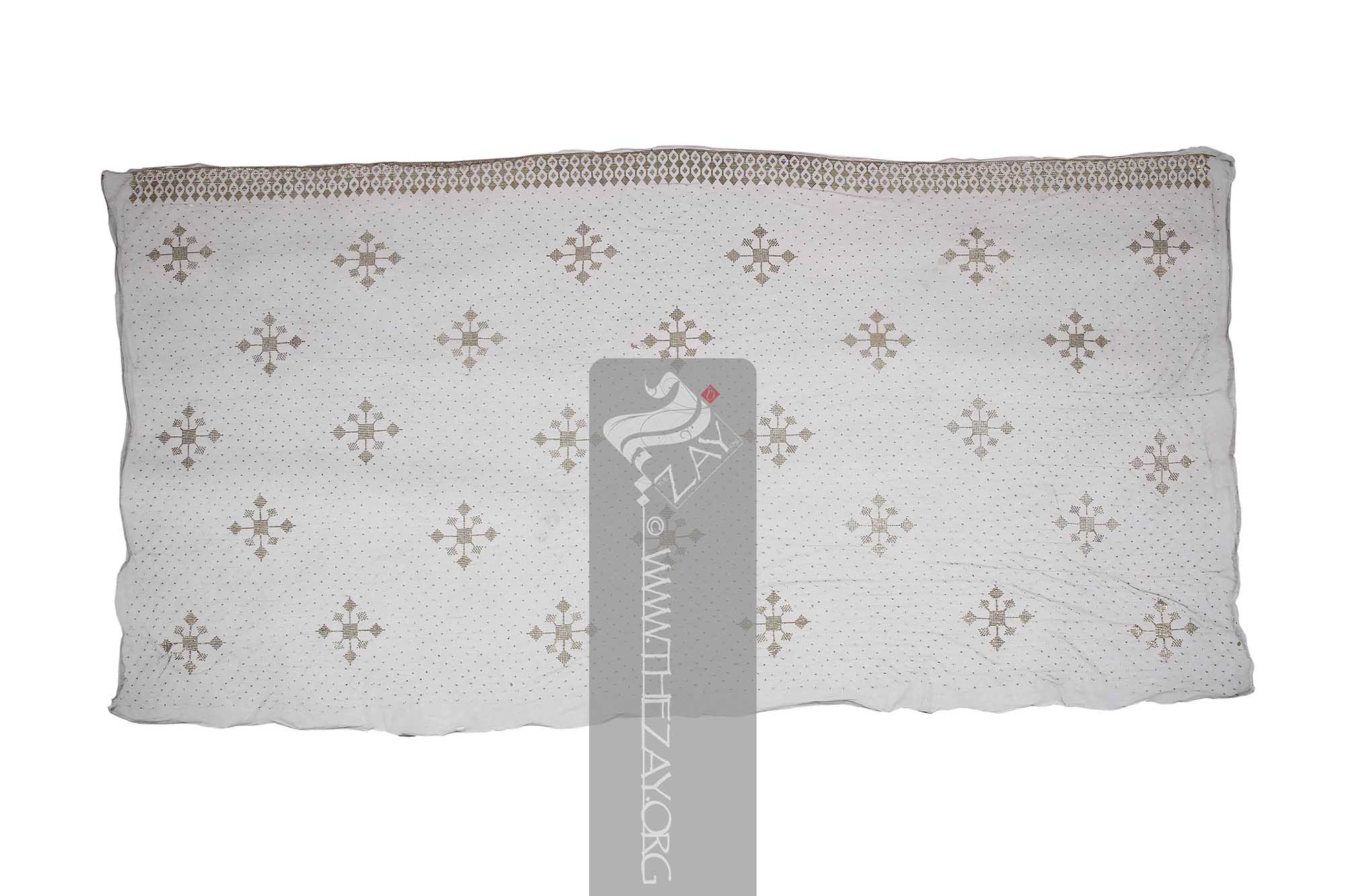
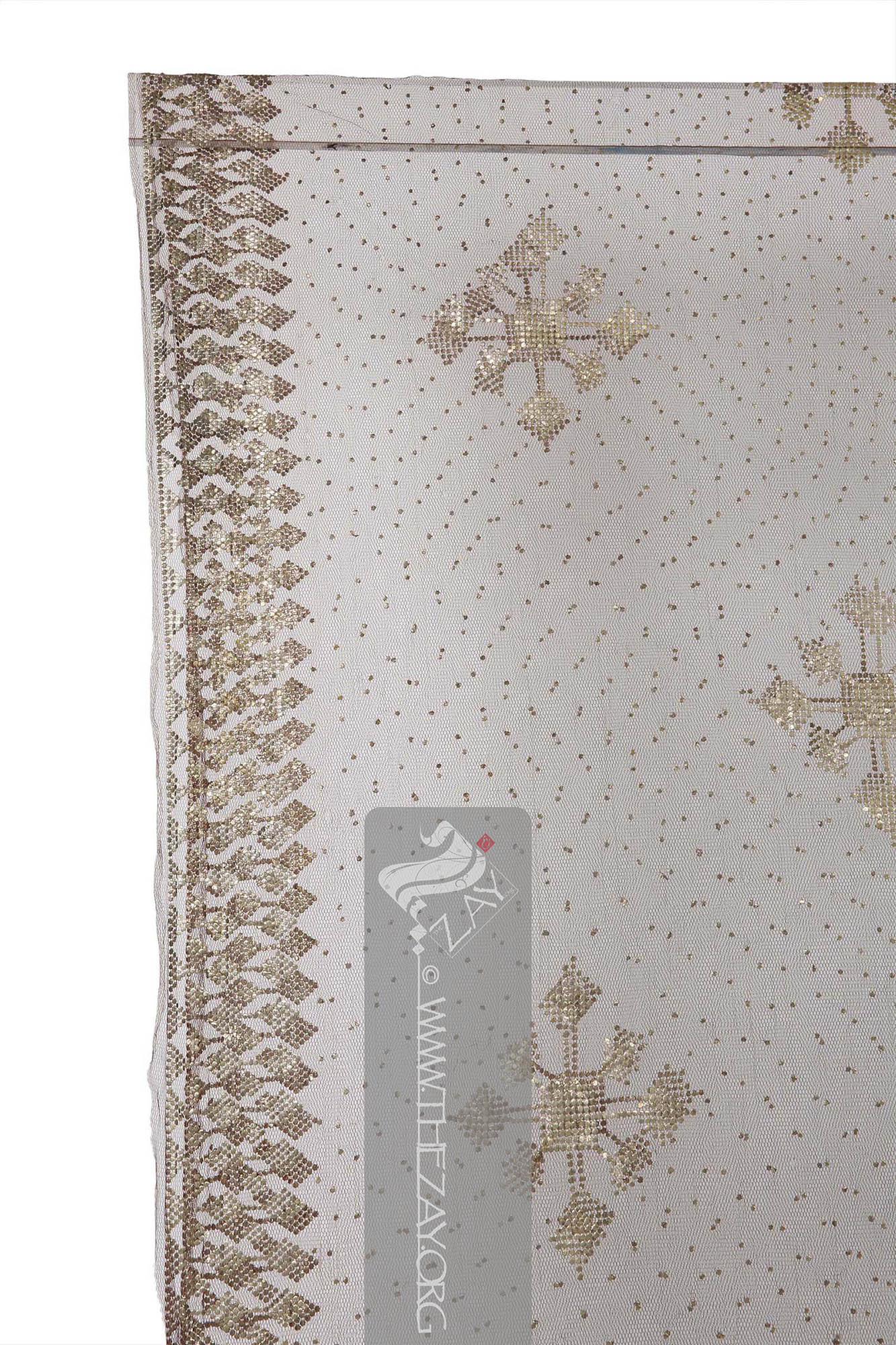
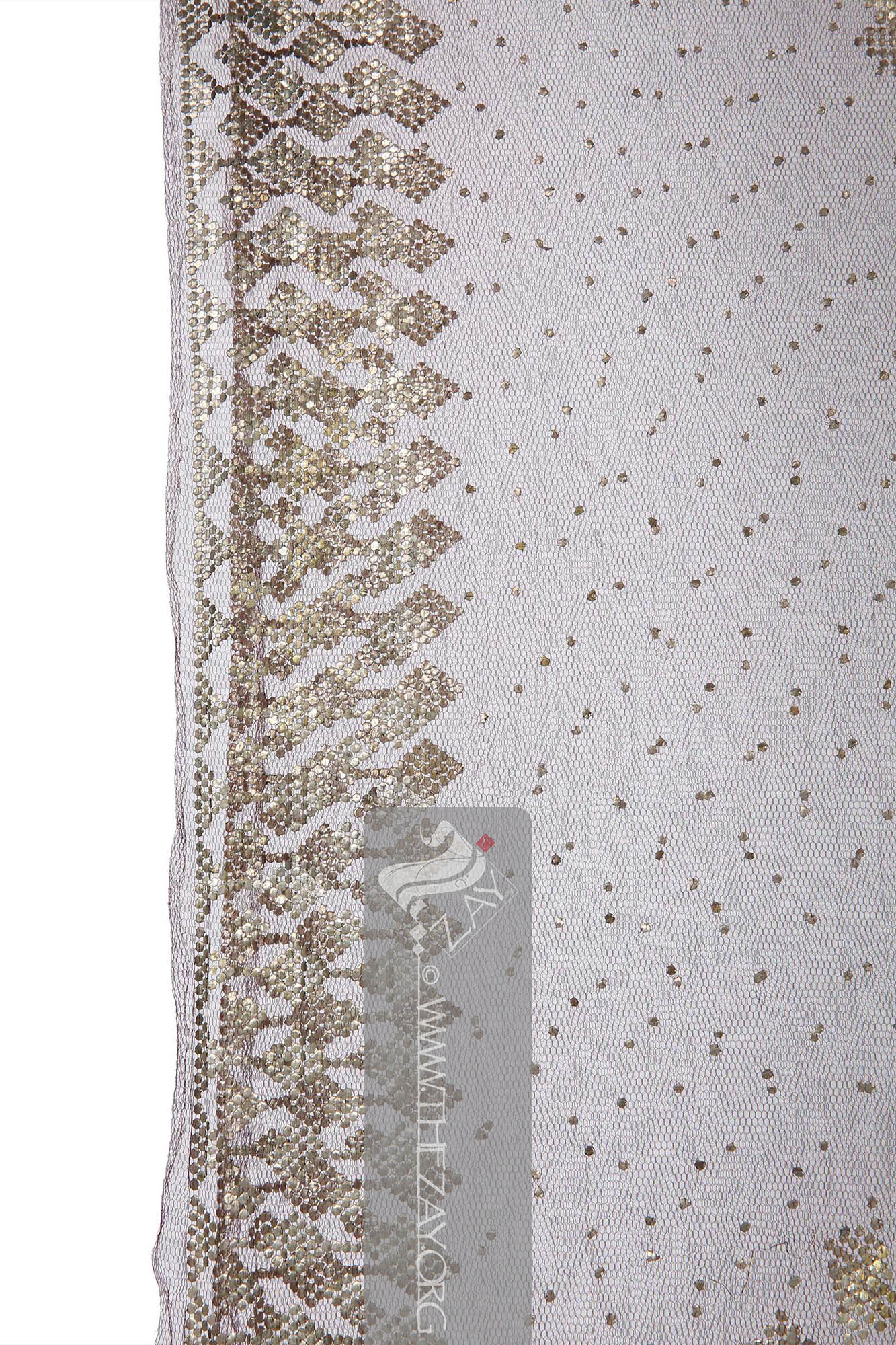
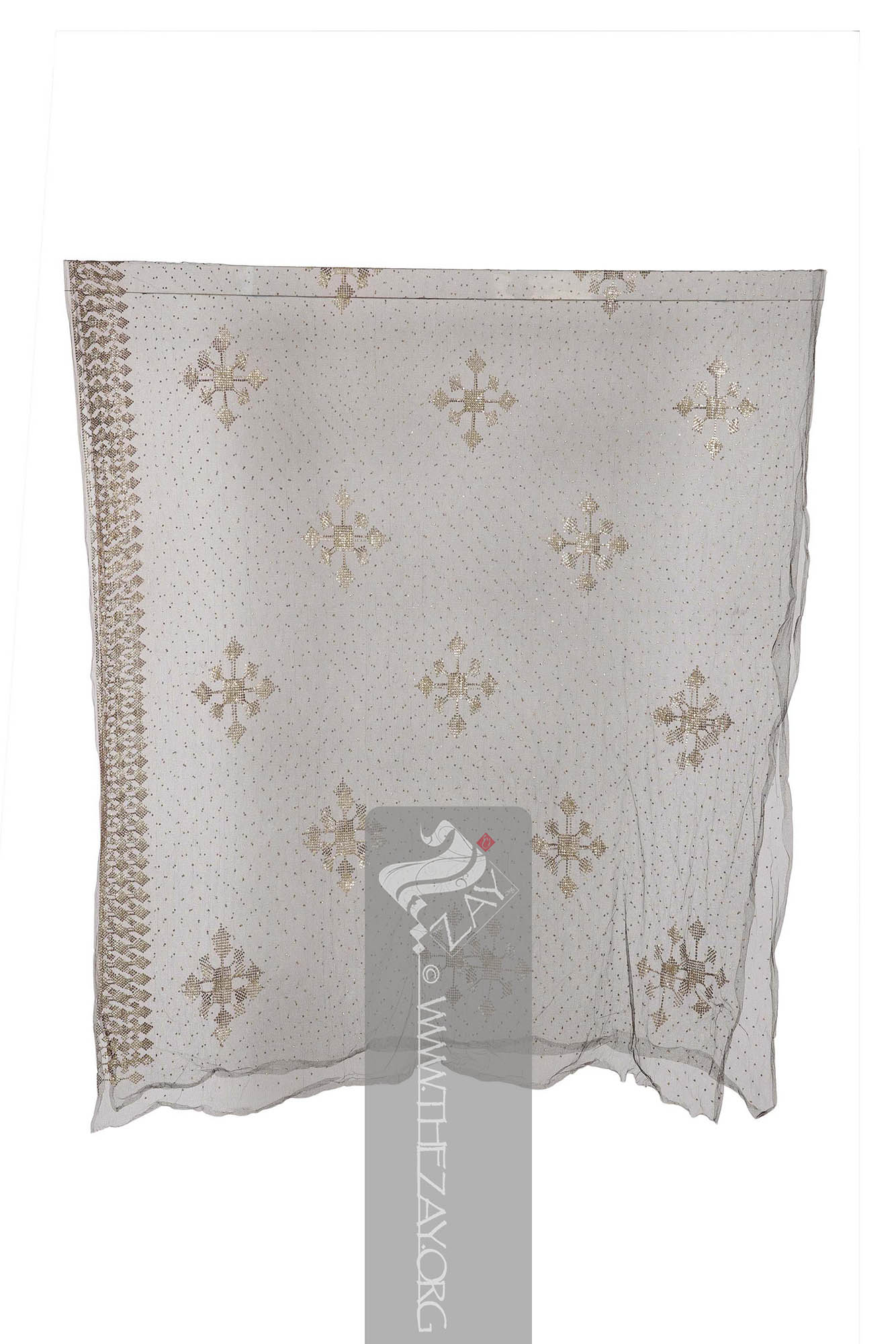
A (selvedge Selvedge: (English: Self-finished edge or self-edge: a dialect forming transition), an edge produced on woven fabric during manufacture that prevents it from unravelling. Traditionally the term selvage applied to only loom woven fabric, presently it could be applied to flat knitted fabric too. ) to selvedge Selvedge: (English: Self-finished edge or self-edge: a dialect forming transition), an edge produced on woven fabric during manufacture that prevents it from unravelling. Traditionally the term selvage applied to only loom woven fabric, presently it could be applied to flat knitted fabric too. woven black tulle fabric, of possibly synthetic material, the piece is heavily adorned with metal plates or wires (khus Khūṣ: (Arabic: straw, sing. khūṣah), flat silver or metallic flat straw used in embroidery or tallī making.), possibly silver, in hammered style (naqdah Naqdah: (Arabic: coins, synonyms: mnaghadah, naghdah, mnaghadah) Since silver was a form of currency, it came to refer to silver adorned garments. The term refers to articles decorated with silver (tallī) straw (khūs) in small coin-like dots. The (qāf) is pronounced (gha) colloquially.) embellishments. The central field of the piece is adorned with repeats of small circular metal specs. This is overlaid with large, stylized floral repeats.
Each floral pattern is composed of a circular centre with a series of linear patterns extending outward, creating a sunburst effect. Each line is further topped with a rhombus shape, making it a star-shaped floral pattern.
While one of the (weft Weft: one of the two basic components used in weaving that transforms thread or yarns into a piece of fabric. It is the crosswise thread on a loom that is passed over and under the warp threads.) edges comprises the continuation of the central design, the other has a wide panel forming a border. This panel is composed of triangular repeats at the base supporting a pillar of two layers of rhombus repeats.
Each rhombus is connected to its corresponding pair in the pillar and its triangular base with a thin line. These pillars are separated from each other with two layers of comparatively smaller rhombi.
More Info
Although such naqdah Naqdah: (Arabic: coins, synonyms: mnaghadah, naghdah, mnaghadah) Since silver was a form of currency, it came to refer to silver adorned garments. The term refers to articles decorated with silver (tallī) straw (khūs) in small coin-like dots. The (qāf) is pronounced (gha) colloquially. embellished veils were once a popular item amongst the masses, often employing precious metals such as silver and gold plates for embellishments, they are now quite hard to find. Today, they are primarily donned by the elderly, especially during celebrations and special occasions or can be found in a bridal trousseau.
Generally draped over the head, covering the back of the head, neck and shoulders, it is often gathered and tucked around the forearm of the wearer, thus firmly framing the face with shimmering adornments. If worn by a bride, however, the veil is pulled down the front, covering the face, revealing only the silhouette across a shimmering curtain to the onlookers.
The embellishment technique that traditionally used precious metals such as silver and sometimes gold could be deemed as the physical manifestation of the traditional Arabic idiom ‘zinah wa khazinah’, which roughly translates to ‘beauty and wealth together’, since the decorative element both enhances the beauty of the garment and stands as a testament to the status of the wearer.