

1 of 5
| Local Name | Shaylah tur mnaghadah, Shaylah mnaghadah talli fadhah kazouah, Shaylah talli, Shaylah khusah, wigayah, samādah |
| Object Category | Headwear |
| Gender | Female |
| Date of object | c. 1970 |
| Place Of orgin | UAE |
| Region | UAE |
| Object Range | UAE, Oman, Qatar, Bahrain, Kuwait, KSA, Iran et al |
| Dimensions | Length: 120 cm Width: 220 cm |
| Materials | Synthetic Metal |
| Technique | Woven Other |
| Color | |
| Motif | Geometric Floral Paisley |
| Provenance | Purchased, Independent Dealer, Al Ain 2021 |
| Location | The Zay Zay: (Arabic: costume, Pl. azyaā’), a set of clothes in a style typical of a particular country or historical period. Initiative |
| Status | Storage |
| ZI number | ZI2021.500970.8 UAE |
Object Note
Part of a lot along with 12 more items (ZI2021.500970.1 UAE, ZI2021.500970.2 UAE, ZI2021.500970.3 UAE, ZI2021.500970.4 UAE, ZI2021.500970.5 UAE, ZI2021.500970.6 UAE, ZI2021.500970.7 UAE, ZI2021.500970.9 UAE, ZI2021.500970.10 UAE, ZI2021.500970.11 UAE, ZI2021.500970.12 UAE, and ZI2021.500970.13 UAE) also in the collection.
Object History
This piece was purchased by Dr. Reem Tariq
Ṭariq: (Arabic; Synonym: tulle_bi_talli
Tūlle_bi_tallī: (French: Tulle – a city in France where fine material for veil was first made; Turkish: tel – wire; Synonym: tariq; talli; badla; khus_dozi ), series of small metal knots made on a woven net ground as embellishment. The term is commonly used in the North African Arab region specifically in Egypt. Ṭariq: (Arabic; Synonym: tulle_bi_talli
Tūlle_bi_tallī: (French: Tulle – a city in France where fine material for veil was first made; Turkish: tel – wire; Synonym: tariq; talli; badla; khus_dozi ), series of small metal knots made on a woven net ground as embellishment. The term is commonly used in the North African Arab region specifically in Egypt.
Having spotted historical pieces on the social media account of Dr. Reem’s publication, Sultanibooksuae, this independent antique dealer from the city of Al Ain approached The Zay Zay: (Arabic: costume, Pl. azyaā’), a set of clothes in a style typical of a particular country or historical period. Initiative to help source items that were originally gifted by a member of the Al Nahyan family to one of the ladies in their entourage who requested to remain anonymous.
It is a well-established practice among members of ruling families in the region to distribute gifts consisting of suitcases filled with textiles, gowns, perfumes, and incense, and on occasion even their own garments, to members of their entourage, relatives, and the wider community. While some recipients choose to wear these items, others discreetly re-gift or sell them, thereby facilitating their circulation beyond the immediate sphere of elite patronage.
We at The Zay Zay: (Arabic: costume, Pl. azyaā’), a set of clothes in a style typical of a particular country or historical period. convey our heartfelt gratitude to both the dealer and the previous owner for their contribution to the collection.
Object Features
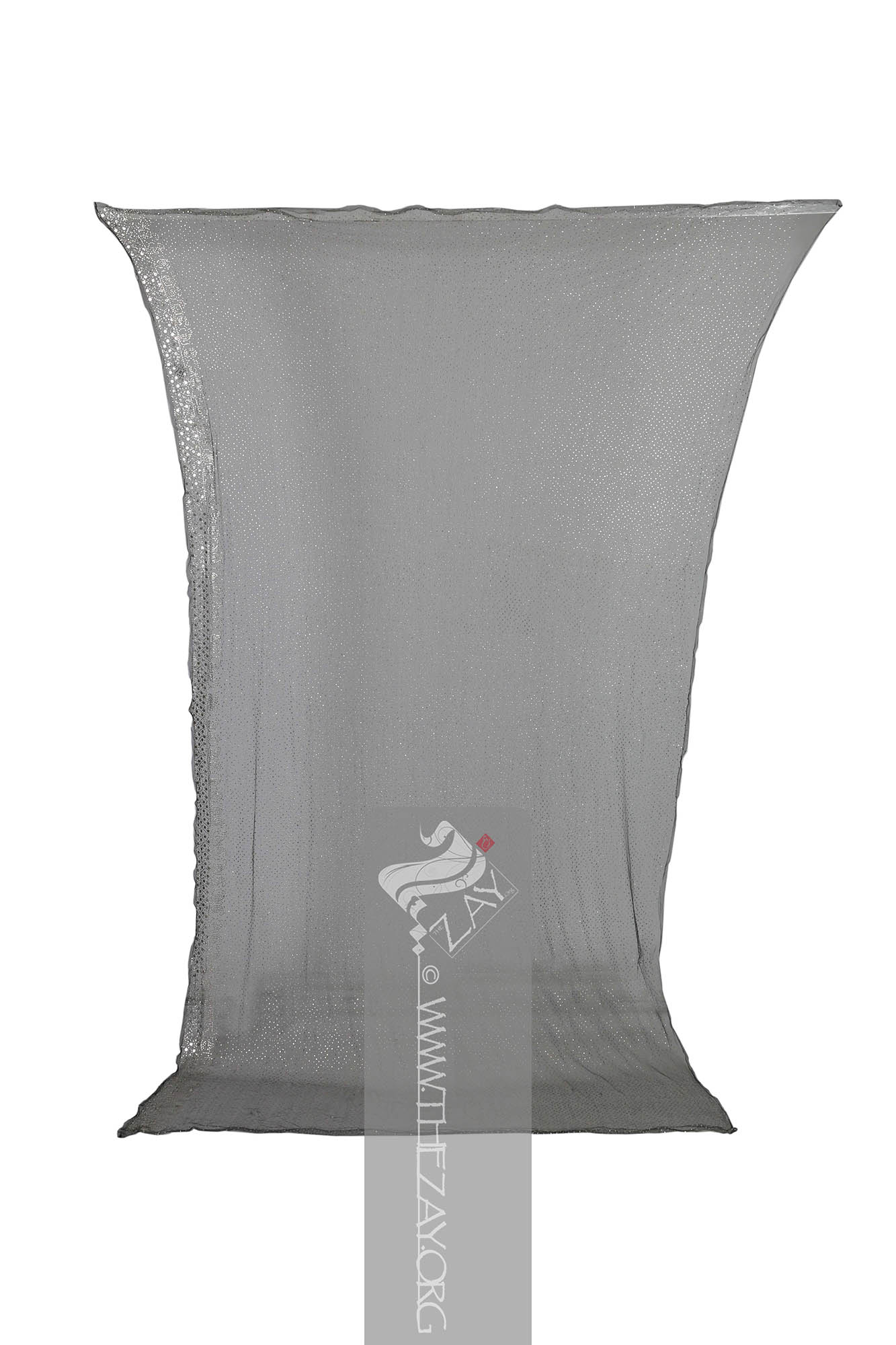
This is a traditional head scarf
Scarf: (English), usually a rectangular piece of cloth loosely worn over the shoulders, upper body and arms, and sometimes also over the head. (shaylah
Shaylah: (Colloquial Gulf Arabic), a length of fabric used as shawl, head cover or veil. Also known as (wigāyah) or (milfa’), generally made from sheer fabrics such as tulle (tūr), cotton gauze (wasmah
Wasmah: (Arabic: woad), is derived from the woad herb (wasmah) used to dye the cotton gauze black. It is mainly used for headcovers or veils and overgarments in most of the Arab gulf region.) (nidwah) or (Nīl), or silk chiffon (sarī).) / (shaylah
Shaylah: (Colloquial Gulf Arabic), a length of fabric used as shawl, head cover or veil. Also known as (wigāyah) or (milfa’), generally made from sheer fabrics such as tulle (tūr), cotton gauze (wasmah
Wasmah: (Arabic: woad), is derived from the woad herb (wasmah) used to dye the cotton gauze black. It is mainly used for headcovers or veils and overgarments in most of the Arab gulf region.) (nidwah) or (Nīl), or silk chiffon (sarī). tur
Tūr: (Arabised from French: tulle), refers to a net-like soft, fine silk, cotton, or nylon material, used for making veils and dresses. In colloquial Arabic the letter (L) is turned into (ra). mnaghadah
Mnaghadah: (Arabic: mnaqad: with coins). Since silver was a form of currency, it came to refer to silver adorned garments. The term refers to articles decorated with silver (tallī) straw (khūs) in small coin-like dots. In the Arab Gulf region, the terms (mnaghadah), (mnaghad) (nighdah) and (tallī) are often used interchangeably, with the (qāf) pronounced (gha) colloquially.) / (shaylah
Shaylah: (Colloquial Gulf Arabic), a length of fabric used as shawl, head cover or veil. Also known as (wigāyah) or (milfa’), generally made from sheer fabrics such as tulle (tūr), cotton gauze (wasmah
Wasmah: (Arabic: woad), is derived from the woad herb (wasmah) used to dye the cotton gauze black. It is mainly used for headcovers or veils and overgarments in most of the Arab gulf region.) (nidwah) or (Nīl), or silk chiffon (sarī). mnaghadah
Mnaghadah: (Arabic: mnaqad: with coins). Since silver was a form of currency, it came to refer to silver adorned garments. The term refers to articles decorated with silver (tallī) straw (khūs) in small coin-like dots. In the Arab Gulf region, the terms (mnaghadah), (mnaghad) (nighdah) and (tallī) are often used interchangeably, with the (qāf) pronounced (gha) colloquially. talli
Tallī: (Turkish: tel – wire, string), Gulf Arab – a woven braided trimming made with metal wire, threads and ribbons often sewn on detachable panels used as embellishments. Other – (Synonym: tulle_bi_talli
Tūlle_bi_tallī: (French: Tulle – a city in France where fine material for veil was first made; Turkish: tel – wire; Synonym: tariq; talli; badla; khus_dozi ), series of small metal knots made on a woven net ground as embellishment. The term is commonly used in the North African Arab region specifically in Egypt. Tallī: (Turkish: tel – wire, string), Gulf Arab – a woven braided trimming made with metal wire, threads and ribbons often sewn on detachable panels used as embellishments. Other – (Synonym: tulle_bi_talli
Tūlle_bi_tallī: (French: Tulle – a city in France where fine material for veil was first made; Turkish: tel – wire; Synonym: tariq; talli; badla; khus_dozi ), series of small metal knots made on a woven net ground as embellishment. The term is commonly used in the North African Arab region specifically in Egypt.
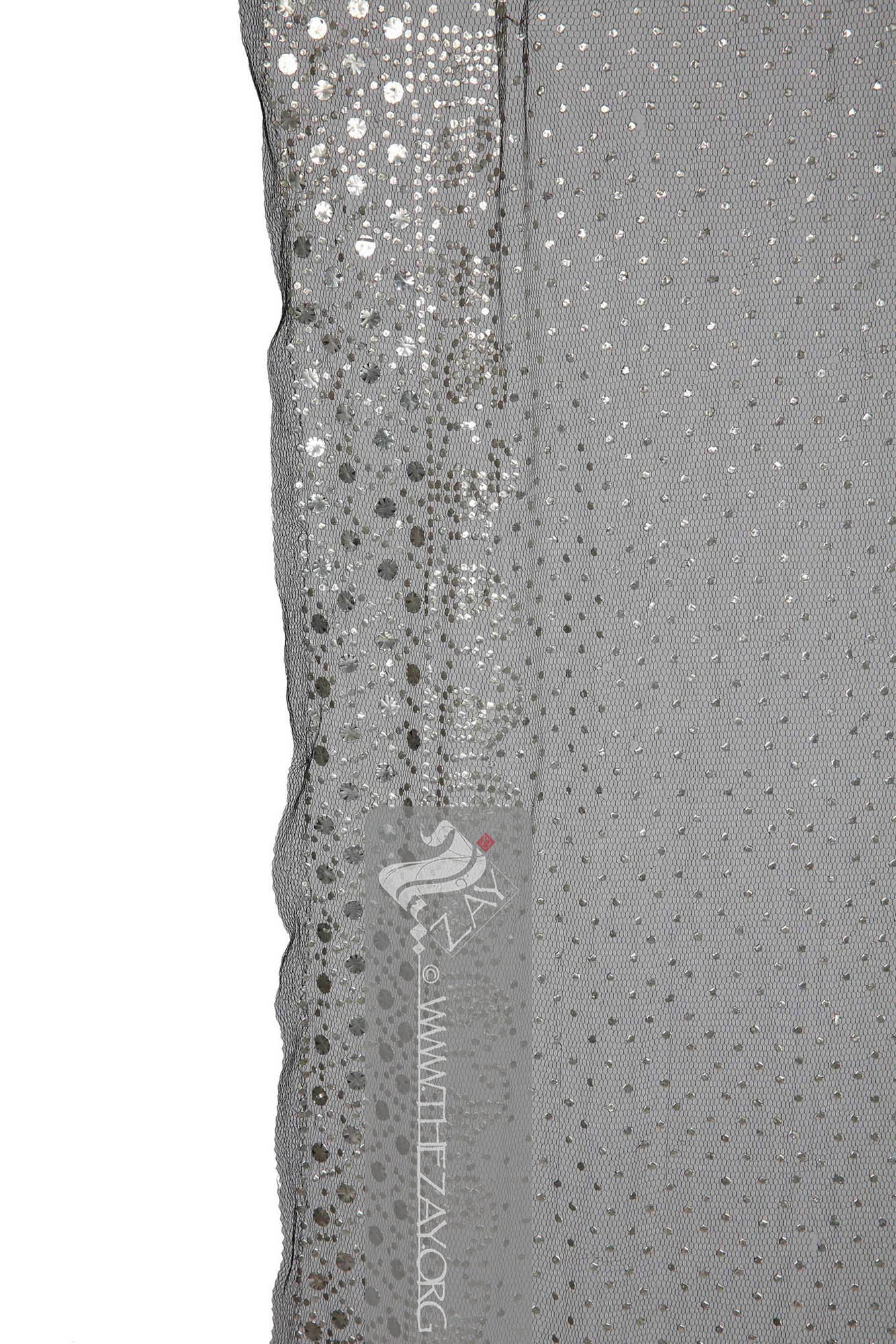
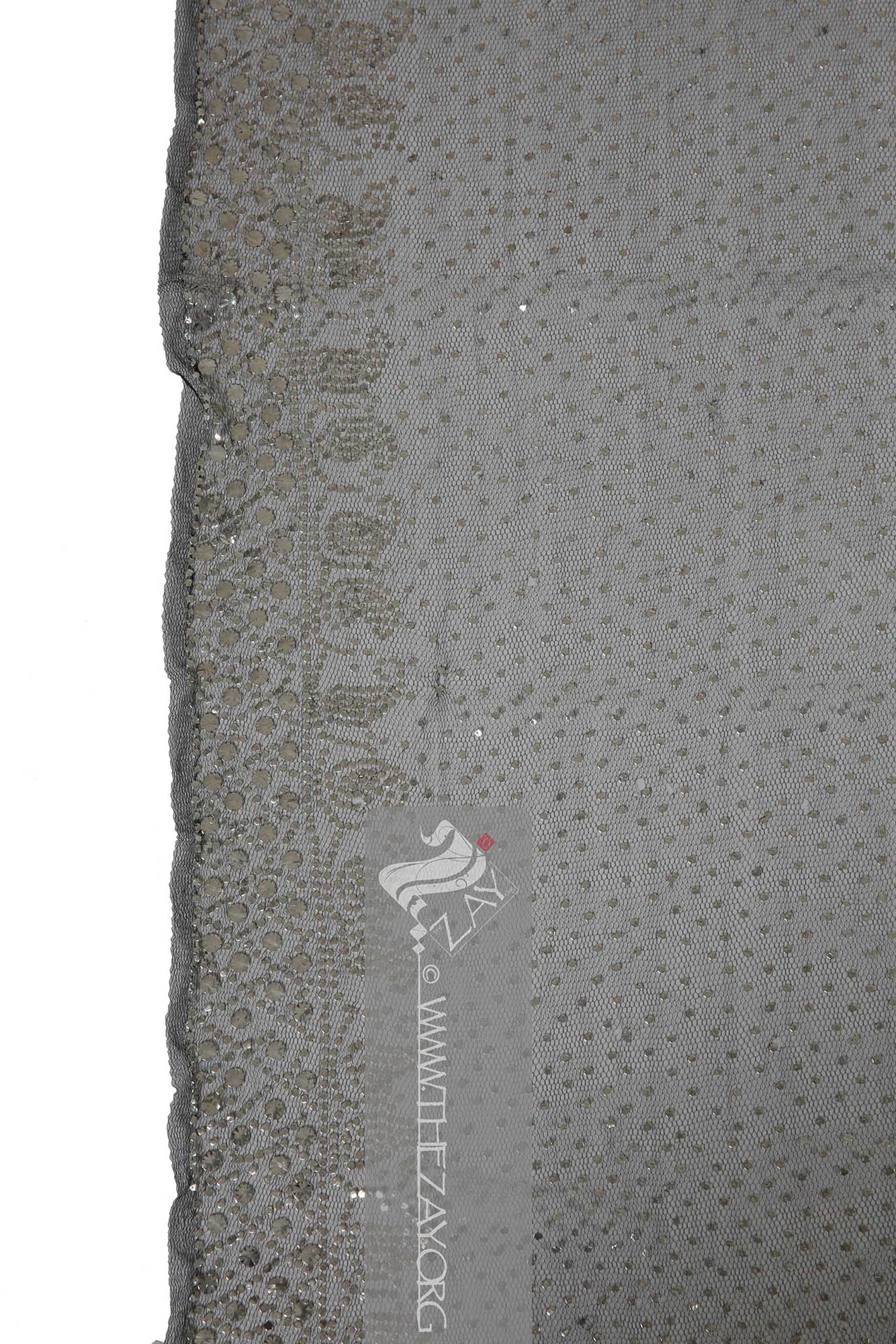
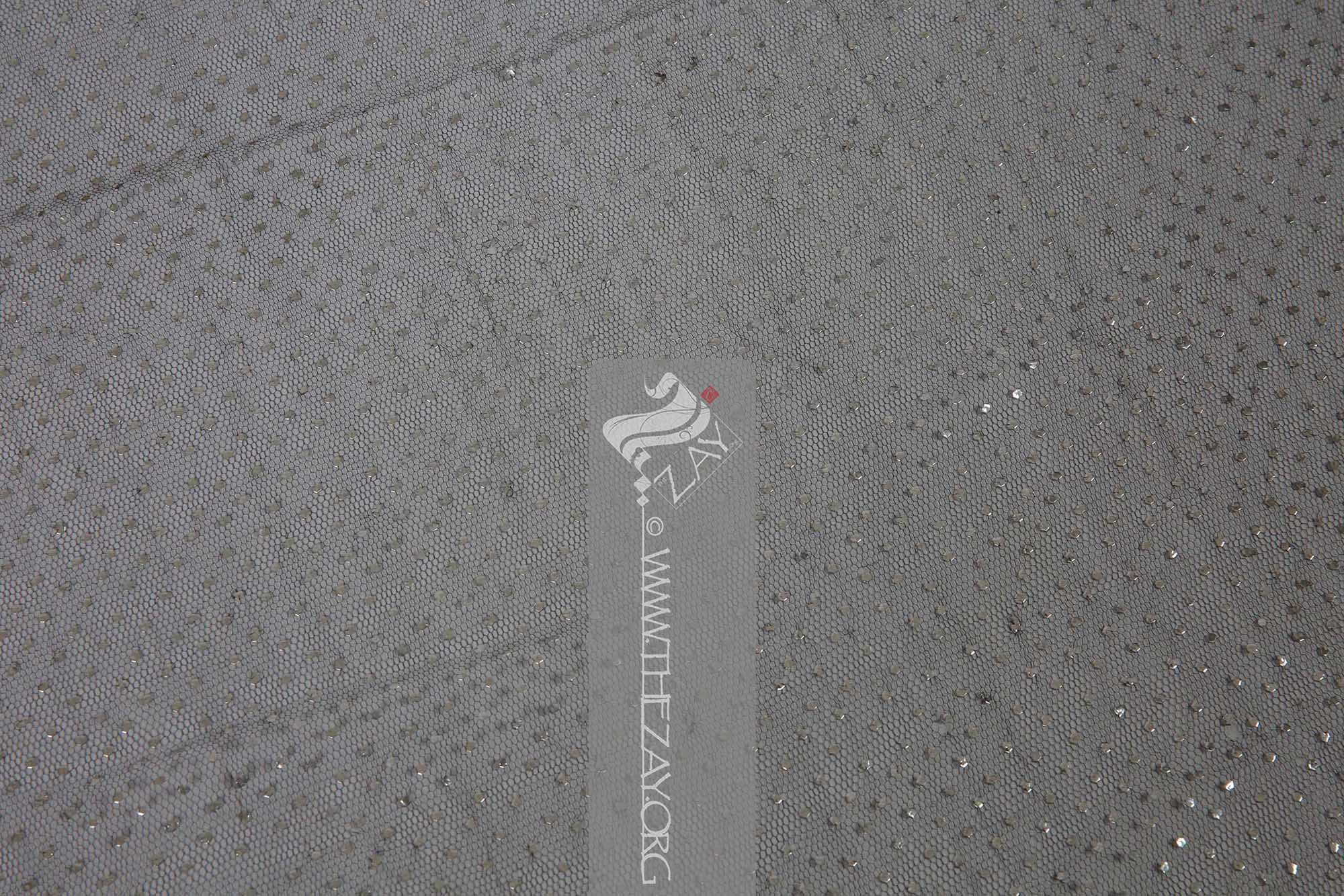
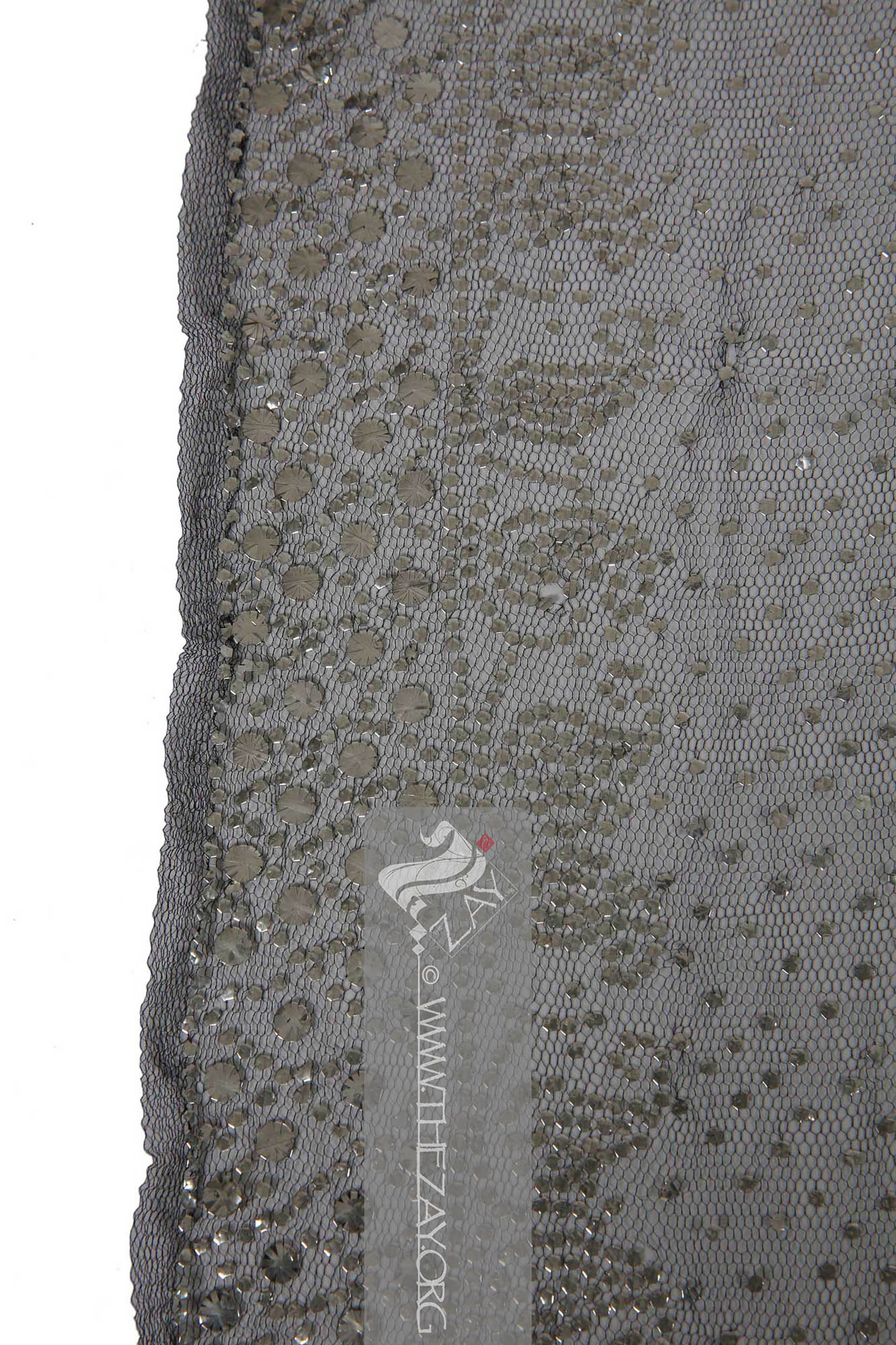
Constructed of a woven black tulle, possibly of silk, the field of the piece is adorned with repeats of small silver specs of metal plates or wires (khus Khūṣ: (Arabic: straw, sing. khūṣah), flat silver or metallic flat straw used in embroidery or tallī making.) in hammered style (naqdah Naqdah: (Arabic: coins, synonyms: mnaghadah, naghdah, mnaghadah) Since silver was a form of currency, it came to refer to silver adorned garments. The term refers to articles decorated with silver (tallī) straw (khūs) in small coin-like dots. The (qāf) is pronounced (gha) colloquially.) embellishments. The central field of the piece is filled with dense repeats of small specs of metal.
One of the (weft Weft: one of the two basic components used in weaving that transforms thread or yarns into a piece of fabric. It is the crosswise thread on a loom that is passed over and under the warp threads.) edges is adorned with a wide horizontal panel of diagonal rhombus repeats forming smaller grids with a large circular plate at the centre of each. This forms the base over which runs a scalloped banner that holds a (paisley Paisley: (Scottish Gaelic, Pàislig: a town in Scotland), often called buta, boteh, amli, or kalgi in the subcontinent and kazuwah in Arabic, is a Persian tear drop motif with a curved end specially in textiles. Its popularity and subsequent local production in 18th century at Paisley are responsible for its nomenclature.) / (Gazuwah Gāzūwah: (Arabic: Kāzū: cashew nut, pl. gāzūwāt), a vegetative paisley Paisley: (Scottish Gaelic, Pàislig: a town in Scotland), often called buta, boteh, amli, or kalgi in the subcontinent and kazuwah in Arabic, is a Persian tear drop motif with a curved end specially in textiles. Its popularity and subsequent local production in 18th century at Paisley are responsible for its nomenclature. form, similar to the kidney-shaped cashew nut, printed or embroidered on fabrics. The fabric can also be referred to as (bū_ kāzūwah). Also pronounced (Kāzūwah) or (Kāzū) in some Arab dialects, the letter (kāf) is at times pronounced (gā). ) pattern in its trough.