

1 of 3
| Local Name | Harz |
| Object Category | Headwear |
| Gender | Female |
| Date of object | c. 20th century |
| Place Of orgin | Morocco |
| Region | Morocco |
| Object Range | Morocco, Libya, Tunis, Egypt, Algeria, et al |
| Dimensions | Length: 145 cm Width: 80 cm |
| Materials | Silk |
| Technique | Machine Stitched Machine Embroidered |
| Color | |
| Motif | Floral Calligraphy |
| Provenance | Purchased, William Emmette, USA 2018 |
| Location | The Zay Zay: (Arabic: costume, Pl. azyaā’), a set of clothes in a style typical of a particular country or historical period. Initiative |
| Status | In Storage |
| ZI number | ZI2018.500835.5 MOROCCO |
Object Note
Part of a lot with four more items (ZI2018.500835.1 MOROCCO, ZI2018.500835.2 MOROCCO, ZI2018.500835.3 MOROCCO, and ZI2018.500835.4 MOROCCO) also in the collection.
Object History
This item was purchased by Dr. Reem Tariq
Ṭariq: (Arabic; Synonym: tulle_bi_talli
Tūlle_bi_tallī: (French: Tulle – a city in France where fine material for veil was first made; Turkish: tel – wire; Synonym: tariq; talli; badla; khus_dozi ), series of small metal knots made on a woven net ground as embellishment. The term is commonly used in the North African Arab region specifically in Egypt. Ṭariq: (Arabic; Synonym: tulle_bi_talli
Tūlle_bi_tallī: (French: Tulle – a city in France where fine material for veil was first made; Turkish: tel – wire; Synonym: tariq; talli; badla; khus_dozi ), series of small metal knots made on a woven net ground as embellishment. The term is commonly used in the North African Arab region specifically in Egypt.
Mr. Emmett, who had in turn acquired these pieces through purchased from a lady whose mother was a private secretary to two of Hollywood’s most famous celebrities – Sir Laurence Olivier and Vivienne Leigh. She acquired her collection from both Olivier and Leigh through purchase, as well as donations and gifts.
Object Features
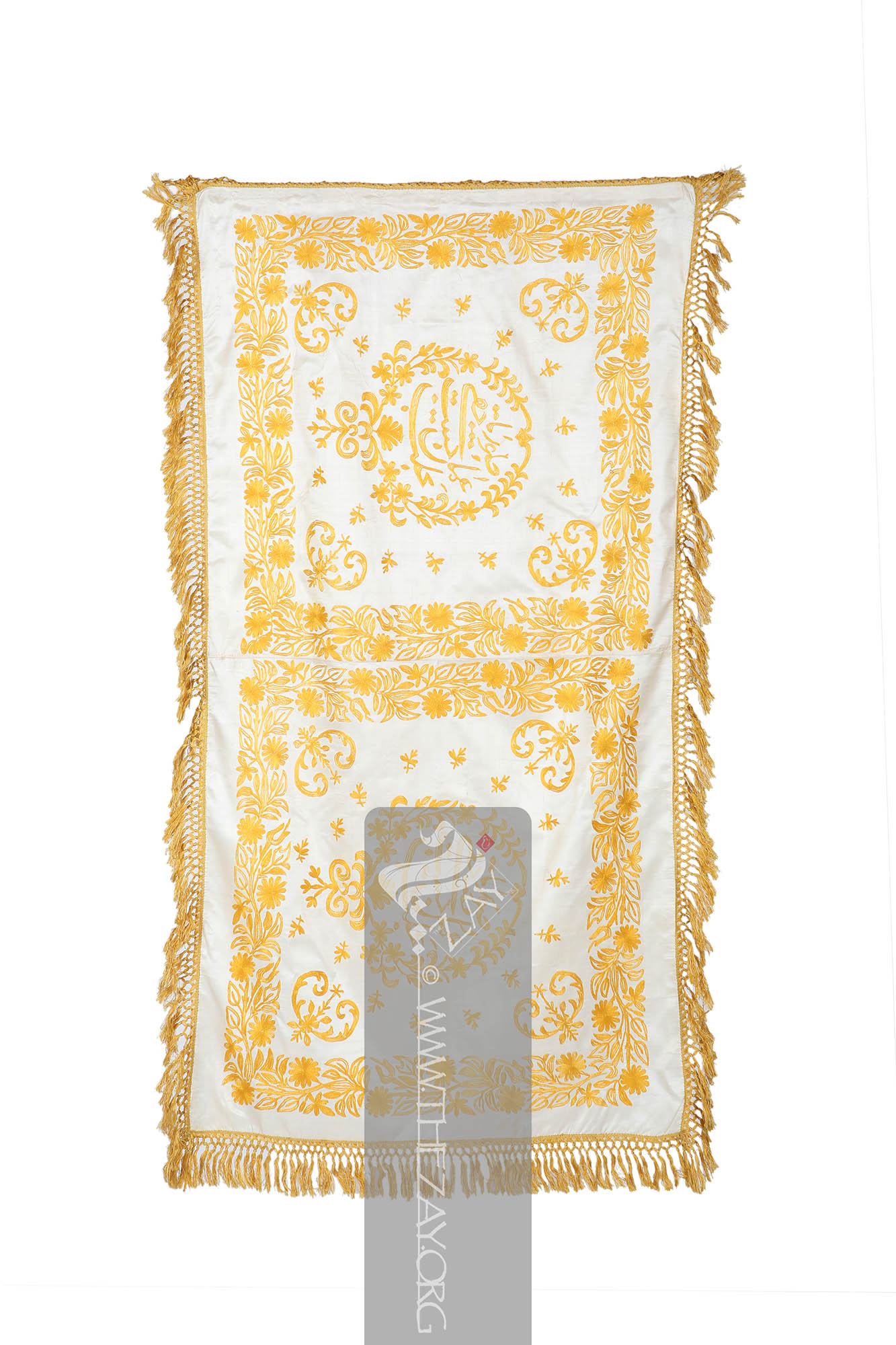
This is either a silk scarf
Scarf: (English), usually a rectangular piece of cloth loosely worn over the shoulders, upper body and arms, and sometimes also over the head. (sbiniyah_roumiyah
Sbīnīyah_rūmīyah: (Arabic: Rome – a city in Italy), a head dress or scarf
Scarf: (English), usually a rectangular piece of cloth loosely worn over the shoulders, upper body and arms, and sometimes also over the head. traditionally worn by urban Moroccan women. Often made of silk these scarves are characterised by the series of fringes at its edge. European scarves were traditionally named after the Italian city of Rome to denote its foreign origin. Ḥarz: (Arabic), a headband worn by urban Moroccan women to fasten and hold the headdress or scarf
Scarf: (English), usually a rectangular piece of cloth loosely worn over the shoulders, upper body and arms, and sometimes also over the head. in its place.
While the field of the fabric is heavily embellished with (aghabani
Aghabānī: (Arabic), a type of embroidered fabric often either silk or cotton. The embroidery technique used to create the embellishment was needlepoint chain_stitch
Chain_stitch: An embroidery technique where a looped stitch is made in a continuous chain-like pattern. Each stitch is formed by looping the thread through the previous stitch, creating a linked chain. with Damascus and Aleppo as centre for such craftsmanship in the Levant.
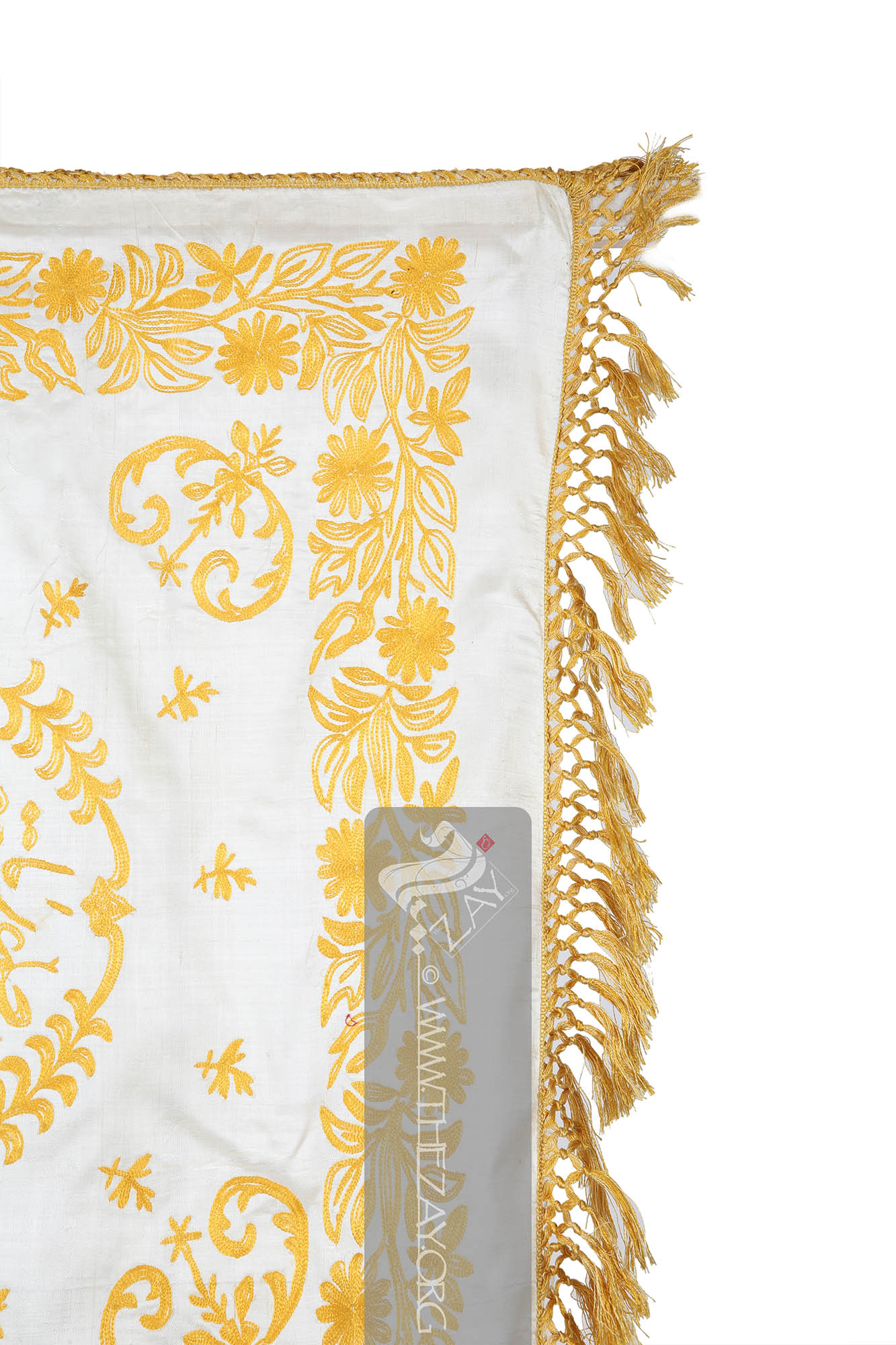
Both the fabric panels reflect similar embroidered patterns. The design pattern in each panel can be roughly divided into four layers.
The outermost layer is a wide panel running along the edges, creating a square frame. The panel is composed primarily of floral, tulips, and foliage patterns repeated along a wavy central vine.
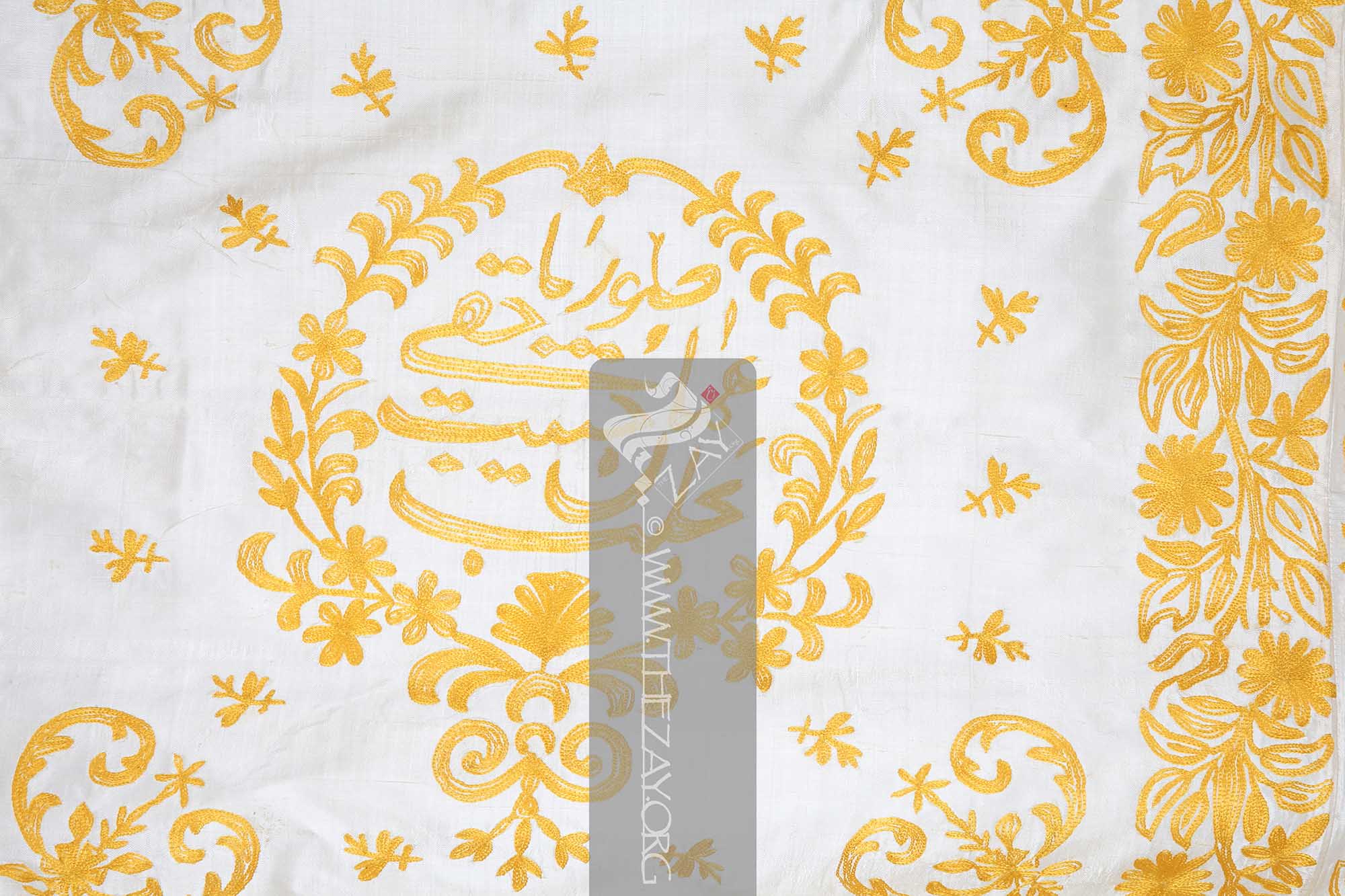
The second layer consists of four large corner elements composed of a floral and foliage bouquet with two large curling leaves flanking the central stem. This layer also features sporadic repeats of small floral patterns with flanking foliage that fills up the space.
The third layer is a large floral and foliage wreath along a circular vine with curling leaves at its base, flanking it from both sides, and a (palmette Palmette: (French: Palmette – Small palm, synonym Greco-Roman: Anthemion), a decorative element, motif, or ornament particularly pertaining to designs of architecture and decorative arts that has radiating petals resembling a palm leaf. It is believed to have originated in ancient Egypt and had subsequently reached far and wide. ) shaped floral pattern in the centre of the base. This wreath frames a stylized Arabic script in the centre, forming an elaborate medallion.
The panel could either be a scarf
Scarf: (English), usually a rectangular piece of cloth loosely worn over the shoulders, upper body and arms, and sometimes also over the head. called the sbiniyah_roumiyah
Sbīnīyah_rūmīyah: (Arabic: Rome – a city in Italy), a head dress or scarf
Scarf: (English), usually a rectangular piece of cloth loosely worn over the shoulders, upper body and arms, and sometimes also over the head. traditionally worn by urban Moroccan women. Often made of silk these scarves are characterised by the series of fringes at its edge. European scarves were traditionally named after the Italian city of Rome to denote its foreign origin. Ḥarz: (Arabic), a headband worn by urban Moroccan women to fasten and hold the headdress or scarf
Scarf: (English), usually a rectangular piece of cloth loosely worn over the shoulders, upper body and arms, and sometimes also over the head. in its place.
More Info
The headdresses of Moroccan women have undergone significant changes since the early 20th century, following the introduction of large quantities of cheap silk into the market. Historically, Moroccan women wore shawls and headscarves made of heavy brocade
Brocade: (Italian: brocco – twisted thread), is a richly decorative fabric woven with an intricate raised pattern. Its origins can be traced back to ancient China, where it was made for the imperial court. It later spread to Europe during the Renaissance and became popular in couture and decorative arts. , but these have been replaced by silk scarves with fringes known as sbiniyah_roumiyah
Sbīnīyah_rūmīyah: (Arabic: Rome – a city in Italy), a head dress or scarf
Scarf: (English), usually a rectangular piece of cloth loosely worn over the shoulders, upper body and arms, and sometimes also over the head. traditionally worn by urban Moroccan women. Often made of silk these scarves are characterised by the series of fringes at its edge. European scarves were traditionally named after the Italian city of Rome to denote its foreign origin. Sbīnīyah_rūmīyah: (Arabic: Rome – a city in Italy), a head dress or scarf
Scarf: (English), usually a rectangular piece of cloth loosely worn over the shoulders, upper body and arms, and sometimes also over the head. traditionally worn by urban Moroccan women. Often made of silk these scarves are characterised by the series of fringes at its edge. European scarves were traditionally named after the Italian city of Rome to denote its foreign origin.
These silk scarves envelop the entire bulk of the hair, which is securely held in place by a headband called (harz
Ḥarz: (Arabic), a headband worn by urban Moroccan women to fasten and hold the headdress or scarf
Scarf: (English), usually a rectangular piece of cloth loosely worn over the shoulders, upper body and arms, and sometimes also over the head. in its place.
Links