

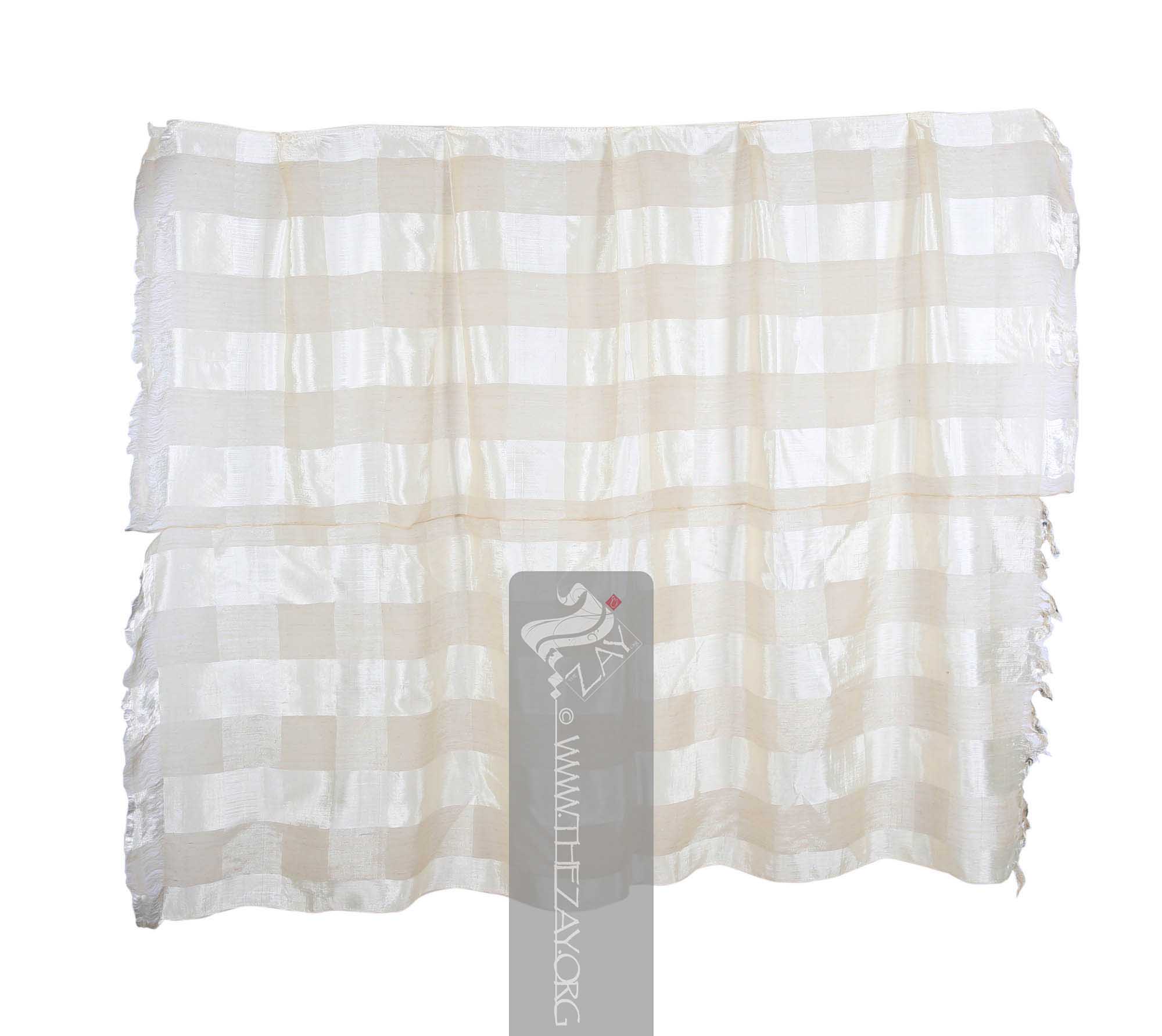

1 of 2
| Local Name | Izar |
| Object Category | Overgarment |
| Gender | Female |
| Date of object | c. 20th century |
| Place Of orgin | Iraq |
| Region | Iraq |
| Object Range | Syria, Lebanon, Jordan, Palestine, Egypt, Iraq, Türkiye et al |
| Dimensions | Length: 86 cm Width: 260 cm |
| Materials | Silk Linen |
| Technique | Woven Hand Stitched |
| Color | |
| Motif | Geometric |
| Provenance | - |
| Location | The Zay Zay: (Arabic: costume, Pl. azyaā’), a set of clothes in a style typical of a particular country or historical period. Initiative |
| Status | In Storage |
| ZI number | ZI1997.500237 IRAQ |
Object Features
This is a woven cloak (izar
Izār: (Arabic: azar: to support and strengthen, synonyms: wizrah
Wizrah: (Arabic: small garment, synonyms: izār, wizār, fūṭah), refers to a loincloth wrapped around the lower half of the body, between the navel and the knee. Known in the Arabian Peninsula, Iraq, the Horn of Africa (Somalia, Somaliland, Djibouti, Ethiopia, and Eritrea), Indonesia, Malaysia, Bangladesh, Pakistan, and countries in some parts of East Africa and in India., wizār, fūṭah, sharshaf
Sharshaf: (Ottoman Turkic: çarsaf – bed sheet; Synonym: mlaya, mlyaya, sharsaf), a set of large cloth usually used as a body wrap by women in public. Mlāyah: (Arabic; Synonym: ‘izār, çarsaf, sharshaf
Sharshaf: (Ottoman Turkic: çarsaf – bed sheet; Synonym: mlaya, mlyaya, sharsaf), a set of large cloth usually used as a body wrap by women in public. Sharshaf: (Ottoman Turkic: çarsaf – bed sheet; Synonym: mlaya, mlyaya, sharsaf), a set of large cloth usually used as a body wrap by women in public.
The silk warp
Warp: One of the two basic components used in weaving which transforms thread or yarns to a piece of fabric. The warp is the set of yarns stretched longitudinally in place on a loom before the weft
Weft: one of the two basic components used in weaving that transforms thread or yarns into a piece of fabric. It is the crosswise thread on a loom that is passed over and under the warp threads. is introduced during the weaving process. over linen (weft
Weft: one of the two basic components used in weaving that transforms thread or yarns into a piece of fabric. It is the crosswise thread on a loom that is passed over and under the warp threads.) produces a series of wide chequered panels. Two identical pieces of fabric are hand stitched along their weft
Weft: one of the two basic components used in weaving that transforms thread or yarns into a piece of fabric. It is the crosswise thread on a loom that is passed over and under the warp threads. edges to each other to form a stitched version of the izar
Izār: (Arabic: azar: to support and strengthen, synonyms: wizrah
Wizrah: (Arabic: small garment, synonyms: izār, wizār, fūṭah), refers to a loincloth wrapped around the lower half of the body, between the navel and the knee. Known in the Arabian Peninsula, Iraq, the Horn of Africa (Somalia, Somaliland, Djibouti, Ethiopia, and Eritrea), Indonesia, Malaysia, Bangladesh, Pakistan, and countries in some parts of East Africa and in India., wizār, fūṭah, sharshaf
Sharshaf: (Ottoman Turkic: çarsaf – bed sheet; Synonym: mlaya, mlyaya, sharsaf), a set of large cloth usually used as a body wrap by women in public.
While referred to as the çarşaf / sharshaf
Sharshaf: (Ottoman Turkic: çarsaf – bed sheet; Synonym: mlaya, mlyaya, sharsaf), a set of large cloth usually used as a body wrap by women in public.
It's worth mentioning that while the ‘abayah ‘Abāyah: (Arabic: cloak, Pl. ‘abāyāt, or ‘Ibī. In Classical Arabic: ‘abā’ah, pl: ‘abā’āt, synonyms: ‘Abā, ‘abāh, ‘abāt, dafah Daffah : (Arabic: side, synonyms: ‘Abā, ‘abāyah, ‘abāh, ‘abāt, bisht or mishlaḥ), long, wide, and sleeveless outer cloak worn in public by both sexes. In time this article of dress evolved and changed in shape, style, and function., bisht Bisht: (Arabic: bjd or bjād: cloak, Akkadian: bishtu or Persian: back, pl. bshūt synonyms: ‘Abā,‘abāyah, ‘abāh, ‘abāt, dafah Daffah : (Arabic: side, synonyms: ‘Abā, ‘abāyah, ‘abāh, ‘abāt, bisht or mishlaḥ), long, wide, and sleeveless outer cloak worn in public by both sexes. In time this article of dress evolved and changed in shape, style, and function., or mishlaḥ), long, wide, and sleeveless outer cloak worn in public by men. In time this article of dress evolved and changed in shape, style, and function., or mishlaḥ), long, wide, and sleeveless outer cloak worn in public by both sexes. In time this article of dress evolved and changed in shape, style, and function. is a sewn garment, the çarşaf is often unstitched. Although stitched çarşaf such as this also existed it was not the same as the ‘abayah ‘Abāyah: (Arabic: cloak, Pl. ‘abāyāt, or ‘Ibī. In Classical Arabic: ‘abā’ah, pl: ‘abā’āt, synonyms: ‘Abā, ‘abāh, ‘abāt, dafah Daffah : (Arabic: side, synonyms: ‘Abā, ‘abāyah, ‘abāh, ‘abāt, bisht or mishlaḥ), long, wide, and sleeveless outer cloak worn in public by both sexes. In time this article of dress evolved and changed in shape, style, and function., bisht Bisht: (Arabic: bjd or bjād: cloak, Akkadian: bishtu or Persian: back, pl. bshūt synonyms: ‘Abā,‘abāyah, ‘abāh, ‘abāt, dafah Daffah : (Arabic: side, synonyms: ‘Abā, ‘abāyah, ‘abāh, ‘abāt, bisht or mishlaḥ), long, wide, and sleeveless outer cloak worn in public by both sexes. In time this article of dress evolved and changed in shape, style, and function., or mishlaḥ), long, wide, and sleeveless outer cloak worn in public by men. In time this article of dress evolved and changed in shape, style, and function., or mishlaḥ), long, wide, and sleeveless outer cloak worn in public by both sexes. In time this article of dress evolved and changed in shape, style, and function.. It is intriguing to observe how this Turkic term has evolved into a colloquial expression in the Arab region especially in Syria, likely due to its historical connection to the Ottoman Empire.
Furthermore, owing to the extensive Arabic vocabulary, there exist regional variations in terminologies for the same garment. While some references identify the complete ensemble as a çarşaf / sharshaf
Sharshaf: (Ottoman Turkic: çarsaf – bed sheet; Synonym: mlaya, mlyaya, sharsaf), a set of large cloth usually used as a body wrap by women in public. Izār: (Arabic: azar: to support and strengthen, synonyms: wizrah
Wizrah: (Arabic: small garment, synonyms: izār, wizār, fūṭah), refers to a loincloth wrapped around the lower half of the body, between the navel and the knee. Known in the Arabian Peninsula, Iraq, the Horn of Africa (Somalia, Somaliland, Djibouti, Ethiopia, and Eritrea), Indonesia, Malaysia, Bangladesh, Pakistan, and countries in some parts of East Africa and in India., wizār, fūṭah, sharshaf
Sharshaf: (Ottoman Turkic: çarsaf – bed sheet; Synonym: mlaya, mlyaya, sharsaf), a set of large cloth usually used as a body wrap by women in public. Mlāyah: (Arabic; Synonym: ‘izār, çarsaf, sharshaf
Sharshaf: (Ottoman Turkic: çarsaf – bed sheet; Synonym: mlaya, mlyaya, sharsaf), a set of large cloth usually used as a body wrap by women in public. Izār: (Arabic: azar: to support and strengthen, synonyms: wizrah
Wizrah: (Arabic: small garment, synonyms: izār, wizār, fūṭah), refers to a loincloth wrapped around the lower half of the body, between the navel and the knee. Known in the Arabian Peninsula, Iraq, the Horn of Africa (Somalia, Somaliland, Djibouti, Ethiopia, and Eritrea), Indonesia, Malaysia, Bangladesh, Pakistan, and countries in some parts of East Africa and in India., wizār, fūṭah, sharshaf
Sharshaf: (Ottoman Turkic: çarsaf – bed sheet; Synonym: mlaya, mlyaya, sharsaf), a set of large cloth usually used as a body wrap by women in public.
Moreover, comparable drapes are frequently observed among the women of North African nations like Algeria, Libya, and Tunisia. While the fabrics, weaves, and even dimensions may vary from those in the Levant, they are similarly draped around the body, secured by belts and sizable fibula brooches.
Links