
1 of 8
| Local Name | Burgu’ |
| Object Category | Face mask |
| Gender | Female |
| Date of object | c. 1909 |
| Place Of orgin | KSA |
| Region | Hijaz |
| Object Range | KSA |
| Dimensions | Length: 14 cm Width: 19 cm |
| Materials | Cotton Metal |
| Technique | Hand Stitched |
| Color | |
| Motif | Geometric Floral Calligraphy |
| Provenance | Purchased, Auction, Brussels 2021 |
| Location | The Zay Zay: (Arabic: costume, Pl. azyaā’), a set of clothes in a style typical of a particular country or historical period. Initiative |
| Status | In storage |
| ZI number | ZI2021.500938 KSA |
Object History
Dr. Reem Tariq
Ṭariq: (Arabic; Synonym: tulle_bi_talli
Tūlle_bi_tallī: (French: Tulle – a city in France where fine material for veil was first made; Turkish: tel – wire; Synonym: tariq; talli; badla; khus_dozi ), series of small metal knots made on a woven net ground as embellishment. The term is commonly used in the North African Arab region specifically in Egypt. Ṭariq: (Arabic; Synonym: tulle_bi_talli
Tūlle_bi_tallī: (French: Tulle – a city in France where fine material for veil was first made; Turkish: tel – wire; Synonym: tariq; talli; badla; khus_dozi ), series of small metal knots made on a woven net ground as embellishment. The term is commonly used in the North African Arab region specifically in Egypt.
Object Features
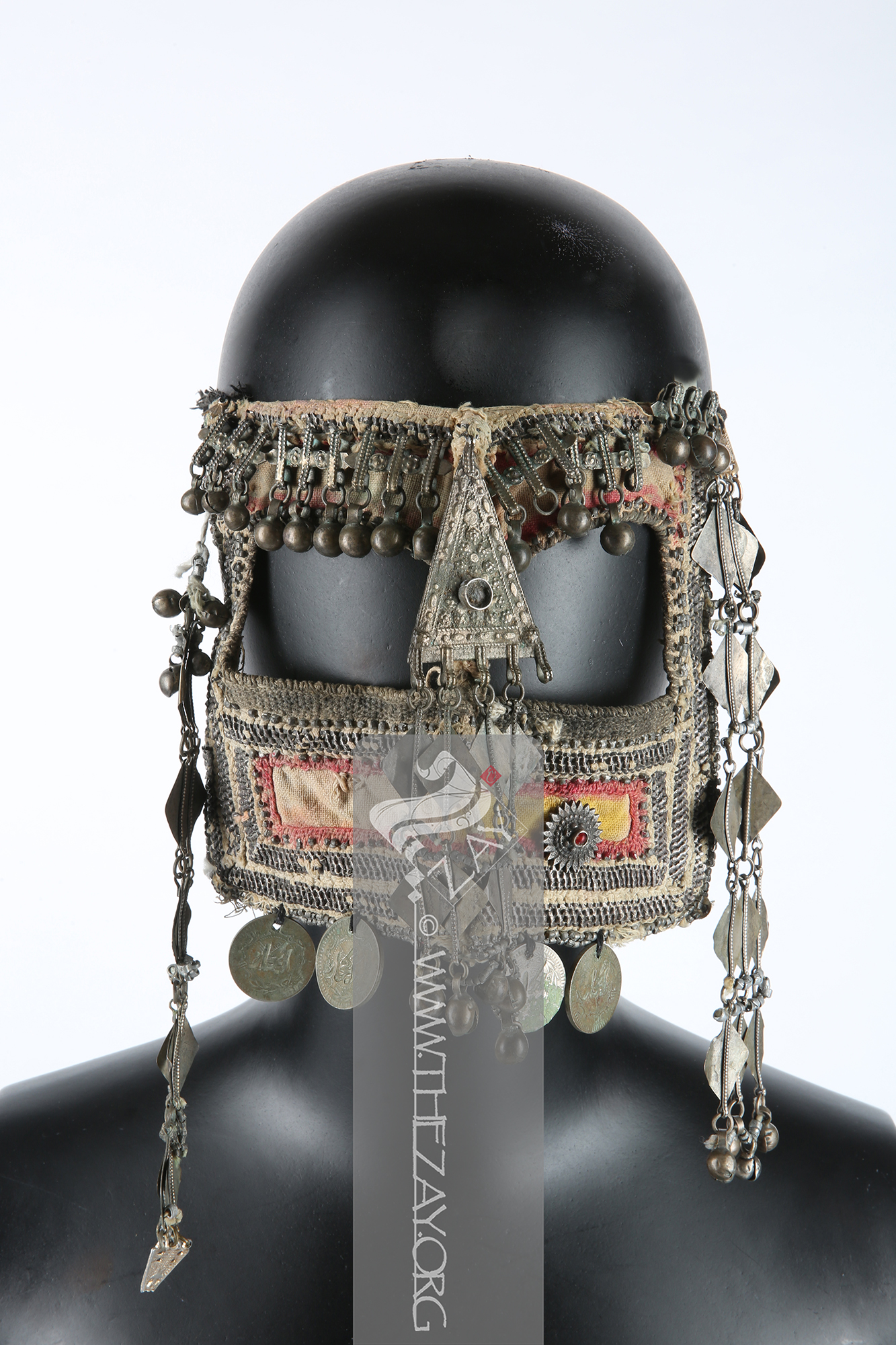
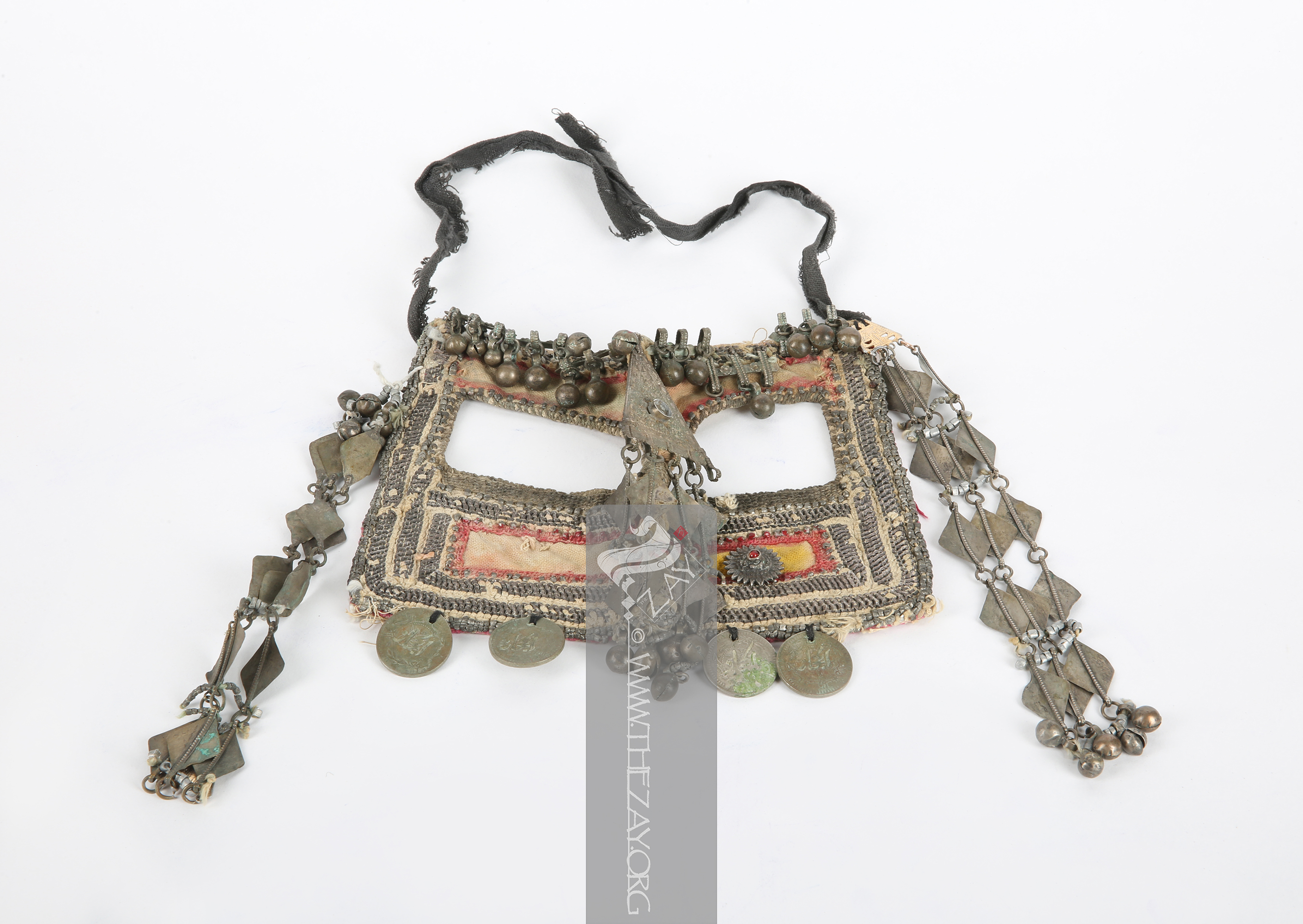
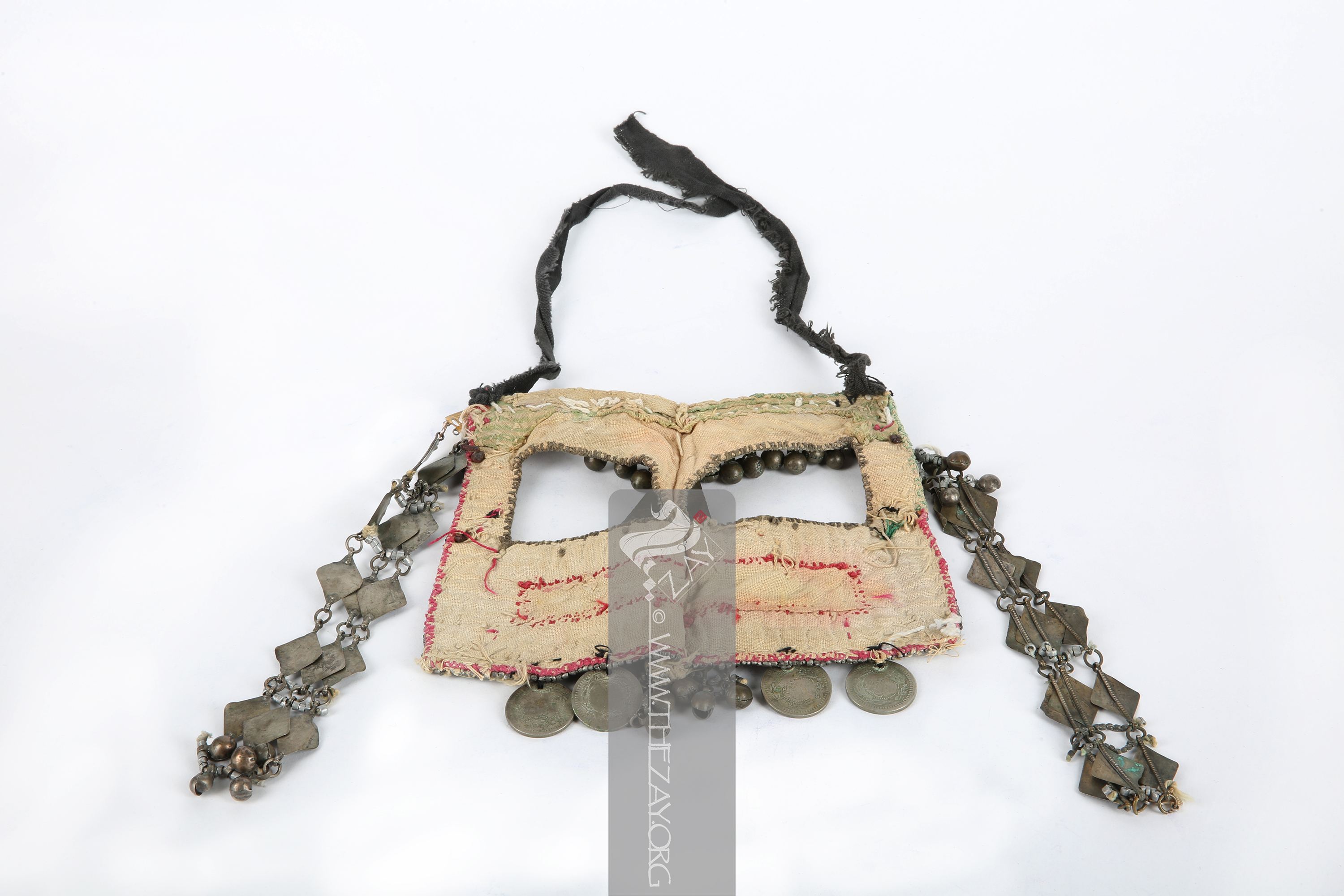
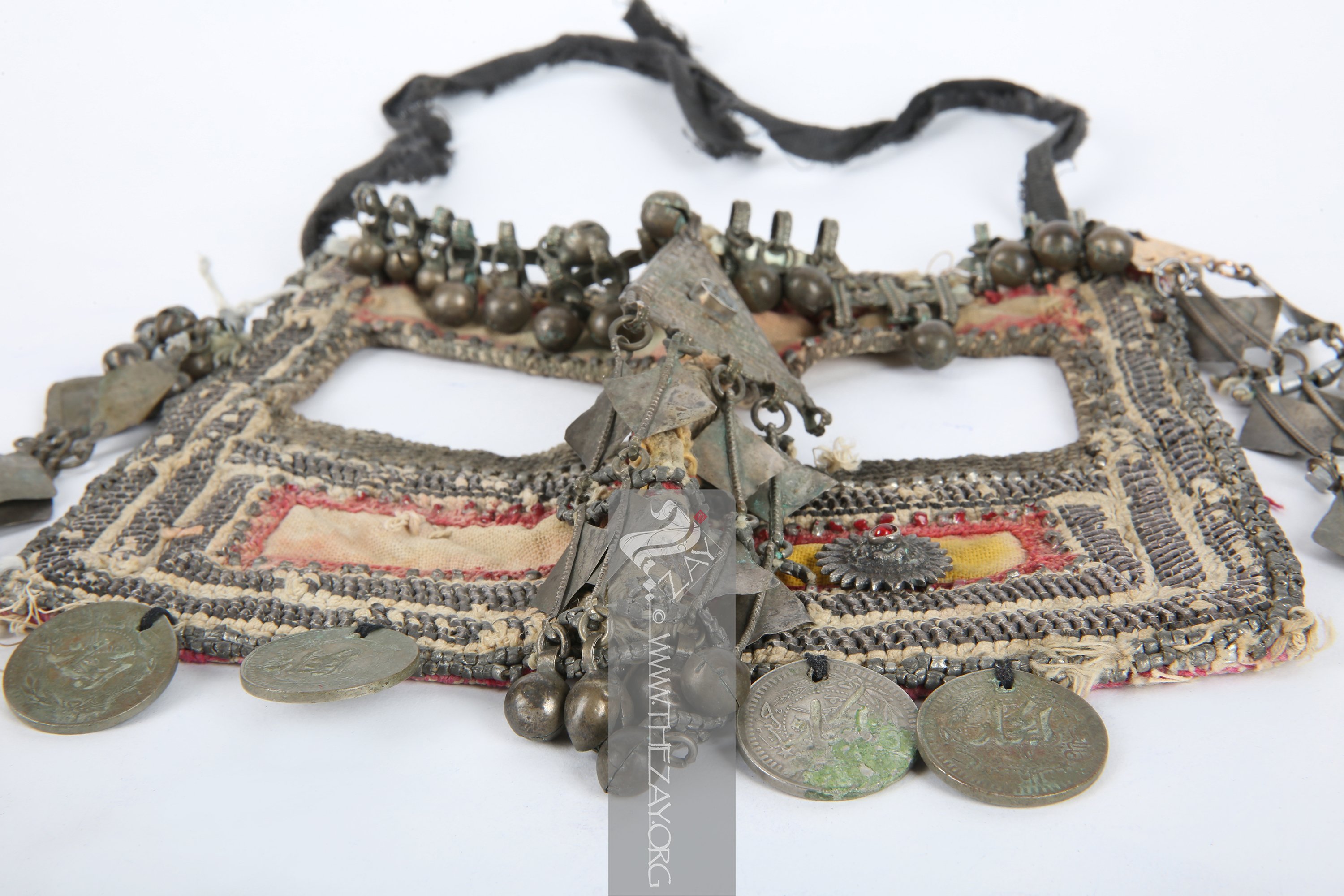
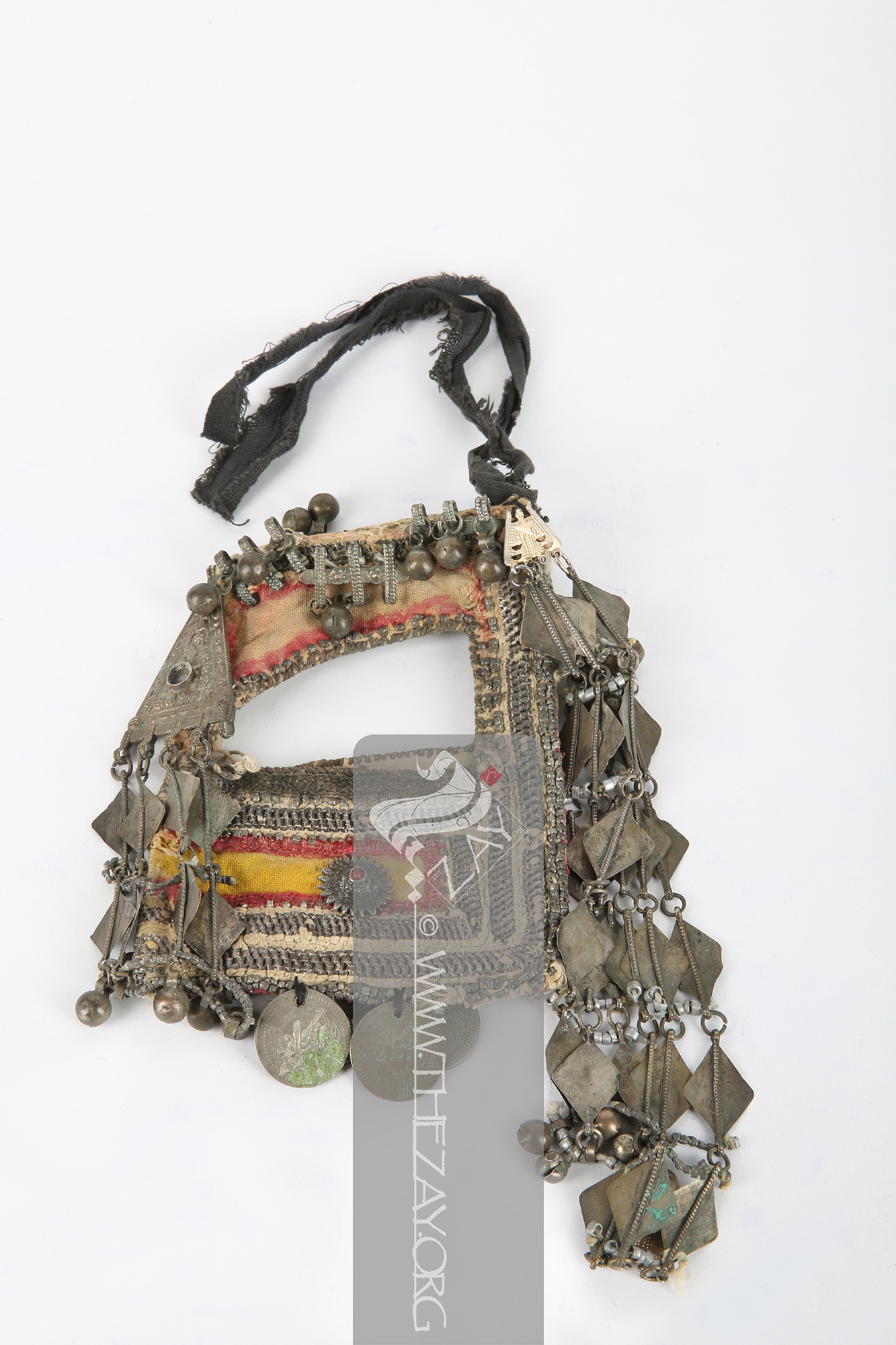
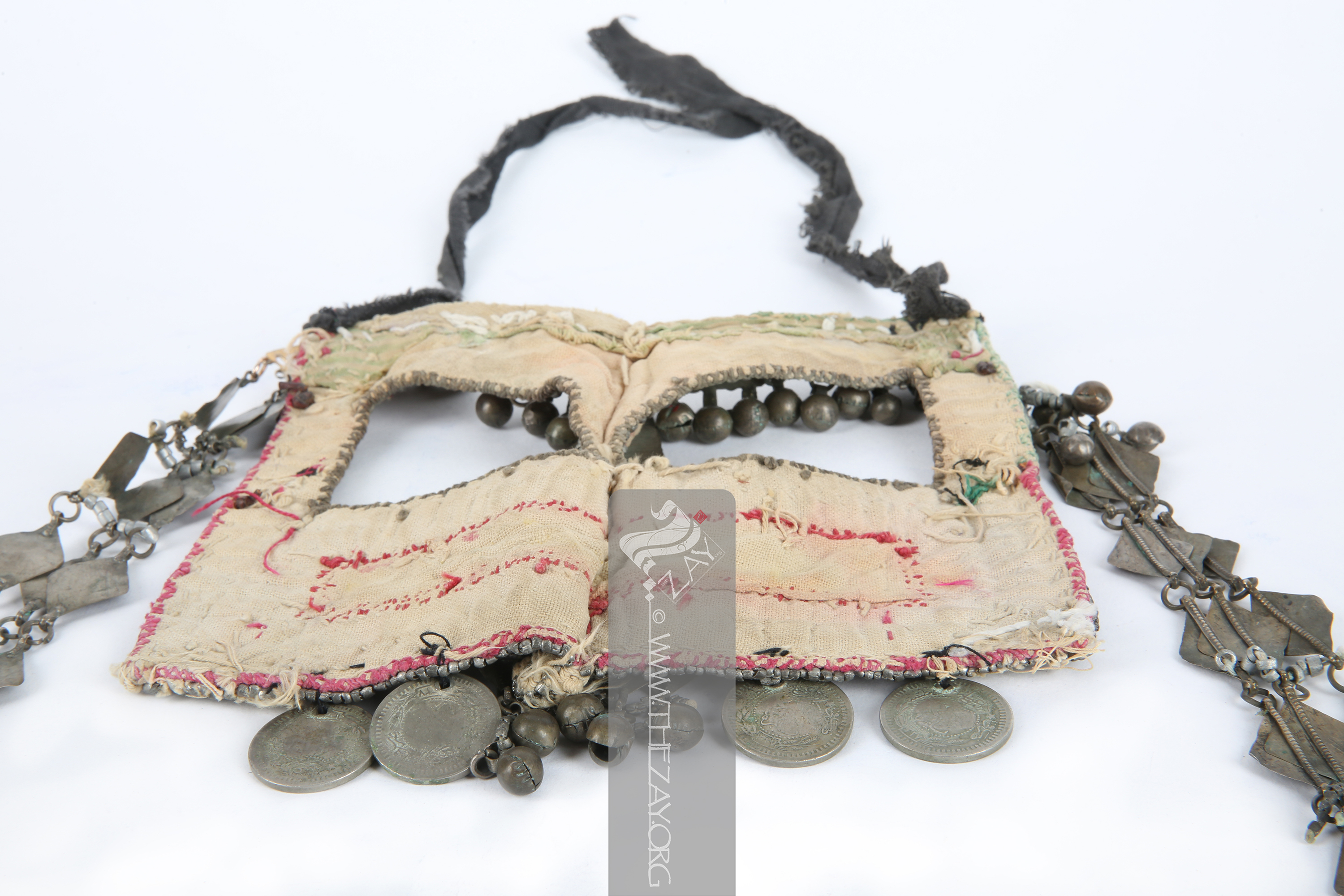
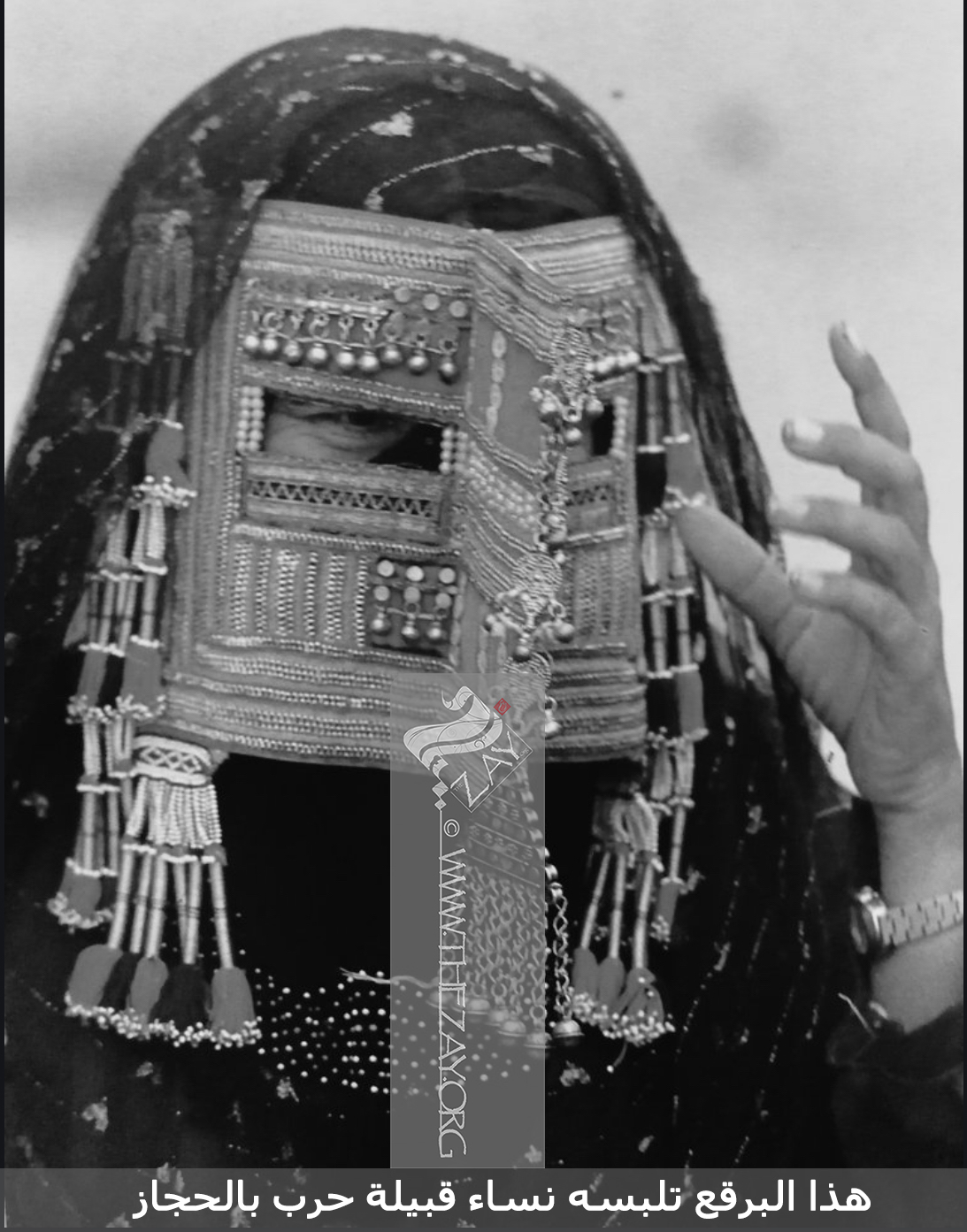
This is a Bedouin woman’s face mask (burgu Burgu’: (Arabic: burqa’: mask, pl. barāqi’), a generic name given to one of many forms of face veils or masks, known as (niqāb). Stiffer versions made of indigo Indigo: (Latin: Indigo – India, synonym: nil Nīl: (Latin: indigo), Arabised term for Indigo, a natural dye belonging to the ‘Indigofera Tinctoria’ species of plants that have been cultivated in East Asia, Egypt, India, and Peru since antiquity. According to Pliny the Elder, it was named after India as it was the source of the dye.), a natural dye belonging to the ‘Indigofera Tinctoria’ species of plants that has been cultivated in East Asia, Egypt, India, and Peru since antiquity. According to Pliny the Elder, it was named after India as it was the source of the dye. -dyed cotton, are known as (batūlah) in Oman and Qatar. The (qāf) turns to (ga) in many Arab dialects.’) from the Hejaz region of Saudi Arabia. Constructed of plain, thick ivory cotton fabric, the burqa is rectangular in shape.
Covering the entire face of the wearer from forehead to chin, the piece features two wide, almond-shaped slits with a vertical stitch down the centre, creating a stiff ridge. A black cotton ribbon is attached to the two top corners of the burgu Burgu’: (Arabic: burqa’: mask, pl. barāqi’), a generic name given to one of many forms of face veils or masks, known as (niqāb). Stiffer versions made of indigo Indigo: (Latin: Indigo – India, synonym: nil Nīl: (Latin: indigo), Arabised term for Indigo, a natural dye belonging to the ‘Indigofera Tinctoria’ species of plants that have been cultivated in East Asia, Egypt, India, and Peru since antiquity. According to Pliny the Elder, it was named after India as it was the source of the dye.), a natural dye belonging to the ‘Indigofera Tinctoria’ species of plants that has been cultivated in East Asia, Egypt, India, and Peru since antiquity. According to Pliny the Elder, it was named after India as it was the source of the dye. -dyed cotton, are known as (batūlah) in Oman and Qatar. The (qāf) turns to (ga) in many Arab dialects.’ for fastening.
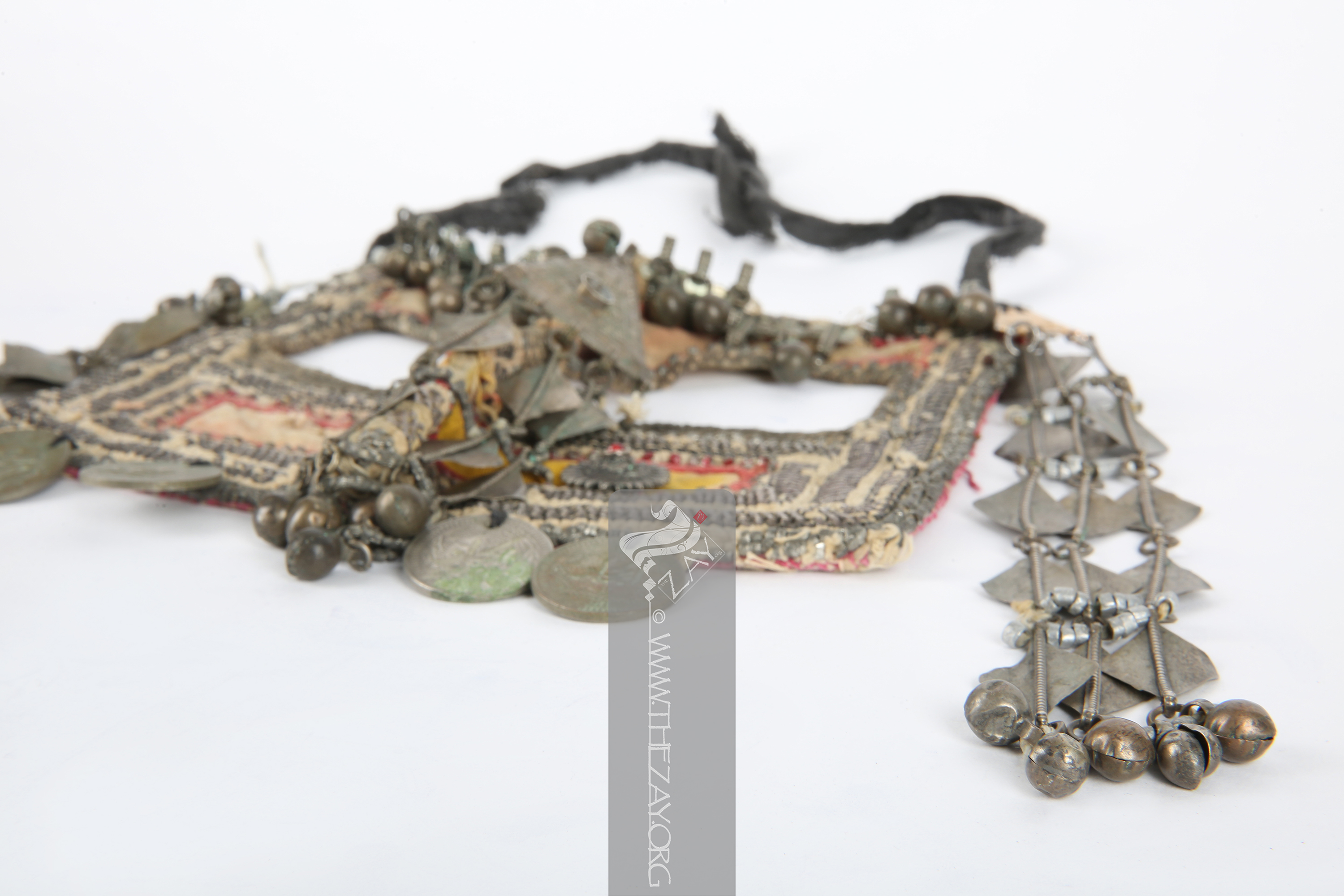
The piece is adorned with a variety of metal ornaments. The upper edge is adorned with a series of rectangular metal strips, possibly silver, each terminating in a small, dangling round bell.
Affixed to the upper corners of the mask are tassels featuring diamond-shaped metal pieces. At the centre of the mask, a vertical line extends along the ridge of the nose, from which a triangular metal pendant is suspended.
This pendant is accompanied by four strings of diamond-shaped metal pendants, each terminating in small, dangling round bells. A fifth string, once attached, appears to have been lost.
Silver (talli
Tallī: (Turkish: tel – wire, string), Gulf Arab – a woven braided trimming made with metal wire, threads and ribbons often sewn on detachable panels used as embellishments. Other – (Synonym: tulle_bi_talli
Tūlle_bi_tallī: (French: Tulle – a city in France where fine material for veil was first made; Turkish: tel – wire; Synonym: tariq; talli; badla; khus_dozi ), series of small metal knots made on a woven net ground as embellishment. The term is commonly used in the North African Arab region specifically in Egypt. Tallī: (Turkish: tel – wire, string), Gulf Arab – a woven braided trimming made with metal wire, threads and ribbons often sewn on detachable panels used as embellishments. Other – (Synonym: tulle_bi_talli
Tūlle_bi_tallī: (French: Tulle – a city in France where fine material for veil was first made; Turkish: tel – wire; Synonym: tariq; talli; badla; khus_dozi ), series of small metal knots made on a woven net ground as embellishment. The term is commonly used in the North African Arab region specifically in Egypt.
Suspended from the lower edge of the burgu Burgu’: (Arabic: burqa’: mask, pl. barāqi’), a generic name given to one of many forms of face veils or masks, known as (niqāb). Stiffer versions made of indigo Indigo: (Latin: Indigo – India, synonym: nil Nīl: (Latin: indigo), Arabised term for Indigo, a natural dye belonging to the ‘Indigofera Tinctoria’ species of plants that have been cultivated in East Asia, Egypt, India, and Peru since antiquity. According to Pliny the Elder, it was named after India as it was the source of the dye.), a natural dye belonging to the ‘Indigofera Tinctoria’ species of plants that has been cultivated in East Asia, Egypt, India, and Peru since antiquity. According to Pliny the Elder, it was named after India as it was the source of the dye. -dyed cotton, are known as (batūlah) in Oman and Qatar. The (qāf) turns to (ga) in many Arab dialects.’ are four silver coins, possibly old Saudi riyals, bearing the Hijri date of 1327, corresponding to the year 1909 in the Gregorian calendar.
The piece is entirely hand-stitched and hand-embroidered. Given that the burgu Burgu’: (Arabic: burqa’: mask, pl. barāqi’), a generic name given to one of many forms of face veils or masks, known as (niqāb). Stiffer versions made of indigo Indigo: (Latin: Indigo – India, synonym: nil Nīl: (Latin: indigo), Arabised term for Indigo, a natural dye belonging to the ‘Indigofera Tinctoria’ species of plants that have been cultivated in East Asia, Egypt, India, and Peru since antiquity. According to Pliny the Elder, it was named after India as it was the source of the dye.), a natural dye belonging to the ‘Indigofera Tinctoria’ species of plants that has been cultivated in East Asia, Egypt, India, and Peru since antiquity. According to Pliny the Elder, it was named after India as it was the source of the dye. -dyed cotton, are known as (batūlah) in Oman and Qatar. The (qāf) turns to (ga) in many Arab dialects.’ often signified the tribe and social status of the wearer, the craftsmanship and detailing of this example suggest that it likely belonged to someone from an affluent family.
Links