

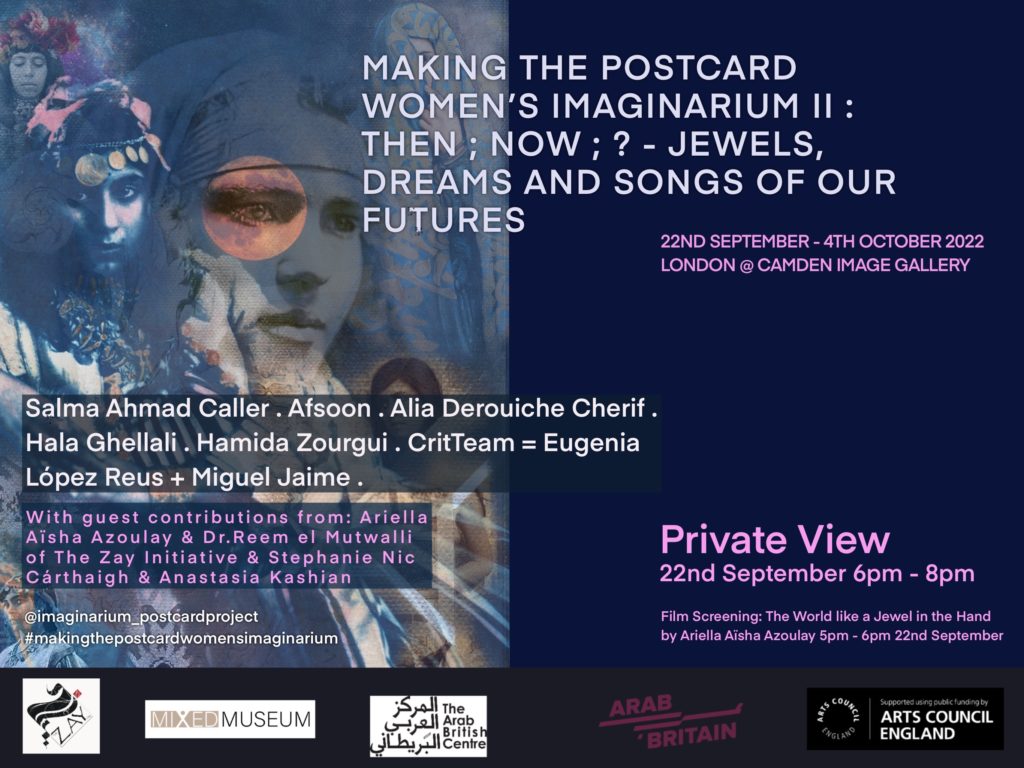
DATE: 22nd September – 4th October 2022
LOCATION: CAMDEN IMAGE GALLERY – LONDON
CURATOR: Salma Ahmad Caller, Founder of the Imaginarium ABOUT THE EXHIBITION: Making The Postcard Women’s Imaginarium is a project created and founded by Egyptian British artist, art historian, and writer Salma Ahmad Caller, in 2018, to decolonise the representations of women from the Middle East and North Africa on colonial postcards from the late 19th century to the mid 20th century. The Imaginarium postcard project was created as a place for artists, academics, writers, and researchers to personally engage with the Postcard Women and their potential ways of being, and to meditate upon different histories and geographies, to become intercessors on behalf of the Postcard Women, rewriting histories and incorporating new perspectives and visions and reclaiming cultural riches and richness's.
THE ZAY
Zay: (Arabic: costume, Pl. azyaā’), a set of clothes in a style typical of a particular country or historical period. INITIATIVE AND IMAGINARIUM: The Zay
Zay: (Arabic: costume, Pl. azyaā’), a set of clothes in a style typical of a particular country or historical period. Initiative is delighted to have been invited to be a guest exhibitor at the Exhibition with ‘Our Narrative – a Trilogy through Dress’. A beautiful series of portraits of Dr. Reem El Mutwalli, her daughter Mae Noaf and her mother Buthaina, each wearing the Iraqi overgarment called ‘hashmi
Hashmī: (Arabic: Hashim (House of) – an Arab royal family from the Banu Hashim clan of the Quraysh tribe), a type of elaborately decorated women’s traditional garment or thawb
Thawb: (Arabic: thawb, Pl. Athwāb/thībān), can be pronounced thobe
Thobe: (Arabic: thawb, Pl. Athwāb/thībān), can be pronounced thawb or tobe
Tobe: (Arabic: thawb, Pl. Athwāb/thībān), can be pronounced thawb or thobe based on locale. The standard Arabic word for ‘fabric’ or ‘garment’. It can refer to a qamīs-like tunic worn by men and women in the Arabian Peninsula, Iraq, the southern and south-western ports and islands of Iran, and some countries in East and West Africa. More specifically, it can refer to the square-shaped Bedouin overgarment worn by women. based on locale. The standard Arabic word for ‘fabric’ or ‘garment’. It can also refer to a qamīs-like tunic worn by men and women in the Arabian Peninsula, Iraq, the southern and south-western ports and islands of Iran, and some countries in East and West Africa. More specifically, it can refer to the square-shaped Bedouin overgarment worn by women. or tobe
Tobe: (Arabic: thawb, Pl. Athwāb/thībān), can be pronounced thawb or thobe based on locale. The standard Arabic word for ‘fabric’ or ‘garment’. It can refer to a qamīs-like tunic worn by men and women in the Arabian Peninsula, Iraq, the southern and south-western ports and islands of Iran, and some countries in East and West Africa. More specifically, it can refer to the square-shaped Bedouin overgarment worn by women. based on locale. The standard Arabic word for ‘fabric’ or ‘garment’. It can also refer to a qamīs-like tunic worn by men and women in the Arabian Peninsula, Iraq, the southern and south-western ports and islands of Iran, and some countries in East and West Africa. More specifically, it can refer to the square-shaped Bedouin overgarment worn by women in the Arabian Gulf region. from Iraq that was named after the royal family that ruled Iraq until the mid 20th century.
Capturing their journeys and the complexities of having mixed cultural identities, to illustrate The Zay Zay: (Arabic: costume, Pl. azyaā’), a set of clothes in a style typical of a particular country or historical period. Initiative’s role in collecting Arab dress, adornment, their histories, and living narratives.
The Zay Zay: (Arabic: costume, Pl. azyaā’), a set of clothes in a style typical of a particular country or historical period. Initiative’s database where accurate information and vital stories of heritage can be found, is her way of taking back control of how Arab dress is seen and understood in a rapidly changing world.