Object NoteThis article was donated together with a few more under garments; a similar (
sarwal
Ṣarwāl: (Farsi: shalvār; Synonym: salwar, shirwāl), trousers featuring tapering ankles and drawstring closure of Central Asian origin. They disseminated in the Indian subcontinent between c.1st-3rd century BCE. Although exact period of its arrival in the Arab world is disputed their widespread adoption is confirmed from the 12th century.
) (
ZI2021.500977.3 UAE), two slips (
shalhah
Shalḥah: (Arabic), slip. ) (ZI2021.500977.1 UAE) & (ZI2021.500977.1a UAE), and prayer foot wrap (
kis_salah
Kīs_salāh: (Arabic, kīs: bag, salāh: prayer), in the UAE this refers to a pair of foot size cloth pouches with basic draw strings worn on the feet at prayers to cover them as an added sign of piety.) (ZI2021.500977.1b UAE).
Fakhria Lutfi, born in Dubai in 1962, holds a bachelor's in graphic design from The American University DC. She was married at the age of 25 and boar 3 children - 2 boys and 1 girl. She declared that this piece of clothing was bequeathed to her (
mkhalaf_’alayiha
Mkhalaf_’alayīha: (Arabic: khalafah, ’alayīha: to her) meaning 'left behind', 'inherited'.) by her mother, who stitched it herself in the 1940s, and was known to do so for her friends as well. Fakhria’s mother Fatmah Mohammad Amin Abdul Ghafar was married at the age of 13 or 14, and almost every 2 years she had a child where Fakhria is the youngest of 12 siblings.
Object History Due to the prevailing notions of modesty in Arab cultures, this is one of the rarest undergarments in the UAE. objects like this rarely come to market because of their age, their high value due to the type of adornment, and last but not least, because they are undergarments (
sarwal
Ṣarwāl: (Farsi: shalvār; Synonym: salwar, shirwāl), trousers featuring tapering ankles and drawstring closure of Central Asian origin. They disseminated in the Indian subcontinent between c.1st-3rd century BCE. Although exact period of its arrival in the Arab world is disputed their widespread adoption is confirmed from the 12th century.
).
Generally, women felt reserved (
hishim
ḥishim: (Arabic: ḥishmah), the act of being reserved.) over letting go of such an intimate article of dress for they hardly comprehended the documentary value of placing their items within a historical collection, they were encouraged to sell their items to The
Zay
Zay: (Arabic: costume, Pl. azyaā’), a set of clothes in a style typical of a particular country or historical period. Collection following the suggestion that they use the proceeds as (
sadaqah
Ṣadaqah: (Arabic: charitable act), also can refer to the book: Sadaqah, published by Dr. Reem Tariq
Ṭariq: (Arabic; Synonym: tulle_bi_talli
Tūlle_bi_tallī: (French: Tulle – a city in France where fine material for veil was first made; Turkish: tel – wire; Synonym: tariq; talli; badla; khus_dozi ), series of small metal knots made on a woven net ground as embellishment. The term is commonly used in the North African Arab region specifically in Egypt.
; talli; badla; khus_dozi ), series of small metal knots made on a woven net ground as embellishment. The term is commonly used in the Levant Arab region specifically in Lebanon.
el Mutwalli 2012, (https://thezay.org/shop/sadaqah/).), to help build a mosque or school. Their reserve was multi-layered; it being an undergarment an intimate article of dress. In addition, the act of selling can infer financial need, and even after they were convinced to do so for the sake of charity, they followed the tradition that dictates one does not publicly declare good deeds.
In this case, we have the reverse - Fakhria is an educated woman who fully understood the value of the work carried by The
Zay
Zay: (Arabic: costume, Pl. azyaā’), a set of clothes in a style typical of a particular country or historical period. Initiative, thus her donation of intimate clothing adds great value to the collection by shedding light on articles of dress that are not generally handed down from one generation to the other.
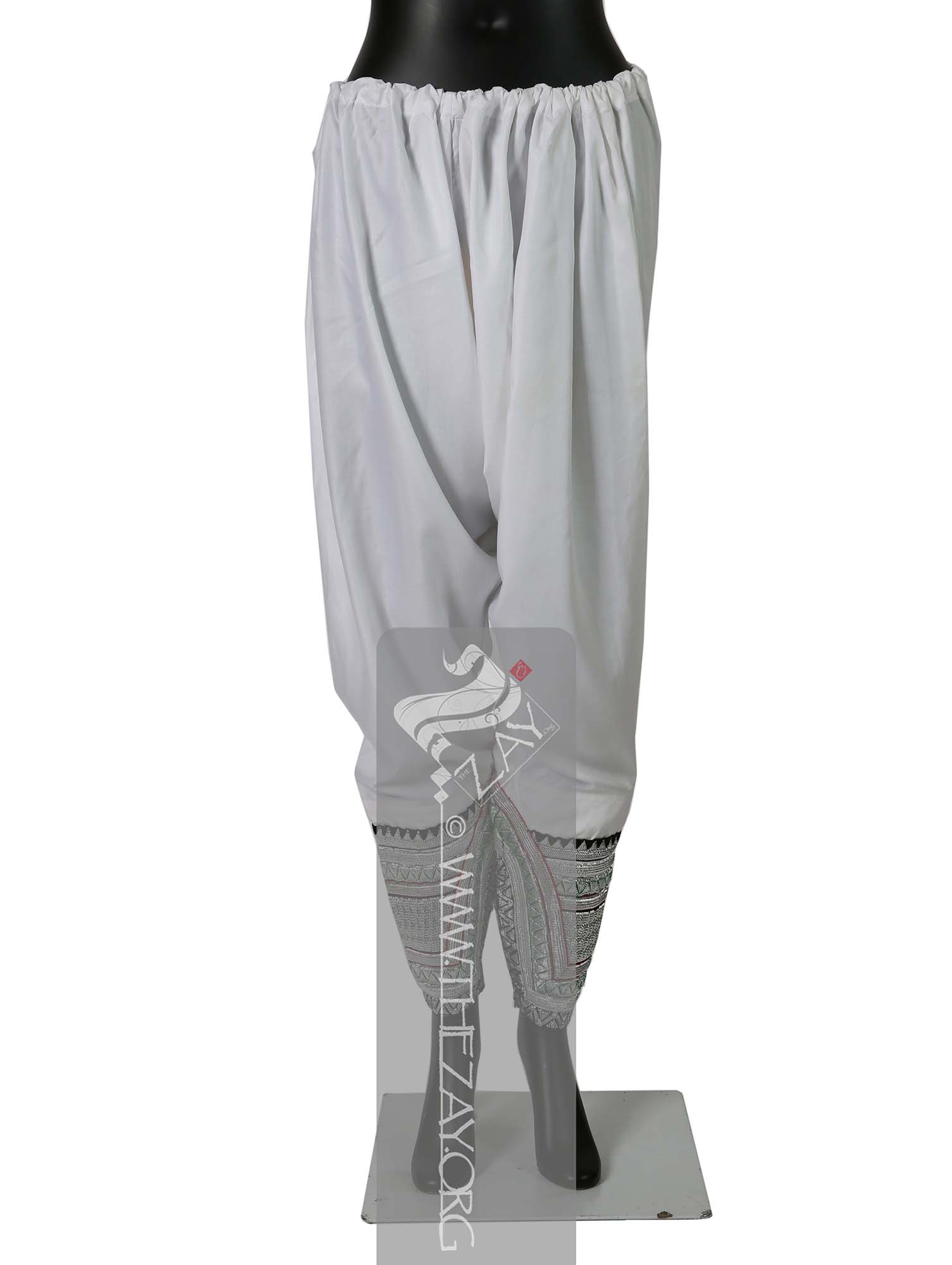
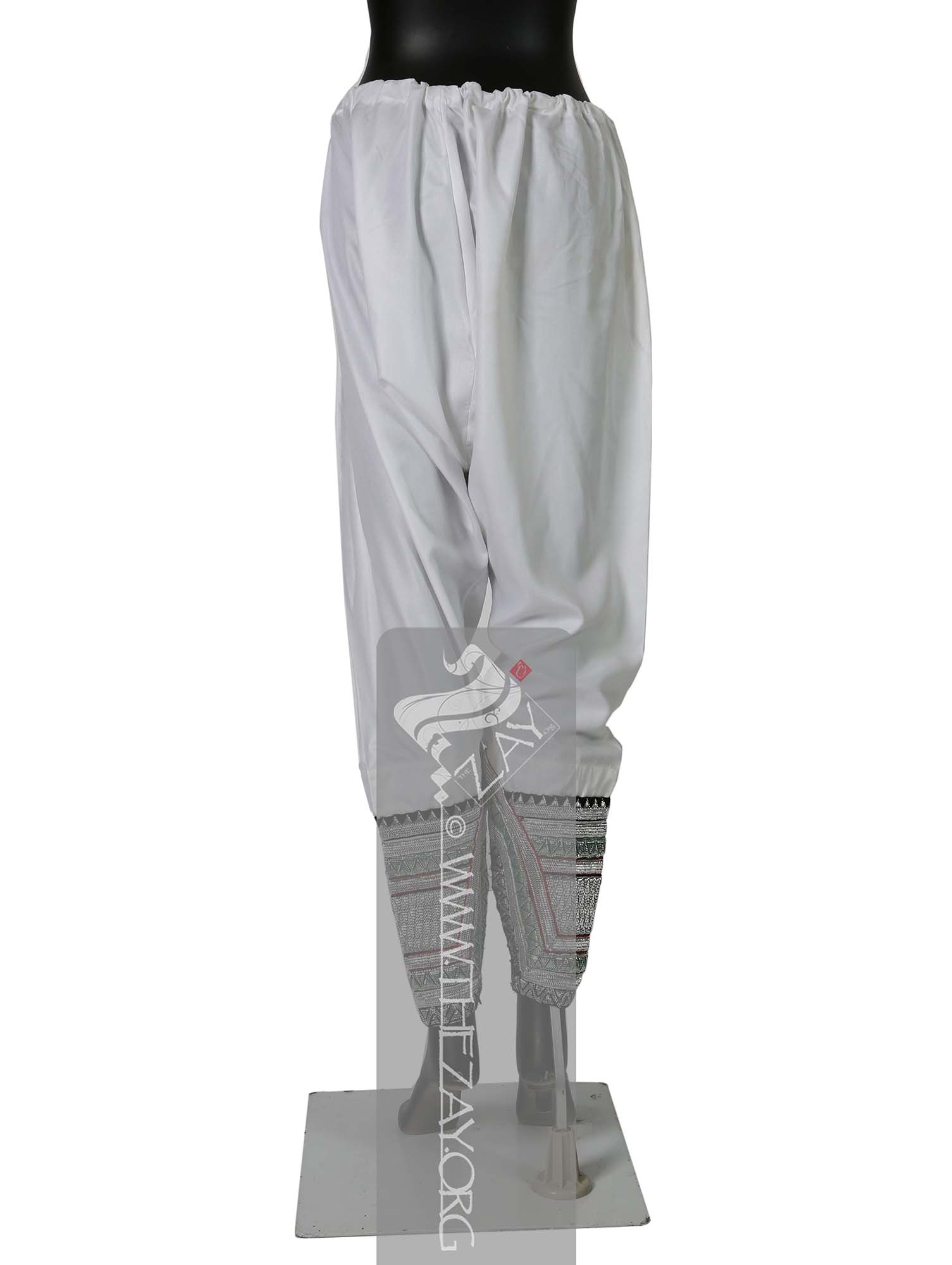
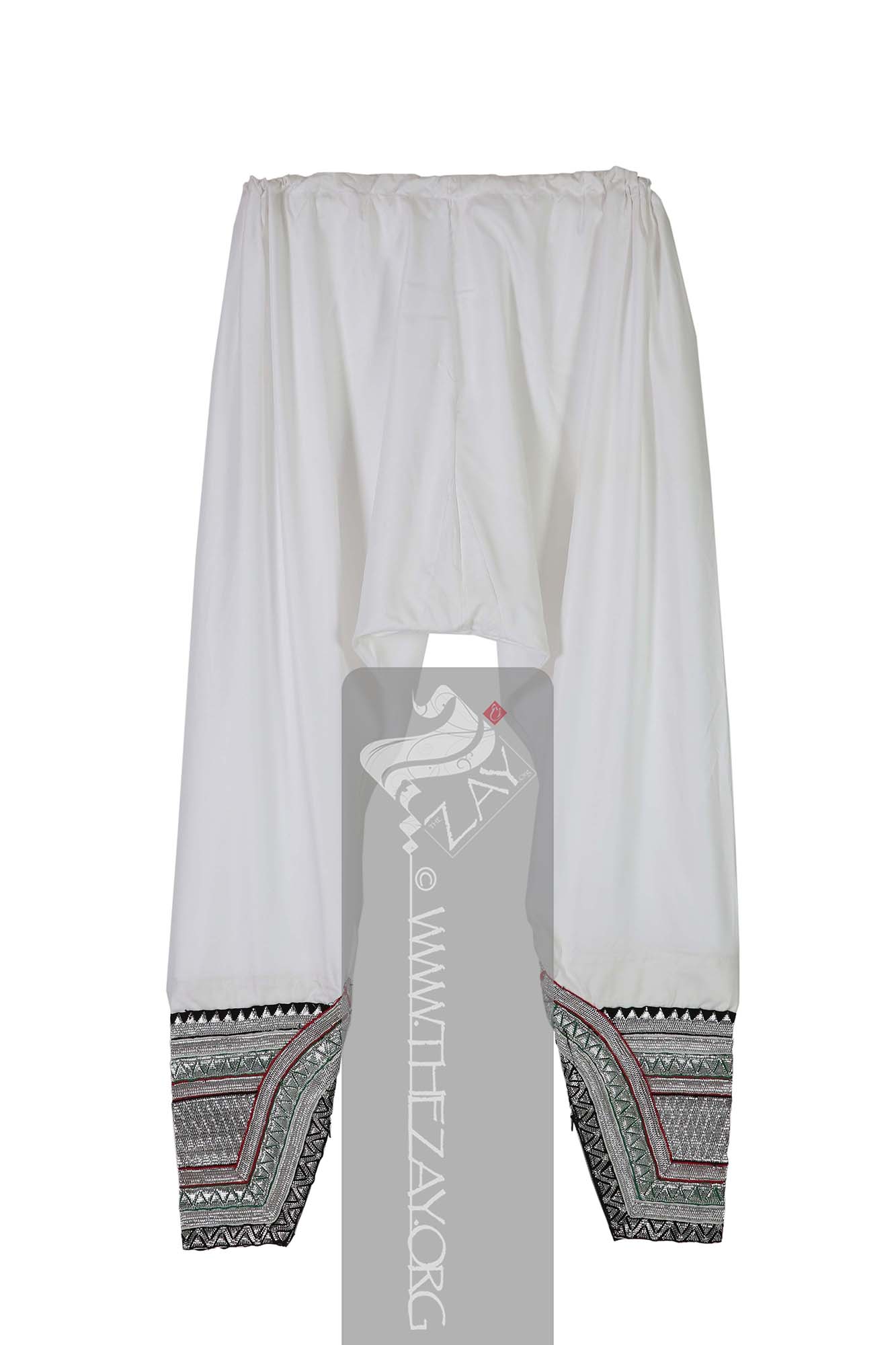
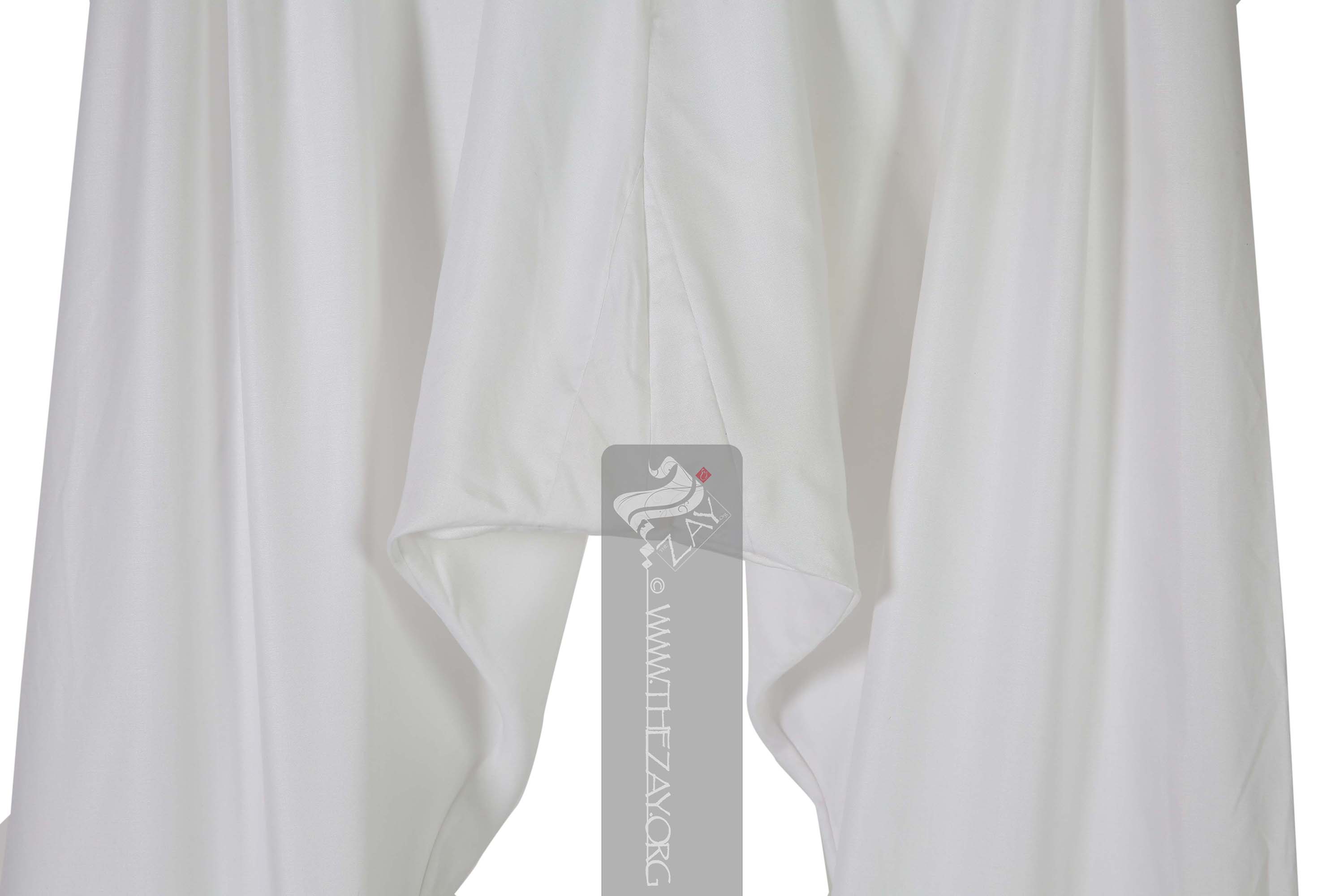
Object Features These underpants (
sarwal
Ṣarwāl: (Farsi: shalvār; Synonym: salwar, shirwāl), trousers featuring tapering ankles and drawstring closure of Central Asian origin. They disseminated in the Indian subcontinent between c.1st-3rd century BCE. Although exact period of its arrival in the Arab world is disputed their widespread adoption is confirmed from the 12th century.
) are made of white calico cotton, which was the norm before oil wealth transformed the Gulf region. Customarily, if more than one fabric was used, the visible lower part of the pants was made from the more expensive material. The hidden top part was generally made from cotton or either lower grade or leftover silk remnants. Cotton was normally the preferred choice as it was more functional. It breathes better and is more durable than silk; especially important for a garment that is in constant contact with the body.
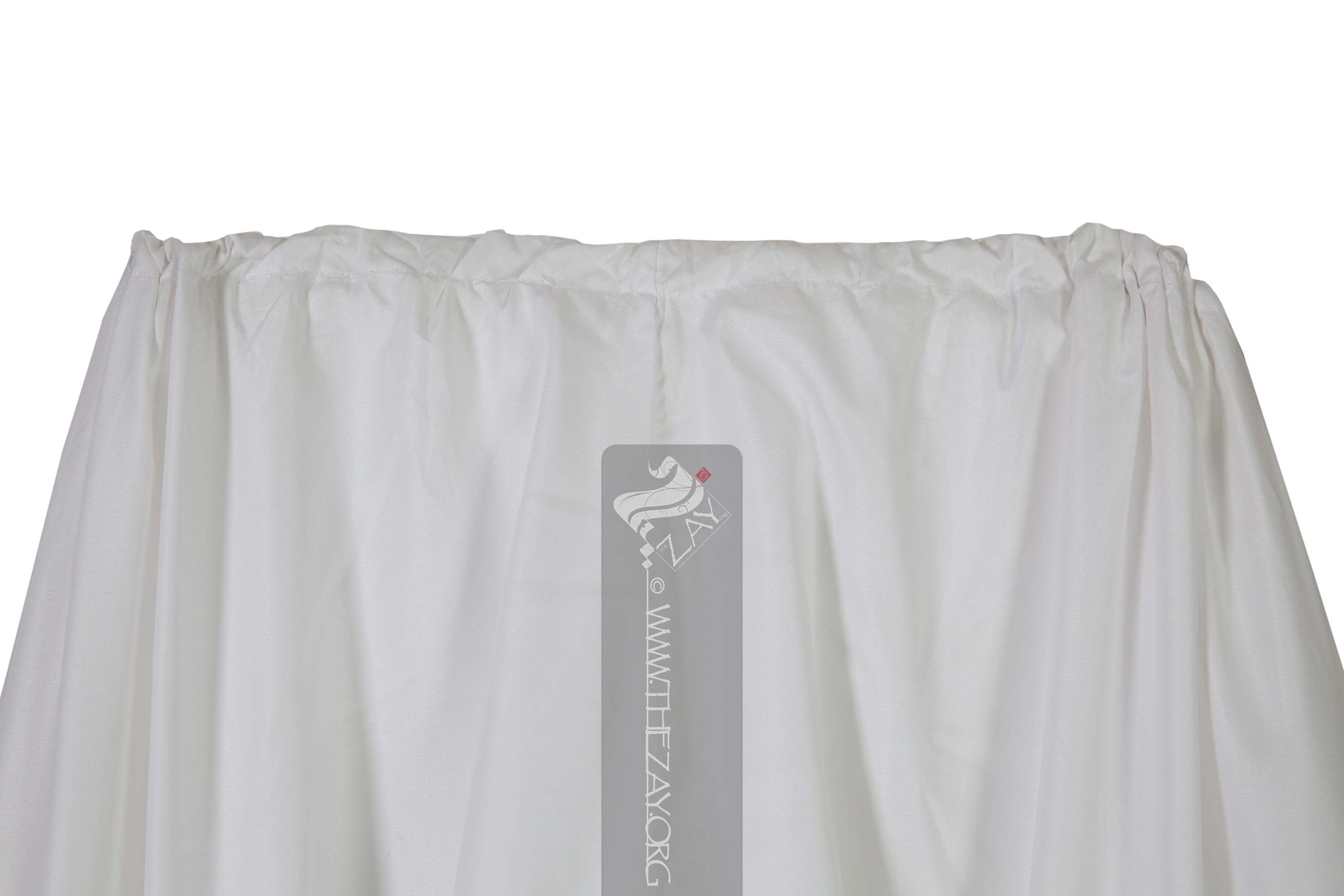
The baggy waistline is gathered and fixed in place with a hidden elasticated cord rather than the traditional cotton (
nsai’ah
Nsai’ah: (Arabic: diminutive of nis’ah: belt). A woven cotton or wool spun flat cord, used to gather and fasten underpants on to the waist. Also used to denote any chevron motif.). The garment is opened and closed with the aid of a zipper versus earlier versions that used traditional cotton thread ball buttons (igam) or metal snap studs (
siq_w_biq
Siq_w_biq: (Colloquial Arabic), metallic snap studs used to fasten clothing. The term in an onomatopoeia representing the sound that the snaps make when opening and snapping shut.), which suggests that the cuffs have been up-cycled from an older garment.
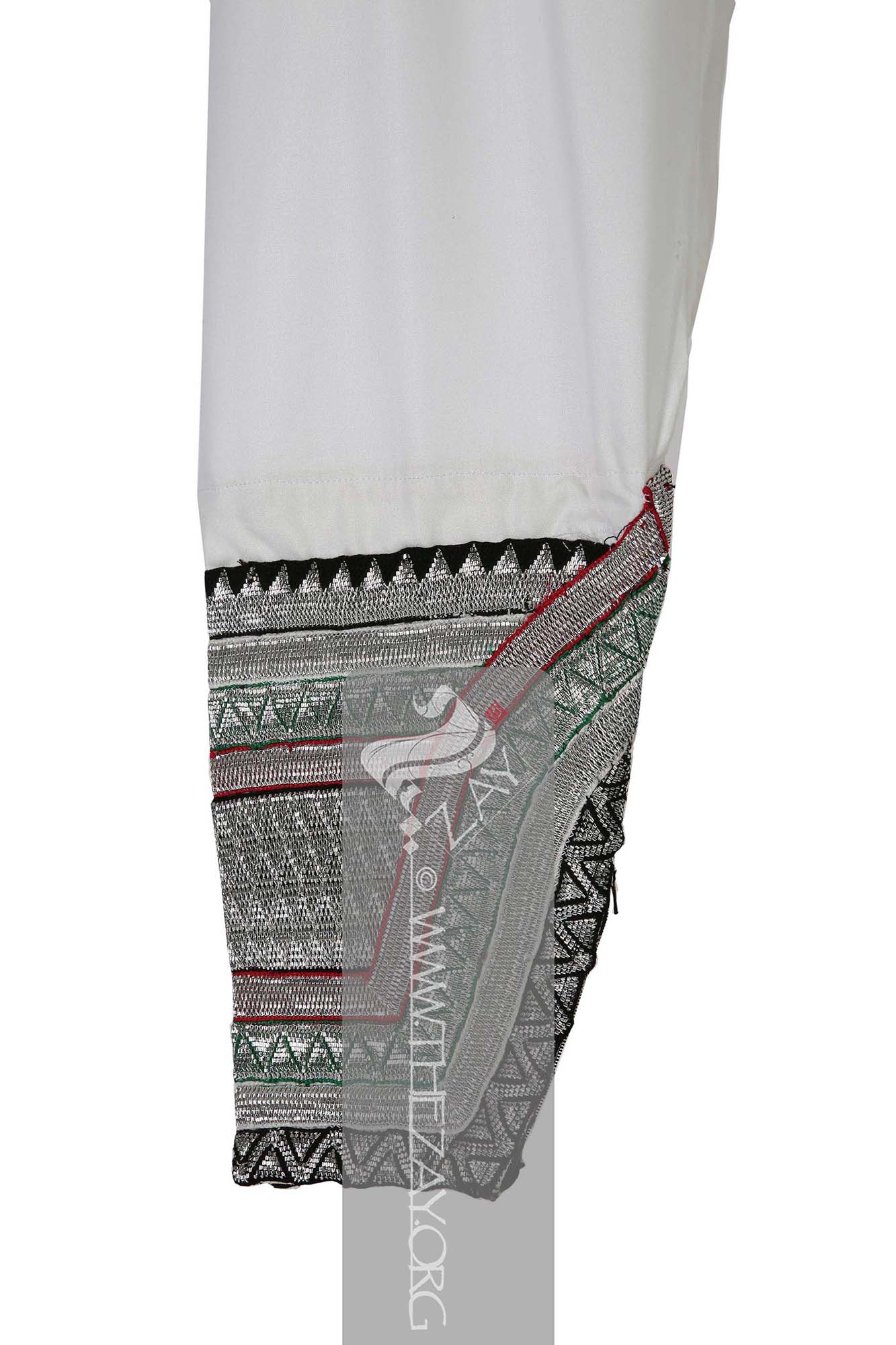
The decorative cuff (
badlah
Bādlah: (Hindustani: badal – cloud from Sanskirt: vārdala – water; Synonym: tariq; talli
Tallī: (Turkish: tel – wire, string), Gulf Arab – a woven braided trimming made with metal wire, threads and ribbons often sewn on detachable panels used as embellishments. Other – (Synonym: tulle_bi_talli
Tūlle_bi_tallī: (French: Tulle – a city in France where fine material for veil was first made; Turkish: tel – wire; Synonym: tariq; talli; badla; khus_dozi ), series of small metal knots made on a woven net ground as embellishment. The term is commonly used in the North African Arab region specifically in Egypt.
; tariq; badla; khus_dozi), series of small metal knots made on a woven net ground as embellishment.
; tulle_bi_talli
Tūlle_bi_tallī: (French: Tulle – a city in France where fine material for veil was first made; Turkish: tel – wire; Synonym: tariq; talli; badla; khus_dozi ), series of small metal knots made on a woven net ground as embellishment. The term is commonly used in the North African Arab region specifically in Egypt.
; khus_dozi
Khus_dozi: (Persian: Khvosh – an Iranian province; dozi – needlework; Synonym: tariq; talli
Tallī: (Turkish: tel – wire, string), Gulf Arab – a woven braided trimming made with metal wire, threads and ribbons often sewn on detachable panels used as embellishments. Other – (Synonym: tulle_bi_talli
Tūlle_bi_tallī: (French: Tulle – a city in France where fine material for veil was first made; Turkish: tel – wire; Synonym: tariq; talli; badla; khus_dozi ), series of small metal knots made on a woven net ground as embellishment. The term is commonly used in the North African Arab region specifically in Egypt.
; tariq; badla; khus_dozi), series of small metal knots made on a woven net ground as embellishment.
; tulle_bi_talli
Tūlle_bi_tallī: (French: Tulle – a city in France where fine material for veil was first made; Turkish: tel – wire; Synonym: tariq; talli; badla; khus_dozi ), series of small metal knots made on a woven net ground as embellishment. The term is commonly used in the North African Arab region specifically in Egypt.
; badla), series of small metal knots made on a woven net ground as embellishment. The term is commonly used in Iran and parts of the Arabian Peninsula possibly because Khvosh was one of the centres for the craft.
), series of small metal knots made on a woven net ground as embellishment. The term is commonly used in India and parts of the subcontinent.
) is of a basic traditional form typical of this period. The
talli
Tallī: (Turkish: tel – wire, string), Gulf Arab – a woven braided trimming made with metal wire, threads and ribbons often sewn on detachable panels used as embellishments. Other – (Synonym: tulle_bi_talli
Tūlle_bi_tallī: (French: Tulle – a city in France where fine material for veil was first made; Turkish: tel – wire; Synonym: tariq; talli; badla; khus_dozi ), series of small metal knots made on a woven net ground as embellishment. The term is commonly used in the North African Arab region specifically in Egypt.
; tariq; badla; khus_dozi), series of small metal knots made on a woven net ground as embellishment.
adornment is completed in silver colour metallic tinsel straw (
khus
Khūṣ: (Arabic: straw, sing. khūṣah), flat silver or metallic flat straw used in embroidery or tallī making.).
The
badlah
Bādlah: (Hindustani: badal – cloud from Sanskirt: vārdala – water; Synonym: tariq; talli
Tallī: (Turkish: tel – wire, string), Gulf Arab – a woven braided trimming made with metal wire, threads and ribbons often sewn on detachable panels used as embellishments. Other – (Synonym: tulle_bi_talli
Tūlle_bi_tallī: (French: Tulle – a city in France where fine material for veil was first made; Turkish: tel – wire; Synonym: tariq; talli; badla; khus_dozi ), series of small metal knots made on a woven net ground as embellishment. The term is commonly used in the North African Arab region specifically in Egypt.
; tariq; badla; khus_dozi), series of small metal knots made on a woven net ground as embellishment.
; tulle_bi_talli
Tūlle_bi_tallī: (French: Tulle – a city in France where fine material for veil was first made; Turkish: tel – wire; Synonym: tariq; talli; badla; khus_dozi ), series of small metal knots made on a woven net ground as embellishment. The term is commonly used in the North African Arab region specifically in Egypt.
; khus_dozi
Khus_dozi: (Persian: Khvosh – an Iranian province; dozi – needlework; Synonym: tariq; talli
Tallī: (Turkish: tel – wire, string), Gulf Arab – a woven braided trimming made with metal wire, threads and ribbons often sewn on detachable panels used as embellishments. Other – (Synonym: tulle_bi_talli
Tūlle_bi_tallī: (French: Tulle – a city in France where fine material for veil was first made; Turkish: tel – wire; Synonym: tariq; talli; badla; khus_dozi ), series of small metal knots made on a woven net ground as embellishment. The term is commonly used in the North African Arab region specifically in Egypt.
; tariq; badla; khus_dozi), series of small metal knots made on a woven net ground as embellishment.
; tulle_bi_talli
Tūlle_bi_tallī: (French: Tulle – a city in France where fine material for veil was first made; Turkish: tel – wire; Synonym: tariq; talli; badla; khus_dozi ), series of small metal knots made on a woven net ground as embellishment. The term is commonly used in the North African Arab region specifically in Egypt.
; badla), series of small metal knots made on a woven net ground as embellishment. The term is commonly used in Iran and parts of the Arabian Peninsula possibly because Khvosh was one of the centres for the craft.
), series of small metal knots made on a woven net ground as embellishment. The term is commonly used in India and parts of the subcontinent.
basically consists of the large central part (
bayt
Bayt: (Arabic: house). Colloquially in the UAE it refers to the larger, middle part of the decorative ankle-cuff (bādlah) and can include between one to twenty different braids (talli
Tallī: (Turkish: tel – wire, string), Gulf Arab – a woven braided trimming made with metal wire, threads and ribbons often sewn on detachable panels used as embellishments. Other – (Synonym: tulle_bi_talli
Tūlle_bi_tallī: (French: Tulle – a city in France where fine material for veil was first made; Turkish: tel – wire; Synonym: tariq; talli; badla; khus_dozi ), series of small metal knots made on a woven net ground as embellishment. The term is commonly used in the North African Arab region specifically in Egypt.
; tariq; badla; khus_dozi), series of small metal knots made on a woven net ground as embellishment.
_fatlah
Fātlah: (Arabic: fatala: to twist/twine, pl. fātlāt/ftūl), in the UAE colloquially, it refers to braids in (tallī) work. The braid or strand resembles a running stitch, where the effect is attained by continuously looping metallic thread with silk, cotton, or synthetic thread. ), hand-stitched side by side in different motifs, and hemmed by a few lines forming the rim (trāf).) and the edges (
traf
Ṭrāf: (Arabic: aṭrāf, sing. ṭaraf: edges). Colloquially in the UAE it refers to the part that forms the rim or border on decorative ankle-cuffs (bādlah).) also known as (
bruwi
Bruwī (Arabic; Yabrī: to sculpt, synonyms: talli_shakil
Tallī_shakil: (Arabic: shape), colloquial UAE reference to any pattern used in traditional tallī making. , traf
Ṭrāf: (Arabic: aṭrāf, sing. ṭaraf: edges). Colloquially in the UAE it refers to the part that forms the rim or border on decorative ankle-cuffs (bādlah).), colloquially in the UAE refers to the talli
Tallī: (Turkish: tel – wire, string), Gulf Arab – a woven braided trimming made with metal wire, threads and ribbons often sewn on detachable panels used as embellishments. Other – (Synonym: tulle_bi_talli
Tūlle_bi_tallī: (French: Tulle – a city in France where fine material for veil was first made; Turkish: tel – wire; Synonym: tariq; talli; badla; khus_dozi ), series of small metal knots made on a woven net ground as embellishment. The term is commonly used in the North African Arab region specifically in Egypt.
; tariq; badla; khus_dozi), series of small metal knots made on a woven net ground as embellishment.
band that creates the edge or ending on the cuffs (bādilah) and can come in different designs. ). The
bayt
Bayt: (Arabic: house). Colloquially in the UAE it refers to the larger, middle part of the decorative ankle-cuff (bādlah) and can include between one to twenty different braids (talli
Tallī: (Turkish: tel – wire, string), Gulf Arab – a woven braided trimming made with metal wire, threads and ribbons often sewn on detachable panels used as embellishments. Other – (Synonym: tulle_bi_talli
Tūlle_bi_tallī: (French: Tulle – a city in France where fine material for veil was first made; Turkish: tel – wire; Synonym: tariq; talli; badla; khus_dozi ), series of small metal knots made on a woven net ground as embellishment. The term is commonly used in the North African Arab region specifically in Egypt.
; tariq; badla; khus_dozi), series of small metal knots made on a woven net ground as embellishment.
_fatlah
Fātlah: (Arabic: fatala: to twist/twine, pl. fātlāt/ftūl), in the UAE colloquially, it refers to braids in (tallī) work. The braid or strand resembles a running stitch, where the effect is attained by continuously looping metallic thread with silk, cotton, or synthetic thread. ), hand-stitched side by side in different motifs, and hemmed by a few lines forming the rim (trāf). can be between one and 40 braids of (
ftul
Ftūl: (Arabic: fatala: to twist/twine, sing. Fātlah, pl. fātlāt), in the UAE colloquially, it refers to the braids in (tallī) work. The braid or strand resembles a running stitch, where the effect is attained by continuously looping metallic thread with silk, cotton, or synthetic thread. talli
Tallī: (Turkish: tel – wire, string), Gulf Arab – a woven braided trimming made with metal wire, threads and ribbons often sewn on detachable panels used as embellishments. Other – (Synonym: tulle_bi_talli
Tūlle_bi_tallī: (French: Tulle – a city in France where fine material for veil was first made; Turkish: tel – wire; Synonym: tariq; talli; badla; khus_dozi ), series of small metal knots made on a woven net ground as embellishment. The term is commonly used in the North African Arab region specifically in Egypt.
; tariq; badla; khus_dozi), series of small metal knots made on a woven net ground as embellishment.
) with different decorations, then the braids are sewn manually with each other so that the
bayt
Bayt: (Arabic: house). Colloquially in the UAE it refers to the larger, middle part of the decorative ankle-cuff (bādlah) and can include between one to twenty different braids (talli
Tallī: (Turkish: tel – wire, string), Gulf Arab – a woven braided trimming made with metal wire, threads and ribbons often sewn on detachable panels used as embellishments. Other – (Synonym: tulle_bi_talli
Tūlle_bi_tallī: (French: Tulle – a city in France where fine material for veil was first made; Turkish: tel – wire; Synonym: tariq; talli; badla; khus_dozi ), series of small metal knots made on a woven net ground as embellishment. The term is commonly used in the North African Arab region specifically in Egypt.
; tariq; badla; khus_dozi), series of small metal knots made on a woven net ground as embellishment.
_fatlah
Fātlah: (Arabic: fatala: to twist/twine, pl. fātlāt/ftūl), in the UAE colloquially, it refers to braids in (tallī) work. The braid or strand resembles a running stitch, where the effect is attained by continuously looping metallic thread with silk, cotton, or synthetic thread. ), hand-stitched side by side in different motifs, and hemmed by a few lines forming the rim (trāf). is surrounded by the
traf
Ṭrāf: (Arabic: aṭrāf, sing. ṭaraf: edges). Colloquially in the UAE it refers to the part that forms the rim or border on decorative ankle-cuffs (bādlah). to form its borders.
The traditional basic style of
badlah
Bādlah: (Hindustani: badal – cloud from Sanskirt: vārdala – water; Synonym: tariq; talli
Tallī: (Turkish: tel – wire, string), Gulf Arab – a woven braided trimming made with metal wire, threads and ribbons often sewn on detachable panels used as embellishments. Other – (Synonym: tulle_bi_talli
Tūlle_bi_tallī: (French: Tulle – a city in France where fine material for veil was first made; Turkish: tel – wire; Synonym: tariq; talli; badla; khus_dozi ), series of small metal knots made on a woven net ground as embellishment. The term is commonly used in the North African Arab region specifically in Egypt.
; tariq; badla; khus_dozi), series of small metal knots made on a woven net ground as embellishment.
; tulle_bi_talli
Tūlle_bi_tallī: (French: Tulle – a city in France where fine material for veil was first made; Turkish: tel – wire; Synonym: tariq; talli; badla; khus_dozi ), series of small metal knots made on a woven net ground as embellishment. The term is commonly used in the North African Arab region specifically in Egypt.
; khus_dozi
Khus_dozi: (Persian: Khvosh – an Iranian province; dozi – needlework; Synonym: tariq; talli
Tallī: (Turkish: tel – wire, string), Gulf Arab – a woven braided trimming made with metal wire, threads and ribbons often sewn on detachable panels used as embellishments. Other – (Synonym: tulle_bi_talli
Tūlle_bi_tallī: (French: Tulle – a city in France where fine material for veil was first made; Turkish: tel – wire; Synonym: tariq; talli; badla; khus_dozi ), series of small metal knots made on a woven net ground as embellishment. The term is commonly used in the North African Arab region specifically in Egypt.
; tariq; badla; khus_dozi), series of small metal knots made on a woven net ground as embellishment.
; tulle_bi_talli
Tūlle_bi_tallī: (French: Tulle – a city in France where fine material for veil was first made; Turkish: tel – wire; Synonym: tariq; talli; badla; khus_dozi ), series of small metal knots made on a woven net ground as embellishment. The term is commonly used in the North African Arab region specifically in Egypt.
; badla), series of small metal knots made on a woven net ground as embellishment. The term is commonly used in Iran and parts of the Arabian Peninsula possibly because Khvosh was one of the centres for the craft.
), series of small metal knots made on a woven net ground as embellishment. The term is commonly used in India and parts of the subcontinent.
includes several stripes called (talli_shakl) or (
bruwi
Bruwī (Arabic; Yabrī: to sculpt, synonyms: talli_shakil
Tallī_shakil: (Arabic: shape), colloquial UAE reference to any pattern used in traditional tallī making. , traf
Ṭrāf: (Arabic: aṭrāf, sing. ṭaraf: edges). Colloquially in the UAE it refers to the part that forms the rim or border on decorative ankle-cuffs (bādlah).), colloquially in the UAE refers to the talli
Tallī: (Turkish: tel – wire, string), Gulf Arab – a woven braided trimming made with metal wire, threads and ribbons often sewn on detachable panels used as embellishments. Other – (Synonym: tulle_bi_talli
Tūlle_bi_tallī: (French: Tulle – a city in France where fine material for veil was first made; Turkish: tel – wire; Synonym: tariq; talli; badla; khus_dozi ), series of small metal knots made on a woven net ground as embellishment. The term is commonly used in the North African Arab region specifically in Egypt.
; tariq; badla; khus_dozi), series of small metal knots made on a woven net ground as embellishment.
band that creates the edge or ending on the cuffs (bādilah) and can come in different designs. ), which are located between the
bayt
Bayt: (Arabic: house). Colloquially in the UAE it refers to the larger, middle part of the decorative ankle-cuff (bādlah) and can include between one to twenty different braids (talli
Tallī: (Turkish: tel – wire, string), Gulf Arab – a woven braided trimming made with metal wire, threads and ribbons often sewn on detachable panels used as embellishments. Other – (Synonym: tulle_bi_talli
Tūlle_bi_tallī: (French: Tulle – a city in France where fine material for veil was first made; Turkish: tel – wire; Synonym: tariq; talli; badla; khus_dozi ), series of small metal knots made on a woven net ground as embellishment. The term is commonly used in the North African Arab region specifically in Egypt.
; tariq; badla; khus_dozi), series of small metal knots made on a woven net ground as embellishment.
_fatlah
Fātlah: (Arabic: fatala: to twist/twine, pl. fātlāt/ftūl), in the UAE colloquially, it refers to braids in (tallī) work. The braid or strand resembles a running stitch, where the effect is attained by continuously looping metallic thread with silk, cotton, or synthetic thread. ), hand-stitched side by side in different motifs, and hemmed by a few lines forming the rim (trāf). and the
traf
Ṭrāf: (Arabic: aṭrāf, sing. ṭaraf: edges). Colloquially in the UAE it refers to the part that forms the rim or border on decorative ankle-cuffs (bādlah).. Usually, a (talli_qitan) is placed on the lower edge, while the upper edge is decorated with a (
talli_ghuli
Tallī_ghūlī: (Colloquial UAE: snake), a direct reference to a specific pattern used in traditional tallī making, an undulating line zig-zag line (four running stitches up and four down) that resembles a snake’s movement. It requires 9 spools (dhahārī) of thread, 1 metallic straw (khūṣah), and 12 hours of work to obtain a meter-long cord.) or (
talli_minsharah
Tallī_minshārah: (Arabic: minshārah: a saw), Colloquially in the (tallī) making. It is a filled in running stitch version of the (ghūlī) triangle. It requires 10 spools (dhahārī) of thread, 1 metallic straw (khūṣah), and 12 hours of work to obtain a meter-long cord.). Each braid is made separately and then the braids are manually sewn together.
The large and wide
badlah
Bādlah: (Hindustani: badal – cloud from Sanskirt: vārdala – water; Synonym: tariq; talli
Tallī: (Turkish: tel – wire, string), Gulf Arab – a woven braided trimming made with metal wire, threads and ribbons often sewn on detachable panels used as embellishments. Other – (Synonym: tulle_bi_talli
Tūlle_bi_tallī: (French: Tulle – a city in France where fine material for veil was first made; Turkish: tel – wire; Synonym: tariq; talli; badla; khus_dozi ), series of small metal knots made on a woven net ground as embellishment. The term is commonly used in the North African Arab region specifically in Egypt.
; tariq; badla; khus_dozi), series of small metal knots made on a woven net ground as embellishment.
; tulle_bi_talli
Tūlle_bi_tallī: (French: Tulle – a city in France where fine material for veil was first made; Turkish: tel – wire; Synonym: tariq; talli; badla; khus_dozi ), series of small metal knots made on a woven net ground as embellishment. The term is commonly used in the North African Arab region specifically in Egypt.
; khus_dozi
Khus_dozi: (Persian: Khvosh – an Iranian province; dozi – needlework; Synonym: tariq; talli
Tallī: (Turkish: tel – wire, string), Gulf Arab – a woven braided trimming made with metal wire, threads and ribbons often sewn on detachable panels used as embellishments. Other – (Synonym: tulle_bi_talli
Tūlle_bi_tallī: (French: Tulle – a city in France where fine material for veil was first made; Turkish: tel – wire; Synonym: tariq; talli; badla; khus_dozi ), series of small metal knots made on a woven net ground as embellishment. The term is commonly used in the North African Arab region specifically in Egypt.
; tariq; badla; khus_dozi), series of small metal knots made on a woven net ground as embellishment.
; tulle_bi_talli
Tūlle_bi_tallī: (French: Tulle – a city in France where fine material for veil was first made; Turkish: tel – wire; Synonym: tariq; talli; badla; khus_dozi ), series of small metal knots made on a woven net ground as embellishment. The term is commonly used in the North African Arab region specifically in Egypt.
; badla), series of small metal knots made on a woven net ground as embellishment. The term is commonly used in Iran and parts of the Arabian Peninsula possibly because Khvosh was one of the centres for the craft.
), series of small metal knots made on a woven net ground as embellishment. The term is commonly used in India and parts of the subcontinent.
as this example illustrates is usually reserved for social occasions, and the smaller, narrower one is applied on everyday
sarwal
Ṣarwāl: (Farsi: shalvār; Synonym: salwar, shirwāl), trousers featuring tapering ankles and drawstring closure of Central Asian origin. They disseminated in the Indian subcontinent between c.1st-3rd century BCE. Although exact period of its arrival in the Arab world is disputed their widespread adoption is confirmed from the 12th century.
or those worn by an elderly woman.
In this example, the cuffs are exaggerated in size typical of the 1990s as a form of wealth statement. The central portion (
bayt
Bayt: (Arabic: house). Colloquially in the UAE it refers to the larger, middle part of the decorative ankle-cuff (bādlah) and can include between one to twenty different braids (talli
Tallī: (Turkish: tel – wire, string), Gulf Arab – a woven braided trimming made with metal wire, threads and ribbons often sewn on detachable panels used as embellishments. Other – (Synonym: tulle_bi_talli
Tūlle_bi_tallī: (French: Tulle – a city in France where fine material for veil was first made; Turkish: tel – wire; Synonym: tariq; talli; badla; khus_dozi ), series of small metal knots made on a woven net ground as embellishment. The term is commonly used in the North African Arab region specifically in Egypt.
; tariq; badla; khus_dozi), series of small metal knots made on a woven net ground as embellishment.
_fatlah
Fātlah: (Arabic: fatala: to twist/twine, pl. fātlāt/ftūl), in the UAE colloquially, it refers to braids in (tallī) work. The braid or strand resembles a running stitch, where the effect is attained by continuously looping metallic thread with silk, cotton, or synthetic thread. ), hand-stitched side by side in different motifs, and hemmed by a few lines forming the rim (trāf).) is composed of nine (1 cm) wide cords or braids (
ftul
Ftūl: (Arabic: fatala: to twist/twine, sing. Fātlah, pl. fātlāt), in the UAE colloquially, it refers to the braids in (tallī) work. The braid or strand resembles a running stitch, where the effect is attained by continuously looping metallic thread with silk, cotton, or synthetic thread. ); the three top braids are in black cotton (
hdub
Hdūb: (Arabic: hadb: eyelash), in colloquial UAE, the term refers to any fringe on a garment.) thread and silver tinsel straw (
khus
Khūṣ: (Arabic: straw, sing. khūṣah), flat silver or metallic flat straw used in embroidery or tallī making.); the first is in a saw-tooth motif called (
talli_minsharah
Tallī_minshārah: (Arabic: minshārah: a saw), Colloquially in the (tallī) making. It is a filled in running stitch version of the (ghūlī) triangle. It requires 10 spools (dhahārī) of thread, 1 metallic straw (khūṣah), and 12 hours of work to obtain a meter-long cord.); the following two are, in 5 running stitch motif called (talli_fatlah) or (talli_ftul) or (talli_khusah); the fourth green cotton (
hdub
Hdūb: (Arabic: hadb: eyelash), in colloquial UAE, the term refers to any fringe on a garment.) thread and silver tinsel straw (
khus
Khūṣ: (Arabic: straw, sing. khūṣah), flat silver or metallic flat straw used in embroidery or tallī making.), in a line of repetitive triangles (muthalathat), followed by a band of 5 running stitch motif called (talli_fatlah) or (talli_ftul) or (talli_khusah), in red cotton (
hdub
Hdūb: (Arabic: hadb: eyelash), in colloquial UAE, the term refers to any fringe on a garment.) thread and silver tinsel straw (
khus
Khūṣ: (Arabic: straw, sing. khūṣah), flat silver or metallic flat straw used in embroidery or tallī making.). The
bayt
Bayt: (Arabic: house). Colloquially in the UAE it refers to the larger, middle part of the decorative ankle-cuff (bādlah) and can include between one to twenty different braids (talli
Tallī: (Turkish: tel – wire, string), Gulf Arab – a woven braided trimming made with metal wire, threads and ribbons often sewn on detachable panels used as embellishments. Other – (Synonym: tulle_bi_talli
Tūlle_bi_tallī: (French: Tulle – a city in France where fine material for veil was first made; Turkish: tel – wire; Synonym: tariq; talli; badla; khus_dozi ), series of small metal knots made on a woven net ground as embellishment. The term is commonly used in the North African Arab region specifically in Egypt.
; tariq; badla; khus_dozi), series of small metal knots made on a woven net ground as embellishment.
_fatlah
Fātlah: (Arabic: fatala: to twist/twine, pl. fātlāt/ftūl), in the UAE colloquially, it refers to braids in (tallī) work. The braid or strand resembles a running stitch, where the effect is attained by continuously looping metallic thread with silk, cotton, or synthetic thread. ), hand-stitched side by side in different motifs, and hemmed by a few lines forming the rim (trāf). is then finished with four lines of repetitive triangles (muthalathat) in black cotton (
hdub
Hdūb: (Arabic: hadb: eyelash), in colloquial UAE, the term refers to any fringe on a garment.) thread and silver tinsel straw (
khus
Khūṣ: (Arabic: straw, sing. khūṣah), flat silver or metallic flat straw used in embroidery or tallī making.), creating one central mass.
The cuff edges (
traf
Ṭrāf: (Arabic: aṭrāf, sing. ṭaraf: edges). Colloquially in the UAE it refers to the part that forms the rim or border on decorative ankle-cuffs (bādlah).) or (
bruwi
Bruwī (Arabic; Yabrī: to sculpt, synonyms: talli_shakil
Tallī_shakil: (Arabic: shape), colloquial UAE reference to any pattern used in traditional tallī making. , traf
Ṭrāf: (Arabic: aṭrāf, sing. ṭaraf: edges). Colloquially in the UAE it refers to the part that forms the rim or border on decorative ankle-cuffs (bādlah).), colloquially in the UAE refers to the talli
Tallī: (Turkish: tel – wire, string), Gulf Arab – a woven braided trimming made with metal wire, threads and ribbons often sewn on detachable panels used as embellishments. Other – (Synonym: tulle_bi_talli
Tūlle_bi_tallī: (French: Tulle – a city in France where fine material for veil was first made; Turkish: tel – wire; Synonym: tariq; talli; badla; khus_dozi ), series of small metal knots made on a woven net ground as embellishment. The term is commonly used in the North African Arab region specifically in Egypt.
; tariq; badla; khus_dozi), series of small metal knots made on a woven net ground as embellishment.
band that creates the edge or ending on the cuffs (bādilah) and can come in different designs. ) are created in four 1 cm wide cords; the first or inner cord is composed of 5 running stitch motifs called (talli_fatlah) or (talli_ftul) or (talli_khusah); the first using red cotton (
hdub
Hdūb: (Arabic: hadb: eyelash), in colloquial UAE, the term refers to any fringe on a garment.) thread twined with silver tinsel straw (
Khus
Khūṣ: (Arabic: straw, sing. khūṣah), flat silver or metallic flat straw used in embroidery or tallī making.); followed by a band of green cotton thread and silver tinsel (
khus
Khūṣ: (Arabic: straw, sing. khūṣah), flat silver or metallic flat straw used in embroidery or tallī making.), in repetitive triangular motif (muthalathat); then a 5 running stitch motif called (talli_fatlah) or (talli_ftul) or (talli_khusah), in white cotton (
hdub
Hdūb: (Arabic: hadb: eyelash), in colloquial UAE, the term refers to any fringe on a garment.) thread twined with silver tinsel straw (
khus
Khūṣ: (Arabic: straw, sing. khūṣah), flat silver or metallic flat straw used in embroidery or tallī making.); and finished with a cord of black cotton (
hdub
Hdūb: (Arabic: hadb: eyelash), in colloquial UAE, the term refers to any fringe on a garment.) with silver tinsel (
khus
Khūṣ: (Arabic: straw, sing. khūṣah), flat silver or metallic flat straw used in embroidery or tallī making.) in a stylized undulating snake pattern (
talli_ghuli
Tallī_ghūlī: (Colloquial UAE: snake), a direct reference to a specific pattern used in traditional tallī making, an undulating line zig-zag line (four running stitches up and four down) that resembles a snake’s movement. It requires 9 spools (dhahārī) of thread, 1 metallic straw (khūṣah), and 12 hours of work to obtain a meter-long cord.) combined with triangles (muthalathat).