

1 of 5
| Local Name | Sarwal, Shirwal |
| Object Category | Pants |
| Gender | Female |
| Date of object | c. 2021 |
| Place Of orgin | United Arab Emirates |
| Region | Al Dhaid - Sharjah |
| Object Range | UAE, Oman, Qatar, Bahrain, Iran et al |
| Dimensions | Length: 100 cm Width: 38 cm |
| Materials | Silk Metal |
| Technique | Machine Stitched Hand Embroidered |
| Color | |
| Motif | Geometric |
| Provenance | Donated, Khasibah Ali Al Dhmani, Al Dhaid 2021 |
| Location | The Zay Zay: (Arabic: costume, Pl. azyaā’), a set of clothes in a style typical of a particular country or historical period. Initiative |
| Status | In storage |
| ZI number | ZI2021.500903d UAE |
Object Note
Part of a set with four more items (ZI2021.500903 UAE, ZI2021.500903a UAE, ZI2021.500903b UAE, and ZI2021.500903c UAE) also in the collection.
Object History
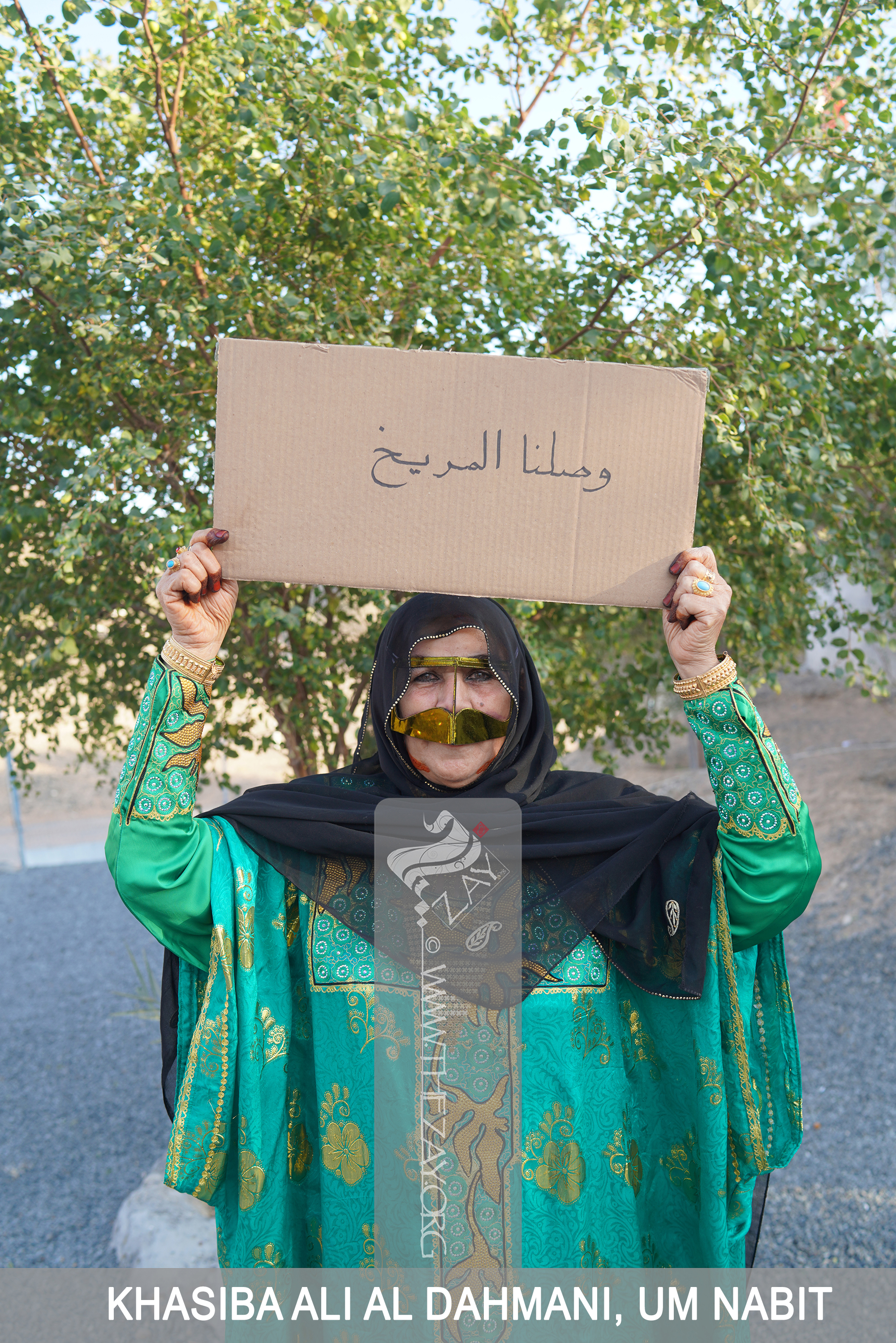
This piece was donated to The Zay Zay: (Arabic: costume, Pl. azyaā’), a set of clothes in a style typical of a particular country or historical period. Initiative by Khasibah Ali Al Dhmani of Al Dhaid, Sharjah, to commemorate the UAE’s historic mission to Mars on February 9, 2021, and to enrich The Zay Zay: (Arabic: costume, Pl. azyaā’), a set of clothes in a style typical of a particular country or historical period. Initiative’s collection.
The donation was inspired by an image that caught the attention of Dr. Reem Tariq
Ṭariq: (Arabic; Synonym: tulle_bi_talli
Tūlle_bi_tallī: (French: Tulle – a city in France where fine material for veil was first made; Turkish: tel – wire; Synonym: tariq; talli; badla; khus_dozi ), series of small metal knots made on a woven net ground as embellishment. The term is commonly used in the North African Arab region specifically in Egypt. Ṭariq: (Arabic; Synonym: tulle_bi_talli
Tūlle_bi_tallī: (French: Tulle – a city in France where fine material for veil was first made; Turkish: tel – wire; Synonym: tariq; talli; badla; khus_dozi ), series of small metal knots made on a woven net ground as embellishment. The term is commonly used in the North African Arab region specifically in Egypt.
The photograph quickly gained traction online, making Khasibah Ali Al Dhmani, the woman in the image, a public figure. Her story was covered by prominent outlets, including Vogue Arabia. Recognizing the cultural and historical significance of both the photograph and the attire worn in it, Dr. Reem successfully acquired the items for The Zay Zay: (Arabic: costume, Pl. azyaā’), a set of clothes in a style typical of a particular country or historical period. Initiative’s collection. Both Ms. Al Joker and Ms. Al Dhmani graciously supported the suggestion to donate these artifacts to honour the occasion.
Khasibah Ali Al Dhmani was born on July 1, 1953, although her exact birthdate may differ due to historical practices of recording dates. Before the establishment of the UAE in 1971, birth dates were often not recorded according to the Gregorian calendar. Later, birthdates for those born before 1971 were generally approximated, with July 1 commonly used for official purposes. Birth years were often determined through recollections of significant events, such as notable leadership changes or extreme weather phenomena.
Married in her early teens, Ms. Al Dhmani is the mother of six sons and ten daughters. Despite not receiving a formal education, she became a successful entrepreneur, founding a local perfume house specializing in traditional fragrances and incense. An active participant in cultural heritage events, Ms. Al Dhmani frequently showcases UAE traditions, as reflected in her social media presence.
Alia Bint Sultan Al Joker, a Dubai native, holds a bachelor's degree in integrated communications and marketing from Zayed University and a master's degree in quality management from Wollongong University. A passionate and dedicated photographer, she was the Director of Family Development at the UAE Ministry of Community Development at the time of donation.
The Zay Zay: (Arabic: costume, Pl. azyaā’), a set of clothes in a style typical of a particular country or historical period. Initiative extends its heartfelt gratitude to Ms. Khasibah Ali Al Dhmani and Ms. Alia Bint Sultan Al Joker for their generous contributions, which honour the UAE’s Mars mission and enrich the cultural narrative preserved by The Zay Zay: (Arabic: costume, Pl. azyaā’), a set of clothes in a style typical of a particular country or historical period. Initiative.
Object Features
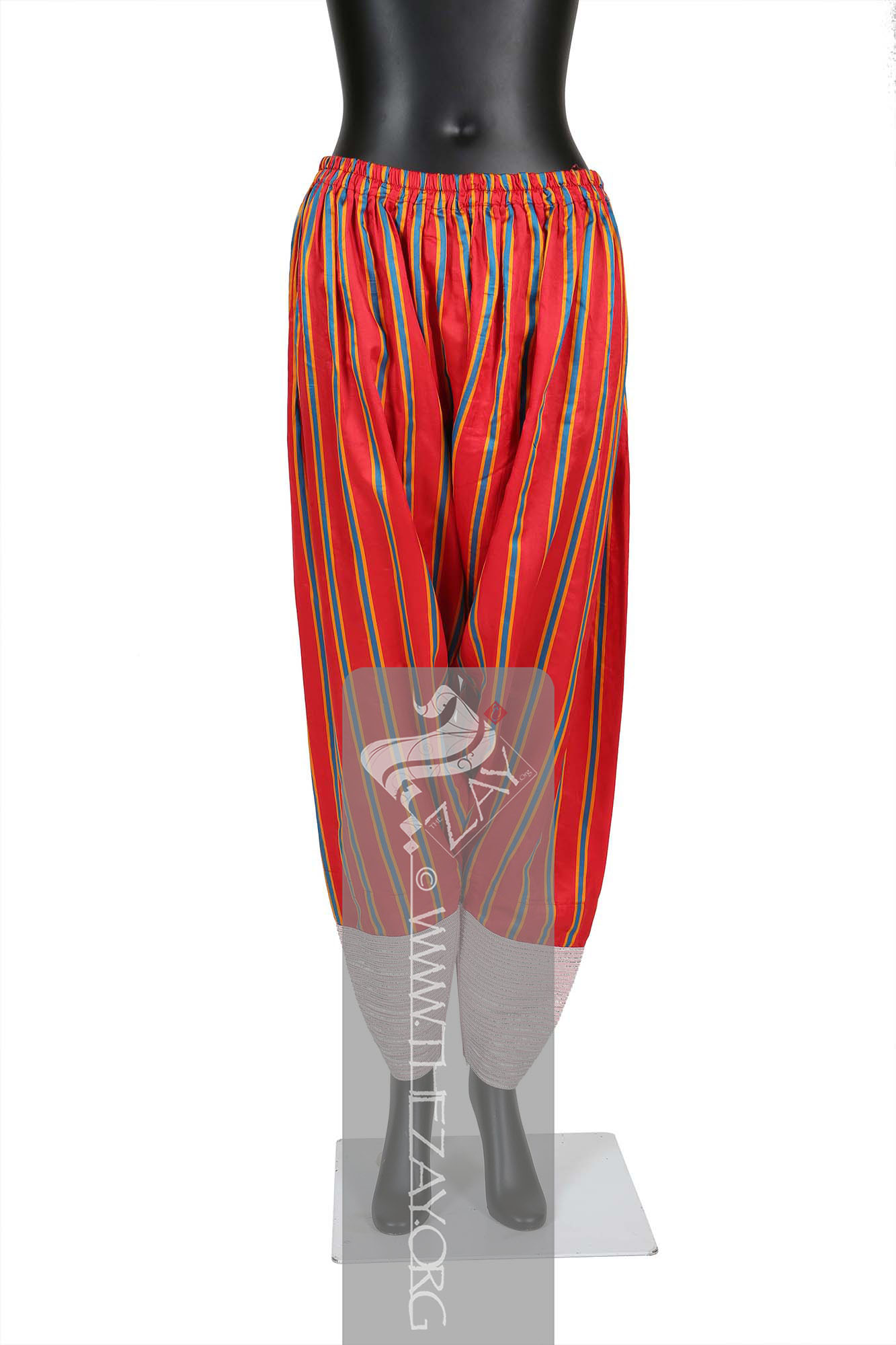
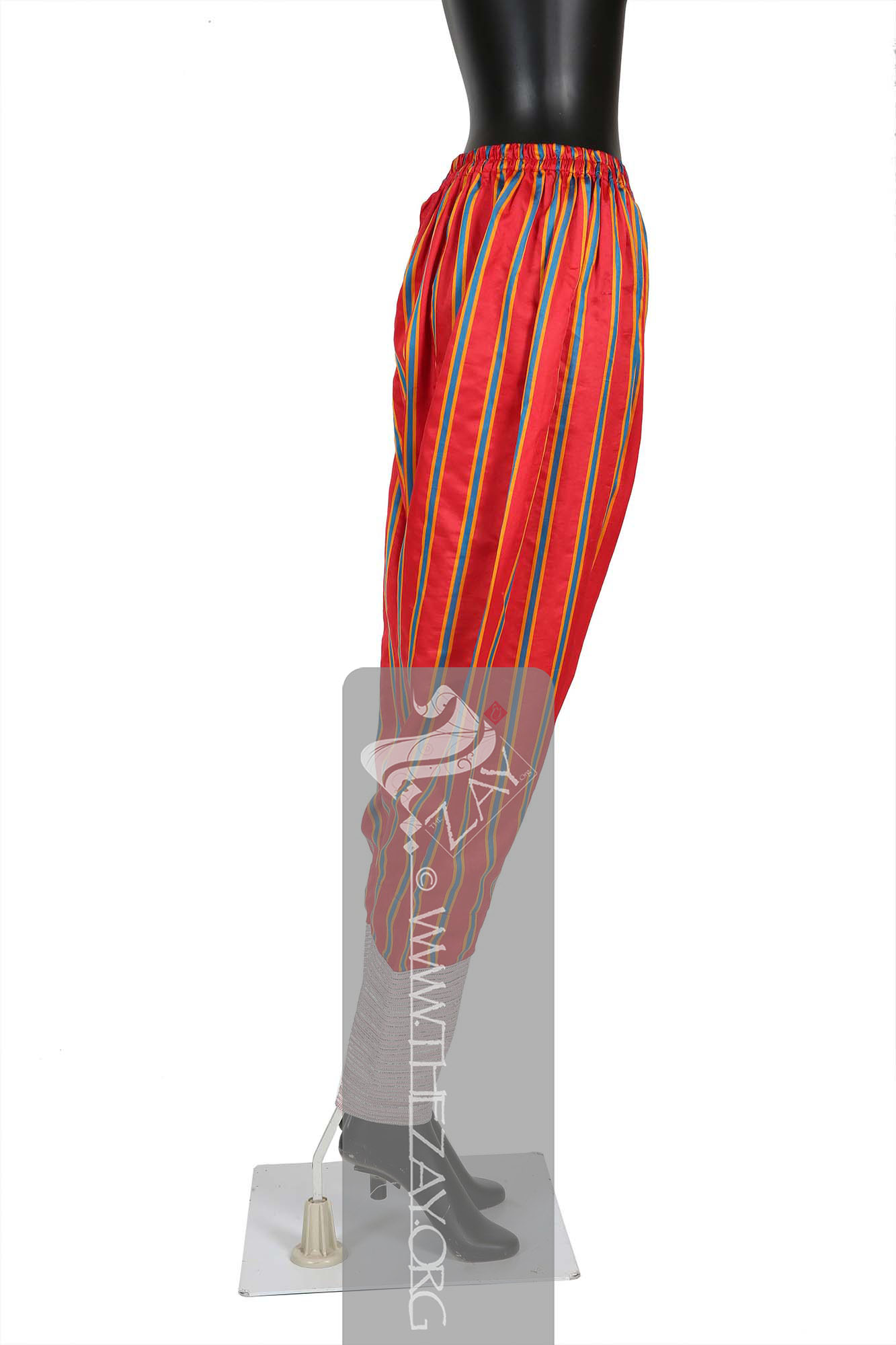
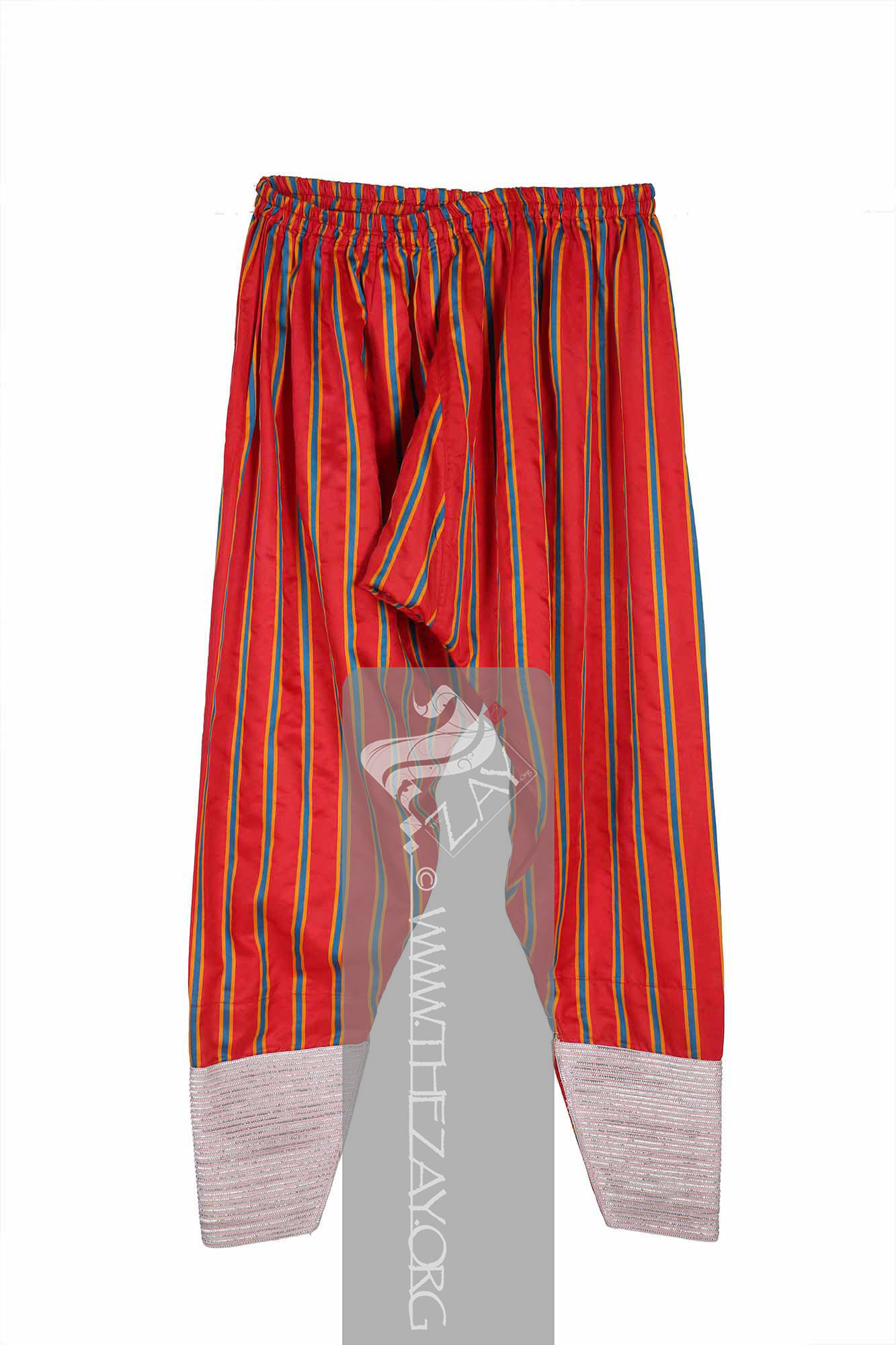
This is a pair of silk trousers (sarwal
Ṣarwāl: (Farsi: shalvār; Synonym: salwar, shirwāl), trousers featuring tapering ankles and drawstring closure of Central Asian origin. They disseminated in the Indian subcontinent between c.1st-3rd century BCE. Although exact period of its arrival in the Arab world is disputed their widespread adoption is confirmed from the 12th century.
Constructed of a colourful woven striped silk fabric in pink, orange, and (turquoise
Turquoise: (French: turquois – present day Türkiye; Synonyms: firuze, pheroza), is a naturally occurring opaque mineral mined in abundance in Khorasan province of Iran and has been used for making dye for centuries. The term is a derivative of the French word for the country Türkiye once called Turkey. ) blue, these sarwal
Ṣarwāl: (Farsi: shalvār; Synonym: salwar, shirwāl), trousers featuring tapering ankles and drawstring closure of Central Asian origin. They disseminated in the Indian subcontinent between c.1st-3rd century BCE. Although exact period of its arrival in the Arab world is disputed their widespread adoption is confirmed from the 12th century. Bādlah: (Hindustani: badal – cloud from Sanskirt: vārdala – water; Synonym: tariq; talli
Tallī: (Turkish: tel – wire, string), Gulf Arab – a woven braided trimming made with metal wire, threads and ribbons often sewn on detachable panels used as embellishments. Other – (Synonym: tulle_bi_talli
Tūlle_bi_tallī: (French: Tulle – a city in France where fine material for veil was first made; Turkish: tel – wire; Synonym: tariq; talli; badla; khus_dozi ), series of small metal knots made on a woven net ground as embellishment. The term is commonly used in the North African Arab region specifically in Egypt. Tūlle_bi_tallī: (French: Tulle – a city in France where fine material for veil was first made; Turkish: tel – wire; Synonym: tariq; talli; badla; khus_dozi ), series of small metal knots made on a woven net ground as embellishment. The term is commonly used in the North African Arab region specifically in Egypt. Khus_dozi: (Arabic: khus – straw from Akkadian – kikkišu – piled up reed; Persian: dozi – needlework; Synonym: tariq; talli
Tallī: (Turkish: tel – wire, string), Gulf Arab – a woven braided trimming made with metal wire, threads and ribbons often sewn on detachable panels used as embellishments. Other – (Synonym: tulle_bi_talli
Tūlle_bi_tallī: (French: Tulle – a city in France where fine material for veil was first made; Turkish: tel – wire; Synonym: tariq; talli; badla; khus_dozi ), series of small metal knots made on a woven net ground as embellishment. The term is commonly used in the North African Arab region specifically in Egypt. Tūlle_bi_tallī: (French: Tulle – a city in France where fine material for veil was first made; Turkish: tel – wire; Synonym: tariq; talli; badla; khus_dozi ), series of small metal knots made on a woven net ground as embellishment. The term is commonly used in the North African Arab region specifically in Egypt. Tallī: (Turkish: tel – wire, string), Gulf Arab – a woven braided trimming made with metal wire, threads and ribbons often sewn on detachable panels used as embellishments. Other – (Synonym: tulle_bi_talli
Tūlle_bi_tallī: (French: Tulle – a city in France where fine material for veil was first made; Turkish: tel – wire; Synonym: tariq; talli; badla; khus_dozi ), series of small metal knots made on a woven net ground as embellishment. The term is commonly used in the North African Arab region specifically in Egypt. Bū_qlaym: (Arabic: bū: diminutive of abū: father, qlaym: diminutive of qalam: pencil), generally refers to pencil striped fabrics.
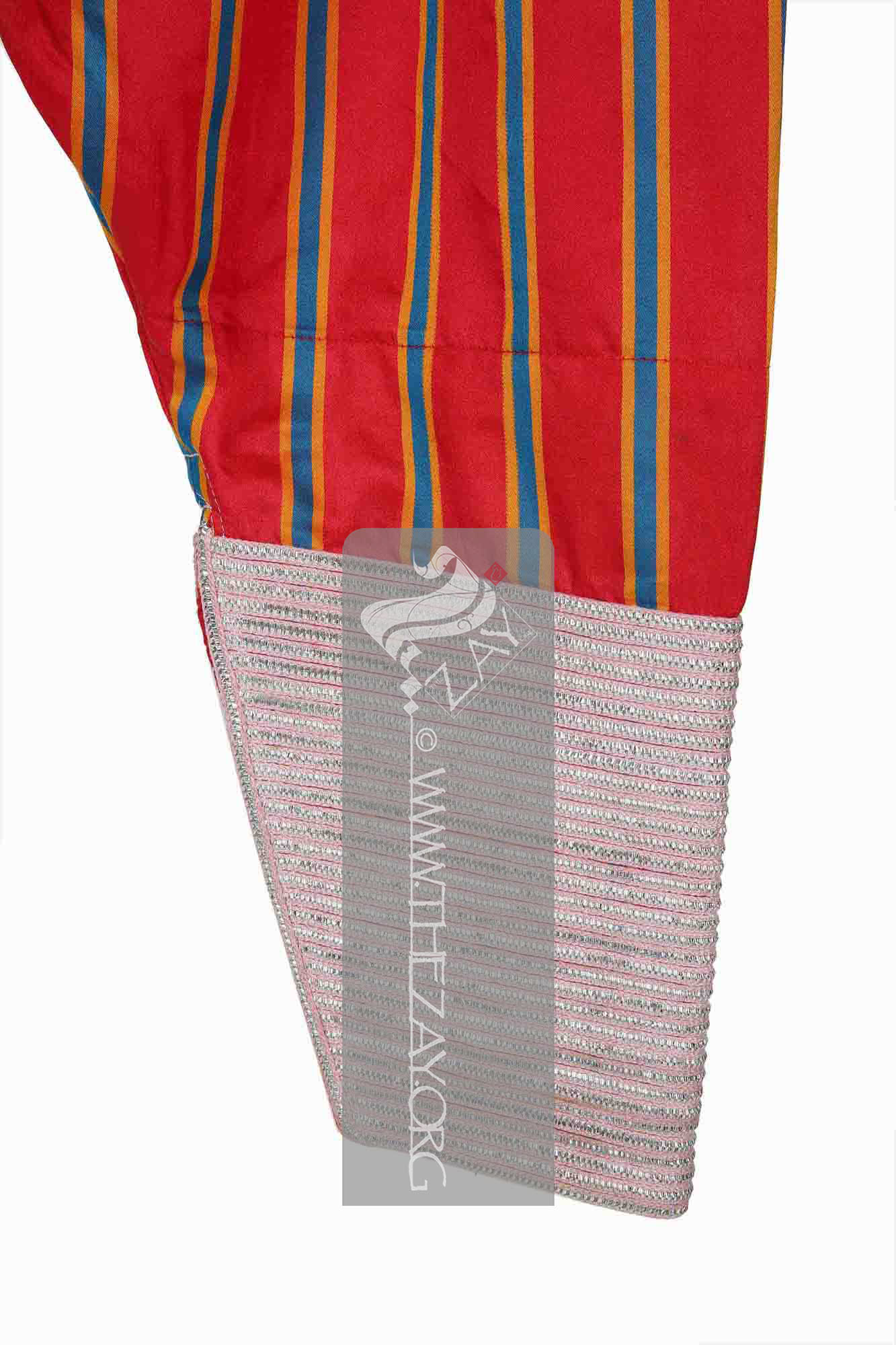
While multiple horizontally parallel rows of talli
Tallī: (Turkish: tel – wire, string), Gulf Arab – a woven braided trimming made with metal wire, threads and ribbons often sewn on detachable panels used as embellishments. Other – (Synonym: tulle_bi_talli
Tūlle_bi_tallī: (French: Tulle – a city in France where fine material for veil was first made; Turkish: tel – wire; Synonym: tariq; talli; badla; khus_dozi ), series of small metal knots made on a woven net ground as embellishment. The term is commonly used in the North African Arab region specifically in Egypt. Ṣarwāl: (Farsi: shalvār; Synonym: salwar, shirwāl), trousers featuring tapering ankles and drawstring closure of Central Asian origin. They disseminated in the Indian subcontinent between c.1st-3rd century BCE. Although exact period of its arrival in the Arab world is disputed their widespread adoption is confirmed from the 12th century.
It is worth noting that these embellished broad cuffed sarwal
Ṣarwāl: (Farsi: shalvār; Synonym: salwar, shirwāl), trousers featuring tapering ankles and drawstring closure of Central Asian origin. They disseminated in the Indian subcontinent between c.1st-3rd century BCE. Although exact period of its arrival in the Arab world is disputed their widespread adoption is confirmed from the 12th century. Tallī: (Turkish: tel – wire, string), Gulf Arab – a woven braided trimming made with metal wire, threads and ribbons often sewn on detachable panels used as embellishments. Other – (Synonym: tulle_bi_talli
Tūlle_bi_tallī: (French: Tulle – a city in France where fine material for veil was first made; Turkish: tel – wire; Synonym: tariq; talli; badla; khus_dozi ), series of small metal knots made on a woven net ground as embellishment. The term is commonly used in the North African Arab region specifically in Egypt. Khus_dozi: (Arabic: khus – straw from Akkadian – kikkišu – piled up reed; Persian: dozi – needlework; Synonym: tariq; talli
Tallī: (Turkish: tel – wire, string), Gulf Arab – a woven braided trimming made with metal wire, threads and ribbons often sewn on detachable panels used as embellishments. Other – (Synonym: tulle_bi_talli
Tūlle_bi_tallī: (French: Tulle – a city in France where fine material for veil was first made; Turkish: tel – wire; Synonym: tariq; talli; badla; khus_dozi ), series of small metal knots made on a woven net ground as embellishment. The term is commonly used in the North African Arab region specifically in Egypt. Tūlle_bi_tallī: (French: Tulle – a city in France where fine material for veil was first made; Turkish: tel – wire; Synonym: tariq; talli; badla; khus_dozi ), series of small metal knots made on a woven net ground as embellishment. The term is commonly used in the North African Arab region specifically in Egypt.
With cross-cultural lineages running deep between the communities living on either side of the Gulf, it is thus no wonder that material culture such as this has found firm grounds on both sides.